Apple debuts new woven nylon Watch bands and all-black Milanese loop

The Sport band collection gets a color update for spring, too.

At a town hall event on Monday, Apple announced a few new interchangeable bands for the Apple Watch. The company will now sell a woven nylon band option that features a four-layer construction and comes in some flashy colors, including light blue, pink, and yellow. The Sport band collection is receiving some new colors as well, and Apple has also added a black version of the luxe Milanese Loop band.

According to Tim Cook, about one-third of Apple Watch wearers regularly switch out their wristbands. That's a particularly interesting figure when you consider that each Apple Watch comes with just one band—if you want extra options, you'll have to shell out more money. Additional bands don't come cheap, either: the Sport bands are $49 each and the Milanese Loop along with the Classic Buckle straps are $149 when purchased separately. If nothing else, this points to the trend of Apple Watch wearers wanting extra wristbands to personalize the look and feel of their smartwatch.

Apple didn't mention any new partnerships with fashion houses or other design companies, nor did it touch upon its hyped partnership with Hermés that it announced last fall. The luxury leather bands start at $1,100, making them significantly more expensive than the base model of the Apple Watch itself. Apple didn't get into pricing for the new nylon bands, but Apple's store website should update with the new bands and pricing soon.

Read on Ars Technica | Comments

Casio’s rugged Android Wear watch goes on sale March 25 for $500

It’s the smartwatch for anyone who spends more time outdoors than indoors.

If you've been dying for an Android Wear watch that can withstand the most treacherous adventures, your search ends soon. Casio announced that its rugged Android Wear smartwatch, the Smart Outdoor Watch WSD-F10, will be available to purchase on March 25 at its website, Amazon, Rei, and Google's online store.

Casio first unveiled the WSD-F10 at CES and made it clear that the company isn't targeting the majority of people interested in Android Wear. The WSD-F10 is made specifically for the most outdoorsy users, featuring a 1.3-inch, 320 x 320-pixel dual-layer LCD display designed to be readable even in bright sunlight and a fairly chunky case that's water-resistant up to 50 meters. The case is also military-tested to withstand shocks, vibrations, and other disturbances that could come while trekking in the wilderness.

The watch will include an app called Tools that provides nature-based updates including sunrise and sunset times, altitude and atmospheric pressure measurements, and tide graphs. These stats are meant to help adventurers on their trips, as are the physical buttons on the side of the device that can be used to control the watch even while wearing gloves. In addition to the standard features of Android Wear, you'll also be able to track basic fitness including steps and distance and specific-activities like trekking (hiking), cycling, and fishing.

Read 1 remaining paragraphs | Comments

Fitbit Blaze reviewed: A totally unnecessary tracker with a few cool features

It’s not a bad device, I just don’t know why it exists.

Video shot/edited by Jennifer Hahn. (video link)

When Fitbit announced the Blaze "smart fitness watch," it did not make the best first impression. Many thought the Blaze was a peculiar answer to its competition, namely the Apple Watch, and the company's stock immediately fell more than 13 percent.

However, the Fitbit Blaze is not a smartwatch in the same way as the Apple Watch or the Android Wear. Fitbit took what it does best—connected fitness—and put it in a device designed to appeal to the ever growing number of people interested in smartwatches. But if the idea of fun applications and sending texts from your wrist intrigues you, the $199 Blaze is not what you want. Instead, the Blaze creates and fills a weird middle-ground space. This is a wearable for the die-hard Fitbit crowd, particularly those on the more active side of the spectrum. The Fitbit Blaze is for those want to wear something that does just slightly more than an average step counter.

Read 19 remaining paragraphs | Comments

iRobot’s most affordable vacuum is the tiny, new Braava Jet mopping robot

The $199 robo-vac gets in those hard-to-reach kitchen and bathroom crannies.

(credit: Valentina Palladino)

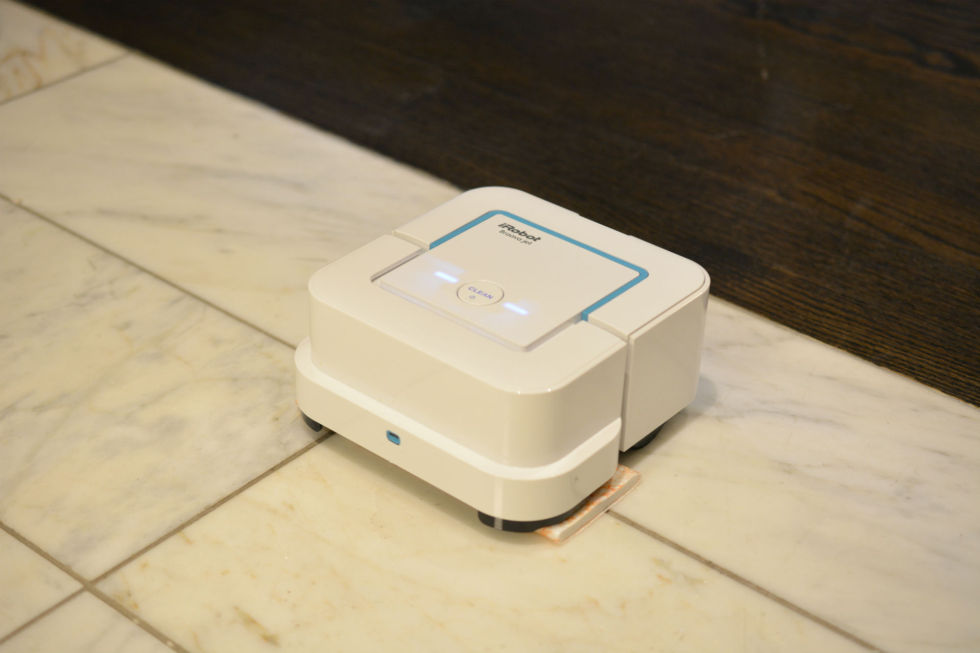
Roombas get a lot of attention for their ability to easily and autonomously suck up dirt, dust, pet hair, and anything else that might be infiltrating your carpet. While you can use Roomba vacuums on hardwood floors, they can't handle cleaning up liquids or really scrubbing hard surfaces. iRobot announced its newest device today that addresses this issue: the Braava Jet Mopping Robot. iRobot has other hard surface-friendly devices including another Braava, but its hoping the tiny Braava Jet will make the case for robotic cleaning devices to folks who live in tighter quarters.

iRobot developed the Braava Jet by going to those most knowledgable about robot vacuums: current Roomba users. The company asked users where they felt their robo-vacuums could improve, and it found that while Roombas basically solved the issue of cleaning carpet around the home, users still had to mop hardwood and tile floors, specifically those in their kitchens and bathrooms. Also, hardwood is becoming the default flooring choice for new homes.

iRobot's answer to these concerns is the Braava Jet. The tiny square robot is designed to get into tight corners of rooms and smaller spaces, and it's easy to use since it has just one button on its top that's used to start and stop the device. iRobot told us there was temptation to connect the Braava Jet to a smartphone app, like the Roomba 980 that was launched last year, but the company decided against it for two reasons: simplicity and price. The Braava Jet was designed to be as user-friendly as possible, and it's also iRobot's most affordable robo-vac at $199.

Read 7 remaining paragraphs | Comments

Fossil’s Q Motion tracks sleep and activity, learns from Misfit devices

The $95 activity and sleep tracker will be shown off at SXSW this year.

(credit: Fossil)

Fossil has been quiet since the start of 2016, but now we are getting a glimpse of the company's first new wearable of the year. The company just announced the Q Motion, a slim, cylindrical tracker that is the company's first to track sleep in addition to activity.

None of Fossil's current wearables—the Q Founder smartwatch, the non-display Q Grant watch, and the Q Reveler tracker—monitor how much sleep you get, so this is a good addition for the Q Motion but also an expected one. The Q Motion is also the first device to come from Fossil since the company purchased Misfit, which makes both connected fitness wearables and home devices. Most of Misfit's wearables track sleep, and while the Q Motion is clearly positioned as part of Fossil's line, it's likely that Misfit taught the fashion company a thing or two as it developed features for this device.

The Q Motion also looks very much like Misfit's newest device, the Misfit Ray. Both are stylish yet minimalist bracelets, with a cylinder module in the middle. Both track activity (although with the Ray, you can designate specific activities within Misfit's app) and sleep, and both have vibration motors and small LEDs on the module that go off when you receive smartphone notifications. While the Ray only receives text, call, and alarm alerts, Fossil's Q Motion will be able to filter the notifications you receive on the device via its Android and iOS app just like the other Q wearables.

Read 2 remaining paragraphs | Comments

Swatch not “competing with Apple,” will aim smart tech at plastic brand

Swatch will have to make unique devices to compete in a saturated market.

(credit: Swatch)

We're learning more about how the legacy watch company Swatch plans to make its products smarter for the wearable age. At a news conference in Biel, Switzerland, Swatch Group AG said it plans to focus smartwatch technology on its more affordable plastic watch brand before attempting to put the technology in high-end devices.

According to The Wall Street Journal, this strategy is in response to devices like the Apple Watch which live in the under $1,000 price range (at least, the base models of the Apple Watch do). Since most other Swiss watchmakers focus on the luxury market, Swatch is the company most threatened by sub-$1,000 smart devices taking over its industry. According to IDC, smartwatches will be the most popular type of wearable device going forward, and it's expected that 34.3 million units will be shipped in 2016, which would be up from 2015's expected 21.3 million units.

However, even if Swatch plans to produce smart devices in the same price range as the Apple Watch, Swatch CEO Nick Hayek claims the company doesn't want to compete as a consumer technology company. "We are not talking about competing with Apple,” Hayek is quoted as saying in the WSJ. "They are consumer-electronics people and we don’t want to get into that sector. We are also competing with jewelry; it’s two different worlds."

Read 2 remaining paragraphs | Comments

Got an old phone? Make it into a home security camera.

Apps let you turn that old iPhone into a home security camera, albeit with limits.

(credit: Jorge Quinteros)

Smart security cameras are one of the easiest ways to start transforming your normal home into a connected home. Everyone knows about Alphabet's Nest cam, but there are plenty of other cameras to consider from companies including Samsung, D-Link, and Canary. However, you don't have to drop $200 on a bulbous eye-looking camera if you don't want to—there are apps for that. Numerous Android and iOS apps claim to use your old smartphone's cameras to replicate the features of these dedicated cams, letting you check in from your current smartphone whenever you want.

These security apps have nearly the same features as regular smart cameras but are free to download and require no extra hardware. Even older phones are powerful enough to be repurposed. That doesn't mean the apps are quite as good as purpose-built security cameras, though. We looked into the differences between home security cameras and their smartphone equivalents (specifically the apps Manything and Alfred) to see if one method of monitoring your home is better than the other.

HOME SECURITY CAMERAS VS. APPS
PRODUCT Nest Cam Canary Cam Manything Alfred
CAMERA RESOLUTION 1080p 1080p depends on smartphone depends on smartphone
FIELD OF VIEW 130 degrees 147 degrees depends on smartphone depends on smartphone
INTERNET 2.4GHz, 5GHz Wi-Fi (802.11 b/g/n) 2.4GHz Wi-Fi (802.11 b/g/n), connected Ethernet smartphone Wi-Fi smartphone Wi-Fi
LIVE STREAMING Yes Yes Yes Yes
NIGHT VISION Yes Yes No Yes
MOTION/SOUND DETECTION Yes Yes Motion only Motion only
MOBILE APP Android and iOS Android and iOS Android and iOS Android and iOS
SUBSCRIPTION Nest Aware, $10 per month/$100 per year for 10 days' video, $30 per month/$300 per year for 30 days' video Canary plans: $5, $10, and $30 per month plans Cloud storage plans range from $2.99 to $19.99 per month depending on saved days and number of cameras Free
PRICE $199 $199 Free app (cost of smartphone) Free app (cost of smartphone)
OTHER PERKS Speaker, microphone, 8 infrared LEDs for night vision 90dB+ siren, night vision, ambient light sensor, temperature, humidity, and air quality detection detection zones, record or still mode, two-way talk, camera remote control two-way talk, camera remote control

Features: Extra hardware or bare-bones software?

Stand-alone security cameras and monitoring apps share a number of common features, and one of the biggest and most important is live streaming. Any smart camera will give you the ability to watch a live stream of your home over Wi-Fi or data either from a Web application, a companion mobile app, or both. They'll also have a recording feature, and some are more customizable than others. Many stand-alone cameras like the Ezviz Mini will let you schedule a time during the day to record video footage. Others will just record whenever they sense motion (and in some cases, sound) in the room or in designated activity zones.

Read 15 remaining paragraphs | Comments

Intel acquires Replay Technologies, sets sights on 3D sports broadcasting

The Israeli company specializes in 360-degree, “free dimensional” videos.

(credit: Replay Technologies)

Intel is diving further into 3D technology, and it's hoping to bring sports fans along for the ride. The company announced overnight that it acquired the Israeli company Replay Technologies, which makes "free dimensional" 3D video technology. Intel has been partnering with Replay since 2013, and most recently the two companies joined forces during the NBA All-Star Weekend, where fans got to experience a full 360 degrees of the popular Slam Dunk contest.

Intel explains how that collaboration worked: Replay's freeD technology created a 3D video rendering of the entire court using 28 ultra-HD cameras placed around the area. Those cameras were connected to Intel servers, which then allowed broadcasters to transmit the contest from various angles and give fans a 360-degree view of the dunks. This kind of 3D video technology is extremely computation-intensive, so Intel had to use a lot of servers to pull of this experience.

Intel is no stranger to 3D technology: the company's RealSense 3D cameras have been around for the past couple of years and have been integrated into PCs and laptops. The cameras allow users to do things like implement a green-screen effect to change the background behind them and look around Google Maps' Street View using just head motions, but those features are more along the lines of fun and interesting than practical. Acquiring Replay Technologies is a way for Intel to expand 3D video technology into a different industry, not to mention on a larger scale. The company refers to the next iteration of broadcast sports as "immersive sports," which it says is inherently more interactive and collaborative than simply watching a basketball game on TV.

Read 2 remaining paragraphs | Comments

Sony teases “N,” an audio-focused wearable that doesn’t go in your ears

The hands-free device is the first to come out of Sony’s Future Lab Program.

Sony announced a new research and development group called the Future Lab Program, and a curious video gives us a glimpse of the initiative's first project. Referred to as "N," the prototype is a hands-free wearable that provides "a new way of experiencing audio such as music and sound, allowing the user to receive audio information without having to insert any object into his or her ear."

The video is pretty mysterious, featuring a women floating in water with earbuds falling off of her and disappearing into the black water. She's then transported to the top of a cliff overlooking a city, and we hear a voice talking about the weather and giving positive sentiments about the day ahead.

Video: Sony

Only if you look closely can you see the woman is wearing a Sony-branded device around her neck. It's a shiny white gadget that curves over her shoulders, but there's not much else we can deduce about it from this video. N is apparently a product that untethers you from the wired hassle of traditional earbuds. It doesn't fit into your ears either, instead transmitting audio for you to hear. The woman in the video seems to respond to the voice, saying "ready," so it's possible that N has some voice recognition features as well.

Read 1 remaining paragraphs | Comments

PewDiePie could win an Emmy someday thanks to new Academy rules

New and revised Emmy categories make room for short-form, online video content.

The Television Academy has made some small changes that could mean big things for online video content creators. The organization announced that it has expanded the criteria to be considered for an Emmy, making it easier for Internet-exclusive shows to win awards.

Content that will fall under the new "short-form" award categories are defined as "series with a minimum of six episodes running an average of 15 minutes or less per episode, exhibited over-the-air and/or via cable, satellite or Internet." Specifically, the three award categories are Outstanding Short Form Series—Comedy or Drama, which replaces the Short Format Live Entertainment category; the new Outstanding Short Form Series—Variety category; and the Outstanding Short Form Series—Reality/Nonfiction, which replaces the Short Format Nonfiction category.

While online video creators still struggle to gain the same recognition as traditional media creators (and the big budgets that follow), this change to the Emmys is a step in the right direction. It provides more validity for online content like the shows on YouTube and YouTube Red, which is already showing content from PewDiePie, Lilly Singh, and Rooster Teeth. The main awards show for Internet video until this point has been The Webbys, which are big awards for Internet creators but nowhere near as well-known as the Emmys by the general public and media. If nothing else, this could give Web video creators the chance to show traditional media that online video can be just as artistic and legitimate as regular television shows.

Read on Ars Technica | Comments