Chrome and Firefox Block KickassTorrents as “Phishing” Site

Chrome and Firefox are actively blocking direct access to the popular torrent site KickassTorrents. According to the browsers, Kat.cr is a “deceptive site” or “web forgery,” that may steal user information. The site’s operators are looking into the issue, and hope to resolve it soon.

Source: TF, for the latest info on copyright, file-sharing, torrent sites and ANONYMOUS VPN services.

kickasstorrents_500x500There’s a slight panic breaking out among KickassTorrents users, who are having a hard time accessing the site.

Over the past few hours Chrome and Firefox have both started to block access to Kat.cr due to reported security issues.

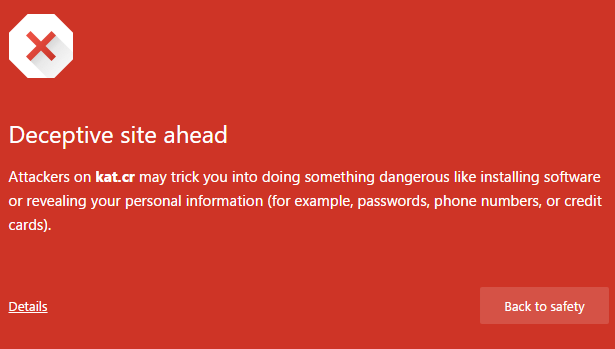
Instead of a page filled with the latest torrents, visitors are presented with an ominous red warning banner.

“Deceptive site ahead: Attackers on kat.cr may trick you into doing something dangerous like installing software or revealing your personal information,” the Chrome warning reads.

Chrome warns against using Kat.cr

chromekatdecept

Firefox users encounter a similar banner, branding Kat.cr as a “web forgery” which may trick users into sharing personal information. This may lead to identity theft or other fraud.

“Web forgeries are designed to trick you into revealing personal or financial information by imitating sources you may trust. Entering any information on this web page may result in identity theft or other fraud,” the browser warns.

Firefox’s alert

katffforg

Interestingly, Google’s safebrowsing page for Kat.cr currently lists no issues with the site.

The KAT team informs TorrentFreak that they are looking into the issue and hope to have the blocks removed soon.

This is not the first time the two browsers have flagged KickassTorrents. Last year site was flagged on several occasions after it was linked to a malicious advertiser.

At the time the KAT team said they addressed the issue in a matter of hours, but it nonetheless took more than two days before the site was unblocked on both Firefox and Chrome.

Impatient or adventurous users who want to bypass the warning can do so by disabling their browser’s security warnings altogether in the settings, at their own risk of course.

Source: TF, for the latest info on copyright, file-sharing, torrent sites and ANONYMOUS VPN services.


U.S. ISPs Refuse to Disconnect Persistent Pirates

The U.S. broadband association USTelecom, a trade association representing many ISPs, is taking a stand against abusive takedown notices and a recent push to terminate the accounts of repeat infringers. They argue that ISPs are not required to pass on takedown notices and stress that their subscribers shouldn’t lose Internet access based solely on copyright holder complaints.

Source: TF, for the latest info on copyright, file-sharing, torrent sites and ANONYMOUS VPN services.

ustelecoSigned into law nearly two decades ago, the Digital Millenium Copyright Act (DMCA) aimed to ready copyright law for the digital age.

The law introduced a safe harbor for Internet providers, meaning that they can’t be held liable for their pirating users as long as they ‘deal’ with repeat infringers.

Generally speaking, ISPs are not very eager to disconnect accounts of frequent copyright infringers. While the law allows for account terminations, it stipulates that this should happen under “appropriate” circumstances.

Some copyright holders have argued that three infringement notices are enough to warrant a disconnection, but most Internet providers don’t want to go this far.

In a recent recommendation to the Copyright Office the U.S. broadband association USTelecom points out that DMCA’s safe harbor provisions are generally working as intended, shielding Internet intermediaries from liability for copyright infringements carried out by their users.

However, the group stresses that in most cases ISPs act as mere conduits who pass on digital information. These type of services are not subject to takedown notices as they fall under section 512(a) of the DMCA, so all takedown notices are by definition invalid.

“It is inappropriate and contrary to the DMCA to suggest that ISPs should somehow be responsible for policing copyright rights when those service providers are acting as mere conduits for digital communications,” USTelecom writes.

Nonetheless, every month ISPs are bombarded with millions of takedown notices, triggered by allegedly pirating customers.

“Despite this well-established precedent, ISPs are receiving millions of invalid notices relating to conduit services. These notices frequently include improper ‘settlement’ demands that rights holders pressure ISPs to forward to unrepresented consumers.”

USTelecom stresses that ISPs have no obligation to process takedown notices under the DMCA, as they merely pass on traffic. While most forward this information as a courtesy, they are not required to do so.

Not all copyright holders agree with this stance. In fact, USTelecom points out that in recent years they have been pushing for tougher actions against Internet subscribers who receive multiple notices.

“In some cases, the senders of these notices even want the ISPs to terminate Internet access based on these allegations – which, again, the ISPs as mere conduits could not evaluate even if they were obligated to do so under the DMCA.”

“These actions constitute an abuse of the DMCA notice process, and should be acknowledged as such by the Copyright Office,” USTelecom adds.

Even if ISPs were required to forward DMCA notices, they believe that terminating Internet connections goes too far. The group points out that the notices are not always sent to the right person, for example, and add that the senders do not always represent the copyright holder.

It should be up to a court to decide if a person loses his or her Internet access, not the Internet provider acting solely on claims of alleged copyright infringements.

“Any allegations intended to justify the termination or long-term suspension of Internet access connections should be subject to some form of judicial review before depriving subscribers of all access to the Internet,” USTelecom writes.

“Internet access is essential to modern life, including economic life and exercise of other fundamental rights. It is simply unthinkable, that a consumer should be able to lose access to such a fundamental and crucial tool absent some form of formal adjudication.”

USTelecom’s response to the DMCA consultation of the Copyright Office comes at an interesting time. Just a few months ago, Cox Communication was ordered to pay $25 million because it failed to disconnect subscribers whose connections were repeatedly used to pirate content.

The telecom group clearly disagrees with this verdict, which is currently under appeal, and hopes to have the U.S. Government on its side.

Source: TF, for the latest info on copyright, file-sharing, torrent sites and ANONYMOUS VPN services.

Top 10 Most Pirated Movies of The Week – 04/11/16

The top 10 most downloaded movies on BitTorrent are in again. ‘The Revenant’ tops the chart this week, followed by ‘Star Wars: The Force Awakens’ ‘Hail Caesar!’ completes the top three.

Source: TF, for the latest info on copyright, file-sharing, torrent sites and ANONYMOUS VPN services.

revenantThis week we have three newcomers in our chart.

The Revenant, which was releases as Blu-Ray rip a few days ago, is the most downloaded movie.

The data for our weekly download chart is estimated by TorrentFreak, and is for informational and educational reference only. All the movies in the list are BD/DVDrips unless stated otherwise.

RSS feed for the weekly movie download chart.

Ranking (last week) Movie IMDb Rating / Trailer
torrentfreak.com
1 (4) The Revenant 8.2 / trailer
2 (1) Star Wars: The Force Awakens 8.3 / trailer
3 (6) Hail Caesar! (Webrip) 6.8 / trailer
4 (2) Deadpool (HDrip subbed) 8.6 / trailer
5 (3) Batman v Superman: Dawn of Justice (Cam/TS) 7.5 / trailer
6 (6) Kung Fu Panda 3 (Web-DL) 8.0 / trailer
7 (…) The Finest Hours (Web-DL) 7.0 / trailer
8 (…) Mr. Right (Web-DL) 6.4 / trailer
9 (…) The Jungle Book (Hindi Cam) 8.3 / trailer
10 (9) The Hateful Eight 8.0 / trailer

Source: TF, for the latest info on copyright, file-sharing, torrent sites and ANONYMOUS VPN services.

Netflix Disappears From MPAA’s ‘Legal’ Movie Search Engine

Less than two years ago the MPAA launched its search engine WhereToWatch, offering viewers a database of alternatives to piracy. However, those who try the search engine today will notice that results for Netflix, the largest entertainment platform in the United States, are no longer listed. Is there a feud going on behind the scenes?

Source: TF, for the latest info on copyright, file-sharing, torrent sites and ANONYMOUS VPN services.

netflixqDuring the fall of 2014 Hollywood launched WhereToWatch, its very own search engine for movies and TV-shows.

The site enables people to check if and where the latest entertainment is available, hoping to steer U.S. visitors away from pirate sites.

The launch received a ton of favorable press. It was soon followed up by another press release highlighting some of the positive responses, including the following comment from The Institute for Policy Innovation.

“Instead of scrolling first through Netflix and then through your cable video on demand offerings, WheretoWatch.com is a one-stop shop to see what options are available to you to get to the specific movie or TV show you’re looking for.”

However, fast forward a few months and Netflix has suddenly disappeared from the WhereToWatch results. Quite embarrassingly, this means that the search engine doesn’t index the most widely used TV and movie streaming platform.

Searching for the Tarantino classic “Pulp Fiction,” for example, shows a wide variety of streaming options but not Netflix.

wtw-pulp

The problem gets even worse for content that’s exclusively available on Netflix, such as the popular TV-shows House of Cards and Better Call Saul. Or the recent movie “Pee-wee’s Big Holiday.”

The film, which ironically was promoted in an article on WhereToWatch, is not available online according to the WhereToWatch results.

wtw-pee

Over the past week TorrentFreak asked the MPAA, WhereToWatch and Netflix for a comment on the issue, but none of the parties have responded.

What makes the disappearance even more intriguing is the fact that GoWatchIt, the site that WhereToWatch uses for its search results, does list Netflix as a viewing option for the example above.

Could it be that, for some reason, the MPAA has decided to turn off the Netflix option? Or perhaps Netflix objected to being included in the results?

The latter may seem unlikely, but there are other search engines that have Netflix issues as well. FindanyFilm, the British version of WhereToWatch, doesn’t list any Netflix content either.

“We get all our data directly from our retail partners and unfortunately Netflix don’t currently work with us,” the company told us when we asked about the peculiar absence.

Whatever the reason, the MPAA might want to make Netflix results a priority for WhereToWatch. After all, a legal movie and TV search engine without the most popular paid video streaming service in the world is not going to be very useful.

Source: TF, for the latest info on copyright, file-sharing, torrent sites and ANONYMOUS VPN services.

KickassTorrents Ups Privacy With 2-Factor Authentication

KickassTorrents has become the first public torrent site to offer two-factor authentication to its users. The new feature helps users to increase their privacy and makes it harder for malicious parties to hijack their accounts.

Source: TF, for the latest info on copyright, file-sharing, torrent sites and ANONYMOUS VPN services.

kickassMost torrent sites are not known for their advanced security features, but KickassTorrents recently made a change in this direction.

The most used torrent site on the Internet has millions of visitors per day, and the site now offers registered users the option to secure their accounts with two-factor authentication.

Simply put, this offers people an extra later of security, similar to what most other large services including Google, Facebook and Twitter offer.

“Using a username and password together with a piece of information that only the user knows makes it harder for potential intruders to gain access and steal that person’s personal data or identity,” KAT’s Mr.Gooner explains.

The feature can be enabled in the profile settings, after which a second screen pops up detailing the authentication procedure.

KAT’s “2FA”

katauth

KAT’s two-factor authentication requires users to use a third party authentication app of their choosing, which is then required to login to the account. This means that even if one’s password is compromised, outsiders can’t get into the account.

While there’s very little valuable information to “steal” from a KickassTorrents account, quite a few people can appreciate the extra layer of security. After all, some download and upload habits are better left private.

Sloppy users should keep in mind that if one loses access to the app, he or she can no longer get into their account. As a precaution, it’s wise to write down the code and store it somewhere safe.

The new two-factor authentication feature is entirely optional. So, torrenters who feel pretty confident about their security already can just continue to use the ‘plain’ old password.

Source: TF, for the latest info on copyright, file-sharing, torrent sites and ANONYMOUS VPN services.

Copyright Group Likens Massive DMCA Abuse Protests to “Zombie Apocalypse”

Last week a campaign launched by Fight for the Future and popular YouTube channel ChannelAwesome to protest DMCA abuse generated nearly 100,000 responses, overwhelming the U.S. Copyright Office. This effort appears to have frustrated various industry insiders, with Copyright Alliance boss Keith Kupferschmid likening it to a “Zombie Apocalypse.”

Source: TF, for the latest info on copyright, file-sharing, torrent sites and ANONYMOUS VPN services.

copyright-bloodIn recent years there have been a lot of complaints about the current state of the DMCA takedown process.

To hear the growing concerns from all sides, the U.S. Copyright Office launched a public consultation in order to evaluate the impact and effectiveness of the 1998 copyright law.

Just before the deadline expired last week, Fight for the Future (FFTF) and popular YouTube channel ChannelAwesome decided to join in. They launched a campaign through which people could protest DMCA abuse, triggering over 90,000 responses in less than 24 hours.

The public interest was so overwhelming that the Government’s servers reportedly “crashed” under the heavy load.

The protest organizers were delighted to see that so many people had voiced their concerns. Up until they got involved there had only been a few dozen responses so their efforts made a huge impact.

However, copyright holders and industry groups are not pleased with the public outcry. Earlier this week Keith Kupferschmid, CEO of the Hollywood funded Copyright Alliance, likened it to a “Copyright Zombie Apocalypse.”

“Well, in case you were unconscious and left for dead in a hospital last week, the copyright community experienced its own zombie apocalypse,” Kupferschmid writes.

His main complaint is that nearly all comments were sent through the TakedownAbuse campaign site, where people could send in the pre-filled form highlighting various abuse related problems.

“These 90,000 comments are all identical submissions generated merely by clicking on the ‘I’m in’ button at takedownabuse.org. Like the zombies in The Walking Dead, there was not a lot of effort or brainpower that went into the 90,000 plus submissions,” he notes.

“If there are problems with the DMCA the best way to understand what those problems are, and to attempt to address them, is for those with concerns to voice them in detail and not file yet another zombie comment. As we’ve learned from The Walking Dead, those zombies are rather easily disposed of.”

While Kupferschmid certainly has a point when he argues that the massive number of responses is unlikely to generate a broad range of insights, the harsh wording appears to be a sign of bitter frustration.

Knowing that tens of thousands of people share a certain point of view has value, and the Copyright Office is clever enough to take the context into account.

Interestingly, however, Kupferschmid notes that he would say the same if the comments were voicing pro-copyright sentiments.

This is rather ironic because the Copyright Alliance is actively promoting several pro-copyright campaigns that also allow the public to sign pre-written petitions. Unlike the form at TakedownAbuse.org, people can’t even edit the message. Like “zombies,” all they are encouraged to do is sign.

TorrentFreak spoke to FFTF’s Tiffiniy Cheng, who notes that people did edit or add their own comments. In any case, equating tens of thousands of concerned citizens to zombies might not be best move.

“The expression of a disagreement with a certain policy is valuable to our democracy and debate. And, that’s what we have here,” Cheng says.

“The people who filed comments have experienced real censorship that they want to stop and care deeply about stopping DMCA takedown abuse. You can’t discount that, they are getting organized and demanding a seat at the table the best way they know how – by coming together and showing how big this problem is,” she adds.

After the comment deadline passed the Takedownabuse campaign received thousands of additional comments. They plan to submit these additional responses to the Copyright Office as a petition.

Perhaps the Copyright Alliance should join in, rally some “zombies,” and launch a petition of their own?

Source: TF, for the latest info on copyright, file-sharing, torrent sites and ANONYMOUS VPN services.

Pirates Frustrated After TV Release Groups Swap .MP4 for .MKV

After years under a previous regime, several prominent Internet piracy groups have adopted a new set of TV-release standards. The rules will go into effect this weekend, but several groups have already made the switch, frustrating many bewildered pirates who must now play .MKV instead of .MP4 files.

Source: TF, for the latest info on copyright, file-sharing, torrent sites and ANONYMOUS VPN services.

crypirateWhile pirates may not appear to be the most organized people, the groups that make up the top of the piracy pyramid abide by strict rules.

Every so often they agree on a new set of standards, which determine what a proper release should look like. Most recently, new changes were announced for TV show releases, and these are set to go into effect this coming weekend.

The new rules are announced in lengthy documents, one for HD and one for SD TV-releases.

“Since the last revision of this document in 2012, TV-X264-SD has grown and become a major section that many people contribute to and depend on. This new revision aims to update the standards from 2012 to standards suitable for 2016 and the future,” the intro to the SD version reads.

The rules are intended for Scene groups only. These groups don’t share their work directly to the public, but between themselves on so-called “topsites”. However, most of the time their releases are also the source of TV-shows that end up being shared on public pirate sites.

This means that hundreds of million of people around the world will be affected by the changes, albeit indirectly.

For the most part the rules deal with technicalities regarding release formatting, tagging and various audio, subtitle and video settings. These changes are hardly noticeable to outsiders, except for the “container” part.

mkvcontainer

Instead of using .MP4 as the file format, all releases will be .MKV moving forward. This is the Matroska container which has been the standard for HD releases in recent years.

Some groups have already made the switch over the past few days, causing confusion among BitTorrent users.

“SUDDENLY everything (well many things) is MKV instead of MP4,” one downloader writes, adding “There is no way a way a whole bunch of encoders woke up today and suddenly decided to use MKV instead of MP4. Does anybody have any idea Whats going on?”

mkvlogo Others complain about not being able to watch MKV files on their video players, or branding MKV as inferior.
“All I can figure is that since things were just fine the way they were, a couple of people decided to screw everything up for everyone else,” another frustrated TV fan notes.

Several P2P TV-distribution groups, which are not part of the Scene, were also taken by surprise. However, TorrentFreak is informed that they won’t convert their releases to MP4, as some people have recommended.

Instead, the ETTV group advises TV-show downloaders to convert the videos to MP4 themselves if they want, pointing them to the free Rebox tool that can do this in a few seconds.

“SD tv shows will soon be released in mkv containers. If you’re an mp4 fan you can remux the mkv files to mp4 in 2 simple steps in less than 30 seconds with the app link below,” ETTV writes.

ETTVcomment

Interestingly, there were also massive complaints in 2012 when the SD standards changed from .AVI to MP4. At the time some people were literally outraged, vowing to ban certain sites and groups.

Whether we will see a repeat of this backlash will become clear after April 10, when the rules go into effect.

This time around it may not be as bad. Many video players support the MKV format and a lot of downloaders were already familiar with it, since HD shows have been released this way for years.

Source: TF, for the latest info on copyright, file-sharing, torrent sites and ANONYMOUS VPN services.

Steal This Show S01E08: Maybe Free Is Not The Future

Today we bring you the next episode of the Steal This Show podcast, discussing the latest file-sharing and copyright news. In this episode we talk with BitTorrent Inc. founders Ashwin Navin and Dave Harrison.

Source: TF, for the latest info on copyright, file-sharing, torrent sites and ANONYMOUS VPN services.

steal240Featuring Ashwin Navin and Dave Harrison – founders of BitTorent Inc., and currently CEO and CTO of Samba TV respectively.

We discuss Screening Room, the founder of Napster’s plan to bring movies to your living room on release day; the BPI’s prodigious anti-piracy efforts and why the future may doom them to failure; and the ongoing war between Google and the MPAA.

Finally, Ashwin and Dave share what they’ve learned since the early days of BitTorrent, hint at where things are headed in the world of online TV, point to a couple of interesting developments in the P2P world, and wonder if maybe free is not the future, after all.

Steal This Show aims to release bi-weekly episodes featuring insiders discussing copyright and file-sharing news. It complements our regular reporting by adding more room for opinion, commentary and analysis.

The guests for our news discussions will vary and we’ll aim to introduce voices from different backgrounds and persuasions. In addition to news, STS will also produce features interviewing some of the great innovators and minds.

Host: Jamie King

Guests: Ashwin Navin and Dave Harrison.

Produced by Jamie King
Edited & Mixed by Eric Bouthiller
Original Music by David Triana
Web Production by Siraje Amarniss

Source: TF, for the latest info on copyright, file-sharing, torrent sites and ANONYMOUS VPN services.

Linking to Pirated Content Is Not Copyright Infringement, Says EU Court Adviser

Linking to pirated content that is already available to the public can not be seen as copyright infringement under the European Copyright Directive. This is the advice Advocate General Melchior Wathelet has sent to the EU Court of Justice, in what may turn out to be a landmark case.

Source: TF, for the latest info on copyright, file-sharing, torrent sites and ANONYMOUS VPN services.

http-link-hyperlinkOne of the key roles of the EU’s Court of Justice is to interpret European law to ensure that it’s applied in the same manner across all member states.

The Court is also called upon by national courts to clarify finer points of EU law to progress local cases with Europe-wide implications.

In recent years the Court was called upon to rule on several cases related to hyperlinking, in an effort to established whether links to other websites can be seen as copyright infringement.

Previously, it ruled that links to copyrighted works are not infringing if the copyright holder published them in public, and the same is true for embedding copyrighted videos.

But what if a link points to content that is not authorized by the copyright holder? Would this still be allowed? According to EU Advocate General Melchior Wathelet, it is.

In an advisory opinion to the EU Court of Justice, which will issue a final ruling later, the Advocate General reviewed a dispute between the Dutch weblog GeenStijl.nl and Playboy.

In October 2011, GeenStijl.nl published a post linking to leaked Playboy photos, which were hosted on the file-hosting service FileFactory.

Playboy publisher Sanoma successfully requested the removal of the photos at the hosting service, but in response GeenStijl continued to link to other public sources where they were still available.

The Dutch Court asked the EU Court of Justice to rule whether these links can be seen as a ‘communication to the public’ under Article 3(1) of the Copyright Directive of the Copyright Directive, and whether they facilitate copyright infringement.

In his advice today the Advocate General acknowledges that the hyperlinks facilitate the discovery of the copyrighted works, and make them more easily available. However, this isn’t copyright infringement.

“…hyperlinks which lead, even directly, to protected works are not ‘making them available’ to the public when they are already freely accessible on another website, and only serve to facilitate their discovery,” the EU Court of Justice’s writes, commenting on the advice.

The Advocate General argues that “linking” is not the same as making the content available, which would apply to the original uploader. This means that GeenStijl’s actions can not be characterized as copyright infringement.

“The actual act of ‘making available’ is the action of the person who effected the initial communication. Consequently, hyperlinks which are placed on a website and which link to protected works that are freely accessible on another site cannot be classified as an ‘act of communication’ within the meaning of the Directive.”

“In fact, the intervention of the owner of the site which places the hyperlink, in this case GS Media, is not indispensable to the photos in question being made available to internet users, including those who visit GeenStijl’s website,” the Court clarifies.

The advice is a setup for a landmark ruling. However, the Court stresses that the advice only applies to this particular case.

Technically, most torrent sites including The Pirate Bay, mostly link to material that’s already available elsewhere. However, in these cases the general purpose of the site may also be taken into account.

That said, the advice is good news for news sites, bloggers and the general public, as incidentally linking to relevant copyrighted material should be allowed in most cases.

The Advocate General’s advice is not binding, but the European Court of Justice often uses such advice as the basis of its rulings. The final verdict is expected to be released later this year.

Source: TF, for the latest info on copyright, file-sharing, torrent sites and ANONYMOUS VPN services.

Steam Censors Pirate Bay Links in Chat Client

Steam users who want to share a link to The Pirate Bay from the built-in chat client will be disappointed, as mentions of the popular torrent site are being censored. Links to various torrent and file-sharing sites are actively stripped from discussions, presumably because Valve doesn’t appreciate some of the content that’s shared through the site.

Source: TF, for the latest info on copyright, file-sharing, torrent sites and ANONYMOUS VPN services.

steamWith millions of active users Steam is not just a game distribution platform, but also a social network and a communication tool.

Many people use Steam’s instant messaging tool for chats with friends. About games of course, but also about lots of other stuff.

Interestingly, it appears that Steam doesn’t want its users to mention certain topics, piracy included. When one user tried to post a link to the notorious torrent site The Pirate Bay this week, Steam actively censored the message.

Instead of the link the user on the other end saw {LINK REMOVED} in the chat window, as illustrated below.

TF tested some more domains to check if this was merely a one-off incident. We discovered that the same also happens to another torrent site, Torrentz, while the URL of the KickassTorrents website comes through without any issues.

{LINK REMOVED}

steamtpbb

The screenshot below shows what the same conversation looks like from the other side.

Please note that the sender of a censored URL doesn’t get any notification that their link has been censored – only the receiving party sees the “link removed” mention.

Same conversation from the other side

tpbsteamothers

Further tests showed that in addition to The Pirate Bay and Torrentz, links to the file-hosting service 4shared are also being removed from Steam conversations.

It’s unclear why Steam is censoring these particular links. TorrentFreak contacted Valve to find out more about the disappearing chats, but at the time of publication we have yet to receive a response.

Since all the censored sites are frequently associated with copyright infringement, it could be that piracy concerns are among the reasons for the links being censored. However, Steam is also known to remove certain URLs to prevent malware and viruses from spreading.

What’s perhaps even more worrying than a link or two being removed, is that Steam is actively monitoring everything that’s said in private conversations between users. This is also reflected in the privacy policy.

“Any information that is disclosed in chat, forums or bulletin boards should be considered public information,” Steam’s agreement reads.

This is not the first time that Steam’s link removal policy has been brought up. Previously we reported that chats mentioning the old Kickasstorrents domain Kickass.to, were also removed from chats.

Source: TF, for the latest info on copyright, file-sharing, torrent sites and ANONYMOUS VPN services.