Panama Papers Endanger Anonymity of ‘Pirate’ Sites

Described as one of the largest leaks in history, the Panama Papers reveal where some of the wealthiest people in the world hide their fortunes. However, offshore companies are also widely used for anonymity, as the listing of two Megaupload defendants reveals. This could spell trouble for quite a few file-sharing sites and services that hide behind offshore companies.

Source: TF, for the latest info on copyright, file-sharing, torrent sites and ANONYMOUS VPN services.

megaupload-logoThis weekend an unprecedented database of over 11 million files leaked from Mossack Fonseca, the world’s largest offshore law firm.

The database was initially leaked to the German newspaper Süddeutsche Zeitung by an anonymous source. The newspaper then shared it which the International Consortium of Investigative Journalists (ICIJ), who involved hundreds of journalists around the world.

The reporting thus far has mainly focused on how some of the wealthiest people in the world used offshore companies to launder money and avoid tax. However, Mossack Fonseca is also frequently used as a privacy tool.

This explains why the names of two former Megaupload employees appear in the Panama Papers. As reported by Trouw, early 2010 Dutch programmer Bram Van der Kolk and Slovak designer Julius Bencko started a an offshore company with help from Mossack Fonseca.

Van der Kolk and Bencko are both wanted by the U.S. Government for their involvement with Megaupload. However, their British Virgin Islands-based company “Easy Focus Technology Limited” had nothing to do with the defunct file-sharing service.

In fact, Van der Kolk says that the reason to use an offshore company was to remain anonymous and hide their ties to Megaupload.

“The British Virgin Islands are for companies what Mega is for files: privacy, at least as long as the information does not leak from the trust office!” Van der Kolk says.

The pair didn’t want Megaupload boss Kim Dotcom to know about their side-project, as he might have objected to it. Nothing more than that.

“Not so much because our project was competing with Megaupload or that we could thus spend less time on Megaupload. More because Kim would never allow it in principle, and it would lead directly to an unnecessary escalation.”

This anonymity aspect is also crucial for a lot of names that appear in the Panama Papers. For example, many “pirate” sites use offshore companies to keep the owners out of the public view. This may help to avoid legal issues, for example.

This is believed to be one of the main reasons why several torrent sites, pirate streaming services and file-hosting companies are located in the British Virgin Islands, Cyprus, Jersey, Panama and the Seychelles.

The Pirate Bay’s “parent company” Reservella, for example, is reportedly incorporated in the Seychelles. In fact, during a lawsuit in the Netherlands anti-piracy group BREIN showed evidence (pdf) listing Mossack Fonseca as Reservella’s registered agent.

Interestingly, Mossack Fonseca denied that they had anything to do with the company (pdf), suggesting that the report BREIN produced may have been fabricated.

TorrentFreak spoke with several Pirate Bay insiders who confirm that Reservella should not appear in the Panama Papers, nor do they expect any other TPB-info to turn up from the leaked documents.

Still, the privacy element will certainly have several other “pirate” sites worried that their owners may be exposed in the future. Thus far no public directory of names and companies have been released, but if that happens there is bound to be more panic.

Source: TF, for the latest info on copyright, file-sharing, torrent sites and ANONYMOUS VPN services.

Movie Studios Want to Copy Megaupload’s Servers

Hollywood’s major movie studios are protesting a request from Megaupload’s legal team to put their civil lawsuit on hold for another six months. The movie studios will only agree to the request if they can get copies of the Megaupload servers stored at Cogent, something the defunct cloud-hosting service fiercely objects to.

Source: TF, for the latest info on copyright, file-sharing, torrent sites and ANONYMOUS VPN services.

megaupload-logoWell over four years have passed since Megaupload was shutdown, but aside from Andrus Nomm’s plea deal there has been little progress in U.S. proceedings.

Last December a New Zealand District Court judge ruled that Kim Dotcom and his colleagues can be extradited to the United States to face criminal charges.

This decision was quickly appealed by the defense and will be heard in August, so until then not much is expected to happen.

But there’s more legal trouble for the defunct file-hosting service. In addition to the criminal case, Megaupload and Kim Dotcom are also battling civil lawsuits against the major record labels and Hollywood’s top movie studios.

Fearing that they might influence criminal proceedings, Megaupload’s legal team previously managed to put these cases on hold, with permission from the copyright holders. However, when Megaupload’s counsel recently opted for another stay pending the extradition appeal, the movie studios objected.

In a new motion filed at a federal court in Virginia, Megaupload’s lawyers inform the court that the studios will only agree to the stay if they can get a copy of Megaupload’s data at Cogent Communications.

“Plaintiffs indicated they would not consent unless Defendants agreed to allow Plaintiffs to immediately serve a subpoena on a third-party, Cogent Communications, to obtain a mirrored copy of Megaupload’s users’ data cached on servers Megaupload had leased from Cogent,” they write (pdf).

Cogent was one of the companies where Megaupload stored its servers. While the original machines are no longer intact, the company has backed up all data which it will keep in storage pending the various lawsuits.

The Hollywood studios now argue that they “would prefer” to have a copy of the cached data as well, but this is something Megaupload has strong legal objections to.

“The cached data belongs to Megaupload’s users. Megaupload was an ISP to its users, who entrusted it with their data, and, by federal statute, Megaupload has certain legal obligations to its users, including confidentiality and privacy,” Megaupload’s legal team writes.

“As Megaupload explained to Plaintiffs in a lengthy meet-and-confer email, that there are numerous issues and legal risks implicated by Plaintiffs’ proposal to serve a subpoena on Cogent to obtain a mirrored copy of the cached user data,” they add.

Both sides discussed the matter in detail but were unable to come to an agreement they would feel comfortable with. Megaupload nonetheless, asks the court to freeze the case for another six-months.

If the court would find it appropriate that someone else other than Cogent gets access to the data, they believe that Megaupload would be the best suited party for this.

The movie studios are expected to submit their objection to the request and ask for a subpoena to copy Megaupload’s data at Cogent. A hearing on the renewed request for a stay is scheduled for later this month.

Source: TF, for the latest info on copyright, file-sharing, torrent sites and ANONYMOUS VPN services.

WordPress Wants Statutory Damages for DMCA Abuse

WordPress.com is taking a strong stance against copyright takedown abuse. The company is recommending that the U.S. Copyright Office should introduce statutory damages and bonds to decrease the frequency of fraudulent and abusive DMCA takedown requests.

Source: TF, for the latest info on copyright, file-sharing, torrent sites and ANONYMOUS VPN services.

wordpressAutomattic, the company behind the popular WordPress.com blogging platform, receives thousands of takedown requests from rightsholders every year.

A substantial percentage of these notices contain inaccuracies and several are clearly fraudulent or abusive.

The company highlights some of the worst offenders in its “Hall of Shame” and has also sued takedown abusers in the past.

In a recent submission to the U.S. Copyright Office, Automattic’s General counsel Paul Sieminski explains that “enforcement robots” and the lack of human review are in part to blame for many of the inaccurate notices.

“While we recognize that the use of automated tools may be necessary with respect to some types of infringement on some types of websites, personal blogs are not the proper targets for enforcement robots.”

“Copyright holders have an obligation to consider fair use before sending a takedown notice, and robots simply cannot tell fair use from foul in any but the most obvious circumstances,” Sieminski adds.

Automattic does its best to comply with the DMCA but the company believes that more should be done to prevent this type of behavior in the future. The current regulations are not sufficient to deter the fraudulent and abusive, the company argues.

Among other changes, the company suggests the addition of statutory damages for DMCA takedown abuse, so the worst offenders can be punished appropriately.

With statutory damages, companies who are victims of DMCA abuse would no longer have to prove actual monetary harm. Instead, the law will prescribe a fixed damages amount.

“Damages from abusive notices of claimed infringement can sometimes be difficult to quantify. Thus, in order to further the goals of compensation and deterrence, statutory damages for abusive notices of claimed infringement and abusive counter notifications could be added either to section 504 or to section 1203.”

In addition, WordPress.com’s parent company suggests the introduction of bonds, as is common in other parts of the legal system. This would mean that copyright holders have something concrete to lose when they make false statements.

“Such a bond may be the only way to ensure that those who cause damage via misrepresentations are called to account for their misdeeds,” Sieminski writes.

Automattic’s comments (pdf) were submitted as part of the Government’s public consultation to evaluate the effectiveness of the DMCA’s Safe Harbor provisions. The U.S. Copyright Office will use the feedback to evaluate whether the DMCA law should be reformed in the future.

Source: TF, for the latest info on copyright, file-sharing, torrent sites and ANONYMOUS VPN services.

Top 10 Most Pirated Movies of The Week – 04/04/16

The top 10 most downloaded movies on BitTorrent are in again. ‘Star Wars: The Force Awakens’ tops the chart this week, followed by ‘Deadpool’ ‘Batman v Superman: Dawn of Justice’ completes the top three.

Source: TF, for the latest info on copyright, file-sharing, torrent sites and ANONYMOUS VPN services.

starwars-logo

starwThis week we have two newcomers in our chart.

Star Wars: The Force Awakens is the most downloaded movie for the second week in a row.

The data for our weekly download chart is estimated by TorrentFreak, and is for informational and educational reference only. All the movies in the list are BD/DVDrips unless stated otherwise.

RSS feed for the weekly movie download chart.

Ranking (last week) Movie IMDb Rating / Trailer
torrentfreak.com
1 (1) Star Wars: The Force Awakens 8.3 / trailer
2 (2) Deadpool (HDrip subbed) 8.6 / trailer
3 (9) Batman v Superman: Dawn of Justice (Cam/TS) 7.5 / trailer
4 (4) The Revenant (Web-DL) 8.2 / trailer
5 (3) Ice Age: The Great Egg-Scapade (Web-DL) 6.1 / trailer
6 (…) Hail Caesar! (Webrip) 6.8 / trailer
7 (6) Kung Fu Panda 3 (Web-DL) 8.0 / trailer
8 (…) Pandemic (Web-DL) 4.6 / trailer
9 (8) The Hateful Eight 8.0 / trailer
10 (5) The 5th Wave (HDrip) 5.4 / trailer

Source: TF, for the latest info on copyright, file-sharing, torrent sites and ANONYMOUS VPN services.

Contra Piracy Targets Filesharers With Automated $250 ‘Fines’

Every day tens of thousands of subscribers receive piracy notifications from their Internet providers. While most notifications come without any strings attached, automated settlement requests have become a popular way to extract money from file-sharers. Contra Piracy is a relative newcomer to this game, targeting American and Canadian pirates with hefty settlements.

Source: TF, for the latest info on copyright, file-sharing, torrent sites and ANONYMOUS VPN services.

contropiracyFor more than two decades online piracy has been a widely debated topic in the entertainment industries.

This problem has motivated several companies to sue downloaders or target them with takedown requests, which are sometimes bundled with settlement demands to extract some money in return.

In the United States and Canada a new player recently appeared on this front. The Swiss based outfit “Contra Piracy” is targeting local Internet users with hefty fines for allegedly sharing pirated movies via BitTorrent.

The company operates in a network of law firms and anti-piracy tracking outfits such as Canipre and Logistep. The latter is banned from tracking BitTorrent users in its home country, but has been very active abroad.

Contra Piracy is working with a variety of rightsholders and TorrentFreak has seen notices for several film titles including Anger Of The Dead and Turbo Kid. It’s also the first outfit to apply this scheme for games in North America, as shown by this settlement request for “Metro: Last Light.”

These notices are sent to ISPs who then forward them to their customers, often with the settlement demand included. Internet subscribers in the U.S. and Canada are among the targets, and with proposed settlements of several hundred dollars they are significantly more expensive than competitors such as Rightscorp.

Settlement Request

contra-settlement

While it may appear otherwise, Contra Piracy uses DMCA or notice and takedown emails in order to contact subscribers via their ISPs. This is an easy way to get the settlement requests to thousands of alleged pirates at minimal cost but it also means that they don’t know who the subscriber is.

While copyright holders certainly have the right to protect their works, the Contra Piracy operation seems to be rather sloppy.

The company’s website is littered with spelling mistakes and grammatical errors, which becomes apparent from the following quote taken from their questions section.

“You accept all legal risk shoudl a cause of action be issued at a court of relevent jurisdiction. If a claim is issued against you, you will be required to defend that action abd you may become subject to payment of attorney fees and costs associated through poursuit of civil enforcement.”

In addition, the settlement notices are sometimes sent months after the actual infringement took place. For example, a notice received last week lists a file that was allegedly pirated last September, which means that some ISPs will not be able to link the IP-address to a customer.

Finally, Contra Piracy appears to invest very little effort in gaining credibility. The company produced a video advertising how piracy may devastate the livelihoods of filmmakers. Judging from the video below, Contra Piracy itself is low on creative resources too.

Contra Piracy Promo…

Still, the company probably generates enough income to continue its operation in the U.S. and Canada. With a minimal investment, they are able to rake in substantial revenue.

Contra Piracy isn’t completely unknown to torrenting pirates in America. The same outfit was previously involved in a classic copyright trolling case which was thrown out of court.

With the new scheme this is no longer a problem, as the takedown notice approach helps them to bypass the judicial system.

Source: TF, for the latest info on copyright, file-sharing, torrent sites and ANONYMOUS VPN services.

This Millennium’s Best Picture Oscar Winners Are Not On Netflix

A recent study commissioned by Hollywood shows that with 120 legal online services, movies and TV-shows are more accessible than ever before. Unfortunately, however, content remains scattered and the dominant streaming service Netflix doesn’t have any of the best picture Oscar winners of this century in its U.S. catalog.

Source: TF, for the latest info on copyright, file-sharing, torrent sites and ANONYMOUS VPN services.

netfAn often heard excuse from pirates is that they can’t find the content they’re looking for in their home country, at least not for a decent price.

In recent months Hollywood has started to attack what they see as a myth, pointing out that movies and TV-shows are more widely available than ever before.

“The number of online platforms for legally viewing movies and TV shows continues to grow steadily, making more creative content from all over the world available to more audiences than ever before,” the MPAA’s Julia Jenks wrote last week.

“There are now more than 480 unique legitimate online services available in countries around the world and 120 such services available in the United States.”

This is correct and backed up by a recent MPAA-commissioned study. But there’s also an important element missing from the analysis. Unlike the music industry, where subscription services such as Spotify offer the most popular content, the video market is much more scattered.

Perhaps the public doesn’t want to use dozens of different services to watch movies and TV-shows?

And what about the news that the content library of the dominant video platform Netflix is shrinking rather than growing? Earlier this week Allflix showed that the U.S. Netflix catalog has shrunk by more than 2,500 titles since 2014.

This prompted us to conduct a small survey, looking at some of the top movies made over the past two decades – the winners of the Academy Award’s Best Picture category. Quite surprisingly, none of the films that won the prestigious award this millennium are available on the U.S. version of Netflix.

We have to go all the way back to 1999 to spot the first Best Picture Oscar winner on Netflix, American Beauty.

Interestingly, many of the more recent Oscar winners are available in other regions, such as Afghanistan, Antarctica, Aruba, Canada, Guyana, Haiti and Venezuela, to name a few.

As can be seen in the table below, the only Best Picture-winning film that’s not on a non-U.S. version of Netflix is Spotlight, which makes sense as it hasn’t been released for the home-entertainment market yet.

Best Picture Oscar Winners on Netflix? (April 2016)

Year Movie Available US? Available elsewhere?
torrentfreak.com
2015 Spotlight No No
2014 Birdman No Yes, Canada
2013 12 Years a Slave No Yes, Japan and South Korea
2012 Argo No Yes, Afghanistan and 115 others
2011 The Artist No Yes, Aruba and 10 others
2010 The King’s Speech No Yes, Venezuela and 51 others
2009 The Hurt Locker No Yes, Cuba and 58 others
2008 Slumdog Millionaire No Yes, Samoa and 23 others
2007 No Country for Old Men No Yes, Guyana and 58 others
2006 The Departed No Yes, Antarctica and 34 others
2005 Crash No Yes, Suriname and 45 others
2004 Million Dollar Baby No Yes, Holy See and 3 others
2003 The Lord of the Rings: The Return of the King No Yes, Azerbaijan and 131 others
2002 Chicago No Yes, Haiti and 45 others
2001 A Beautiful Mind No Yes, Norfolk Island and 21 others
2000 Gladiator No Yes, Montserrat and 45 others
1999 American Beauty Yes Yes, Bhutan and 210 others
1998 Shakespeare in Love Yes Yes, Puerto Rico and 6 others
1997 Titanic No Yes, Canada
1996 The English Patient Yes Yes, Martinique and 52 others

The Oscar-winner limitations don’t seem to be tied to the Best Picture category either. Of the twelve films that won an Oscar in 2013, only two are listed in the U.S. Netflix library.

The two films are “The Lady in Number 6: Music Saved My Life,” which won an Oscar for the best short documentary, and “The Great Gatsby” which won the Oscars for best costume and best production design.

We can’t and won’t point any fingers as to the source of this availability “problem.” It might be that the studios are reluctant to put their most acclaimed titles on Netflix, or perhaps Netflix isn’t willing to pay enough.

However, the above does illustrate that in its current form, Netflix alone is certainly not going solve Hollywood’s piracy problems. This is an important note, as Netflix is by far the most popular consumption platform for films and TV-shows.

Ultimately, it doesn’t really matter whether there are 12 or 12,000 legal video platforms in a country. More services may actually mean that it becomes less convenient for consumers, as long as the content is scattered.

Source: TF, for the latest info on copyright, file-sharing, torrent sites and ANONYMOUS VPN services.

Music Industry: DMCA Copyright Law is Obsolete and Harmful

A coalition of 400 artists and various music groups including the RIAA are calling on Congress to reform existing copyright law. The DMCA is obsolete, dysfunctional and harmful, they claim, calling for stronger measures against the ongoing piracy troubles they face.

Source: TF, for the latest info on copyright, file-sharing, torrent sites and ANONYMOUS VPN services.

cassetteSigned into law by President Bill Clinton in 1998, the Digital Millenium Copyright Act (DMCA) aimed to ready copyright law for the digital age.

The law introduced a safe harbor for Internet services, meaning that they can’t be held liable for their pirating users as long as they properly process takedown notices and deal with repeat infringers.

However, in recent years copyright holders, Internet services and the public in general have signaled various shortcomings. On the one hand, rightsholders believe that the law doesn’t do enough to protect creators, while the opposing side warns of increased censorship and abuse.

To hear the growing concerns from all sides the U.S. Copyright Office launched a public consultation in order to evaluate the impact and effectiveness of the DMCA’s safe harbor provisions.

A few hours ago a broad coalition of 400 artists and music groups, including the RIAA, Music Publishers Association and A2IM submitted their response. The 70-page brief provides a comprehensive overview of what the music industry sees as the DMCA shortcomings while calling for significant reform.

“The Music Community’s list of frustrations with the DMCA is long,” the groups write, adding that “a law that might have made sense in 1998 is now not only obsolete but actually harmful.”

The music industry’s comments focus heavily on search engines, Google in particular. In recent years music companies have sent hundreds of millions of takedown notices to Google, but despite these efforts, copyright infringing material is still topping many search results.

“The notice-and-takedown system has proved an ineffective tool for the volume of unauthorized digital music available, something akin to bailing out an ocean with a teaspoon,” they write.

“Copyright owners should not be required to engage in the endless game of sending repeat takedown notices to protect their works, simply because another or the
same infringement of the initially noticed work appears at a marginally different URL than the first time.”

The music groups are calling for advanced technologies and processes to ensure that infringing content doesn’t reappear elsewhere once it’s removed, a so-called “notice and stay down” approach.

This includes audio fingerprinting technologies, hash-matching technologies, meta-data correlations and the removal of links that point to content which has been taken down already.

“The current standard of ‘URL by URL’ takedown does not make sense in a world where there is an infinite supply of URLs,” the groups add.

Another problem with the DMCA, according to the music companies, is that the safe harbor provision also protects sites that are clearly profiting from copyright infringement.

Describing it as a “get out of jail free” card for many dubious sites, RIAA and the others demand change.

“At its worst, the DMCA safe harbors have become a business plan for profiting off of stolen content; at best, the system is a de facto government subsidy enriching some digital services at the expense of creators. This almost 20 year-old, 20th Century law should be updated,” they write.

The music industry groups note that these and other issues have turned the DMCA law into a “dysfunctional relic,” and are calling on Congress to take action and come up with a copyright law that better protects their interests.

The anti-DMCA comments submitted to the U.S. Government are the strongest we’ve seen thus far, but more responses are expected to be published after the deadline passes today.

Where most copyright holders call for stricter anti-piracy measures, many Internet services and activists are expected to focus on the increase on DMCA abuse and censorship.

Earlier this week a Google-funded report revealed that close to 30% of all DMCA requests it receives are “questionable” and the EFF previously called on the public to share their DMCA horror stories.

In addition, Fight for the Future just launched a campaign page, helping the public to inform the Copyright Office that DMCA abuses should be stopped. The campaign generated over 50,000 comments in a day, ‘crashing’ the Government’s website.

Source: TF, for the latest info on copyright, file-sharing, torrent sites and ANONYMOUS VPN services.

50,000 People Protest DMCA Abuse, “Crash” Government Server

A campaign launched by Fight for the Future and popular YouTube channel ChannelAwesome to protest DMCA abuse has generated 50,000 responses to the U.S. Copyright Office in less than 24 hours. The public interest is so overwhelming that the Government’s servers “crashed” under the heavy load.

Source: TF, for the latest info on copyright, file-sharing, torrent sites and ANONYMOUS VPN services.

copyright-brandedThe U.S. Government is currently running a public consultation to evaluate the effectiveness of the DMCA’s Safe Harbor provisions, including issues around automated takedown requests and potential abuse.

The deadline for comments expires tonight and despite being announced three months ago, it only generated a few dozen responses until yesterday.

That quickly changed when Fight for the Future (FFTF) and the popular YouTube channel Channel Awesome got involved. They launched a campaign urging the public to speak out against DMCA takedown abuse and censorship yesterday afternoon, generating an overwhelming response.

By this morning the campaign video had been viewed 170,000 times, and the buzz triggered 50,000 comments to the Copyright Office, submitted through the form hosted at TakedownAbuse.org.

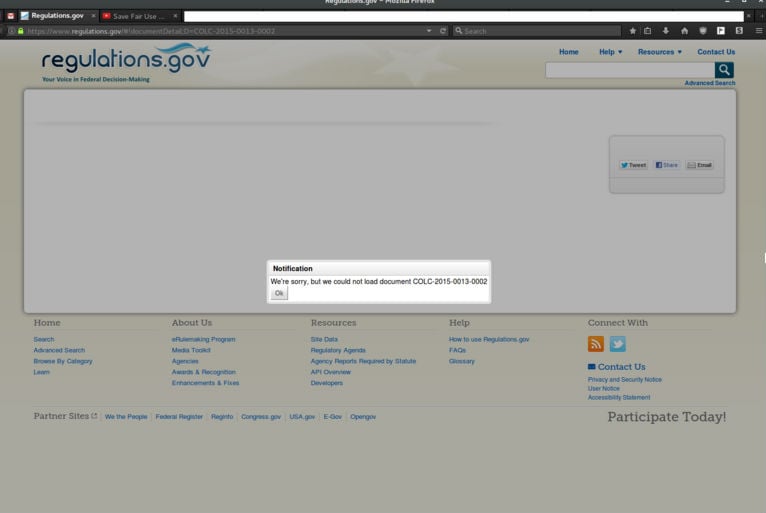
As a result the official Regulations.gov site reportedly became unresponsive for a while.

“The flood of new submissions over the last several hours appears to have repeatedly crashed the website that the government set up to receive feedback,” FFTF writes.

Issues at Regulations.gov

regul

Due to the massive response, many submitted comments are now waiting in a queue, prompting the activist group to call for an extension of the consultation’s deadline.

“The DMCA affects all Internet users and they should have an opportunity to express their concerns with the ways content is censored from the Internet, causing damage to free speech that can’t be undone,” FFTF co-founder Tiffiniy Cheng says.

“The Copyright Office has a responsibility to make sure these voices are heard. They need to extend the deadline and make sure their website stays up and can receive comments the entire time.”

The comments the campaign site allows people to send to the Copyright Office urge Congress to impose statutory damages for rightholders that abuse the DMCA takedown process or fail to take fair use into account. In addition, they call for a discouragement of automated takedown systems, including YouTube’s Content-ID system.

Given the high number of submissions generated by the campaign, it will be interesting to see what conclusions the Copyright Office will draw after the review is completed.

Channel Awesome’s campaign video

Source: TF, for the latest info on copyright, file-sharing, torrent sites and ANONYMOUS VPN services.

The Pirate Bay Reveals New “Climate Saving” Design

The Pirate Bay will soon roll out a new look. The notorious pirate site has picked a command-line themed green on black design for the coming years. Apart from improving the user experience, the darker design will also be more gentle on the environment due to reduced monitor power consumption.

Source: TF, for the latest info on copyright, file-sharing, torrent sites and ANONYMOUS VPN services.

tpbAs predicted a few months ago, The Pirate Bay will roll out a new design for the site this year.

This week a reader spotted the following .css file on Pastebin, suggesting that The Pirate Bay will launch a green on black look later this month, something the TPB crew confirmed today.

“Yes, after more than a decade it’s time for something fresh. We’re still ironing out a few minor bugs but the design should go live in a week or two,” Pirate Bay’s Winston tells TorrentFreak.

While the user interface will remain mostly intact, the change is quite dramatic. The TPB team was kind enough to share two of the latest mockups, revealing a command-line inspired look.

Pirate Bay’s future homepage

tpb-green-353

Aside from the cosmetic change, the redesign also has an ulterior motive.

“We spend most of our time looking at the command line, so for us the change is natural. But the new design also aims to lower the global power consumption by decreasing the demands on our user’s monitors.”

“We’ll therefore rename the site into ‘The Green Bay’ once we go live, just for the lulz,” Winston adds.

TPB’s new design

tpb-green-full

The theory behind the lower energy consumption is simple. Dark websites demand a tiny bit less energy from monitors than light ones, which adds up for a site that generates roughly a billion pageviews per month.

While the effectiveness of this type of energy saving up for debate, the idea itself is not new. A dark version of Google, Blackle, made headlines all across the Internet a few years ago with a similar idea.

And if that’s not good enough, the TPB team has some other tips in store to save the planet.

“Our users tend to be very climate aware. One of the main reasons to download the latest movies is so they don’t have to pump too much carbon into the atmosphere by driving their car to the movie theaters,” Winston notes.

In addition to The Pirate Bay, KickassTorrents is also working on a new look. The site already updated its homepage for non-registered users a few weeks ago, going for a more basic white look. The rest of the site is expected to follow soon.

The Pirate Bay team doesn’t have a hard date for the design launch yet, but it’s expected to go live later this month.

Source: TF, for the latest info on copyright, file-sharing, torrent sites and ANONYMOUS VPN services.

28% of Piracy Takedown Requests Are “Questionable”

A new study published by researchers from Columbia University’s American Assembly and Berkeley reveals that more than 28% of the takedown requests received by Google are “questionable.” Nearly five percent of the takedown notices that were reviewed did not target the supposed infringing content, while another 24 percent raised other concerns, including fair use.

Source: TF, for the latest info on copyright, file-sharing, torrent sites and ANONYMOUS VPN services.

google-bayIn recent years copyright holders have overloaded Google with DMCA takedown notices, targeting links to pirated content.

These requests have increased dramatically over the years. In 2008, the search engine received only a few dozen takedown notices during the entire year, but today it processes two million per day on average.

Copyright holders have used this increase to call for tougher anti-piracy actions from search engines and other intermediaries, claiming that the current system is broken. For its part, Google is concerned that the continued increase may lead to more mistakes.

This week, researchers from Columbia University’s American Assembly and Berkeley published an in-depth review of the current takedown regime, with one study zooming in on the millions of takedown requests Google receives every week.

Using data Google provides to the Lumen database, the researchers reviewed the accuracy of more than 108 million takedown requests. The vast majority of these, 99.8%, targeted Google’s web search.

According to the researchers their review shows that more 28% of all requests are “questionable.” This includes the 4.2% of notices in which supposed infringing material is not listed on the reported URL.

“Nearly a third of takedown requests (28.4%) had characteristics that raised clear questions about their validity, based solely on the facial review and comparisons we were able to conduct. Some had multiple potential issues,” the researchers write.

Among the “questionable” takedown requests are those that target websites that have been shut down over a year ago. As shown in the figure below, rightsholders such as NBC Universal continued to target websites such as Megaupload.com and BTJunkie.org long after they were gone.

“A few senders—generally targeting unauthorized file-sharing sites—continued to send requests targeting links that led to long-defunct sites, calling into question the checks they do to keep their automated algorithms accurate,” the researchers write.

Reporting dead sites

defunct

Other questionable notices were improperly formatted, included a subject matter inappropriate for DMCA takedown, or had potential fair use issues, among other things.

Joe Karaganis, co-author of the report and vice president of Columbia University’s American Assembly, informs TorrentFreak that the often automated notices are problematic because the increase in volume makes human review rather impracticable.

“The problem with automation isn’t that it gets stuff wrong. Human senders turn out to be even worse on average. It’s that automation scales the process up in ways that has made meaningful human review difficult or impossible,” Karaganis says.

“With notice sending robots talking to notice receiving robots, the step of actually looking at the targeted content often drops out of the equation. The main contribution of our study is to go back in to look at the targeted content and make those human judgments,” he adds.

The result of the high number of “questionable” takedown notices is that Google likely removes more content than it should. The company currently acts in response to 97.5% of the takedown requests, which means that the vast majority of the questionable notices are honored.

“At a minimum, Google takes a very conservative approach to these issues and yes, probably over removes content,” Karaganis says.

“They are not special in this regard. Given the risk of high statutory penalties if a service rejects a valid notice, most if not all of them err on the side of takedown. Some just categorically take down 100% of the requests they receive.”

The researchers include several policy recommendations on how the current takedown process can be improved. Among other things, they suggest making it more difficult for senders to issue questionable notices without risk.

In addition, they warn against the “notice and stay down” and automated filtering mechanisms copyright holders frequently call for, as these may increase the potential for abuse while hurting due process.

The report, first highlighted by the Washington Post, is very much in line with the position Google has taken thus far.

In that regard, it is worth highlighting that the research is in part funded by Google, who will undoubtedly deploy it in future lobbying efforts, much like the copyright industries do with the research they fund.

Google won’t have to wait long before it can put the study to use, as the U.S. Government is currently running a public consultation to evaluate the effectiveness of the DMCA’s Safe Harbor provisions. This includes issues around automated takedown requests and potential abuse, and the deadline for comments expires tomorrow.

Source: TF, for the latest info on copyright, file-sharing, torrent sites and ANONYMOUS VPN services.