Mio Fuse reviewed: A fitness band that works better than it looks

Sure you could wear it all day long, but the Fuse doesn’t shine 24/7.

Video shot/edited by Jennifer Hahn. (video link)

Mio has been in the fitness tracker market for a long time, but it's seldom mentioned in the same breath as Fitbit, Jawbone, and Garmin. Mio was one of the first companies to focus on wrist-bound heart rate monitoring, and its monitors are known for their accuracy. The $129 Fuse is the middle-of-the-road Mio device, competing with some of the newest products from Fitbit and Garmin. It features an optical heart rate monitor and daily activity tracking, but not much else.

Now after a few updates, the Fuse also tracks sleep, and it works with Mio's new PAI app, which uses its heart rate analysis to give you personal activity intelligence points when you keep your pulse elevated. While the Mio Go app gives you a daily picture of your activity, PAI provides a long-term view to encourage you to complete high-intensity activities as often as you can. If you're considered a mid-level Fitbit or Garmin device, the Fuse is another viable option if you're looking for a no-frills, no-nonsense tracker.

Read 16 remaining paragraphs | Comments
At the Tribeca Film Festival, VR gives storytellers a new, immersive medium

What’s it like to live in solitary confinement? Prepare to find out.

Video shot/edited by Jennifer Hahn. (video link)

The future of virtual reality beyond immersive gaming and 360-degree movie-watching is mysterious to say the least. At this year's Tribeca Film Festival, we're getting a taste of what devices like the Oculus Rift and Samsung's Gear VR could allow all kinds of creatives to do and the types of experiences we could have using this new medium.

The Storyscapes exhibition at the festival showcases a number of VR experiences and installations that all focus on interactive storytelling. We got to try out a few of them, using mostly the Gear VR headset, and in one case the consumer version of the Oculus Rift, and all of them manage to tell very different stories using the same VR medium. Oscar Raby's "The Turning Forest" is on the fanciful side of the spectrum, incorporating a tunnel-like forest installation and colorful animations to take you through an imaginary world. Meanwhile, other projects examine very real and raw parts of our society, like The Guardian's "6x9," which puts you in the position of an inmate in solitary confinement.

Read 1 remaining paragraphs | Comments

On the hunt for dead drops, an offline and anonymous file-sharing network

USB sticks protruding from exterior walls? What could possibly go wrong?

Video shot/edited by Nathan Finch. (video link)

If you saw a USB dongle sticking out of the wall of your building, what would you do? That's part of the premise of dead drops, a media arts project started by Germany's Aram Bartholl in 2010. Dead drops consist of USB sticks that people place in the world—in any public place—to encourage anonymous file sharing between strangers.

Bartholl was staying in New York as artist in residence when he began leaving dead drops in the Big Apple; they were eventually featured as part of the "Talk to Me" exhibit at the Museum of Modern Art. While dead drops appear to focus on information sharing, it's not the first GPS-based discovery system of its kind. Geocaching has been around much longer than dead drops, and it even has an app that records where the hidden objects—geocaches—are located.

Read 2 remaining paragraphs | Comments

Netflix quietly rolls out HDR content, starts with first season of Marco Polo

You’ll still need a compatible TV to reap the benefits, though.

(credit: Netflix)

Netflix is bumping up the video quality of one of its original shows in an effort to get ahead of the high dynamic range (HDR) streaming game. According to a report by FlatPanelsHD, Netflix released the first season of Marco Polo in HDR as well as 4K, and more HDR-capable shows will come soon. Season two of the show has been confirmed for release in June 2016.

Netflix's corporate communications manager Yann Lafargue confirmed that certain programs will support HDR streaming now but was cryptic about shows to come in the future. "We are indeed live with HDR. It works with compatible TVs, both in HDR10 and Dolby Vision," Lafargue told FlatPanelsHD. "We have season one of Marco Polo for now, but much more content should be available shortly, so stay tuned."

HDR improves picture quality by making blacks darker and whites brighter, resulting in an image sharper and crisper than that of regular HD. Netflix appears to be embracing HDR more than 4K at the moment, although the company has been streaming some 4K content since 2014. At that time, Netflix's 4K content was limited not only by the number of shows available but also by the few TVs that could support the resolution.

Read 2 remaining paragraphs | Comments

RIAA still hates the DMCA, even as streaming revenues soar

Record labels want more revenue from the free, ad-supported music on YouTube.

Music Player app. Does not do movies. Does not display cover art. Does not really do much besides play, pause, and track forward and back. (credit: Lee Hutchinson)

Things are looking up for music streaming in terms of revenue, but good numbers are little solace for the recording industry that isn't seeing the returns it wants on digital music. And the Recording Industry Association of America is still hoping for a change to the DMCA, which remains a major irritant.

According to the International Federation of the Phonographic Industry’s annual report, global revenue from recorded music grew 3.2 percent to $15 billion (£10.5 billion) in 2015. That's the biggest increase over the past two decades, which have seen mostly declining or negligible gains as consumers moved from costly physical formats like CDs to song downloads and then streaming.

That boost is due to a 45 percent increase in revenue from music streaming, which now makes up half of the world's digital music revenue. For the first time, digital music revenues surpassed the revenue from physical music sales of items such as CDs. Despite growing revenues, however, the music industry is still unhappy with the digital music landscape. The IFPI's Chief Executive Frances Moore mentions the "value-gap" between the amount of music consumed for free on "user-upload" sites such as YouTube and the money returned to music rights holders.

Read 7 remaining paragraphs | Comments

Measure your muscle and fat anywhere with Skulpt Chisel

The $99 device uses EIM to tell you how strong your muscles really are.

Video shot/edited by Jennifer Hahn. (video link)

It can be hard to see progress when you're trying to get fit. Pounds don't fly off in a week, and massive muscles don't appear overnight. But a company called Skulpt wants to make it easier for you to see the fitness hurdles you've already jumped. Its $99 Skulpt Chisel is a brick-like device that uses "electrical impedance myography" to assess muscle quality and fat percentage all across the body. Think of it as a tracker for your fitness tracker, if you use a fitness tracker—the Chisel can assess if your workouts are actually working for you. Even if you don't use a fitness device, it can show you which parts of your body need improvement and how you've gotten stronger over time.

How it works: Feel the currents

Design and features go hand-in-hand with the Skulpt Chisel. It's a white, rectangular device that's slightly taller than a deck of cards, with a thin light ring around the edges. The front of the device is just the Skulpt logo, but the back is where all the technology is. That's where you'll find small electrode strips covering most of the surface, along with four small nodes that fit into its charging base. Those electrodes measure muscle quality and fat percentage on different parts of the body using electrical impedance myography, or EIM.

Read 17 remaining paragraphs | Comments

ER docs get heart rate info from Fitbit, save patient’s life

Doctors provided strategic treatment after the man suffered a seizure.

One man's Fitbit device proved to be much more than a smart pedometer. After a 42-year old New Jersey man suffered a seizure at work one day, emergency room doctors used his Fitbit Charge HR to understand his heart rate history and decide how they could best treat him.

Upon arrival at Our Lady of Lourdes Medical Center in Camden, doctors noticed that the man had an atrial fibrillation, or an irregular, fast heartbeat. However, they weren't sure if it was a chronic condition or if it was caused by the seizure itself. Knowing this detail would determine how the doctors could treat the patient: If the arrhythmia was caused by the seizure, they could electrically cardiovert the patient to alleviate it. If it was chronic, the cardioversion could potentially cause a stroke. A stroke could also occur if the arrhythmia was left untreated.

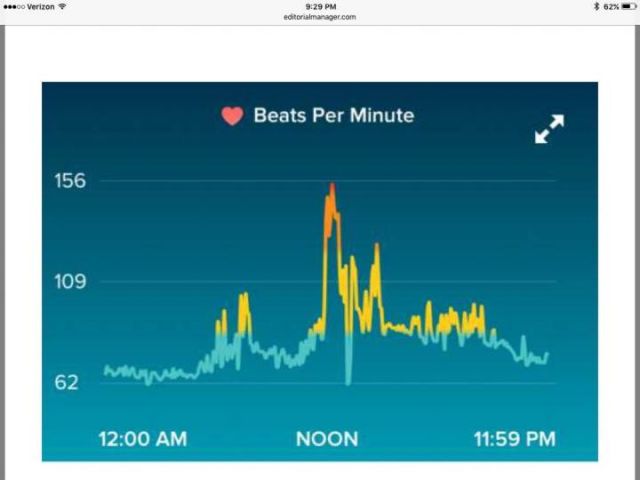
That's where the man's Fitbit Charge HR came in. The doctors accessed the Fitbit app on his smartphone and found his average heart rate as recorded throughout the course of his fitness program. "[It] revealed a baseline pulse rate between 70 and 80 beats/min, with an immediate persistent increase to a range of 140 to 160 bpm at the approximate time of the patient’s seizure. The pulse rate remained elevated until administration of the diltiazem in the field," researchers wrote in the report that now appears in the Annals of Emergency Medicine.

Read 3 remaining paragraphs | Comments

Starz enters streaming world with its own $9/month subscription service

It joins HBO as another premium channel attempting to win over cord-cutters.

(credit: Starz)

Yet another premium channel has jumped into the streaming game. Starz has announced that it will provide video streaming through its new standalone Starz app for Android and iOS. The service will provide access to over 2,400 show and movie titles, including the channel's original series Outlander and the movie Star Wars: The Force Awakens.

According to the announcement, the Starz app will allow up to four users to simultaneously watch videos from the same account. Those who don't already have Starz will pay $8.99 per month, but those who pay for Starz as part of a cable package can access the app and its features for free by using their cable credentials. The price is fairly aggressive considering HBO charges $14.99 per month for HBO Now, and Netflix is now up to the same $9 per month price.

This is good news for cord cutters who are seeking more à la carte channel options. However, none of the premium channel subscription services have been around long enough for us to assess their success. Back in February, HBO revealed that it has amassed just 800,000 subscribers for HBO Now. That might have to do with its higher price tag or may be due to its content offerings: many older HBO shows like The Sopranos are available via Amazon Prime video. Starz programming is also available through Prime video, but as an add-on subscription.

Read 1 remaining paragraphs | Comments

Roku’s new, smaller streaming stick beams audio to your smartphone

The $50 stick replaces the 2014 version with quad-core powered streaming.

(credit: Roku)

Roku continues to regularly update its family of streaming devices, and today the company announced a revamped streaming stick. The latest Roku streaming stick will replace the purple dongle the company released back in 2014, and it works largely the same way (albeit with updated internals and a few extra features).

The new Roku streaming stick has dual-band MIMO antenna and an updated quad-core processor, giving it eight times more power than the 2014 version. Even with that improvement, Roku managed to shave off some bulk from the stick so it's now closer to thumb-drive size. Just like the old streaming stick, the new one plugs into your TV via HDMI port to deliver thousands of "channels," or apps that you can watch video through including Netflix, YouTube, and Time Warner Cable. Unlike the Roku 4 set top box the company released late last year, the new streaming stick doesn't support 4K video and only streams content in 1080p.

The stick comes with a remote just like the company's other devices, but that remote doesn't have a headphone jack for private listening. However, a new feature of the stick solves that issue: it streams audio via Wi-Fi to your smartphone, so you can plug your headphones into your phone and listen to the show you're watching. This will come in handy for those who live in hectic households, live with roommates, or just really want to focus on the latest House of Cards season.

Read 2 remaining paragraphs | Comments

HP goes for bling with new super-thin, copper-accented Spectre notebook

While taking up minimal space, it promises to deliver on battery life and power.

(credit: Valentina Palladino)

Back at this year's CES in January, HP showed off its new sleek and slim Elitebook Folio G1, which echoed the design and Thunderbolt ports of Apple's new MacBook. That device is part of HP's business lineup, and now the company is introducing the new HP Spectre for regular consumers to ogle at. However, the Spectre has a few different tricks in its small, dark frame, including CPU power up to Intel Core i7, three USB Type-C ports, and up to 9.5 hours of battery life.

All of the Spectre's features revolve around its design. HP already has the Spectre x360 convertible laptop series, but with this notebook the company focused on making it as thin as possible while retaining power, efficiency, and battery life. The Spectre measures 10.3mm, making it even slimmer than Apple's 13.1mm MacBook. It is heavier than the MacBook at 2.45 pounds, but weight wasn't necessarily at the top of HP's priority list for this device. Not only is the Spectre an attempt at a slim and stylish statement laptop that you can still do serious work on, but it's also another HP device that mimics the MacBook in the best ways while attempting to fix the issues that most users have with it (namely a lack of ports).

There's not a lot of real estate for an array of ports on the Spectre either, but HP managed to put three USB Type-C ports on the back of the copper-coated edge just behind the notebook's hinge. Two of those ports are Thunderbolt as well, and they all support display, charging, power, and data. You can charge the notebook, hook it up to external displays, and share data using any and every one of the ports.

Read 4 remaining paragraphs | Comments