Fecal transplants in puppies cure 93% of recurring diarrhea cases

Burgeoning method to transfer healthy microbes to the sick gets vetted for pets.

(credit: Jonathan Kriz)

Fecal transplants have gone to the dogs—literally.

A veterinarian in Palmetto, Florida this week revealed a technique that uses poop transfers to successfully treat service puppies in-training that suffer from recurrent diarrhea, a common problem for dogs kept in kennels. The method reportedly cured 87 percent of dogs in the first round and 93 percent of those needing a second treatment.

The veterinarian—Kevin Conrad, head of Palmetto's Southeastern Guide Dogs—said that he and his colleagues began looking into the treatment as a way to cut costs for common gastrointestinal problems that are often caused by bacterial infections that shed from puppy to puppy.

Read 6 remaining paragraphs | Comments
Ancient virus found hibernating in the human genome—and it might wake up

In DNA dig, scientists unearth more viral code, which makes up >8% of our genomes.

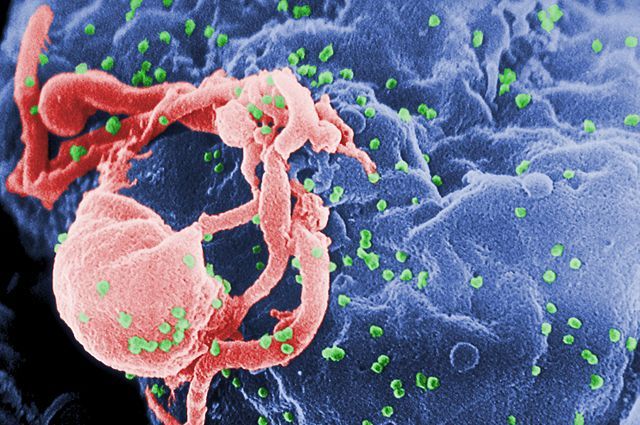
Scanning electron micrograph of HIV-1 budding (in green) from a human cell. (credit: CDC)

In the current era of microbiome research, us humans are already having to come to grips with the fact that ‘I’ is actually ‘we’. Instead of our bodies constituting a single life-form, we are each comprised of complex and diverse ecosystems of microbes that have a profound influence on our existence. Our health and wellbeing is not just determined by what our own cells do, but what our trillions of invisible inhabitants do, too. And the genetic blueprints that govern our biology are partly carried in those microbial inhabitants, as well as in our own cells.

But, as it happens, the DNA in our own cells isn’t solely ours, either. More than eight percent of the human genome is not human at all—it’s from viruses. And scientists are still digging up yet more viral code from human DNA that may well influence our lives.

In a new study this week, researchers analyzed the genomes of more than 2,500 people and found 19 never-before-noticed segments of viral genetic code. Some of that viral DNA may have been traveling down human lineages for at least 670,000 years, the researchers reported in the Proceedings of the National Academy of Sciences.

Read 10 remaining paragraphs | Comments

Viral profiling: Scientists working to predict the next Zika

Study sorts ingredients for terrifying pandemics, immediately notes exceptions.

(credit: Eneas De Troya )

When a virus jumps from wildlife to humans, it could either cause a few infections and fizzle out—or it could spark an explosive outbreak. For instance, health experts feared that H5N1 bird flu would lead to a massive and deadly pandemic in humans in the early 2000s, but with its current limited ability to jump from human to human, it has yet to kick off such a large-scale plague. Zika, Ebola, and HIV/AIDS, on the other hand, have.

Figuring out beforehand the type of viral scenario that will unfold with a new, emerging germ would be vital to protecting public health, allowing health officials to anticipate and thwart the spread of infections before they get out of hand. But researchers have largely struggled with how to make those predictions.

To try to break down the molecular recipe for a pandemic, researchers analyzed a range of biological features from 203 human-infecting viruses—a mix of those that have and have not caused big outbreaks. The researchers aimed to find predictors of infectious potential among each virus’ characteristics, including its family tree; genome’s make-up (DNA or RNA), length, and segmentation; outer structure of its viral particle; tendency to recombine with relative viruses and create variation in its genetics; time spent in a victim; deadliness; and whether or not it spreads via a vector, such as mosquitoes and ticks. The results appear in the Proceedings of the National Academy of Sciences.

Read 7 remaining paragraphs | Comments

Apple unveils CareKit, an open source framework for making health apps

Company hopes ResearchKit success carries over to patient care and treatment monitoring.

Apple VP Jeff Williams revealing CareKit. (credit: Andrew Cunningham)

Today, Apple introduced the open source software framework CareKit, which can be used to develop healthcare apps. Apple plans to release the software in April, and the company said the software is aimed at making things easier for users to track their health and monitor symptoms, medications, and treatment responses and then quickly share that data with medical professionals and loved ones.

The company hopes that CareKit will see the same success as the similar platform ResearchKit, a framework for developing medical research apps. So far, developers and researchers have already started using the ResearchKit platform to develop apps that help diagnose and monitor autism symptoms in young children, help Alzheimer’s patients personalize their care plans, and collect data from epileptics to one day be able to sense an oncoming seizure. Last week, Harvard researchers announced a ResearchKit app to help professional football players track their mental and physical health.

To coincide with today's event, 23andMe announced a new ResearchKit module that will allow its customers to easily share genetic data directly with researchers—streamlining the consent process and securely transferring data directly from 23andMe to a research institution.

Read 4 remaining paragraphs | Comments

See a chemical signal ripple through cells and other cool science wonders

“Cool Science Image” contest lives up to name with tick barbs, crystal axes, etc.

In its sixth year, the University of Wisconsin–Madison’s “Cool Science Image” contest has lived up to its name.

As the name implies, the contest strives to pick out awe-inspiring images of nature or science composed by creative and technically skilled students, researchers, and faculty at UW-Madison. Of the 93 entries, which included 86 stills and seven videos, a panel of judges selected 10 images and two videos. The winners were announced late last week.

The subjects of the winning entries include microscopic impressionism and strobing biochemistry, state lakes snapped by satellites, and the sun’s path from solstice-to-solstice, tracked with a homemade camera.

Read 1 remaining paragraphs | Comments

Standing can also be bad for you, says scientist studying desk set-up

Researchers are falling down on the job of figuring out the healthiest way to work.

(credit: ramsey beyer)

If there’s anything scientists know about the best type of desk for an office worker’s long-term health, it’s that they don’t really know anything, according to a new analysis of the scientific literature on the matter.

After closely examining 20 of the highest quality studies about workplace interventions to reduce sitting time, which include standing, pedaling, and treadmill desks, researchers concluded that there simply isn’t enough data to say whether any of the alternatives are better that just plopping in front of a standard desk.

A number of studies in the past had found that planting your bum in an office chair for hours at a time can up your chances of heart failure, disabilities, and even shorten your life. Collectively, the data spurred a trend for alternative workstations that are aimed at reversing those negative effects, boosting calorie burning, and improving overall health.

Read 4 remaining paragraphs | Comments

Off-switch for overeating and obesity found in the brain

Deleting the enzyme from mice doubled the food they ate, tripled their body fat.

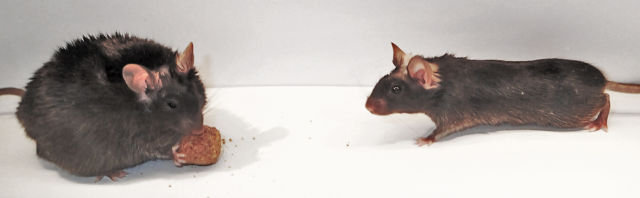
Littermates were injected with either a control virus (right) or a virus that knocked out O-GlcNAcTransferase (OGT) (left) in a subpopulation of cells in the hypothalamus in the brain. OGT knock out made the mouse eat twice as much as its sibling. This photo was taken about five weeks after virus injection. (credit: Olof Lagerlof)

After tediously tracking calories and willfully shunning cravings, many a dieter has likely dreamt of simple switch that, when thrown, could shut down hunger and melt away pounds—and scientists may have just found it.

When researchers knocked down a single enzyme in the brains of mice, the rodents seemed to lose the ability to tell when they were full. They ate more than twice their usual amount of food at meal times and tripled their body fat within three weeks. And—most strikingly—when the researchers reversed the experiment, the mice just quickly stopped eating so much. Data on the enzymatic switch, published Thursday in Science, suggests a possible target for future drugs to treat obesity in humans.

The enzyme is O-GlcNAc transferase, or OGT, which is known to work in a chemical pathway controlled by nutrients and metabolic hormones, particularly insulin. That pathway has long been linked with obesity. But researchers knew almost nothing about the how the pathway linked to the metabolic disorder or OGT’s specific role.

Read 7 remaining paragraphs | Comments

Mysterious outbreak kills Michigan resident after 17 dead in Wisconsin

Obscure bacteria sickening dozens stumps public health investigators as cases continue.

Elizabethkingia anophelis growing on a blood agar plate. (credit: CDC's Special Bacteriology Reference Lab)

An elderly Michigan resident is the latest to die from a rare and unexplained bacterial outbreak that has sickened 54 people in Wisconsin, killing 17, heath officials confirmed Thursday.

The bacteria, Elizabethkingia anopheles, is commonly found in the environment but rarely infects humans. Historically, outbreaks of the bacteria haven’t reached more than around 10 people, making the outbreak in Wisconsin—and now Michigan—the largest ever recorded.

Investigators from the Centers for Disease Control and Prevention have teamed up with state and local authorities to try to track down the source of the bacteria, which is so far unknown. Since the beginning of last November, the outbreak has spread to at least 12 counties in two states.

Read 6 remaining paragraphs | Comments

1% chance of microcephaly in Zika outbreak, scientists estimate

Study suggests relatively low risk of birth defect but big numbers as virus spreads.

Based on data from a past Zika outbreak, researchers estimate that there’s a one-in-100 chance that women infected during the first trimester will give birth to a baby with microcephaly—a birth defect that leaves infants with small and malformed brains and skulls.

There’s still not a definitive link between microcephaly and the mosquito-borne virus, which is currently blazing through Central and South America. But the data coming in has only strengthened the connection. For instance, a recent study found that Zika virus can kill off developing brain cells.

With the new estimate on the rate of microcephaly in Zika infections from an outbreak in French Polynesia starting in 2013, researchers are relieved that it appears the birth defect is relatively rare.

Read 6 remaining paragraphs | Comments

Researchers are brewing up medicines from beer hops

Untapped chemicals in bitter buds may treat inflammation, infections, cancer.

(credit: Paul Miller)

While beer connoisseurs have mixed and heated opinions about the trend of ever-more hoppy beers, some researchers just can’t get enough of the bitter buds.

Their keen interest stems from the potentially untapped medicinal properties of the flowers. Traditional medicine has long used hops for everything from sedation to combatting infections. And researchers have noted that the plant’s chemical constituents appear to have anti-inflammatory, antibacterial, and anti-cancer activities. Yet chemists are still working out all the chemicals responsible for the potentially therapeutic effects and how to use them to brew up new medicines.

Now, with two new studies, researchers report that they’re getting closer to pinning down and optimizing hop-based medicines.

Read 8 remaining paragraphs | Comments