Can Google’s Larry Page make flying cars a reality?

The Google founder owns not one but two flying car startups.

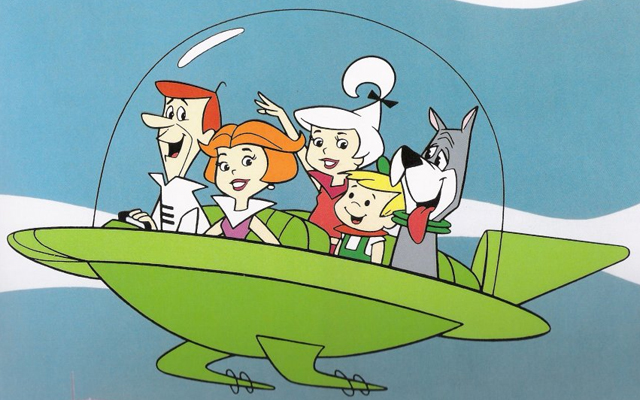
(credit: Warner Brothers Animation)

Like the robber barons of the Gilded Age, some of the tech billionaires of Silicon Valley are using their vast wealth to try to transform the world according to their vision(s). Bill Gates has his foundation. Elon Musk wants us to ditch the fossil-fueled car. Both Musk and Jeff Bezos want space colonies. And Google's Larry Page? He wants those flying cars we were promised.

This week Bloomberg told us that Page owns not one but two flying car startups: Zee.Aero and Kitty Hawk. Both companies appear rather media shy, but they seem to be working on small passenger aircraft that can take off and land vertically, according to reports from former employees, patent filings, and eye-witness accounts from Hollister Municipal Airport in California (where Zee.Aero is testing). The vehicles are probably using electric motors as well. "When the aircraft take off, they sound like air raid sirens," Bloomberg wrote.

Page's companies are but two among a score or more working on flying cars. There are old doyens of the field like Moller, which has been at it for more than 40 years, as well as more recent upstarts like Terrafugia and Aeromobil. It's certainly a lofty goal, but will it succeed? At the very least, it feels like some of the necessary enabling technologies are getting closer to being ready. Battery powered flight is achievable, as last year's English Channel crossing(s) demonstrated. Electric motors are smaller, lighter, and much less complex than jets, and the drone explosion serves as evidence that we can make ungainly shapes fly well even in the hands of amateurs, thanks to software.

Read 3 remaining paragraphs | Comments

League of Legends admits to using chat-log analysis in employee reviews

Toxicity analysis looks for context, such as “using their [developer] authority.”

The hammer comes down—at the workplace. (credit: Riot Games)

League of Legends creators Riot Games have never shied away from the fact that some of its players really, really suck. The company's "tribunal" answer to toxic behavior has paid big dividends in the past few years, but it hasn't zeroed out all rude players—which means Riot still had some recent data handy to connect the dots for an intriguing, workplace-related corollary.

The leading question: Does bad in-game behavior carry over to the workplace? Riot was in a position to know, since its staffers are also avid LoL players—and have apparently signed over permissions for their bosses to track their gameplay.

With help from Google's re:Work staff analytics team, Riot picked through the last 12 months of each staffer's LoL gameplay records and chat logs. The analysts found that in the case of fired employees, 25 percent of them exhibited significantly toxic in-game behavior. This wasn't a surface-level search for vulgar and hateful keywords but rather a deeper, context-specific analysis; according to re:Work, the worst behaviors included "passive aggression (snarky comments) and the use of authoritative language, sometimes using their authority as a Riot employee to intimidate or threaten others."

Read 2 remaining paragraphs | Comments

These are the names for Intel’s first Apollo Lake chips

These are the names for Intel’s first Apollo Lake chips

Intel’s Apollo Lake processors will be the first chips to use the company’s new Goldmont CPU architecture. They’re expected to launch later this year, and they’ll replace the low-power Pentium and Celeron chips in the Braswell family which use Intel’s older Airmont CPU cores.

While we know that Intel is promising that Goldmont will offer up to 30 percent better performance than Airmont, we don’t have a lot of details about the new chips yet.

Continue reading These are the names for Intel’s first Apollo Lake chips at Liliputing.

Tesla denies suspension issue and accuses blogger of lying

Model S with a suspension ball “experienced very abnormal rust,” Tesla says.

The feud between Elon Musk company Tesla Motors and an auto blogger has sparked an indignant open letter from the company.

The feud started on Wednesday when Edward Niedermeyer posted on his blog, the Daily Kanban, that while investigating reports of suspension breakage in Tesla’s Model S and X cars he found something troubling. A poster in a Tesla Motors forum claimed the suspension in his 2013 Model S had failed. The car had 70,000 miles on it and was out of warranty, so Tesla apparently told the owner that the company would not pay for his repairs. Several days later, Tesla contacted him and offered to pay for 50 percent of the repairs if he agreed to sign a Goodwill Agreement. The agreement stipulated that the owner of the Model S would keep confidential the details of the incident and the work required to fix the car.

The Daily Kanban posted part of the agreement, which reads:

Read 9 remaining paragraphs | Comments

Dealmaster: Get a Dell Inspiron 15 7559 for $749.99, and more

Save about $150 on this sweet Dell laptop.

Greetings, Arsians! Courtesy of our partners at TechBargains, the Dealmaster is here with some sweet deals to help pass the time until the weekend gets here. The top item this week is a Dell Inspiron 15 7559. This laptop has a 3.5GHz Intel Core i7-6700HQ, 8GB of RAM, a 1TB 5400RPM Hybrid hard drive, a GeForce GTX 960M with 4GB of video memory, and a 15.6-inch 1080p display. Forget the regular $899.99 price—you can have it for just $749.99.

We've got the laptop and many more deals below.

Laptop & Desktop Computers

Read 3 remaining paragraphs | Comments

Install Android 6.0 Marshmallow on your PC with Android-x86 RC1

Install Android 6.0 Marshmallow on your PC with Android-x86 RC1

The Android-x86 project has been providing a way to install Google’s mobile operating system on desktop and notebook computers for years, and now the team is just about finished with the first build based on Android 6.0.

A release candidate for Android-x86 6.0 is now available for download, and it’s designed to run on most computer with 32-bit x86 or 64-bit x86_64 processors.

This isn’t an emulator that lets you run Android within Windows or another operating system.

Continue reading Install Android 6.0 Marshmallow on your PC with Android-x86 RC1 at Liliputing.

US coal production drops to levels not seen since a 1980s miners’ strike

A 17 percent drop in just a single quarter.

(credit: US EIA)

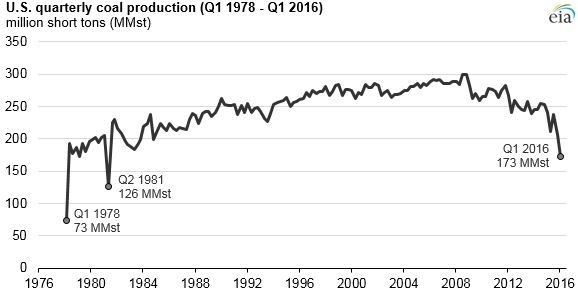
The first three months of 2016 saw a plunge in the US' coal production that may be without precedent. The US Energy Information Administration, which has figures going back to the 1970s, shows only a single quarterly drop of similar magnitude—and that one came during a workers' strike back in the early 1980s. Excepting periods of labor problems, US coal production has not been this low since the EIA started tracking it.

Part of the problem is temporary. The winter was unusually mild, which lowers energy use in general. As a result, many of the coal-burning electrical plants had large stockpiles of coal on hand; they burned through these reserves rather than ordering new coal.

But most of the issues are systemic. Coal is now being undercut by renewables and natural gas, which are displacing some of the demand. Utilities are responding to those low prices by adding new renewable and gas capacity. That additional capacity comes at a time when the US' electricity demand has been growing at an unexpectedly slow pace. Combined, these factors have resulted in less use of existing coal plants. New environmental regulations are also forcing the oldest and least efficient plants to shut down early. Most of these are also coal.

Read 1 remaining paragraphs | Comments

Drug companies continue to raise prices despite public backlash

Pfizer just raised drug prices for a second time this year—and it’s not alone.

(credit: Gatis Gribusts)

Last week, as Vermont Governor Peter Shumlin signed off on the first state law requiring drug companies to justify steep price hikes, Pfizer was in the process of raising the list prices of its drugs by an average of 8.8 percent, according to a Pfizer spokesperson. The price boost follows a similar one in January, which involved raising the list price of more than 100 drugs, some by as much as 20 percent.

Pfizer isn’t alone in this trend. Drug companies including AbbVie, Eli Lilly, Merck, and Bristol-Myers Squibb also continue to steadily raise prices across the board—although, it's happening at “modestly lower” rates than those seen in 2015, as FiercePharma reports.

The march towards ever higher drug costs continues despite strong public outcry. The firestorm has mostly centered on figures such as the executives of Valeant Pharmaceuticals and Martin Shkreli. The former CEO of Turing Pharmaceuticals became notorious for raising the price of a life-saving anti-parasitic drug by more than 5,000 percent as well a running an alleged Ponzi-like scheme. But soaring price increases is an industry-wide phenomenon.

Read 3 remaining paragraphs | Comments

Gawker to declare bankruptcy, auction itself off in wake of Hulk Hogan lawsuit

Chapter 11 filing would help shield the company from Hogan payment (for now).

(credit: Miguel Discart)

Gawker Media is set to formally declare bankruptcy, and owner Nick Denton plans to put the company up for auction, according to numerous media outlets.

"[Gawker Media] is also now formally entertaining offers to buy the company and says it has a firm bid from publisher Ziff Davis to buy the entire operation for less than $100 million," Recode reported.

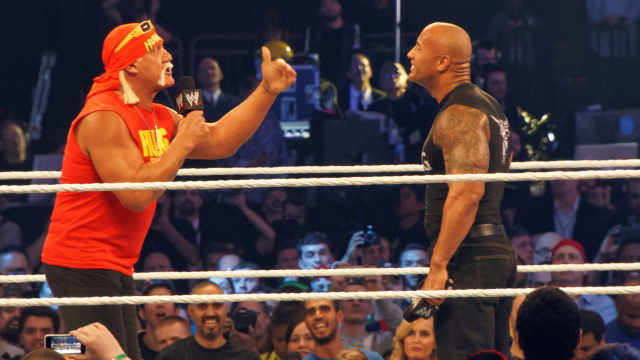
Weeks ago, it came out that Peter Thiel, a billionaire investor, was bankrolling the Hulk Hogan defamation lawsuit, who seemingly sought revenge over being "outed" as "totally gay" a decade ago by Gawker's now-defunct Valleywag site.

Read 5 remaining paragraphs | Comments
Microsoft’s Windows 10 push is effective, damaging, desirable, and deceptive

Op-ed: A free Windows 10 upgrade is good. Forcing people to have it is not.

Danger!

Offering Windows 10 as a free upgrade to non-enterprise users of Windows 7 and Windows 8.1 was a sensible move on Microsoft's part. Microsoft wants developers to create applications for the Universal Windows Platform and to do that, it has to ensure that there are many people using this platform. The company has told the developer community that it expects 1 billion Windows 10 systems within the first two-to-three years, putting an end to the usual chicken-and-egg situation surrounding new Windows releases: developers never use the latest and greatest features, because there's nobody using the latest-and-greatest operating system; there's no reason to use the latest-and-greatest operating system, because software runs just fine on the current one.

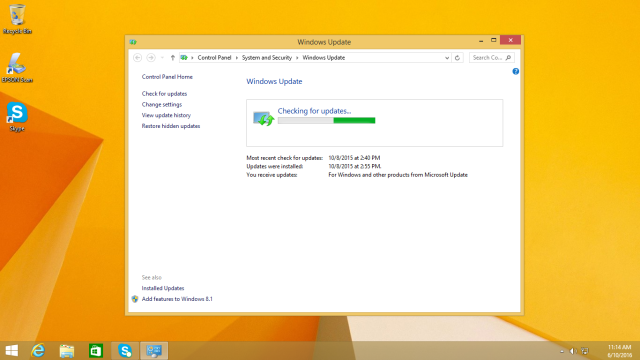
Knowing that few people will actively seek out a new operating system to upgrade their computers, Microsoft offered the Windows 10 upgrade through Windows Update. It also distributed updates that advertised the existence of the Windows 10 update to Windows 7 and 8.1 users. Initially, this merely allowed people to "reserve" their Windows 10 upgrade, but Microsoft has become progressively more aggressive. In the early days, this upgrade was found to be downloading the new operating system even before users opted in, and it was then accused of installing automatically.

In past weeks, the complaints have stepped up. Microsoft has been accused of changing the dialogs advertising the availability of the upgrade. Initially, pressing the X in the corner of the window canceled the upgrade; however, this was changed so that pressing the X merely delayed the upgrade.

Read 11 remaining paragraphs | Comments