Streaming Site Operators Face Jail & $1.7m Forfeiture

The former operators of Swefilmer, Sweden’s largest streaming site, have been prosecuted for copyright infringement and money laundering offenses. The men, aged 22 and 25, are accused of facilitating infringement on 1,400 movies and face penalties of $1.7m.

Source: TF, for the latest info on copyright, file-sharing, torrent sites and ANONYMOUS VPN services.

Founded half a decade ago, Swefilmer was Sweden’s most popular unauthorized streaming site.

Offering all the latest movies and TV shows, Swefilmer (and another, Dreamfilm) captured up to 25% of all web TV viewing in Sweden according to a 2015 report.

Last summer, however, the noose began to tighten. In July local man Ola Johansson revealed that he’d been raided by the police under suspicion of being involved in running the site.

Meanwhile, police continued the hunt for the site’s primary operator and in March 2016 it was revealed that a Turkish national had been arrested in Germany on a secret European arrest warrant. The 25-year-old is said to be the person who received donations from users and set up Swefilmer’s deals with advertisers.

Both men have now been prosecuted by Swedish authorities. In an indictment filed in the Varberg District Court, both men are accused of copyright infringement connected to the unlawful distribution of more than 1,400 movies.

Additionally, the 25-year-old stands accused of aggravated money laundering offenses related to his handling of Swefilmer’s finances.

The prosecution says that the site generated more than $1.7m between November 2013 and June 2015. More than $1.5m of that amount came from advertising with user donations contributing around $110,000. The state wants the 25-year-old to forfeit the full amount. A $77,000 car and properties worth $233,000 have already been seized.

While both could be sent to prison, the 22-year-old faces less serious charges and will be expected to pay back around $3,600.

The trial, which is expected to go ahead in just over a week, will be the most significant case against a streaming portal in Sweden to date.

Source: TF, for the latest info on copyright, file-sharing, torrent sites and ANONYMOUS VPN services.

AVM: Routerfreiheit bringt Kabel-TV per WLAN auf mobile Geräte

Golem.de wollte von AVM wissen, welche Vorteile die Nutzer von der Abschaffung des Routerzwangs haben. Neben dem DVB-C-Tuner für das Streaming des TV-Programms auf mobile Geräte im WLAN wird noch mehr geboten. (Fritzbox, Spam)

Golem.de wollte von AVM wissen, welche Vorteile die Nutzer von der Abschaffung des Routerzwangs haben. Neben dem DVB-C-Tuner für das Streaming des TV-Programms auf mobile Geräte im WLAN wird noch mehr geboten. (Fritzbox, Spam)

Oculus App: Vive-Besitzer können wieder Rift-exklusive Titel spielen

Oculus VR macht einen Rückzieher: Künftig prüft der Hersteller bei Spielen im Oculus Store nicht mehr, ob auch ein Oculus Rift angeschlossen ist. Nur weil das Hardware-DRM entfernt wurde, bedeute das aber nicht, dass es kein Exklusivtitel mehr geben wird. (Oculus Rift, PC)

Oculus VR macht einen Rückzieher: Künftig prüft der Hersteller bei Spielen im Oculus Store nicht mehr, ob auch ein Oculus Rift angeschlossen ist. Nur weil das Hardware-DRM entfernt wurde, bedeute das aber nicht, dass es kein Exklusivtitel mehr geben wird. (Oculus Rift, PC)

Rightscorp Pressures ISPs to Hijack Pirates Browsers

Piracy monetization firm Rightscorp is promoting its browser hijacking system to ISPs. In a proposal revealed by Internet provider RCN, Rightscorp suggests a gradual approach where pirating subscribers eventually have to pay a fine to regain Internet access.

Source: TF, for the latest info on copyright, file-sharing, torrent sites and ANONYMOUS VPN services.

hijackRightscorp has made plenty of headlines in recent years, often due its aggressive attempts to obtain settlements from allegedly pirating Internet users.

Thus far these efforts haven’t been particularly successful. Rightscorp is reporting millions in losses and most major Internet providers are not forwarding their settlement demands, even when they are offered a cut of the proceeds.

In order to make their services more ‘appealing’ to ISPs the anti-piracy firm recently added a new strategy. In addition to sending in notices, it now offers ISPs a system where the browsers of subscribers are locked until they pay their ‘fine.’

We uncovered the browser hijacking plan before, but thanks to a letter made public by Internet provider RCN we can now see how Rightscorp promotes it to ISPs.

The letter detailing Rightscorp’s proposal was released by RCN this week, as part of the court case it started earlier this month. In the letter Rightscorp claims that it’s tracking tens of thousands of repeat infringers on RCN’s network, for which it sent over a million notices.

“Unfortunately, the problem on your network is massive and growing,” Rightscorp writes.

“It is our professional estimation that on an annual basis, there are still 95 million instances of songs, movies, TV shows, software applications and eBooks being distributed illegally on the RCN network annually without compensation to the owners,” they add.

The anti-piracy outfit says that in order to solve this issue and prevent further Government regulation, repeat infringements have to be properly warned. This means implementing a system where subscribers face serious consequences.

“In our opinion, the average RCN subscriber simply does not fear that there will be any consequences if they continue to engage in piracy.

“Rightscorp has a proven solution that has reduced repeat copyright infringers on ISPs that work with us. We see 374% less repeat infringement on ISPs that work with us versus ISPs that do not work with us,” the letter adds.

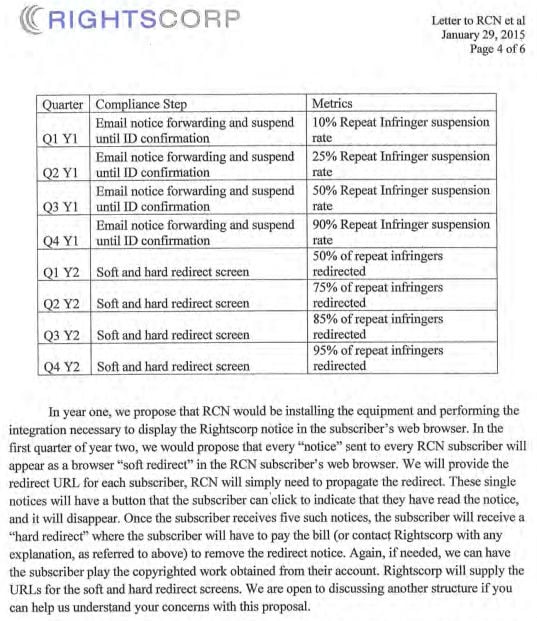
Instead of merely forwarding settlement demands, Rightscorp proposes a system where the ISP hijacks subscribers’ browsers. Initially, this would only affect 10% of infringers but the number would gradually increase to 90%.

The letter also contains details about the setup of the hijacking system, which works via a combination of soft and hard redirects.

Rightscorp’s proposal
rightscrcnletter

The soft redirect will suspend Internet access until the subscribers acknowledge that they’ve read the notice. After five notices this switches to a hard redirect, which requires subscribers to pay up in order to browse the web again.

“These single notices will have a button that the subscriber can click to indicate that they have read the notice, and it will disappear,” Rightscorp explains.

“Once the subscriber receives five such notices, the subscriber will receive a ‘hard redirect’ where the subscriber will have to pay the bill to remove the redirect notice,” they add.

The letter is framed as a cooperation that can benefit both parties, but also applies some mild pressure here and there. For example, it closes by mentioning the devastating effect piracy can have on copyright holders and reminds the ISP of the major impact it can have.

“Without the browser hijacking, copyright holders have no option to stop piracy,” the company claims.

“Just one RCN subscriber with a 5Mbps upload speed running BitTorrent can give away 1.5 million MBps or 12,000 movies a year for free. We are tracking thousands of RCN subscribers doing exactly that every day.”

“Do you really want to stand by and do almost nothing while every American content creator is forced to have their work distributed worldwide for free on your network?” the letter asks.

We doubt that RCN is cheering on its pirating subscribers. However, the company also doesn’t appreciate being pressured into commercial partnerships with companies that have a dubious status.

Instead, it declined the offer and filed a lawsuit against music group BMG, one of Rightscorp’s major clients, describing the company’s piracy monitoring tools as flawed. Whether any other ISPs will take the bait will become apparent in the future.

Rightscorp’s full letter can be downloaded here (pdf).

Source: TF, for the latest info on copyright, file-sharing, torrent sites and ANONYMOUS VPN services.


Samsung Ahead may be a Google Glass-like Smart Helmet (according to trademark filing)

Samsung Ahead may be a Google Glass-like Smart Helmet (according to trademark filing)

Samsung has filed for a trademark on a logo for an unannounced product called Ahead… which seems to some sort of device that you wear… on your head. Get it?

While the trademark application doesn’t provide a lot of details, Samsung does describe the category of devices which it would apply to, which paints a picture of a helmet with Google Glass-style smart features.

For example, the trademark would apply to “werable telecommunication machines and implements in the shape of a helmet,” and “wearable computer in the shape of a helmet,” as well as “electric audio an dvisual apparatus” such as MP3 players, portable computers, or digital cameras.

Continue reading Samsung Ahead may be a Google Glass-like Smart Helmet (according to trademark filing) at Liliputing.

The auto engineering marvels at the Lane Motor Museum are ridiculously cool

Some of the world’s rarest cars are on display in Tennessee.

From the entrance of Nashville, TN's Lane Motor Museum. (credit: Megan Geuss)

When Ars was invited to do a test drive of the 2016 Chevrolet Cruze in Nashville, we wanted to make the most of our trip down south. Between playing the tourist by looking for live music and eating hot chicken, we made a stop at the Lane Motor Museum. Founded by Jeff Lane in 2003, the museum houses an extraordinary collection of rare and replica vehicles, including oddities and historical models. 

We took plenty of pictures, but there were a lot of cars we missed as well. For a more complete look, we recommend you stop by next time you're in Nashville.

We've separated photos of some of the coolest cars into categories. The first category are traditional vehicles, plane components, or vehicle styles that have been modified to create something new and exciting. For instance, the replica Dymaxion, originally designed by Buckminster Fuller, is a spiritual ancestor of today's nerd/maker culture. The Dymaxion was supposed to eventually be an all-purpose vehicle, capable of flying, driving, and floating. Alas, after a couple fateful accidents and a lack of funding, work on the Dymaxion was discontinued.

Read 4 remaining paragraphs | Comments

To mitigate poverty, Y Combinator set to launch minimum income plan

A few dozen Oakland residents to get $2,000 per month, no strings, for a year.

(credit: Jaegar Moore)

OAKLAND, Calif.—Earlier this month, Y Combinator, the famed Silicon Valley incubator dropped a bombshell: it had selected this city to be the home of its new "Basic Income" pilot project, to start later this year.

The idea is pretty simple. Give some people a small amount of money per month, no strings attached, for a year, and see what happens. With any luck, people will use it to lift themselves out of poverty.

In this case, as Matt Krisiloff of Y Combinator Research (YCR) told Ars, that means spending about $1.5 million over the course of a year to study the distribution of "$1,500 or $2,000" per month to "30 to 50" people. There will also be a similar-sized control group that gets nothing. The project is set to start before the end of 2016.

Read 13 remaining paragraphs | Comments

China’s powerful new rocket makes a successful debut launch

New fuels, new rockets, new spaceport—China continues to make strides in space.

The Long March 7 rocket lifted off at 8:01am ET on Saturday morning. (credit: Chinese TV screenshot)

China's developing space program took another major step forward on Saturday with the launch of its Long March 7 rocket, a new class of booster capable of lifting up to 13.5 metric tons to low-Earth orbit (LEO). The primary payload of the flight was a dummy version of its next-generation crew capsule and some cubesats.

The launch highlighted several key advances for the rapidly modernizing Chinese rocket program. It marked the first launch from the Wenchang Satellite Launch Center, located on Hainan Island, the country's southernmost point. This allows better access to geostationary orbit for Chinese satellites. The Long March 7 also operates with kerosene and liquid oxygen fuels, rather than more environmentally dangerous hypergolic fuels used to power earlier launchers that were based on 1970s technology.

The new 53-meter rocket is the medium-class version of a new launch family that will also include the heavy lift Long March 5 vehicle (with similar capabilities to the Delta IV Heavy rocket), and Long March 6 rocket that will launch small satellites into space. Developed by the China Academy of Launch Vehicle Technology, the new fleet of vehicles will allow China to build and service a new space station, which may debut as early as 2022. The rocket launched Saturday is expected to deliver cargo resupply vehicles to Chinese space station.

Read 1 remaining paragraphs | Comments

Elektroauto: Supersportwagen BMW i8 soll 400 km rein elektrisch fahren

BMW plant angeblich eine rein elektrische Version des BMW i8, die mit einer Akkuladung bis zu 400 Kilometer weit kommen soll. Der Zweisitzer wäre damit eine Alternative zum Tesla S, der allerdings eine Reiselimousine darstellt. (BMW, GreenIT)

BMW plant angeblich eine rein elektrische Version des BMW i8, die mit einer Akkuladung bis zu 400 Kilometer weit kommen soll. Der Zweisitzer wäre damit eine Alternative zum Tesla S, der allerdings eine Reiselimousine darstellt. (BMW, GreenIT)