An unexpectedly large city lies in a sea of grass inhabited largely by nomads.
Today all that’s left of the ancient city of Semiyarka are a few low earthen mounds and some scattered artifacts, nearly hidden beneath the waving grasses of the Kazakh Steppe, a vast swath of grassland that stretches across northern Kazakhstan and into Russia. But recent surveys and excavations reveal that 3,500 years ago, this empty plain was a bustling city with a thriving metalworking industry, where nomadic herders and traders might have mingled with settled metalworkers and merchants.
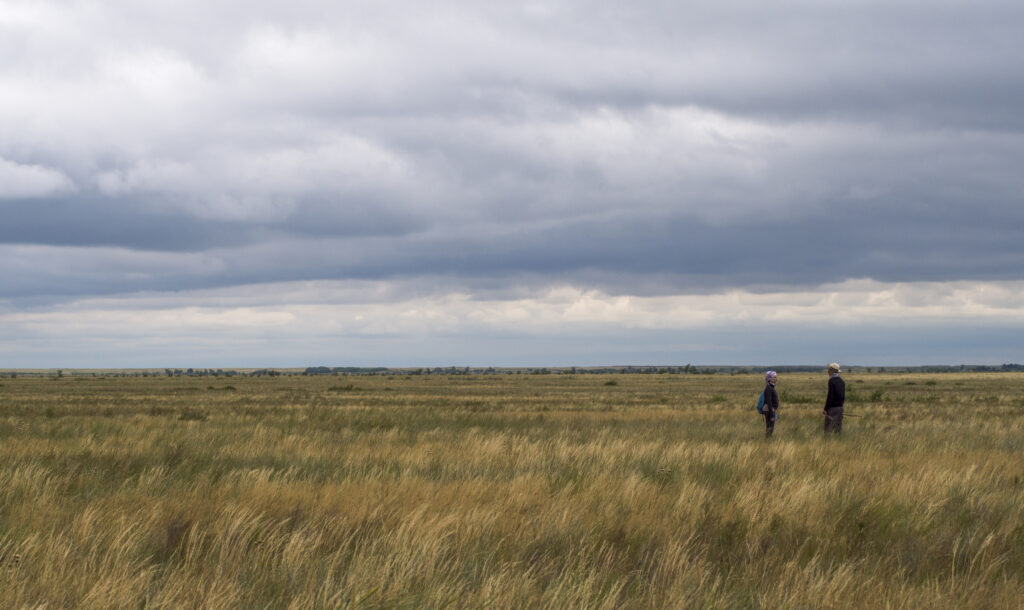
Radivojevic and Lawrence stand on the site of Semiyarka.
Credit:
Peter J. Brown
Welcome to the City of Seven Ravines
University College of London archaeologist Miljana Radivojevic and her colleagues recently mapped the site with drones and geophysical surveys (like ground-penetrating radar, for example), tracing the layout of a 140-hectare city on the steppe in what’s now Kazakhstan.
The Bronze Age city once boasted rows of houses built on earthworks, a large central building, and a neighborhood of workshops where artisans smelted and cast bronze. From its windswept promontory, it held a commanding view of a narrow point in the Irtysh River valley, a strategic location that may have offered the city “control over movement along the river and valley bottom,” according to Radivojevic and her colleagues. That view inspired archaeologists’ name for the city: Semiyarka, or City of Seven Ravines.
Read full article
Comments
 Der ADAC hat seinen neuen TÜV-Report veröffentlicht, in dem erstmals auch Elektroautos umfassend bewertet werden - Tesla schneidet schlecht ab. (Elektroauto, Tesla)
  Der Black Friday bringt Rabatte auf Laser- und Tintenstrahldrucker. Diese Modelle sind ideal für Homeoffice oder Büro und jetzt günstiger. (
 Mit Plasma behandelte Samen sind resistent gegen Keime und Schädlinge, Wasser lässt sich desinfizieren. Das spart Chemikalien und schont die Umwelt. (
 Michael Dorn spricht über seine einzige Regiearbeit bei Star Trek: Enterprise - und eine Lüge, die weitere Episoden verhinderte. (
 Eine Dashcam für vorne und hinten mit 4K-Auflösung, integriertem GPS und ADAS ist am Black Friday bei Amazon günstig wie nie. (
 Die Formel 1 der autonomen Rennwagen wurde erneut von der TU München gewonnen. Bis zum Einsatz der Technik auf der Straße dürfte es aber noch dauern. (
 In Innenräumen können mehrere IoT-Geräte gleichzeitig ohne Unterbrechung betrieben werden. Außerdem ist die Technik sicherer als Laseranwendungen. (
 Mit Artemis III sollen wieder Menschen auf dem Mond landen. Doch der Zeitplan von SpaceX stimmt nicht mit dem der Nasa überein. (