Popular shadow library Anna’s Archive has become a top target for copyright holders. In just three years, publishers and authors have prompted Google to remove 749 million of the site’s URLs from its search results. Despite this immense takedown campaign, which accounts for 5% of all URLs reported to Google on copyright grounds, the site itself remains easily discoverable through the search engine.
From: TF, for the latest news on copyright battles, piracy and more.
 Anna’s Archive is a meta-search engine for shadow libraries that allows users to find pirated books and other related sources.
The site launched in the fall of 2022, just days after Z-Library was targeted in a U.S. criminal crackdown, to ensure continued availability of ‘free’ books and articles to the broader public.
In the three years since then, Anna’s Archive has built up quite the track record. The site has been blocked in various countries, was sued in the U.S. after it scraped WorldCat, and actively provides assistance to AI researchers who want to use its library for model training.
Despite legal pressure, Annas-archive.org and the related .li and .se domains remain operational. This is a thorn in the side of publishers who are actively trying to take the site down. In the absence of options to target the site directly, they ask third-party intermediaries such as Google to lend a hand.
749 Million URLs
Google and other major search engines allow rightsholders to request removal of allegedly infringing URLs. The aim is to ensure that pirate sites no longer show up in search results when people search for books, movies, music, or other copyrighted content.
The Pirate Bay, for example, has been a popular target; Google has removed more than 4.2 million thepiratebay.org URLs over the years in response to copyright holder complaints. While this sounds like a sizable number, it pales in comparison to the volume of takedowns targeting Anna’s Archive.
Google’s transparency report reveals that rightsholders asked Google to remove 784 million URLs, divided over the three main Anna’s Archive domains. A small number were rejected, mainly because Google didn’t index the reported links, resulting in 749 million confirmed removals.
The comparison to sites such as The Pirate Bay isn’t fair, as Anna’s Archive has many more pages in its archive and uses multiple country-specific subdomains. This means that there’s simply more content to take down. That said, in terms of takedown activity, the site’s three domain names clearly dwarf all pirate competition.
Top targeted domains (Google)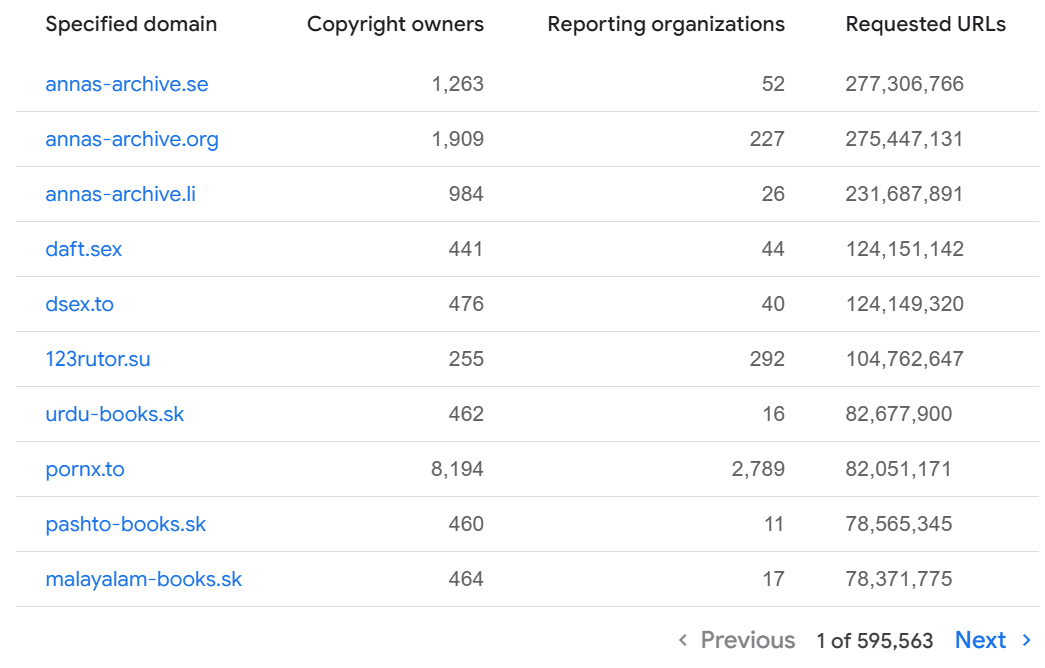
5% of All Google Takedowns, Ever
Since Google published its first transparency report in May 2012, rightsholders have flagged 15.1 billion allegedly infringing URLs. That’s a staggering number, but the fact that 5% of the total targeted Anna’s Archive URLs is remarkable.
Penguin Random House and John Wiley & Sons are the most active publishers targeting the site, but they are certainly not alone. According to Google data, more than 1,000 authors or publishers have sent DMCA notices targeting Anna’s Archive domains.
Yet, there appears to be no end in sight. Rightsholders are reporting roughly 10 million new URLs per week for the popular piracy library, so there is no shortage of content to report.
With these DMCA takedown notices, publishers are aiming to make it as difficult as possible for people to find books on the site using Google. This works, as many URLs are now delisted while others are actively being demoted by the search engine for book-related queries.
That said, the Anna’s Archive website is certainly not unfindable. Searching for the site’s name in Google still shows the main domain as the top search result.
Search: Anna’s Archive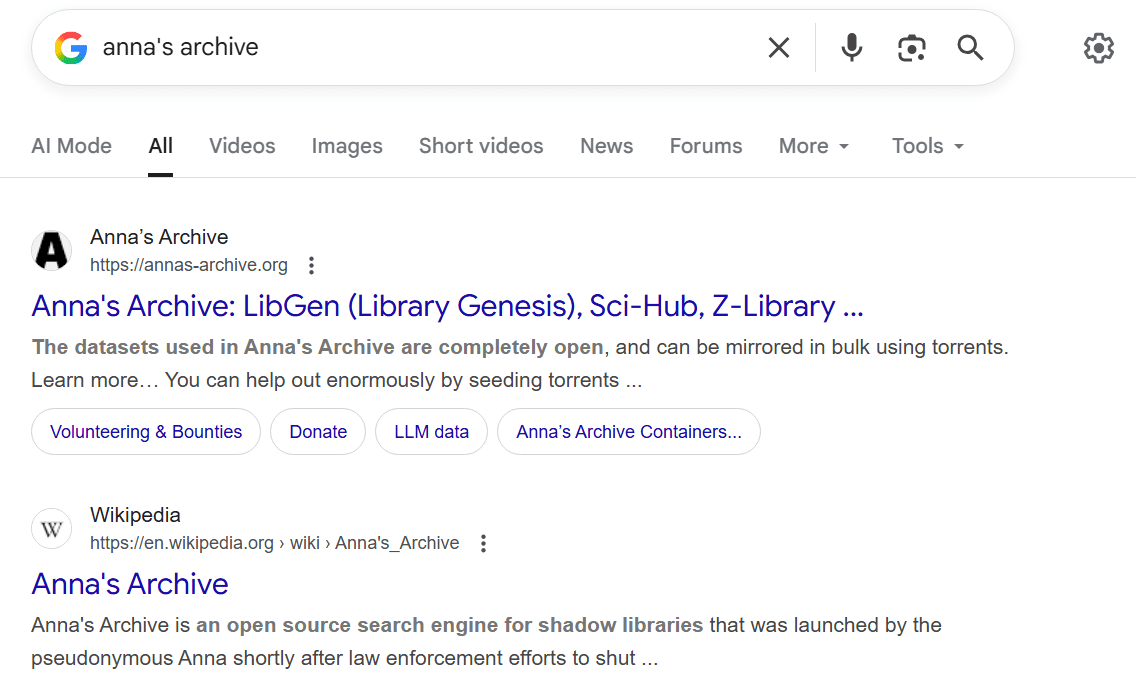
From: TF, for the latest news on copyright battles, piracy and more.
 Top-Smartphone mit 200-MP-Kamera, 120 Hz-Display und 5G: Das Xiaomi Redmi Note 14 Pro ist erstmals mit 35 Prozent Rabatt zu haben. (Xiaomi, Smartphone)
  Nach Mikrocontroller und PDFs läuft Linux auch nativ im Browser. Allerdings hat die Webassembly-Portierung eine Reihe von Einschränkungen. (
 Cyberkriminelle haben es auf Frachtgut abgesehen. Sie kompromittieren Konten von Spediteuren, um ganze Lkw-Ladungen zu kapern. (
 Die Switch 2 verkauft sich besser als erwartet: Rund 10,36 Millionen Geräte wurden abgesetzt, Mario und Donkey Kong sind Spiele-Besteller. (
 Wie man zu einem zu einem Knight-Rider-Pontiac kommt und warum das vielleicht doch keine gute Idee ist, besprechen wir im Podcast. (
 Das Datum im Namen eines Windows-Updates ist laut Microsoft ein "unnötiges technisches Detail". Admins sehen das aber anders. (
 Die Youtube-Kanäle von Enderman sind ohne Vorwarnung gelöscht worden - der Tech-Youtuber vermutet dahinter KI und hofft auf menschliche Hilfe. (
 Drei Ex-Mitarbeiter von Cybersecurityfirmen scheinen ein äußerst fragwürdiges Nebengeschäft betrieben zu haben. Es war Ransomware im Spiel. (