Religion may explain why people are so weirdly cooperative

Believers in punishing, all-knowing gods seem to cheat other believers less.

The level of altruism that humans display is an anomaly in the animal world. Most species don’t interact peacefully with strangers every day or build large, stable societies that rely on cooperative behavior between unrelated individuals. Although there are animals that show altruistic behavior toward their relatives or breeding partners, we still don’t know how humans managed to develop the extreme level of cooperation between strangers needed to build and maintain our societies.

A paper in Nature hints that religion may be one of the keys to understanding this cooperation. The paper's authors suggest that, as people started to believe in gods who see everything and punish wrongdoing, they may have had more motivation to behave nicely toward strangers. They also suggest that beliefs in more powerful gods might widen the circle of cooperation: the more all-knowing your deity, the farther away people can be from you and still benefit from your cooperation.

To test this idea, the authors studied nearly 600 people with a wide range of beliefs from countries around the world. The beliefs included predominant world religions such as Christianity and Hinduism but also local traditions like ancestor worship, animism, and belief in supernatural entities like saints or ghosts. After answering detailed questions about what they believed, participants played a game to assess how they would act toward other people.

Read 8 remaining paragraphs | Comments

Online legal publishers squabble over the right to copyright the law

Do private online publishers own the law, or does it belong to the people?

(credit: Mr.TinDC)

Two big-name legal research companies are battling in federal court over the right to exclusively publish the law—in this case, the Georgia Administrative Rules and Regulations.

The lawsuit (PDF) comes as states across the nation partner with legal research companies to offer exclusive publishing and licensing deals for digitizing and making available online the states' reams of laws and regulations. The only problem is that the law is not copyrightable—or so says one of the publishers involved in the Georgia litigation. In this instance, District of Columbia-based legal publisher Fastcase wants a judge to fend off a cease-and-desist demand from rival Virginia-based Lawriter, which has been designated as the exclusive publisher (PDF) of Georgia's compilation (PDF) of the rules and regulations of its state agencies. The lawsuit says:

The Georgia Regulations are binding law—a broad-ranging collection of rules and regulations governing areas from consumer protection to banking to elections. The Georgia Regulations are promulgated by public agencies of the State of Georgia, and published for the benefit of the public by the Georgia Secretary of State, as required by O.C.G.A. § 50-13-7. Defendant Lawriter purports to have exclusive rights to publish the Georgia Regulations. Consistent with this claim of exclusive rights, Lawriter has sent Plaintiff Fastcase a demand that Fastcase remove the Georgia Regulations from its legal research service, which is provided as a free member benefit to members of the State Bar of Georgia. The Georgia Regulations are public law published under statutory mandate and are in the public domain. Defendant cannot claim any exclusive right in, to, or in connection with, the Georgia Regulations. Thus, Fastcase seeks declaratory judgment that Lawriter has no basis from which to prohibit Fastcase from publishing the Georgia Regulations in its subscription legal research service.

Fastcase also says Lawriter "cannot claim a valid copyright or an exclusive license to a valid copyright. It is well established in American law that state laws, including administrative rules and regulations, are not copyrightable, and must remain public as a matter of due process."

Read 5 remaining paragraphs | Comments

NYPD used stingrays over 1,000 times without warrants since 2008

New York Civil Liberties Union: “The privacy of nearly all New Yorkers is at risk.”

The New York Police Department used cell-site simulators, better known as stingrays, over 1,000 times between 2008 and May 2015 without first acquiring a warrant, according to new public records obtained by the New York Civil Liberties Union (NYCLU).

According to the NYCLU, this marks the first time that the nation’s largest police department has admitted to using the notorious surveillance technology. The NYPD does not have a written policy for stingray use. Police records show that while stingrays were mostly used in investigations of serious felonies—homicide, assault, kidnapping, drug trafficking, rape—they were also used for investigating money laundering and ID theft.

Stingrays are in use by both local and federal law enforcement agencies nationwide. The devices determine a target phone’s location by spoofing or simulating a cell tower, and mobile phones in range of the stingray connect to it and exchange data with it as they would with a real cell tower. Once deployed, the devices intercept data from the target phone along with information from other phones within the vicinity—up to and including full calls and text messages. At times, police have falsely claimed that information gathered from a stingray has instead come from a confidential informant.

Read 8 remaining paragraphs | Comments

Deals of the Day (2-11-2016)

Deals of the Day (2-11-2016)

The Asus Zenfone 2 Laser is a smartphone with a 5.5 inch full HD display, a Qualcomm Snapdragon 615 processor, and a 13MP with laser-assisted auto-focus, which is what gives this model its name. Asus launched the phone in the US a few months ago, charging $249 for a model with 3GB of RAM and […]

Deals of the Day (2-11-2016) is a post from: Liliputing

AVM: Fritzboxen für Supervectoring, G.fast und Docsis 3.1 kommen

Auf den kommenden großen IT-Messen MWC und Cebit werden Fritzboxen mit neuester Technik gezeigt. Doch Supervectoring, G.fast und Docsis 3.1 müssen erst einmal in den Netzen zum Einsatz kommen. (Fritzbox, DSL)

Auf den kommenden großen IT-Messen MWC und Cebit werden Fritzboxen mit neuester Technik gezeigt. Doch Supervectoring, G.fast und Docsis 3.1 müssen erst einmal in den Netzen zum Einsatz kommen. (Fritzbox, DSL)

Ancient hook-ups with Neanderthals left lasting effects on our health

The genetic consequences of prehistoric loving are still doing a walk of shame.

Comparison of Modern Human and Neanderthal skulls from the Cleveland Museum of Natural History. (credit: hairymuseummatt)

WASHINGTON—Around 50,000 years ago, anatomically modern humans shacked up with some Neanderthals—and the genetic consequences are still doing a walk of shame through our generations.

The questionable interbreeding left traces of Neanderthal DNA that are linked to mood disorders, mostly depression, as well as tobacco-use disorders, skin conditions, and hypercoagulation (excessive blood clotting), according to a new study published Thursday in Science. The findings lend support to the theory that our past hominin hook-up has had a lasting influence on modern humans’ health. The data also offers hints at genetic adaptations of our ancient ancestors and, potentially, new insights into the diseases they help cause in modern humans, the authors suggest.

Having these traces of Neanderthal DNA doesn’t “doom us” to having these diseases, cautioned John Capra, bioinformaticist at Vanderbilt University and coauthor of the study. The genetic traces linked to disease in modern humans doesn’t mean that Neanderthals were stricken with those diseases either, he added. In fact, some of them could have been advantageous.

Read 7 remaining paragraphs | Comments

Qualcomm promises gigabit LTE speeds with its new Snapdragon X16 modem

And there are new low-end phone and wearable Snapdragon chips for later in 2016.

(credit: Qualcomm)

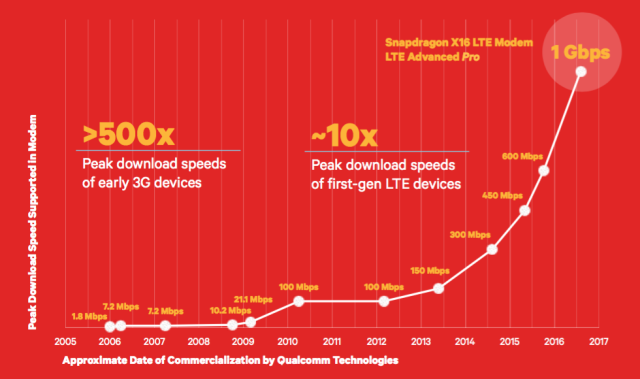
Qualcomm's lead in the mobile SoC and modem market is no longer as unassailable as it once was, but the company continues to be out in front when it comes to pushing new LTE technologies. Case in point: its new Snapdragon X16 modem, which together with the WTR5975 transceiver boasts Category 16 LTE download speeds of up to 1Gbps. Most of today's phones top out at 300Mbps or 450Mbps, and the upcoming Snapdragon 820 will only go up to 600Mbps. The X16 will also support upload speeds of up to 150Mbps, which is equal to or only slightly higher than upload rates supported by current LTE modems.

Most recent LTE speed increases have come via carrier aggregation, which essentially combines multiple chunks of spectrum across multiple antennas to improve bandwidth. Most of today's high-end phones use two or three chunks of 20MHz spectrum to achieve download speeds of up to 300 or 450Mbps, respectively. The Snapdragon X12 achieves its 600Mbps speeds by using three chunks of 20MHz spectrum plus a higher 256-QAM rather than 64-QAM, increasing the amount of data that can be transmitted over the same link from 75Mbps to 100Mbps (albeit at the cost of higher interference). The X16 uses a combination of technologies to hit its 1Gbps theoretical peak. From the press release:

The Snapdragon X16 LTE modem is designed to reach Gigabit Class LTE speeds using the same amount of spectrum as Category 9 LTE devices. By using carrier aggregation and 4x4 MIMO, the Snapdragon X16 LTE modem can receive 10 unique streams of data using only three 20 MHz carriers. Its support for 256-QAM boosts the peak throughput of each stream from ~75 Mbps to ~100 Mbps, with additional gains possible with modem data compression.

To increase the number of 20MHz chunks of spectrum available for use, the modem can also use licensed and unlicensed LTE spectrum simultaneously.

Read 7 remaining paragraphs | Comments

UK authorities sue Star Wars producer over Harrison Ford’s broken leg

Health and Safety Executive says Foodles Production created an unsafe workplace.

Harrison Ford broke his leg at Pinewood studios. Now the production company is getting sued by UK authorities.

On Thursday, the UK Health and Safety Executive (HSE) announced that it is pressing charges against Foodles Production, a UK-based Disney subsidiary that produced Star Wars Episode VII: The Force Awakens, over an incident that left actor Harrison Ford with a broken leg.

According to the HSE press release, Ford was "struck by a heavy hydraulic metal door on the set of the Millennium Falcon” on June 12, 2014, leaving him with a broken leg among other injuries. The accident occurred at Pinewood Studios in Buckinghamshire.

Ford was 71 at the time of the accident.

Read 4 remaining paragraphs | Comments

A week with BMW’s unexpectedly charming X5 Hybrid SUV

A fun-to-drive, fuel efficient SUV? We put it to the test.

It's no secret that we're big fans of BMW's i3 and i8 hybrids here at Ars. Now the Bavarian company is starting to apply that same technology to the models in its regular production range, starting with the (deep breath) BMW X5 xDrive40e. There's no more funky styling and carbon fiber to distract you, just a good-old X5 with an up-to-date powertrain. The idea is to maintain the BMW driving experience but with an added dose of efficiency. So we put an X5 through its paces for a week to find out if that's the case.

BMW's decision to choose the X5 as its first "regular" model to hybridize was a smart one. The SUV is its second-best seller here in the US, and it stands to benefit from the electric vehicle treatment more than the cheaper, lighter 3 Series (although a plug-in hybrid version is coming, too). Under the hood is a 2.0 L, four-cylinder turbocharged gasoline internal combustion engine (ICE) and an electric motor, which together give the X5 a respectable 308ph (230kW) and 332lb-ft (450Nm). The batteries—9kWh of lithium-ion cells—live underneath the luggage compartment, an added bonus of the SUV's size and shape.

That power and torque gets fed to the road through the same eight-speed automatic gearbox as the rest of the X5 range. As with the i3 and i8, the X5 gives you three different modes: Comfort, Sport, and Eco Pro. You pick your mood and the electronic control units and their clever software does the rest. Eco Pro is a bit of a hair shirt. It limits the energy drain from the climate control and seat heaters and lets the car coast with the ICE turned off. Both Eco Pro and Comfort let you drive on electric power alone as long as there's sufficient battery, with the ICE firing up and kicking in as needed (or above 75mph/120km/h).

Read 9 remaining paragraphs | Comments

Intel Atom x5-E8000 is a low-power chip for embedded applications

Intel Atom x5-E8000 is a low-power chip for embedded applications

Intel is expanding its line of Intel Atom x5 processors with a new low-power, quad-core, 64-bit processor. But the new Atom x5-E800 isn’t destined for consumer PCs like tablets, notebooks, and mini desktops. It’s aimed at Internet-of-Things and other embedded applications. The processor is based on Intel’s Braswell architecture, but with a tray price of $39, […]

Intel Atom x5-E8000 is a low-power chip for embedded applications is a post from: Liliputing