Pope’s plane hit by a laser in Mexico City

The culprit doesn’t seem to have been caught, but the strike is common enough these days.

Pilot flying the pope's plane was hit by a laser beam as the plane landed in Mexico City on Friday. (credit: ychamyuen)

Last Friday, a charter Alitalia plane carrying Pope Francis was struck by a laser beam as it came in to land at Mexico City International Airport. Although the pilot was able to land the Airbus A330-200 safely, he alerted air traffic control, which alerted local police, according to USA Today.

It's unclear whether the pope's flight was specifically targeted. ABC News noted that "several other pilots in the area also reported laser strikes.” It appears that no one was hurt.

Still, laser strikes have become more and more common over the last decade. In 2012, the FBI called laser strikes against airplanes an "epidemic," noting that reported strikes in the US went from 283 in 2005 to about 3,700 in 2012. According to USA Today the Federal Aviation Administration logged a record total of 7,153 laser strikes in the US in 2015 through December 11.

Read 1 remaining paragraphs | Comments

Warren Spector returns to game development for System Shock 3

Storied developer leaves academia to work with Otherside Entertainment.

Warren Spector

With nearly 17 years having passed since the well-remembered launch of System Shock 2, we've been having some trouble believing that newly launched studio Otherside Entertainment could recall the series' former glories for the recently announced System Shock 3. Our skepticism is at least a little reduced today, though, with the news that original System Shock producer Warren Spector has joined the Otherside team as studio director.

Spector, who's also known for his work on the Deus Ex, Thief, and Epic Mickey series, was already serving as a creative advisor for Otherside along with his current academic role at the University of Texas Austin. As Spector told GamesIndustry.biz:

"I've loved working with students as Director of the Denius-Sams Gaming Academy in the University of Texas' Moody College of Communication," Spector said. "But when the opportunity to have a bigger role in bringing Underworld Ascendant to life, as well as playing in the System Shock universe once again, helping to bring these games to a 21st century audience, I just couldn't say no. Working on System Shock was one of the most fulfilling things I've done in my career and it's hard to describe how much I'm looking forward to sharing with players what SHODAN has been up to since the last game was released."

While there are still precious few details known about System Shock 3, the array of well-known names being lined up behind the game's development is certainly starting to impress. At Otherside, Spector joins studio founder Paul Neurath, whom he worked with on games like Thief and Ultima Underworld at Looking Glass.

Read 1 remaining paragraphs | Comments

Humans started having sex with Neanderthals over 100,000 years ago

Paleolithic sexytimes reveal that Homo sapiens made it out of Africa earlier than we thought.

Would you do it with a Neanderthal? I mean, maybe, if he looked like this and knew his way around a Linux box.

By now it's pretty obvious that Homo sapiens and Homo neanderthalensis were hot for each other. The two groups of early humans were not separate species—they were kissing cousins, separated by just a few hundred thousand years of evolution. Now we know they started hooking up far earlier than scientists believed was possible.

The standard narrative about how modern humans met Neanderthals is pretty simple. A group of early humans, possibly Homo erectus, hiked out of Africa over 600,000 years ago and settled all over Europe and the Middle East. Over time, they evolved into Neanderthals, Denisovans, and probably several other groups. Meanwhile, back in Africa, the common ancestor of Neanderthals and Homo sapiens was busily evolving into—you guessed it—Homo sapiens sapiens. Around 70 thousand years ago, modern humans started streaming in huge numbers out of Africa, into Europe and the Middle East, possibly spurred on by chilly weather caused by the Toba eruption in Indonesia. There, they met up with their long-lost cousins and immediately started humping.

Genetic analysis has confirmed that said humping took place. Seems like that should be the end of the story, except that even during the Pleistocene, relationships were complicated.

Read 6 remaining paragraphs | Comments

Microsoft’s new Wireless Display Adapter is cheaper, faster

Microsoft’s new Wireless Display Adapter is cheaper, faster

Microsoft launched a wireless display adapter in 2014, giving users a way to stream content from a portable device to a TV without wires. Now the company has unveiled a new model with has a new design, reduced latency, and a lower price tag. It’s available for pre-order for $50, and should begin shipping in […]

Microsoft’s new Wireless Display Adapter is cheaper, faster is a post from: Liliputing

Why Tim Cook is right to call court-ordered iPhone hack a “backdoor”

Custom version of iOS could undo years of work Apple put into securing iPhones.

Tuesday's court order compelling Apple to hack the iPhone belonging to a gunman who killed 14 people and injured 22 others has ignited an acrimonious debate. CEO Tim Cook called the order "chilling" because, he said, it requires company engineers to create the equivalent of a backdoor that could be used against any iPhone. Law enforcement officials, meanwhile, contend the order is narrowly tailored to ensure only the shooter's phone is covered.

Here's why the totality of what we know right now leans in favor of Cook and his slippery slope argument.

The order requires Apple to create a customized version of iOS that will run only on the iPhone 5C belonging to Syed Rizwan Farook. Along with his wife, Tashfeen Malik, Farook went on a deadly shooting rampage in San Bernadino. The FBI understandably wants access to the data stored on Farook's phone so investigators have a better idea of the events leading up to the deadly attack and whether the husband-and-wife team received support from unknown people. But so far investigators have been unable to unlock the device. Security measures Apple built into the iPhone limit the number of guesses they can make, and there's also concern too many guesses could cause the phone to automatically destroy the data it stores.

Read 7 remaining paragraphs | Comments

“Locky” crypto-ransomware rides in on malicious Word document macro

Malware depends on users falling for its pleas—twice if Office macros aren’t on.

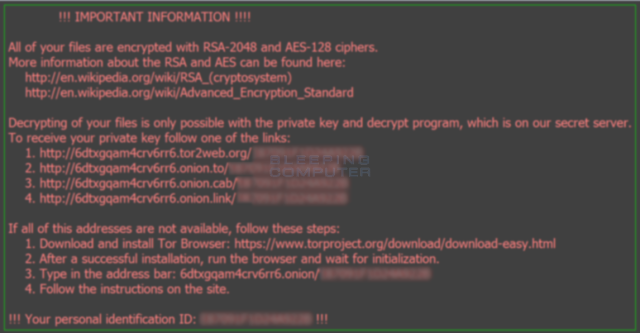
Several security researchers have discovered a new type of malware that jumps onto the ransomware bandwagon, encrypting victims' files and then demanding a payment of half a bitcoin for the key. Named "Locky," the malware depends on a rather low-tech installation method to take root in a user's system: it arrives courtesy of a malicious macro in a Word document.

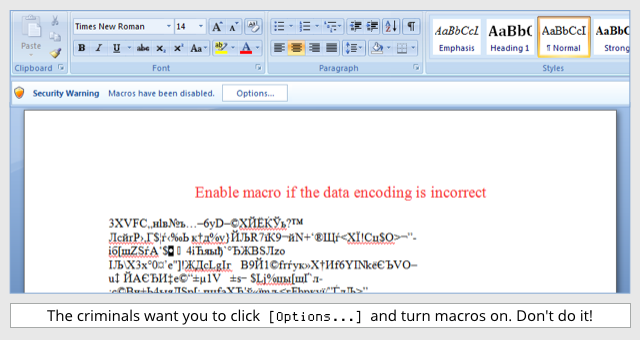
Security researchers Kevin Beaumont and Lawrence Abrams each wrote an analysis of Locky on Tuesday, detailing how it installs itself and its components. The carrier document arrives in an e-mail that claims to be delivering an invoice (with a subject line that includes an apparently random invoice number starting with the letter J). When the document is opened, if Office macros are turned on in Word, then the malware installation begins. If not, the victim sees blocks of garbled text in the Word document below the text, "Enable macro if the data encoding is incorrect"—and then infects the system if the user follows that instruction.

Somehow, this malware has already infected hundreds of computers in Europe, Russia, the US, Pakistan, and Mali. The malicious script downloads Locky's malware executable file from a Web server and stores it in the "Temp" folder associated with the active user account. Once installed, it starts scanning for attached drives (including networked drives) and encrypts document, music, video, image, archive, database, and Web application-related files. Networked drives don't need to be actively mapped to be found, however.

Read 4 remaining paragraphs | Comments

Samsung starts using its great 14nm process on cheaper mobile processors

The FinFET process is becoming more common in SoCs from Samsung and Qualcomm.

(credit: Samsung)

Mobile World Congress is approaching, and chip companies have already started making small announcements ahead of the show. Today, Samsung took the wraps off of the eight-core Exynos Octa 7870, a new SoC intended for midrange smartphones.

The chip itself looks solid but unexciting—it has eight 1.6GHz ARM Cortex A53 CPU cores, a 300Mbps Category 6 LTE modem, and an undisclosed GPU that supports up to 1920×1200 screens. More interesting is the fact that the chip will be made with Samsung's 14nm FinFET manufacturing process, which made the Exynos 7420 shine in Samsung's Galaxy flagships last year. Better manufacturing processes reduce the amount of heat produced and the amount of power used by these processors, which gives chipmakers the room to make the chips run faster, consume less power, or do a little of both.

The 14nm process is showing up in more and more places, which suggests that it's growing more mature—it will make an appearance in the new Exynos 8 Octa 8890 that's likely to ship in the Galaxy S7 and its variants. Qualcomm is using the same process for its upcoming Snapdragon 820 and 625 SoCs and the Snapdragon X16 modem.

Read 1 remaining paragraphs | Comments

Penn Jillette: With game design, “the challenge is precisely the same as magic”

Penn Jillette and Randy Pitchford talk misdirection, artistic escape in Vegas.

Enlarge / Jillette (left) and Pitchford (center) perform a card trick on stage with an audience volunteer. (credit: Kyle Orland)

LAS VEGAS—For all the clichéd talk of the "magic of video games," we don't often think of the similarities between those games and the kind of magic tricks done on stage. But to kick off the annual DICE Summit Wednesday morning, magician Penn Jillette and Gearbox CEO Randy Pitchford (who are working together on a new virtual reality version of Desert Bus) came together to discuss exactly that—how video games can learn from the tricks stage magicians use to play with audience attention.

While many people think of misdirection as essentially pointing and saying "look over there" to fool someone, Jillette stressed that's not actually the case. Instead, misdirection is about studying and learning where people's attention naturally goes and becoming an expert at controlling that. "It's not misdirection; it's direction."

"We've been playing around in VR and traditional games, and one of the challenges is precisely the same as magic," Jillette said. "How to have someone make a totally free choice—put their attention where they want—and have us know where that is."

Read 9 remaining paragraphs | Comments

Asus unveils M Series tablets for business (with remote management software)

Asus unveils M Series tablets for business (with remote management software)

Asus is going after business customers with its new M Series line of Android tablets. The tablets are available with 7 or 10 inch displays and support WiFi and LTE connectivity. But the key selling point is the remote management software which Asus calls Adam (Asus Device Admin for Mobile). Here’s how it works: IT managers […]

Asus unveils M Series tablets for business (with remote management software) is a post from: Liliputing

YouTube Copyright Complaint Kills Harvard Professor’s Copyright Lecture (Update)

YouTube has removed access to a copyright lecture from Harvard Law professor William Fisher, following a takedown request from Sony Music. While the online course includes snippets of well-known Jimi Hendrix covers, the clearly educational use makes this a perfect example of fair use.

Source: TF, for the latest info on copyright, file-sharing, torrent sites and ANONYMOUS VPN services.

youtubefaceWeek in and week out automated bots detect and report millions of alleged copyright infringements, which are then processed by the receiving site without a human ever looking at them.

Unfortunately this process is far from flawless, resulting in many false and inaccurate takedown requests.

For regular Internet users YouTube’s Content-ID is particularly problematic. We highlighted this issue a few years ago but in recent months opposition has been swelling.

Google recognizes the problems and recently offered to pay the legal bills of several people who argued that their removed videos are protected by ‘fair use’ legislation. However, this has had little impact on the Content-ID system which still flags a lot of legal content.

Most recently, Harvard Law professor William Fisher had one of his courses pulled from YouTube following a takedown request submitted by Sony Music. Ironically, the video in question has the rather fitting title: “The Subject Matter of Copyright: Music.”

The video in question

youremove

As pointed out by Techdirt, the course is still available on the CopyrightX project website. A more detailed look shows that it does indeed include some music clips, all covers of Jimi Hendrix’s Little Wing.

None of the tracks, which include covers by Joe Cocker, Santana and Stevie Ray Vaughan, are played in full. Instead, Fisher highlights small segments ranging from 15 to roughly 40 seconds.

Given the educational nature of the clip, this would be an excellent example of fair use. However, the video in question was flagged and subsequently removed from public view by YouTube’s system.

The ‘takedown’ is likely to be an automated one, but that doesn’t make it less of an issue. There appears to be very little oversight of YouTube takedowns, if any, and with more copyright holders joining the Content-ID program the problems may get worse.

Perhaps Professor Fisher could make a case out of this. His colleague Lawrence Lessig did the same a few years ago, with success, and apparently Google is interested in picking up the legal fees.

Ultimately, however, YouTube should consider giving its publishers more tools to counter inaccurate requests. As long as a cat purring is still flagged as copyright infringement, there’s plenty of room for improvement.

Update: The video in question is now accessible again. It was unavailable for more than a day, but apparently the mistake was corrected after it was pointed out in public.

Source: TF, for the latest info on copyright, file-sharing, torrent sites and ANONYMOUS VPN services.