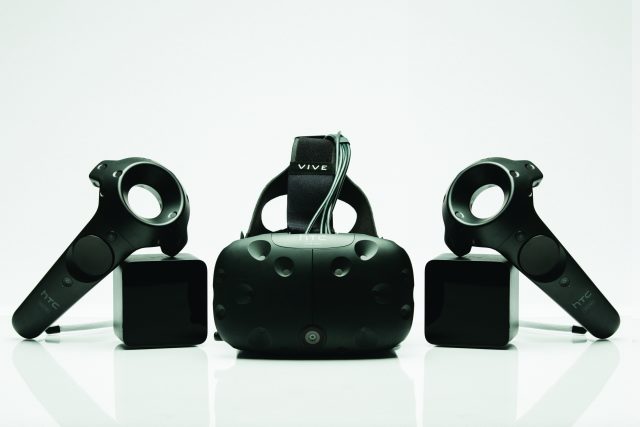
Now that the HTC Vive costs $799, do I still want one?

At that price you have to do some soul searching, or VR has to be really awesome.

If you'd told me a few months ago that the HTC Vive would cost $799 (about £650) at launch, I'd have spat out my tea, banged my fist on the table, and shouted "you sir, are a buffoon!" Then Oculus announced the price of Rift: £500. Since that day, it was inevitable that HTC would announce a higher price. I mean, at the very least, you get more stuff with the Vive—the wacky doughnut-shaped controllers, and room sensors, and of course the headset itself with its many photosensors, and front facing camera for all those "chaperone" safety visuals.

Justified or not, however, I rarely plunk down £650 on anything without some serious soul-searching, especially when it comes to non-essentials. For me, the Vive is simply priced out of reach.

Having made up my mind that no, I wasn't going to buy a Vive at launch, I had an opportunity to try one again here at MWC—and I couldn't resist. Knowing that the Vive costs £650, and knowing that I wouldn't be buying one at launch I wondered: Would I still think the Vive was worth it? And, more worryingly, would it convince me to buy one?

Read 10 remaining paragraphs | Comments

Peering back to the edge of the Universe’s dark ages

We don’t know much yet, but the hardware that will clue us in is on its way.

Part of the Murchison Widefield Array in Australia.

The Universe's first light—the earliest we can peer back in time—is the Cosmic Microwave Background, produced some 350,000 years after the Big Bang. It's the product of electrons pairing up with protons to form hydrogen atoms, releasing light in the process. From there, however, the Universe went dark until the formation of the first stars and galaxies, hundreds of thousands of years later.

Understanding the end of the cosmic dark ages can help us figure out the processes that built the Universe we currently occupy. For now, however, the wavelengths that would allow us to do so have remained out of reach. But researchers are building a new generation of telescopes that will help us reach back to this remote time, and they described their progress at the meeting of the American Association for the Advancement of Science.

The formation of hydrogen left the Universe electrically neutral. From there on out, most of the Universe's light was produced by hydrogen atoms—and typically absorbed by other atoms nearby. It wasn't until a sufficient population of stars formed that the light they produced put hydrogen back into an ionized state, allowing light to pass great distances unhindered. Thus, this "epoch of reionization" made the Universe transparent and accessible to our astronomical eyes. And, by studying it, we can examine the first large-scale structures that formed in the Universe.

Read 13 remaining paragraphs | Comments

Firewatch im Test: Allein in der Wildnis

Den Kopf frei bekommen, das alte Leben hinter sich lassen: In Firewatch schlüpft der Spieler in die Rolle eines Nationalparkwächters. Was als Auszeit in einsamer Wildnis geplant ist, entwickelt sich auf PCs und Playstation 4 zu einem gruseligen Abenteuer der Extraklasse. (Spieletest, Adventure)

Den Kopf frei bekommen, das alte Leben hinter sich lassen: In Firewatch schlüpft der Spieler in die Rolle eines Nationalparkwächters. Was als Auszeit in einsamer Wildnis geplant ist, entwickelt sich auf PCs und Playstation 4 zu einem gruseligen Abenteuer der Extraklasse. (Spieletest, Adventure)

Randa-Meetings: KDE-Apps sollen auf mehr Plattformen laufen

Auf einem Hackathon im Sommer wollen die KDE-Entwickler ihre Erfahrungen mit Betriebssystemen abseits vom klassischen Linux diskutieren. Ziel sind mehr portierte Anwendungen für Windows, Mac OS X und Mobilbetriebssysteme. (KDE, Qt)

Auf einem Hackathon im Sommer wollen die KDE-Entwickler ihre Erfahrungen mit Betriebssystemen abseits vom klassischen Linux diskutieren. Ziel sind mehr portierte Anwendungen für Windows, Mac OS X und Mobilbetriebssysteme. (KDE, Qt)

Freedom & Free Beer: Musikpiraten hoffen auf Erfolg bei neuer Gema-Klage

Die Gema klagt wegen der Veröffentlichung anonymer Musikstücke ein weiteres Mal gegen die Musikpiraten. Ein Berliner Rapper will seinen bürgerlichen Namen nicht preisgeben. (Gema, Urheberrecht)

Die Gema klagt wegen der Veröffentlichung anonymer Musikstücke ein weiteres Mal gegen die Musikpiraten. Ein Berliner Rapper will seinen bürgerlichen Namen nicht preisgeben. (Gema, Urheberrecht)

Aerocool Dream Box: DIY-Bausatz für PC-Gehäuse, Kleiderständer oder Tassenhalter

Ungewöhnlicher Ansatz: Aerocools Dream Box ist ein Bausatz, aus dem sich ein Gehäuse oder ein Bench-Table kreieren lassen. Ideen wie ein Kleiderständer oder ein Tassenhalter sind ebenfalls umsetzbar. (PC-Gehäuse, USB 3.0)

Ungewöhnlicher Ansatz: Aerocools Dream Box ist ein Bausatz, aus dem sich ein Gehäuse oder ein Bench-Table kreieren lassen. Ideen wie ein Kleiderständer oder ein Tassenhalter sind ebenfalls umsetzbar. (PC-Gehäuse, USB 3.0)

Chelsea Manning denied EFF articles because US Army cares about copyright

“It is tremendously important to EFF that [prisoners] have access to our materials.”

(credit: Timothy Krause)

Apparently the US Army is interested in a zealous interpretation of copyright protection, too.

According to the Electronic Frontier Foundation, a Chelsea Manning supporter recently attempted to mail Manning a series of printed EFF articles about prisoner rights. Those materials were withheld and not delivered to her because, according to the EFF, the correspondence contained “printed Internet materials, including email, of a volume exceeding five pages per day or the distribution of which may violate U.S. copyright laws.”

Other materials, including lengthy Bureau of Prisons documents, were allowed through, and so the EFF concludes that "it was potentially copyright concerns that resulted in Manning’s mail being censored."

Read 4 remaining paragraphs | Comments

Portable SSD T3 im Test: 2 TByte für unterwegs

Winzig und riesig zugleich: Samsungs Portable SSD T3 mit einem USB-Type-C-Anschluss ist kompakter als eine Kreditkarte, darin stecken aber satte 2 TByte Flash-Speicher der brandneuen v3-Generation. (Solid State Drive, Speichermedien)

Winzig und riesig zugleich: Samsungs Portable SSD T3 mit einem USB-Type-C-Anschluss ist kompakter als eine Kreditkarte, darin stecken aber satte 2 TByte Flash-Speicher der brandneuen v3-Generation. (Solid State Drive, Speichermedien)

Spro Plus: ZTE präsentiert Beamer mit eingebautem Tablet

Ein kleiner Beamer kann unterwegs praktisch sein – warum nicht gleich noch ein Tablet miteinbauen, denkt sich ZTE. Mit dem Spro Plus hat der Hersteller ein ungewöhnliches, aber interessantes Gerät vorgestellt. (MWC 2016, Beamer)

Ein kleiner Beamer kann unterwegs praktisch sein - warum nicht gleich noch ein Tablet miteinbauen, denkt sich ZTE. Mit dem Spro Plus hat der Hersteller ein ungewöhnliches, aber interessantes Gerät vorgestellt. (MWC 2016, Beamer)