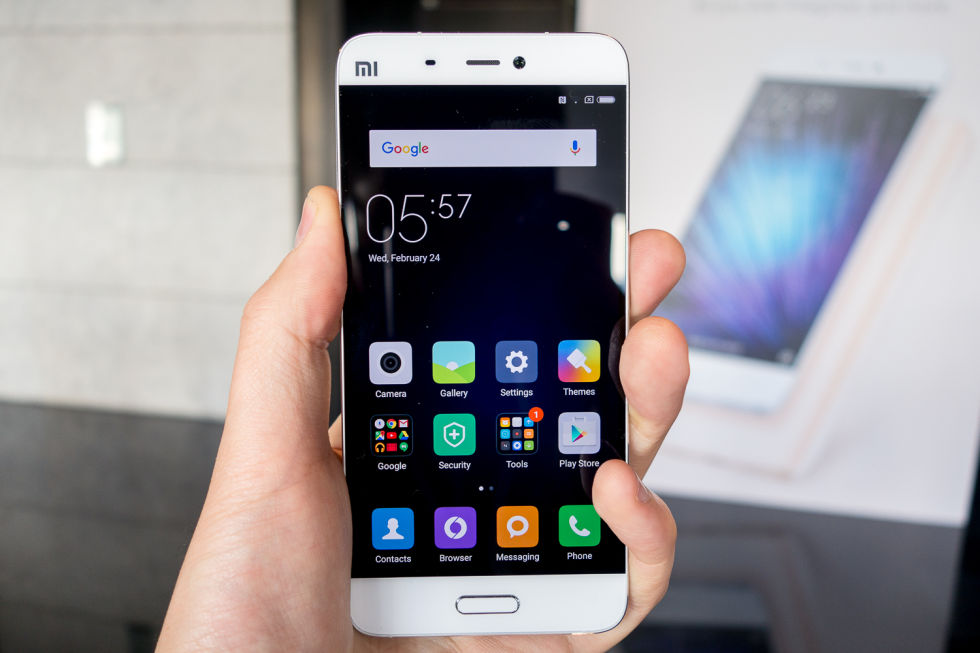
BARCELONA—You might not have heard of Xiaomi, or used any of its products before. And even if you have, you might be wondering why one of China's largest smartphone makers—which historically hasn't sold to the US and Europe—is here at MWC to talk about its new flagship smartphone, the Mi 5. The answer, it seems, isn't to launch a dramatic assault on the Western market in the same way Huawei has, but rather to warn the likes of Apple and Samsung that Xiaomi is coming, and people are going to love it.
In a surprisingly slick, if odd press conference—VP Hugo Barra glided through the room on one of Xiaomi's own Ninebot mini scooters—the company pitted its new Android-based Mi 5 phone against the likes of the Samsung Galaxy S7 and iPhone 6S. And on paper at least, Apple and Samsung have plenty to worry about. The Mi 5 sports the latest Snapdragon 820 SoC running at 2.2GHz, a 5.15-inch 1080p edge-to-edge display, up to 4GB of LPDDR4 RAM, up to 128GB of UFS 2.0 storage, a 16MP f/2.0 camera with 4-axis OIS (a first, it claims), NFC, a fingerprint scanner, 3000mAh battery, and a gorgeous metal and glass (or ceramic) body.

The price for that little lot? An impressive 2,600 yuan ($354, €321) for the high-end 128GB model with a ceramic body, and 1,999 yuan ($262, €238) for the entry-level version with 3GB of RAM and 32GB of storage. A 64GB version will also be available. All will have black, gold, and white colour options, and all will ship with Android 6.0 running Xiaomi's MIUI 7 interface. The phones will be sold direct from Xiaomi's website in China on March 1, making the Mi 5 one of the first commercially available phones with Qualcomm's latest SoC.
Read 9 remaining paragraphs | Comments


 Ein eigener Messaging-Dienst wie Whatsapp oder iMessage fehlt im Angebot von Google. Jetzt will die Firma den von Mobilfunkbetreibern unterstützten RCS-Standard mit Android unterstützen. (

 Toshibas neue Enterprise-SSDs der HK4-Serie mit MLC-NAND-Flash mit 15 Nanometern Strukturbreite und eine 6-GBit/s-SATA-Schnittstelle sind speziell für den Einsatz in Rechenzentren entwickelt worden. (
 Panasonic hat zwei fast identische Toughpad-Handhelds auf den Markt gebracht, die sich nur durch das Betriebssystem unterscheiden. Mit Windows 10 werden vor allem Stammkunden bedient. Die Android-Variante interessiert Umsteiger und Neukunden. (


 Der Streamingdienst Spotify migriert sein Backend in den Cloud-Dienst von Google. Das vereinfache die Arbeit der Entwickler langfristig. Vorher müssen aber noch die Analyse-Werkzeuge umgebaut werden. (

 Die Liste der auf dem Smartphone installierten Apps ist persönlich - und kann viel über die Nutzer aussagen. Forscher haben jetzt untersucht, wie gut sich einzelne Nutzer mit diesen Informationen identifizieren lassen. (


 Nach dem Ende des Safe-Harbor-Abkommens ist die Unsicherheit über den Datentransfer in die USA groß. Nun müssen erste Hamburger Firmen zahlen, weitere werden geprüft. (