Disney announces new Indiana Jones movie with Harrison Ford

Why, why, why, why, why are they doing this?!

What comes after nuking the fridge? We're about to find out.

In 2019, a new Indiana Jones movie will hit theaters, directed by Steven Spielberg and starring Harrison Ford as the adventurous archaeologist who plunders ancient cultures with a style that would make Lara Croft jealous. This is odd news, considering the last movie in the franchise was so terrible that people began to describe all failed sequels as "nuking the fridge" in reference to a particularly awful scene where Indy survives a nuclear blast inside an old refrigerator.

The new movie was announced today with a brief comment from Disney Studios Chairman Alan Horn: “Indiana Jones is one of the greatest heroes in cinematic history, and we can’t wait to bring him back to the screen in 2019. It’s rare to have such a perfect combination of director, producers, actor and role, and we couldn’t be more excited to embark on this adventure with Harrison and Steven.” The announcement also said that the four previous films "have brought in nearly $2 billion at the global box office," which might help explain why everybody is "embarking on this adventure."

Missing from the announcement is Shia La Beouf, who co-starred with Ford in Indiana Jones and the Crystal Skull and was for a while considered to be the heir apparent to the franchise. Ford is presumably going to carry this film, which raises a lot of questions. Though the actor still has the gravitas and humor required for the role, it's hard to imagine a senior Indy running around in classic adventure movie style. It's likely that the studio will want to pair him with a younger star or stars to round out the story.

Read 2 remaining paragraphs | Comments

FBI v. Apple is a security and privacy issue. What about civil rights?

Jesse Jackson: “Activities of civil rights organizations and activists” at stake.

The Rev. Jesse Jackson. (credit: Susan Ruggles)

The ongoing legal drama between Apple and the Federal Bureau of investigation has largely been characterized as an Internet privacy and security issue—and a constitutional one, too. It's also been characterized as a human rights issue. Now, the Rev. Jesse Jackson says it's about civil rights.

Clearly, the security, privacy, and human rights aspects of the fight are all somewhat connected to civil rights. But Jackson's letter to the judge overseeing the legal battle between the tech giant and the federal government has put his own spin on the hot-button topic. Jackson, the president and founder of the Rainbow PUSH Coalition, wrote (PDF) Magistrate Judge Sheri Pym of Riverside Federal Court, urging her to side against the government:

Dr. Martin Luther King would often say, "Where we stand in times of controversy is a measure of our character. Some leaders follow opinion polls. Others stand up for their principles, refuse to compromise and mold opinion."

In these difficult times, the government, courts and private companies must stand up and uphold—however unpopular—our First Amendment rights, our right to privacy and basic individual freedoms guaranteed to us under the US Constitution.

Other writers will weigh in on the intricacies of technology and privacy rights. What I want to bring to the forefront of this legal debate is the impact and implications this case has on civil rights and our historic civil rights movement.

This case cuts right to the heart of our right to live free from unwarranted government surveillance. It is a matter of deep personal concern to me—given the past and present illegal and unwarranted spying and surveillance of civil rights organizations, much conducted under the guise of national security.

Jackson spoke of the FBI infiltrating the Southern Christian Leadership Conference, the wiretapping of King, and how the FBI's COINTELPRO "campaign spied on, infiltrated, and disrupted domestic civil rights and political groups. Rainbow PUSH Coalition and I personally have been subject to spying and surveillance, and more recently, there have been accounts of surveillance of the Black Lives Matter movement and activists."

Read 3 remaining paragraphs | Comments

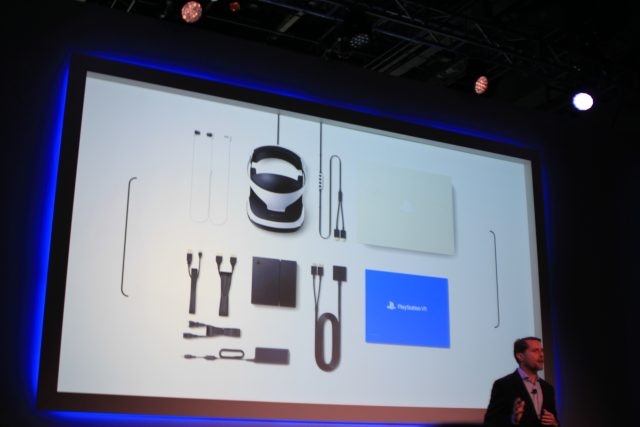
Sony’s PlayStation VR will arrive October for $399

Announcement is a delay from original “first half of 2016” target.

Sony's Andrew House showing everything that comes in the $399 PSVR package.

SAN FRANCISCO—At a Game Developers Conference press event Wednesday, Sony announced that its PlayStation VR headset would launch in October 2016 for $399 / £349 / €399 / 44,980 Yen. That price does not include the PlayStation Move camera needed to track the headset, or the PlayStation Move hand-tracking controllers needed for many games.

The finalized announcement comes nearly two years after Sony's virtual reality headset was officially unveiled as "Project Morpheus" at the 2014 Game Developers Conference. Sony announced a "first half of 2016" launch window for the headset at last year's show, but recent statements from GameStop CEO Paul Raines had suggested that date might slip.

The price comes in well below the $599 Oculus is asking for the Rift, and the $799 HTC is asking for the SteamVR-powered Vive headset, both of which will ship to early orderers in the next few weeks. Those headsets also require a decently powerful PC that can cost $1,000 or more—PlayStation VR users only need to invest in a $350 PlayStation 4.

Read 4 remaining paragraphs | Comments

How new graphics effects can make Unity Engine games look less generic

“Cinematic Image Effects” package adds some punch to the standard “Unity look.”

A shot from the impressive "Adam, Part 1" shows how adding depth-of-field to a Unity scene can make it look significantly less generic. (credit: Unity)

SAN FRANCISCO—The rise of engines like Unity has been great for making game development more accessible to the masses. Unity now says the 1.1 million monthly users of Unity Personal Edition outnumber "all the employees at every public game company in the world." That vast popularity has a negative side effect, though: the rise of an identifiably generic "Unity look" among many games made using the engine.

That "Unity look" is the result of so many new developers using the same Unity Engine default materials, assets, lighting effects, and shaders in their games. Dedicated artists and coders can add their own stamp to a Unity project, of course, by coding their own custom assets and shaders to give their project a more unique aesthetic. But a lot of smaller developers can't or won't bother putting in the work to really get their game past the "generic" look that can characterize Unity projects.

As Unity has progressed from version 5.0 to the newly released version 5.4 beta in the last year, they've put a lot of work into this problem. You can see a lot of those changes in the above video, which shows some pretty generic-looking Unity 5.0 demos getting quite a bit more character by simply implementing some of the graphical effects introduced in the intervening 12 months.

Read 4 remaining paragraphs | Comments

Revealed: The Trump campaign NDA that volunteers must sign

Trump volunteers also sign away their rights to work for other candidates.

A photo of presidential candidate Donald J. Trump is illuminated with flood lights, in a backyard in West Des Moines, Iowa. (credit: Tony Webster)

Working a call center job is a rite of passage for many geeks; back in the day, our own Lee Hutchinson manned the lines as a contractor for computer manufacturer Gateway. The job was, naturally, soul crushing.

But what's it like when you want to work the phones for a presidential candidate—say, Donald Trump?

We found out this week, when New Yorkers who e-mailed the Donald Trump campaign as volunteers were told to attend one of two "Call Center Training Sessions" at the Trump Tower in Manhattan. In fine print at the bottom, the volunteers were told they'd need to sign a non-disclosure agreement, or NDA, to be part of the campaign.

Read 8 remaining paragraphs | Comments

Julia Child is the next PBS star to get a Twitch marathon

Streaming service continues its exploration of collaborative viewing.

(credit: Julia Child with a fish.)

After the success of the charming and emotional Bob Ross marathon on Twitch, the company is expanding the range of its creative streaming with a new marathon. This time around, the topic is cooking—the new Food channel will be broadcasting all 201 episodes of Julia Child's The French Chef. The stream starts today at 5pm EDT and should last around four days.

Twitch started out in 2011 as a video game-oriented offshoot of the Justin.tv lifecasting platform. In August 2014, the original Justin.tv site was closed down so that the company could focus exclusively on Twitch. A few days after this change, Amazon announced that it was buying the company for $970 million.

The Bob Ross and Julia Child streams both represent an attempt to broaden Twitch's appeal in two ways at once. The focus on creativity rather than gaming is one element. While there's a certain amount of crossover—streamers have cast things like making cosplay costumes and creating game-related artwork—as Bob Ross demonstrated, the appeal is broader. Adding cooking into the mix takes things even further from the core gaming audience.

Read 3 remaining paragraphs | Comments

MPAA Takedown Efforts Target Legal Popcorn Time Spin-Offs

Popcorn Time’s ‘legal’ spin-off Butter is at risk of losing access to its codebase hosted at GitHub. The developer platform has informed several projects that some of their code has been flagged by the MPAA as copyright infringing, including a fork managed by the Brazilian Ministry of Culture.

Source: TF, for the latest info on copyright, file-sharing, torrent sites and ANONYMOUS VPN services.

popcorn-butterWhen the MPAA shut down the main PopcornTime.io fork late last year, many of its developers switched to the project’s ‘legal’ spin-off Butter.

Unlike Popcorn-Time, Butter doesn’t include any links to pirated movies and TV-shows. Instead, it acts as a general purpose streaming tool and actively promotes content that’s freely published by indie filmmakers.

Despite this neutral setup, a recent series of takedown requests Hollywood’s MPAA sent to GitHub threatens to pull the project’s code offline.

Correspondence seen by TorrentFreak shows that the MPAA has been asking GitHub to remove the repository of the recently revived PopcornTime.sh, as well as all related forks.

“There are multiple ‘forks’ of Popcorn Time, all of which are 100% unlicensed and infringing, and many of which have been subject to litigation and court orders around the world confirming their infringement,” the MPAA informs GitHub.

“Popcorntime.sh is one of the more recent infringing ‘forks,’ and we attached several specific examples of that site’s infringement to our prior letter. The Project provides to any member of the public the software needed to develop and release additional infringing Popcorn Time forks, and thereby enables infringement on a massive scale.”

Interestingly the notices don’t mention any Butter related projects by name. But since the PopcornTime.sh fork uses code from Butter, Github has also involved several ‘legal’ spin-offs.

In their notices the MPAA lists several files that are “most clearly and unambiguously designed” to deliver or find infringing content, including package.json and torrent_collection.js which are sourced from Butter. Several of the other files that are mentioned have nothing to do with Butter.

MPAA’s takedown request

mpaa-demand

A few hours ago the notices were forwarded to several Butter related projects, including a fork operated by the Brazilian Ministry of Culture, giving the operators 24 hours to respond before their entire codebase is pulled.

Leo Germani, a representative of the Brazilian Ministry of Culture, informed us that they have already responded to GitHub.

“We answered GitHub clarifying that our project is a fork of the Butter project, not Popcorn Time, which we believe is totally unrelated to Popcorn Time and does not have any code that infringes copyright,” Germani says.

“We have been discussing and researching the use of P2P protocols for content distribution and we were excited when we got in touch with the Butter project, which aims to use the power of P2P to distribute licensed audiovisual content,” he adds.

Brazilian technology company Hacklab informed TorrentFreak that one of their repositories was targeted as well.

“Butter is a great technology that can reduce the cost of distributing videos and has the potential to boost the development of our local film industry. As a digital technology company we have to keep up with the most promising technology trends, and Butter is one of these,” Hacklab’s Luis Fagundes says.

“This notification is insane, as it’s directed to a different project and cites a bunch of files that do no violation at all. Unfortunately, the cost of this irresponsibility is high: it causes harm to developers and businesses who, instead of producing value to society, have to respond to a takedown threat,” he adds.

Talking to TorrentFreak, another developer explained that the MPAA’s description of the files is not totally accurate. The package.json file, for example, is not infringing and merely serves as the main entry point for the application.

The torrent_collection.js file, which isn’t enabled by default, allows users to add random torrent files to Butter but doesn’t link to any specific infringing material. The developers hope that their response will be sufficient to keep the project online.

Strangely enough, the people behind the PopcornTime.sh fork itself have not yet been contacted by GitHub and their repository remains online at the time of writing.

Finally, it’s worth mentioning that GitHub is treating the issue very carefully. The MPAA has sent several requests over the past several weeks and Github has repeatedly requested further clarification and additional details.

However, despite GitHub’s vigilance the MPAA isn’t giving up, urging the developer platform to go above an beyond the DMCA to help combat potential copyright infirngements.

“We hope you agree that GitHub’s responsibility to not knowingly assist in a massive copyright infringement operation does not end with its DMCA policy,” the MPAA told the platform.

Source: TF, for the latest info on copyright, file-sharing, torrent sites and ANONYMOUS VPN services.


Deals of the Day (3-15-2016)

Deals of the Day (3-15-2016)

Google’s Nexus 5X smartphone has a 5.2 inch display, a Qualcomm Snapdragon 808 processor, and the latest version of Google’s Android software… not only does it ship with Android 6.0, but it’s also one of the few devices to officially support the Android N Developer Preview. When I reviewed the phone, I liked the design, […]

Deals of the Day (3-15-2016) is a post from: Liliputing

VR Score: Neuer D3D12-Benchmark von Crytek für Virtual Reality

Basemark und Crytek haben den VR Score vorgestellt: Der Benchmark basiert auf der Cry-Engine, nutzt Direct3D 12 und prüft Head-mounted Displays auf ihre VR-Tauglichkeit. Dazu gehören diverse Frametime-Tests, aber auch 3D-Audio, 360-Grad-Videos und Hardware. (Benchmark, Crytek)

Basemark und Crytek haben den VR Score vorgestellt: Der Benchmark basiert auf der Cry-Engine, nutzt Direct3D 12 und prüft Head-mounted Displays auf ihre VR-Tauglichkeit. Dazu gehören diverse Frametime-Tests, aber auch 3D-Audio, 360-Grad-Videos und Hardware. (Benchmark, Crytek)

LTE Advanced: Vodafone beginnt den 1,5-GHz-Bereich zu nutzen

Ericsson und Vodafone gehen in Deutschland den neu ersteigerten Frequenzbereich von 1,5 GHz an. Der Bereich diene vor allem dazu, höhere Downlink-Kapazitäten zur Verfügung zu stellen. (Netzpolitik, Long Term Evolution)

Ericsson und Vodafone gehen in Deutschland den neu ersteigerten Frequenzbereich von 1,5 GHz an. Der Bereich diene vor allem dazu, höhere Downlink-Kapazitäten zur Verfügung zu stellen. (Netzpolitik, Long Term Evolution)