Fearing no punishment, Denver cops abuse crime databases for personal gain

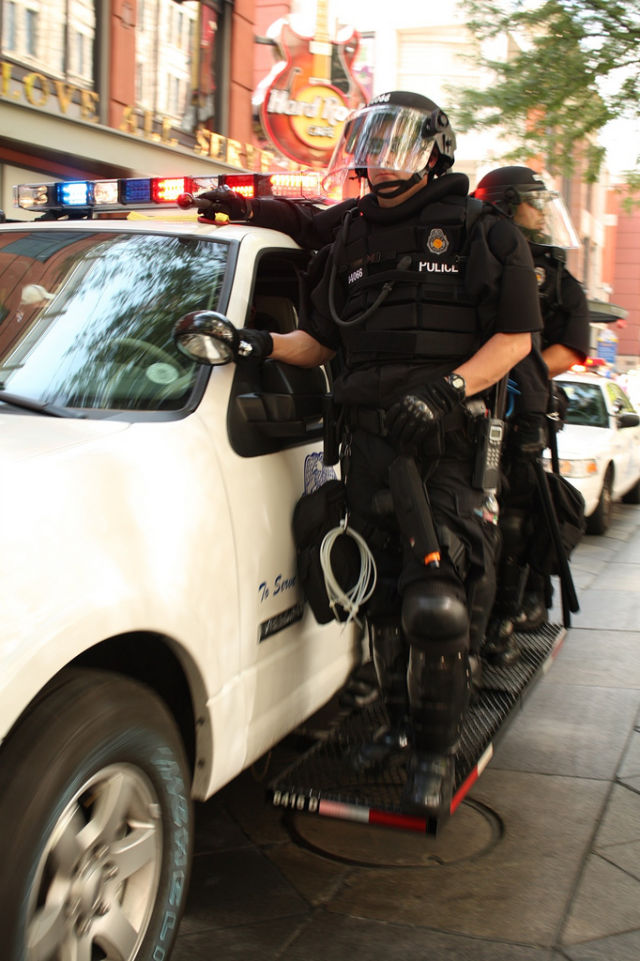
A nurse complained she got a phone call from an officer at a hospital crime scene.

(credit: Noel Hidalgo)

Denver police officers performed searches on state and federal criminal justice databases that were not work-related and instead were made to help officers' in the romance department and to assist friends, according to an independent department monitor. The report said that punishment, usually a written reprimand instead of being charged criminally, is not enough to deter future abuse of the National Crime information Center (NCIC) and the Colorado Crime Information Center (CCIC) databases.

"When used appropriately, they can be powerful tools to investigate crime," the report stated. "But the misuse of these databases for personal, non-law enforcement purposes may compromise public trust and result in harm to community members. We believe that the reprimands that are generally imposed on DPD (Denver Police Department) officers who misuse the databases do not reflect the seriousness of that violation, and may not sufficiently deter future misuse."

The report by Independent Monitor Nicholas Mitchell listed a host of wrongful searches, including an officer getting a phone number of a woman he met on assignment, and an officer running the license plate of a man for a friend who then stalked that person. None of the 25 Denver officers found to have abused the crime databases was ever charged with any access crime. The harshest penalty was a three-day suspension. Civilians who accessed the databases without authorization, however, most likely would be charged with hacking.

Read 7 remaining paragraphs | Comments
Once thought safe, DDR4 memory shown to be vulnerable to “Rowhammer”

New research finds “bitflipping” attacks may pose more risk than many admit.

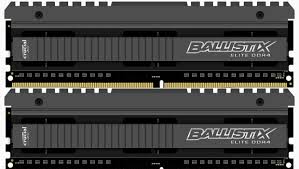
Researchers were able to reproduce bit-flipping attacks on Crucial Ballistix DDR4 DIMMs like those shown here.

Physical weaknesses in memory chips that make computers and servers susceptible to hack attacks dubbed "Rowhammer" are more exploitable than previously thought and extend to DDR4 modules, not just DDR3, according to a recently published research paper.

The paper, titled How Rowhammer Could Be Used to Exploit Weaknesses in Computer Hardware, arrived at that conclusion by testing the integrity of dual in-line memory modules, or DIMMs, using diagnostic techniques that hadn't previously been applied to finding the vulnerability. The tests showed many of the DIMMs were vulnerable to a phenomenon known as "bitflipping," in which 0s were converted to 1s and vice versa. The report was published by Third I/O, an Austin, Texas-based provider of high-speed bandwidth and super computing technologies. The findings were presented over the weekend at the Semicon China conference.

"Based on the analysis by Third I/O, we believe that this problem is significantly worse than what is being reported," the paper warned. "And it is still visible on some DDR4 memory modules."

Read 11 remaining paragraphs | Comments

To help city planners kill traffic jams, US agency turns to Sidewalk Labs

The Alphabet-backed research group wants to quantify commute, quality of life.

On Thursday, the US Department of Transportation (DOT) announced that it would partner with Sidewalk Labs, a city-focused research group that’s a subsidiary of Alphabet (formerly known as Google), to give one US city an overhaul of its traffic analytics infrastructure.

The two institutions said they’d give the chosen city free access to a new analytics platform developed by Sidewalk Labs called Flow, which takes data from Google Maps, Waze and a variety of unspecified sensors to tell city planners which areas of the city are congested, which would be better served by mass transit, and where the city’s transportation resources should be pooled.

The city that gets access to Flow will be the winner of the Smart City Challenge, an ongoing contest sponsored by the DOT in which participant cities must show that they have plans to work technology into their existing transportation network. The finalist cities include Austin, TX; Columbus, OH; Denver, CO; Kansas City, MO; Pittsburgh, PA; Portland, OR; and San Francisco, CA.

Read 7 remaining paragraphs | Comments

Two GDC VR surprises: A lightsaber fight and a Valve-developed game

Valve’s first full game since Dota 2 is a Vive demo reel—and mostly plays like one.

Welcome to The Lab, a mini-game collection launching in April as a freebie for all SteamVR users. (credit: Valve Software)

SAN FRANCISCO—At last year's Game Developers Conference, the SteamVR-powered HTC Vive was a brand new prototype being unveiled publicly for the first time. At this year's show, the VR headset is just a few weeks away from a consumer launch, just behind the much-hyped Oculus Rift.

To promote that launch, Valve is hosting a giant, invite-only SteamVR showcase suite at GDC, packed full of launch-window VR demos. We'll have thoughts on more Vive games and software soon, but for now, we wanted to share our hands-on experiences with the two biggest Vive exclusives unveiled this week: The Lab, and Star Wars: Trials on Tatooine.

VR Wii Sports? Or VR NintendoLand?

The Lab is remarkable because it's Valve's first title with actual VR gameplay, as opposed to the minimally interactive Portal-and Dota 2-themed demos we'd seen at prior events; immersive and cool as they were, we wouldn't call them "games," per se. The Lab also happens to be the first new "game" released by Valve since the closed-beta launch of Dota 2 in 2011. Fans hoping for an epic multiplayer franchise or a lasting, Valve-caliber adventure will instead have to settle on a polished suite of Vive indoctrination mini-games.

Read 15 remaining paragraphs | Comments

Searching for the particle accelerator at the heart of the Milky Way

What’s boosting protons to energies near 1,000 times those we can reach at the LHC?

(credit: HESS telescope)

We're rightly proud of the Large Hadron Collider, which accelerates protons up to 7 Tera-electron Volts before smashing them together. But the Milky Way regularly hurls protons towards Earth that have energies a thousand times higher than that, in the Peta-electron Volt (PeV) range. Astrophysicists refer to the mysterious sources of PeV particles as “PeVatrons."

What can possibly be boosting particles to these levels? A new paper figures out how many of the high-energy protons are being produced and finds one plausible source: the supermassive black hole at our galaxy's center.

Rather than looking for high-energy protons, the authors track them indirectly. Depending on their interactions with the environment, the accelerated protons can produce gamma rays, which are high-energy photons. The energy of these photons are related to the energy of the initial particles.

Read 8 remaining paragraphs | Comments

Mysterious outbreak kills Michigan resident after 17 dead in Wisconsin

Obscure bacteria sickening dozens stumps public health investigators as cases continue.

Elizabethkingia anophelis growing on a blood agar plate. (credit: CDC's Special Bacteriology Reference Lab)

An elderly Michigan resident is the latest to die from a rare and unexplained bacterial outbreak that has sickened 54 people in Wisconsin, killing 17, heath officials confirmed Thursday.

The bacteria, Elizabethkingia anopheles, is commonly found in the environment but rarely infects humans. Historically, outbreaks of the bacteria haven’t reached more than around 10 people, making the outbreak in Wisconsin—and now Michigan—the largest ever recorded.

Investigators from the Centers for Disease Control and Prevention have teamed up with state and local authorities to try to track down the source of the bacteria, which is so far unknown. Since the beginning of last November, the outbreak has spread to at least 12 counties in two states.

Read 6 remaining paragraphs | Comments

On the LPX Show: Can a smartphone be a “fair” phone?

On the LPX Show: Can a smartphone be a “fair” phone?

Fairphone showed off off its modular smartphone made from ethically-sourced materials at the South By Southwest Interactive conference and festival in Austin this week, where the Fairphone 2 was a finalist for an Innovation award. Fairphone didn’t win the award, but this marks one of the first times the team has shown off the phone […]

On the LPX Show: Can a smartphone be a “fair” phone? is a post from: Liliputing

This is the phone NSA suggested Clinton use: A $4,750 Windows CE PDA

SME PED devices were only NSA-approved mobile phones for classified communications.

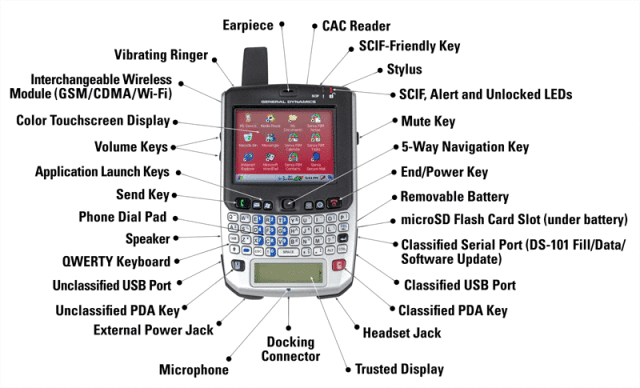
This is what the NSA would have suggested Secretary of State Clinton use as a secure mobile device in 2009: The General Dynamics Sectéra Edge Windows CE secure PDA. Pricetag: $4,750 (not including all the server software and licenses). (credit: General Dynamics)

When former Secretary of State Hillary Clinton was pushing to get a waiver allowing her to use a BlackBerry like President Barack Obama back in 2009, the National Security Agency had a very short list of devices approved for classified communications. It was two devices built for the Secure Mobile Environment Portable Electronic Device (SME PED) program. In fact, those devices were the only thing anyone in government without an explicit security waiver (like the one the president got, along with his souped-up BlackBerry 8830) could use until as recently as last year to get mobile access to top secret encrypted calls and secure e-mail.

Despite $18 million in development contracts for each of the vendors selected to build the competing SME PED phones (or perhaps because of it), the resulting devices were far from user-friendly. The phones—General Dynamics' Sectéra Edge and L3 Communications' Guardian—were not technically "smart phones," but instead were handheld personal digital assistants with phone capability, derived from late 1990s and early 2000s technology that had been hardened for security purposes—specifically, Windows CE technology.

At the time Clinton was asking for a phone, only the Sectéra Edge was available (the Guardian was running behind in development). But you couldn't just buy the Edge and be ready to go—it required multiple server-side and phone-side e-mail additions, desktop synchronization software, and other supporting products. Since it had both a secure and nonsecure side, it required separate accessories for each of its modes. The "Executive Kit" version of the Edge, priced for government purchase at $4,750, included:

Read 2 remaining paragraphs | Comments

Drug reform groups blast Silk Road founder Ross Ulbricht’s life sentence

“Mr. Ulbricht’s draconian sentence flies in the face of standards of decency.”

(credit: Aurich Lawson)

Two leading US non-profits dedicated to reforming drug laws have said that Silk Road founder Ross Ulbricht's sentence of life without parole should be thrown out and that he should be remanded to another judge for re-sentencing.

Ulbricht was convicted last year of conspiracy drug-trafficking charges, as well as distributing false IDs, computer hacking, and money laundering. He admitted to founding the Silk Road darknet marketplace, but his lawyer said it was later handed off to others. Ulbricht is appealing his conviction and his sentence.

"Life sentences are exceedingly rare in the federal criminal justice system, particularly for individuals, like Mr. Ulbricht, with no prior criminal record," write lawyers for the Drug Policy Alliance in an amicus brief (PDF) filed yesterday. "This is particularly true for people convicted of drug offenses, including drug trafficking. In 2013, life sentences were imposed in less than one-third of one percent of all drug trafficking cases... Life sentences are typically reserved for people who committed violent crimes."

Read 8 remaining paragraphs | Comments

Asus E403SA laptop has 14 inch FHD display, 4GB RAM, $399 price tag

Asus E403SA laptop has 14 inch FHD display, 4GB RAM, $399 price tag

It’s been 9 months since Asus unveiled a 14 inch, 3.3 pound budget laptop called the EeeBook E403SA. While the company promised it’d be available in the US in the second half of 2015 for $299 and up, that didn’t happen. But now you can buy the E403SA. The bad news is that the starting price […]

Asus E403SA laptop has 14 inch FHD display, 4GB RAM, $399 price tag is a post from: Liliputing