Liveblog: Dev tools, Xamarin, and Azure at Build 2016

Ars is on the scene to bring you the latest from Build.

View Liveblog
2016-03-31T10:30:00-05:00

San Francisco is still pleasingly sunny, and we're still on the scene for Microsoft's Build developer conference. Day 2 brings another keynote and we'll be liveblogging it from Moscone Center.

Starting at 8:30am PDT, we're expecting to see a fair bit of coding on stage, lots of Visual Studio, and the latest new features to be added to Microsoft's Azure platform. The ability for Windows to run Linux apps is sure to be shown off, something that will no doubt make many developers very happy.

This is the first Build since Microsoft bought Xamarin, and we'd expect at least some time spent talking about just what that's going to mean both for Xamarin developers and existing Windows ones.

Read on Ars Technica | Comments

Microsoft’s new AI tools help developers build smart apps and bots

One app for phones and smart glasses helps blind people navigate the world.

(credit: Microsoft)

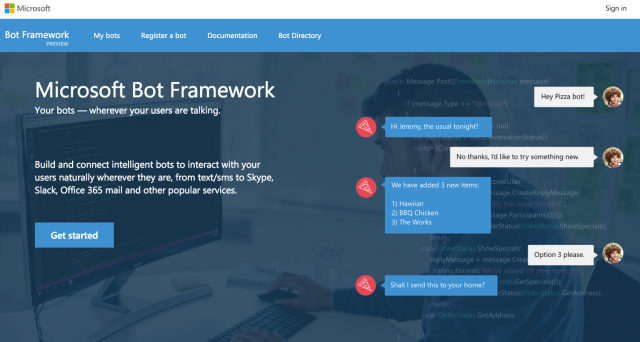
Microsoft is offering new tools to help developers build interactive bots that understand natural language, the company announced at its Build conference today.

There are two key components, which are available in preview and are both part of the larger Cortana Intelligence Suite. "The first, Microsoft Cognitive Services, is a collection of intelligence APIs that allows systems to see, hear, speak, understand and interpret our needs using natural methods of communication," Microsoft said. "The second, the Microsoft Bot Framework, can be used by developers—programming in any language—to build intelligent bots that enable customers to chat using natural language on a wide variety of platforms including text/SMS, Office 365, Skype, Slack, the Web and more."

Though Microsoft's own "Tay" bot became a public relations nightmare, the company demonstrated how artificial intelligence applications built with Microsoft technology can be useful in the real world. Most impressive right now is "Seeing AI," an application to help blind people navigate the world, built by a blind Microsoft software engineer named Saqib Shaikh.

Read 9 remaining paragraphs | Comments

CloudFlare: 94 percent of the Tor traffic we see is “per se malicious”

Legitimate users suffer as Tor becomes favored tool of spammers and fraudsters.

(credit: Ben Salter)

More than ever, websites are blocking users of the anonymizing Tor network or degrading the services they receive. Data published today by Web security company CloudFlare suggests why that is.

In a company blog post entitled "The Trouble with Tor," CloudFlare CEO Matthew Prince says that 94 percent of the requests the company sees coming across the Tor network are "per se malicious." He explains:

That doesn’t mean they are visiting controversial content, but instead that they are automated requests designed to harm our customers. A large percentage of the comment spam, vulnerability scanning, ad click fraud, content scraping, and login scanning comes via the Tor network. To give you some sense, based on data from Project Honey Pot, 18% of global email spam, or approximately 6.5 trillion unwanted messages per year, begin with an automated bot harvesting email addresses via the Tor network.

A graph in the blog post shows that nearly 70 percent of Tor exit nodes were listed as "comment spammer" nodes at some point over the last year.

Read 5 remaining paragraphs | Comments

New model shows Antarctica alone could raise sea level a meter by 2100

And they keep going up for centuries, possibly reaching 12 meters.

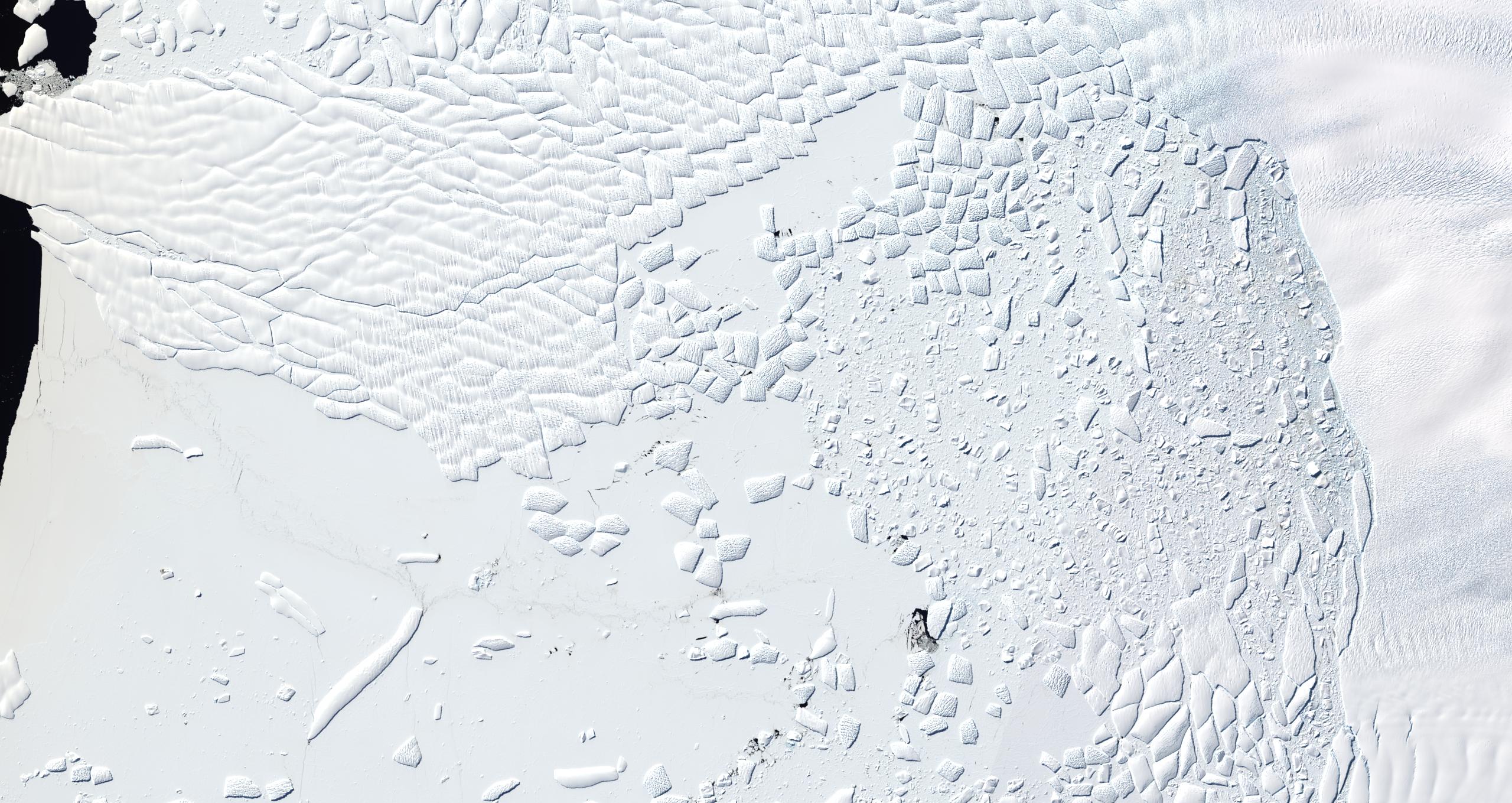
Enlarge / Satellite imagery of the seaward edge of Thwaites Glacier in Antarctica. Thwaites Glacier accounts for a big chunk of the West Antarctic Ice Sheet, and it's vulnerable to major retreat. (credit: Knut Christianson)

It’s obvious that a warming climate will mean less glacial ice and higher sea level, but putting a precise number on these things is another matter. The landscapes concealed beneath the great ice sheets of Greenland and Antarctica are complex in hugely important ways. The interplay of ocean currents, which deliver warmer water to eat away at the underside of floating ice shelves, also varies regionally and even locally. And the ice itself is a dynamic thing, flowing in response to changes at the coastal edges.

So while we use measurements in the present and records from the past to forecast the future, we're stuck with scientific uncertainty, which means we need the language of risk analysis to discuss things sensibly. What is the possible range of sea level rise? And what are the probabilities for different parts of this range?

While some work in this regard has already been done, we're continually sharpening those assessments. As data and knowledge accumulate, our models of the ice sheets become more reliable guides to the future.

Read 9 remaining paragraphs | Comments

Meet the Asus ZenBook Flip UX360CA

Meet the Asus ZenBook Flip UX360CA

As expected, Asus is adding a convertible notebook to is ZenBook UX line of thin, light, and fanless laptops. The Asus ZenBook Flip UX360CA is a 2.9 pound notebook with an Intel Core M Skylake processor, a 13 inch touchscreen display, and a 360 degree hinge that lets you fold the screen backward for use […]

Meet the Asus ZenBook Flip UX360CA is a post from: Liliputing

Deals of the Day (3-30-2016)

Deals of the Day (3-30-2016)

Lenovo offers two completely different versions of its IdeaPad 100S laptop. While both are low-cost notebooks with 11.6 inch displays, one is a Chrome OS notebook with an Intel Atom Z3735F Bay Trail processor and the other is a Windows notebook with a Celeron N2840 Bay Trail processor. Both are normally priced at around $180… […]

Deals of the Day (3-30-2016) is a post from: Liliputing

Hololens: Microsofts Galaxy Explorer wird im Quellcode veröffentlicht

Microsoft hat erneut demonstriert, was mit der Hololens möglich ist und geht offener mit dem eingeschränkten Sichtfeld um. Zudem wird die Galaxy-Explorer-App im Quellcode freigegeben und Skype erlaubt eine Art Remote-Augmented-Reality. (Build 2016, Skype)

Microsoft hat erneut demonstriert, was mit der Hololens möglich ist und geht offener mit dem eingeschränkten Sichtfeld um. Zudem wird die Galaxy-Explorer-App im Quellcode freigegeben und Skype erlaubt eine Art Remote-Augmented-Reality. (Build 2016, Skype)

Creepy experiment uses implanted electrodes to make beetles run faster

This “biobot” is half-computer, half-beetle, and you can control how fast it runs.

Just in case you were craving an army of beetle minions to do your bidding, a group of engineers in Singapore has invented a new kind of "biobot." Fitted out with a microcontroller and electrodes implanted in the muscles of its legs, it's a cyborg beetle that can be made to run faster or slower at the whim of its human master.

Similar kinds of biobots have been built before—the last few years have seen the invention of everything from ratbots to mind-controlled cockroaches—but this is the first variable-speed model. That's because the engineers are directly controlling the insect's leg muscles rather than driving it by manipulating signals in its brain or antennae.

The engineers, who report on their creation in Journal of the Royal Society Interface, admit that there are a few drawbacks to making robots out of living animals. "There are demerits and disadvantages in insect platform due to living organism including limited lifespan, relatively narrow operation temperature range," they write. That said, the team is convinced the good outweighs the bad.

Read 6 remaining paragraphs | Comments

Developers excited about HoloLens, say it needs a whole new way of thinking

The Development Edition starts shipping today.

8ninths virtual workstation. Video shot by Esy Casey and edited by Nathan Fitch. (video link)

The first HoloLens Development Edition kits are shipping today to developers selected to be in the first wave of availability. Over the weekend, the $3,000 kits should get into the hands of developers not bound by NDAs and other restrictions, making this the first time we'll start to see and understand just what the device can be used for.

However, these aren't the first developers outside of Redmond to use the HoloLens. The company has been working with a select group of teams to develop apps for the augmented reality headset and to better learn how to use the hardware.

Read 7 remaining paragraphs | Comments

Copyright Does Not Protect the Klingon Language, Court Hears

Paramount Pictures and CBS Studios can’t claim copyright over the Klingon language, Vulcan’s pointy ears, or Phaser weapons, a court heard this week. This defense comes from the makers of crowdfunded Star Trek spin-off ‘Prelude to Axanar’, who were sued over their use of various well-known Star Trek elements.

Source: TF, for the latest info on copyright, file-sharing, torrent sites and ANONYMOUS VPN services.

klingonEarlier this year Paramount Pictures and CBS Studios filed a lawsuit against the makers of the Star Trek inspired fan film, accusing them of copyright infringement.

The dispute centers around the well-received short film Star Trek: Prelude to Axanar and the planned follow-up feature film Anaxar.

The project is an idea from Alec Peters who started working on it half a decade ago. The short film turned in to a massive hit and quickly raised more than $100,000 through crowdfunding, and the follow-up feature raised another $638,000 on Kickstarter alone.

That’s a serious budget for a fan-art project and the success prompted the attention of both Paramount Pictures and CBS Studios, who filed their complaint at a California federal court last December.

Among other things, the Star Trek rightsholder claimed ownership over various Star Trek related settings, characters, species, clothing, colors, shapes, words, short phrases and even the Klingon language.

This week, Axanar productions and Alec Peters responded to the allegations put forward in the complaint (pdf). According to the makers of the fan film, several of the allegedly “infringing elements” are not protected by copyright to begin with.

In their reply the filmmakers argue that words and short phrases such as names, titles and slogans can’t be protected. This includes the popular phrase “beam me up” as well as several Star Trek related names.

“…the names Garth of Izar, Soval, Richard Robau, and John Gill are not protectable, and neither are the words Andorians, Tellarites, Romulans, Axanar, Archanis IV, Q’onoS, Nausicaa, Rigel, Andoria, Tellar Prime, Vulcans, Klingons, Terra, Starship Enterprise, Starfleet, Federation, Starships, Stardate, and Federation or the short phrase ‘beaming up’,” they write.

In addition, Axanar productions points out that Paramount and CBS can’t claim ownership of the Klingon language, which is nothing more than an idea according to the defendants.

“The Klingon language itself is an idea or a system, and is not copyrightable,” they write.

“The mere allegation that Defendants used the Klingon language, without any allegation that Defendants copied Plaintiffs’ particular expression of that language, is therefore insufficient to state a claim for copyright infringement as to any protected element.”

Vulcan comparison

klingoncomp

The defendants continue by stressing that the use of the Vulcan appearance and the Heat-Ray Phaser weapons are not unique to Star Trek. They are common appearances in nature and / or have been used in fictional works before.

“Vulcan appearance: a species with ‘pointy ears’ is not original to Star Trek, and has appeared in many fictional fantasy works depicting imaginary humanoid species predating Star Trek, including, but not limited to, vampires, elves, fairies, and werewolves, as well as in many animals in nature.”

“Phasers are also known as Heat-Ray weapons, which have existed in science fiction since H.G. Wells’ ‘War of the Worlds’ in 1898,” the complaint notes.

Besides the questions Axanar raises over the copyright protections, they also argue that the allegations aren’t specific enough, since it’s not specified which exact copyrights have been infringed.

“While Plaintiffs allege that they own ‘more than 700’ Star Trek television episodes, a dozen motion pictures, and four books, they still fail to specify which of those copyrights Defendants have allegedly infringed,” the write.

As a result, Axanar Productions asks the court to dismiss or strike the copyright claims in question.

Source: TF, for the latest info on copyright, file-sharing, torrent sites and ANONYMOUS VPN services.