 Das Modder-Tool für Minecraft kann jetzt auch mit Mikrocontrollern kommunizieren. Damit können im Spiel elektronische Schaltungen angesteuert und ausgewertet werden. (Minecraft, Arduino)
 Category: Uncategorised
TeamViewer says there’s no evidence of 2fa bypass in mass account hack
Investigation continues to show external password breaches are cause, spokesman says.
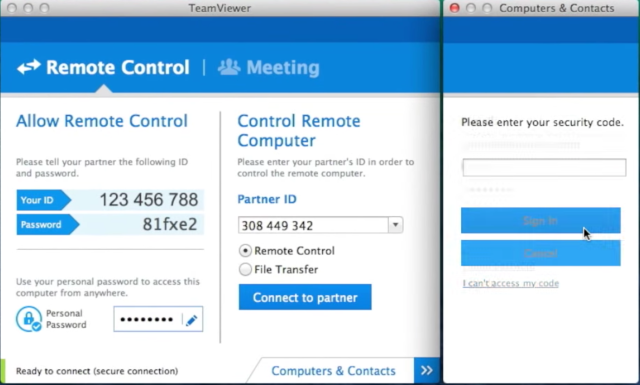
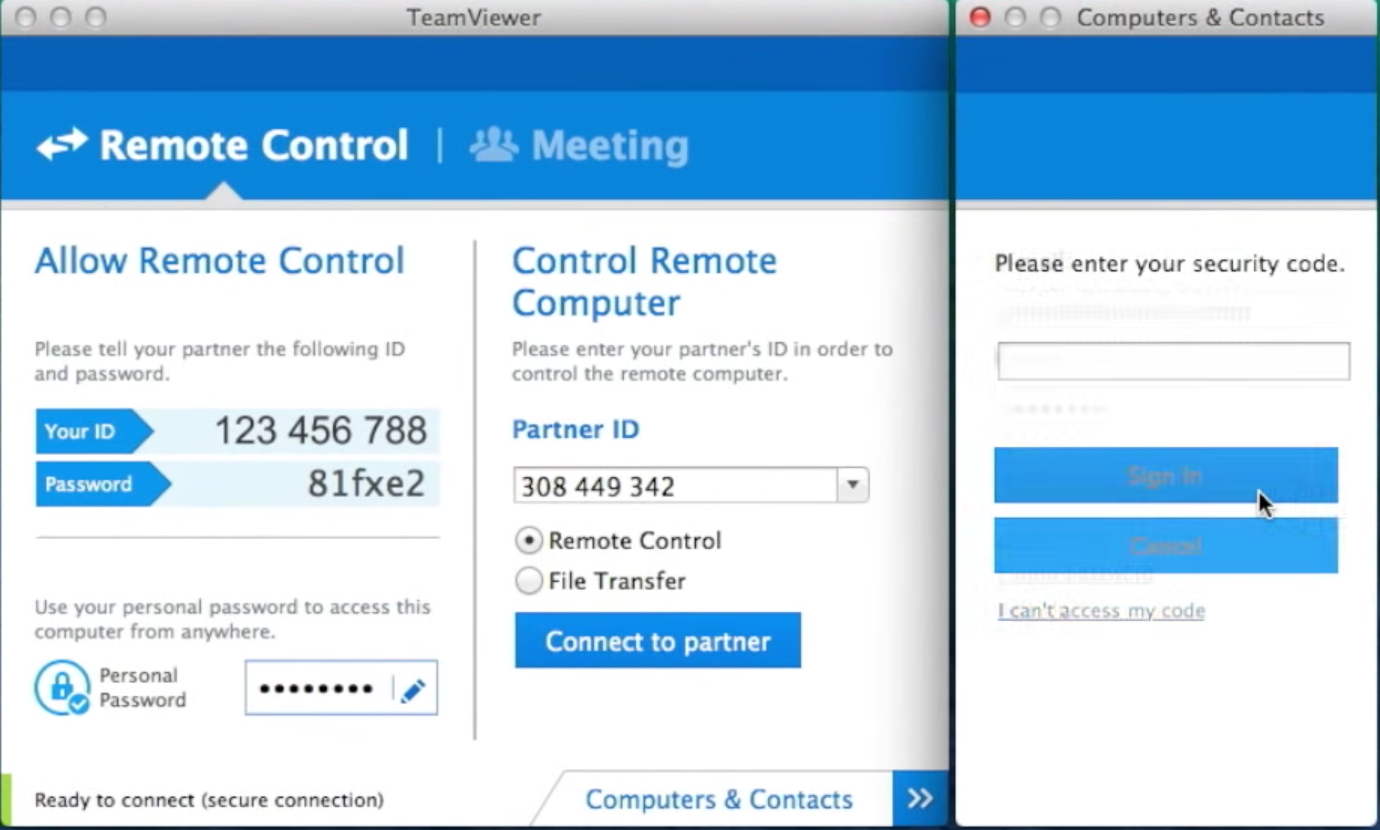
It was a tough week for TeamViewer, a service that allows computer professionals and consumers to log into their computers from remote locations. For a little more than a month, a growing number of users have reported their accounts were accessed by criminals who used their highly privileged position to drain PayPal and bank accounts. Critics have speculated TeamViewer itself has fell victim to a breach that's making the mass hacks possible.
On Sunday, TeamViewer spokesman Axel Schmidt acknowledged to Ars that the number of takeovers was "significant," but it continued to maintain that the compromises are the result of user passwords that were compromised through a cluster of recently exposed megabreaches involving more than 642 million passwords belonging to users of LinkedIn, MySpace, and other services.
Ars spoke with Schmidt to get the latest. What follows is a lightly edited transcript of the conversation:
Read 15 remaining paragraphs | Comments
Nest’s time at Alphabet: A “virtually unlimited budget” with no results
Nest quadrupled its employees, launched no new products, and caused constant bad PR.

(credit: Ron Amadeo / Nest)
Nest CEO Tony Fadell wasn't officially "fired" from Nest, but it certainly feels like it. Nest and Alphabet announced Fadell would be "transitioning" to an advisory role at Alphabet, dropping both Nest and Fadell into a sea of negative press. In just the last few months, Nest has had to deal with reports of an "employee exodus," a string of public insults from Dropcam co-founder and departing Nest employee Greg Duffy, news that even Google supposedly didn't want to work with Nest on a joint project, and fallout from the company's decision to remotely disable Nest's deprecated Revolv devices. Alphabet and Nest both seem to know the announcement about Fadell's "transition" looks bad: the news dropped on a Friday afternoon, a popular time for companies to dump bad news they hope no one will notice.
It's hard to argue with the decision to "transition" Fadell away from Nest. When Google bought Nest in January 2014, the expectation was that a big infusion of Google's resources and money would supercharge Nest. Nest grew from 280 employees around the time of the Google acquisition to 1200 employees today. In Nest's first year as "a Google company," it used Google's resources to acquire webcam maker Dropcam for $555 million, and it paid an unknown amount for the smart home hub company Revolv. Duffy said Nest was given a "virtually unlimited budget" inside Alphabet. Nest eventually transitioned to an Alphabet company, just like Google.
In return for all this investment, Nest delivered very little. The Nest Learning Thermostat and Nest Protect smoke detector both existed before the Google acquisition, and both received minor upgrades under Google's (and later Alphabet's) wing. A year after buying Dropcam, Nest released the Nest Cam, which was basically a rebranded Dropcam. Two-and-a-half years under Google/Alphabet, a quadrupling of the employee headcount, and half-a-billion dollars in acquisitions yielded minor yearly updates and a rebranded device. That's all.
Read 19 remaining paragraphs | Comments
Axl Rose Sends DMCA Notices to Google Targeting ‘Fat’ Photo
Many of us have unflattering photographs that we would rather forget but most exist in family archives that are easily hidden away. However, if you’re a multi-millionaire rock star potentially trying to erase an unfortunate moment, there are always DMCA takedown notices to fall back upon.
Source: TF, for the latest info on copyright, file-sharing, torrent sites and ANONYMOUS VPN services.
 As regularly documented in these pages, copyright holders expend a lot of energy trying to protect their work from Internet piracy.
The tried and tested method is to issue a DMCA takedown notice to webhosts and platforms such as Google, Facebook and YouTube. Millions of these requests are sent and processed every week.
However, while copyright holders are fully entitled to protect their work, there are many instances that cause controversy. These cases often amount to ham-handed efforts at taking down infringing content but others arouse suspicions that censorship is the likely goal.
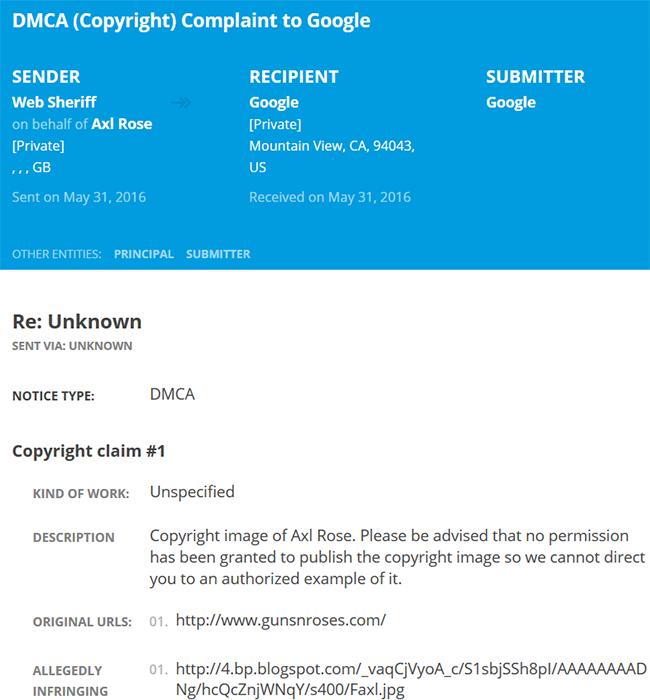
Details of several such cases appeared in the Lumen Database’s DMCA archive this week, having been filed there by Google. They all relate to a wave of copyright claims sent to Blogspot and GoogleUserContent on May 31, 2016 demanding the removal of pictures depicting Guns N’ Roses singer Axl Rose.
“Copyright image of Axl Rose. Please be advised that no permission has been granted to publish the copyright image so we cannot direct you to an authorized example of it,” the notices sent by Web Sheriff on behalf of the singer read.
Each notice (1,2,3,4,5,6) relates to the same image, an excellently framed but rather unflattering picture of Axl Rose taken at the MTS Centre, Winnipeg, Canada, back in 2010.

Intrigued, TorrentFreak tracked down the photographer who captured this moment to see if he was aware of these takedown efforts. We eventually found Boris Minkevich at the Winnipeg Free Press where his fine work is published in all its glory.
During our initial discussions a few things became clear. Firstly, Minkevich definitely took the photo. Second, Minkevich had no idea that Rose was trying to “cleanse the web” of his photo.
Perhaps the first reaction here is that Rose has no right to take down Minkevich’s photo. Since Minkevich was the one who took it, he must own the copyright, right? Web Sheriff doesn’t seem to think so.
“We can gladly confirm that all official / accredited photographers at [Axl Rose] shows sign-off on ‘Photography Permission’ contracts / ‘Photographic Release’ agreements which A. specify and limit the manner in which the photos can be exploited and B. transfer copyright ownership in such photos to AR’s relevant service company,” the company told TF in a statement.
We contacted Minkevich again and asked whether he’d signed any contracts as suggested by Web Sheriff or had any clear idea of who owns the copyrights. He confirmed that some shows make photographers sign an agreement and some don’t. This event was in 2010, a long time to remember back.
However, even if Minkevich took this photograph in an unofficial and/or unauthorized capacity, Web Sheriff still believes there would be issues surrounding ownership.
“[If a photographer] was there and taking shots without permission or authority, then other considerations / factors would come-into-play as to what such individuals can and cannot do in terms of attempting to commercially exploit the resultant images of someone else’s show,” TF was informed.
So while the waters about who owns what continue to swirl, the big question remains – why target the picture at all? Understandably, Web Sheriff told us that client work is confidential but it’s certainly possible that part of the puzzle lies a quick Google search away.
As can been seen below, the photographs taken by Mr Minkevich all those years ago also triggered a viral Axl Rose ‘fat’ meme – hardly the kind of image someone like Axle Rose would like to preserve.

While poking fun at someone’s appearance is sadly par for the course on some parts of the Internet, sending DMCA notices is hardly likely to cure the problem, if indeed that’s what the aim of the half-dozen notices was. It’s possible we’ll never find out for sure.
Finally, it’s worth pointing out that Google hasn’t complied with the requests to remove the images and all remain up and accessible. That may be because Google believes that Axl Rose doesn’t own the photo and that the copyrights sit with Minkevich and/or the Winnipeg Free Press.
Clearly Axl Rose thinks otherwise but as pointed out by Minkevich to TF, the images being targeted on Blogspot are definitely infringing, although perhaps not in the way Axl might’ve hoped.
“Either way the photo was stolen off our website with no permission granted by the Winnipeg Free Press,” he concludes.
Messy? You bet.
Source: TF, for the latest info on copyright, file-sharing, torrent sites and ANONYMOUS VPN services.
The best of British aviation: the Imperial War Museum Duxford
A look at some of the stars of the UK’s largest aviation musuem

Jonathan Gitlin
The AirSpace exhibit at the Imperial War Museum Duxford has an impressive number of aircraft, but boy do they cram them in there!
15 more images in gallery
A recent trip to the UK meant we happened to be near the Imperial War Museum Duxford, the Cambridgeshire outpost where the Imperial War Museum keeps over 200 of its airplanes. It's not just the UK's largest aviation museum—it's a thoroughly good day out for anyone who like things with wings. The site itself has its own share of history, too. It was an RAF base until 1961 and was crucial to the Battle of Britain (as well as starring in the movie of that name).
The gallery above includes some (but not all) of the wonderful (and in some cases not-so-wonderful) flying machines. The hangar of American planes was being refurbished on the day we visited, so you won't see photos of Duxford's B-52 or SR-71. However, you will see plenty of Cold War hardware from both the Royal Air Force and the Royal Navy's Fleet Air Arm.
And we'll wager that some of these planes will not be familiar to our readers, like the ill-fated BAC TSR-2. But the museum has more than a few icons of British aviation history, including Concorde, the spectacularly fast English Electric Lightning, and a pair of "V Force bombers," the Avro Vulcan and Handley Page Victor. Enjoy the photos!
Read on Ars Technica | Comments
With iPhones and computer models, do we still need weather forecasters?
As automation continues to claim jobs in new fields, meteorology may be next.
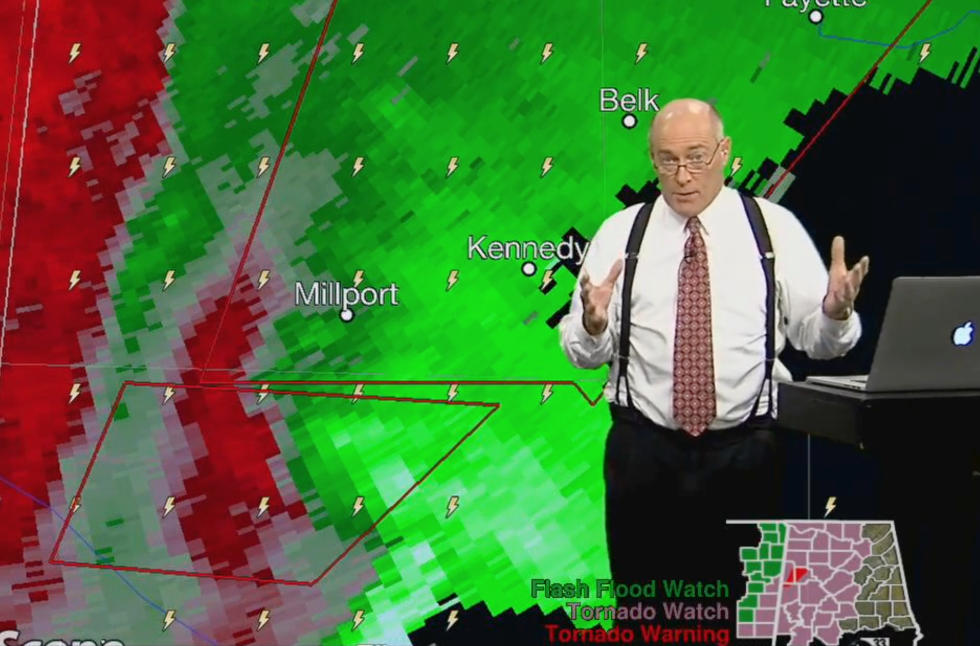
James Spann is Alabama's go-to meteorologist when the state's weather turns severe. (credit: James Spann)
As the 10pm newscast drew near one night last month, the chief meteorologist of Birmingham's ABC-affiliate began to get worked up. Balding and characteristically attired in suspenders, James Spann is one of the most recognizable and respected local TV meteorologists in the country. But he had a familiar problem. The day had been pleasant in Alabama, and more of the same temperate spring weather lay ahead—so what the heck was he going to talk about?
“I’ve got 2 minutes and 30 seconds to fill,” Spann explained. “Everyone in my audience is going to know what the weather is going to do. Except maybe my mom. She’s 85 years old. But most everybody has looked on their phone or some other device already. So what am I going to do? Am I just going to rehash everything they already know?”
Many forecasters have been asking themselves this question lately. Two technologies have converged to rapidly displace the primary function of meteorologists. First are computers that are generally better forecasters than humans. For most types of weather, numerical weather prediction has superseded human forecast methods. And secondly, thanks to the Internet and increasingly ubiquitous weather apps on mobile devices, people have continuous, immediate access to 5-day, 7-day or 10-day forecasts. As technology drives automation and machines take job after job once performed by humans, are meteorologists next in line?
Read 20 remaining paragraphs | Comments
Valve: Steam Controller bekommt mehr Konfigurationsmöglichkeiten
In den vergangenen Monaten hat der Steam Controller eine Reihe neuer Funktionen erhalten, jetzt hat Valve weitere Konfigurationsmöglichkeiten angekündigt – und eine offizielle Verkaufszahl für das Gamepad genannt. (Steam Controller, Eingabegerät)
 In den vergangenen Monaten hat der Steam Controller eine Reihe neuer Funktionen erhalten, jetzt hat Valve weitere Konfigurationsmöglichkeiten angekündigt - und eine offizielle Verkaufszahl für das Gamepad genannt. (Steam Controller, Eingabegerät)
 Weekly News Roundup (5 June 2016)
From Game of Thrones nude scenes to … oh wait, what nude scenes? Read the news roundup for the week ending 5 June 2016
Continue reading …

From Game of Thrones nude scenes to ... oh wait, what nude scenes? Read the news roundup for the week ending 5 June 2016
Is The “Six Strikes” Anti-Piracy Scheme Doomed?
The six-strikes Copyright Alert System has been active for more than three years now. Thus far its impact has hardly been noticed, in public at least. Rightsholders and ISPs have yet to agree on the program’s future course, which may not be as brights as once envisioned.
Source: TF, for the latest info on copyright, file-sharing, torrent sites and ANONYMOUS VPN services.
 Five years ago the MPAA and RIAA teamed up with several major U.S. Internet providers, announcing their plan to shift the norms and behavior of BitTorrent pirates.
The parties launched the Center for Copyright Information (CCI) and agreed on a system through which Internet account holders are warned if their connections are used to download pirated content.
After five or six warnings ISPs can take a variety of repressive measures, including bandwidth throttling and temporary Internet disconnections.
The system has been in place for several years now and is currently set to expire in October, before which the parties have to agree on its future course.
When the initiative was announced many people feared an active witch hunt and various horror stories about falsely accused grandmothers. But, now that several years have passed it’s the silence that stands out most.
It’s almost as if the much praised Copyright Alert System doesn’t exist at all.
Since its inception, CCI has issued no more than three press releases and any recent data on the scope and effectiveness of the program is lacking. The only figures that were published cover the first ten months, ending December 2013.
Hoping to fill this information void TorrentFreak has been asking for fresh data for years, but CCI repeatedly informed us that they have no new numbers to share.
Similarly, the institution’s official Twitter account has been gathering dust for almost a year, exemplifying the lack of communication.
This week we contacted CCI again, and although no data or concrete plans were unveiled, Executive Director Jim Kohlenberger was willing to shed some more light on the operation.
“The system continues to work smoothly, effectively, and as intended,” he says.
“We’ve seen that consumers are interested in the activity happening on their network, that they respond to educationally focused efforts, and are thirsty for more information on the amazing new ways to ethically access content where, when, and how they want.”
According to Kohlenberger there are growing signs that P2P piracy is on the decline, while use of legal content options is growing. Looking ahead, CCI’s director says the system will be further optimized.
“Going forward, we continue to look for opportunities to refine the system, and to advance our efforts and to elevate our consumer-focused mission in pragmatic ways,” Kohlenberger notes.
While the comments are positive, there are also some signs which suggest that there has been very little progress behind the scenes. The parties have been discussing future options for a long time already and thus far nothing has been set in stone.
After the original agreement expired last June it was extended for four months to give the parties some additional time to agree on possible changes. In October another three-month extension was put in place, followed by yet more extensions in February, March and April of this year.
This strange series of short extensions is odd, to say the least.
And while the future for the Copyright Alert System has yet to be decided, critique is swelling. Not just from pirates and activists, but also from copyright holders themselves as they can only send a limited number of complaints.
Last year a group of several independent movie studios called for the end of the system, describing it as a sham. Instead, the movie studios see more mileage in a Canadian notice-and-notice system, where they can send out as many warnings as they like.
Add to this that Australia just abandoned their proposed “strikes” scheme and the fact that Hollywood said it will no longer push for similar measures elsewhere, and the picture gets more and more grim.
Considering the above it wouldn’t be a huge surprise if the scheme terminated itself in the future, but CCI is obviously not hinting in that direction. However, we seriously doubt that things are going as smoothly as they are presented.
Source: TF, for the latest info on copyright, file-sharing, torrent sites and ANONYMOUS VPN services.
Automobile: Rückrufe wegen Software steigen stark
15 Prozent der Rückrufe in der Automobilbranche sind inzwischen in Softwarefehlern begründet. 2011 waren es lediglich 5 Prozent, so eine US-Studie. Auch der ADAC kritisiert die Hersteller und ihre Software – allerdings aus ganz anderen Gründen. (Automotive, Studie)
 15 Prozent der Rückrufe in der Automobilbranche sind inzwischen in Softwarefehlern begründet. 2011 waren es lediglich 5 Prozent, so eine US-Studie. Auch der ADAC kritisiert die Hersteller und ihre Software - allerdings aus ganz anderen Gründen. (Automotive, Studie)