Welcome to the age of ancient DNA sequencing

New tech gives us a sharp view of how farming swept across Eurasia during the Neolithic.

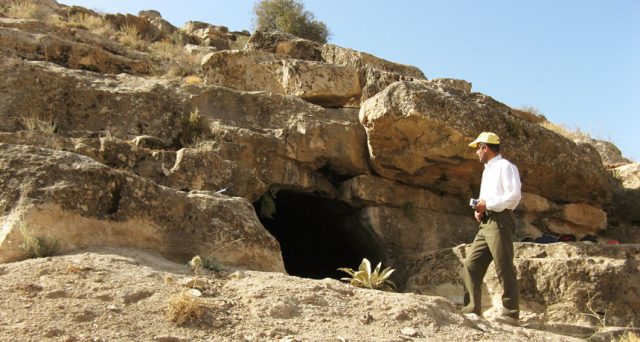
A cave in Iraq where the bones of ancient human farmers were found. Their DNA was sequenced to unlock the mystery of who the earliest farmers were in the region. (credit: FEREIDOUN BIGLARI)

The greatest technological revolution in human history arguably happened about 12,000 years ago, when humans first stopped living as hunter gatherers and became farmers. This so-called Neolithic Revolution transformed human culture, our genomes, and our ecosystems. But the origins of farming have remained a mystery. Was there one eureka moment, when an early Neolithic person realized the seeds they scattered in fall had sprouted into grains two seasons later? Or, more intriguingly, did several groups of people start farming independently?

Two new studies published this month in Science and Nature magazines use DNA analysis of ancient human bones to conclude that farming arose in multiple regions simultaneously. The Science study focused on four farmers who lived between 9,000 and 10,000 years ago in the mountainous Zagros region of Iran. The Nature study analyzed 44 individuals (farmers as well as hunter-gatherers) from Armenia, Turkey, Israel, Jordan, and Iran who lived between 14,000 and 3,500 years ago. By sequencing parts of these ancient people's DNA, researchers could determine their likely ancestry as well as what populations are descended from them today. The researchers conclude that there are at least two groups of ancient humans who discovered farming separately in the Middle East and then exported the Neolithic revolution across large parts of the continent.

The secrets of ancient DNA

Over the past decade, modern DNA sequencing techniques have allowed scientists to recover strands of genetic material from decayed bones that have been infused with microbes over thousands of years. Now, those techniques are widely accessible and highly refined. It starts with how researchers pick their bones. If possible, they'll extract DNA from the petrous bone in the inner ear, a goldmine for genetic material that can yield roughly 100 times more ancient DNA than other parts of the skeleton. Then researchers use a process called in-solution hybridization, which uses special probes made from DNA or RNA that attach to the desired ancient human DNA, fishing it out of a soup of other genetic material from other organisms that accumulated in the decomposing bone. Techniques like these are making it easier than ever for us to sequence ancient DNA and reconstruct the human past.

Read 6 remaining paragraphs | Comments

Lenovo to ship laptops with Endless OS in Mexico

Lenovo to ship laptops with Endless OS in Mexico

Last year a startup called Endless Computers launched a line of inexpensive desktop PCs designed for use in developing markets, among other places. They currently sell for $79 to $229  and run a Linux-based operating system called Endless OS, which comes pre-loaded with apps and educational tools intended to make a PC useful even if you don’t have an internet connection.

In June, Endless announced that it was making the operating system available for download free of charge for anyone that wants to install it on their own.

Continue reading Lenovo to ship laptops with Endless OS in Mexico at Liliputing.

Lenovo to ship laptops with Endless OS in Mexico

Last year a startup called Endless Computers launched a line of inexpensive desktop PCs designed for use in developing markets, among other places. They currently sell for $79 to $229  and run a Linux-based operating system called Endless OS, which comes pre-loaded with apps and educational tools intended to make a PC useful even if you don’t have an internet connection.

In June, Endless announced that it was making the operating system available for download free of charge for anyone that wants to install it on their own.

Continue reading Lenovo to ship laptops with Endless OS in Mexico at Liliputing.

Sony announces PlayStation VR space requirements—is your room big enough?

Pamphlet shows required dead zone, asks players to “remain seated whenever possible.”

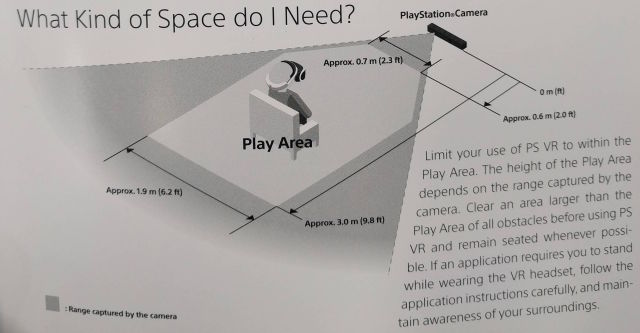
This PlayStation VR promotional pamphlet page spells out some surprising room-space requirements for the system. (credit: Imgur)

As Sony approaches the October launch of its first major virtual reality product, PlayStation VR, the company has begun to publish more info about its system. On Friday, advertising pamphlets revealed a previously unknown aspect: its space requirements.

The amount of suggested minimum space may surprise some players. The pamphlet image, posted anonymously on Imgur and found by Polygon, suggests that players dedicate 9.8' of depth and 6.2' of width to their PSVR play area. This includes a two-foot dead zone directly in front of a single PlayStation Camera, which must be set up for tracking purposes, and a few more feet back to position a chair so that players can look and wave arms all around their play space.

The pamphlet also makes clear that players cannot play very far from the camera. PSVR requires a specific just-close-enough sweet spot to track the system's headset, Move wands, and DualShock 4 controllers. Ideally, players will place a chair in that PSVR zone, as the pamphlet suggests players "remain seated whenever possible." If a particular game asks players to stand up, that may require a repositioning of the PS Camera to track full body height.

Read 2 remaining paragraphs | Comments

AT&T boosts U-verse data cap to 1TB, keeps DSL users at 150GB

AT&T gigabit customers will be upgraded to unlimited data.

Data cap cash. (credit: Aurich Lawson | Getty Images)

AT&T is raising the data caps for U-verse Internet customers to 1TB a month and providing unlimited data "at no additional charge" to customers who subscribe to the company's 1Gbps service.

But DSL users on AT&T's network aren't getting any extra data, and those users must continue to make do with a 150GB monthly limit.

AT&T has been enforcing data caps on DSL users for years but only began enforcement of caps on its faster U-verse service in May this year. Data caps were set at 300GB, 600GB, or 1TB based on the speed tier. But the changes announced today—which take effect August 21—give all U-verse customers a monthly data cap of 1TB or no cap at all. Previously, a 1TB cap was only for customers with speeds from 100Mbps to 1Gbps.

Read 5 remaining paragraphs | Comments

Deals of the Day (7-29-2016)

Deals of the Day (7-29-2016)

I picked up a pair of cheap Bluetooth earbuds last year, and while they’re not the best sounding headphones I own, they’re my go-to headphones for listening to podcasts while walking or tuning into conference calls when I’m working because it’s just so convenient to be able to listen without fumbling over wires.

I actually bought them to use while exercising, and they’re good for that too. But after a year of use, the charging port on my Mpow Cheetah Bluetooth headphones is a little finicky, and it can be hard to get the battery to charge.

Continue reading Deals of the Day (7-29-2016) at Liliputing.

Deals of the Day (7-29-2016)

I picked up a pair of cheap Bluetooth earbuds last year, and while they’re not the best sounding headphones I own, they’re my go-to headphones for listening to podcasts while walking or tuning into conference calls when I’m working because it’s just so convenient to be able to listen without fumbling over wires.

I actually bought them to use while exercising, and they’re good for that too. But after a year of use, the charging port on my Mpow Cheetah Bluetooth headphones is a little finicky, and it can be hard to get the battery to charge.

Continue reading Deals of the Day (7-29-2016) at Liliputing.

Ausfall: Störung im Netz von Netcologne

2016 entwickelt sich zum Jahr der Störungen im Festnetz und Mobilfunk: Diesmal hat es Netcologne getroffen. Störungsursache ist ein Defekt an einem Übertragungsknoten. (Festnetz, Telekommunikation)

2016 entwickelt sich zum Jahr der Störungen im Festnetz und Mobilfunk: Diesmal hat es Netcologne getroffen. Störungsursache ist ein Defekt an einem Übertragungsknoten. (Festnetz, Telekommunikation)

Cinema 3D: Das MIT arbeitet an 3D-Kino ohne Brille

Wer Filme schaut, kennt das Problem: Bedingt durch unterschiedliche Sitzplätze sind Bild und 3D-Darstellung für jeden Zuschauer etwas anders. Ein neues Display des MIT ändert das; obendrein sind keine 3D-Brillen notwendig, womit die Idee für Kinos interessant ist. (3D-Display, Digitalkino)
Wer Filme schaut, kennt das Problem: Bedingt durch unterschiedliche Sitzplätze sind Bild und 3D-Darstellung für jeden Zuschauer etwas anders. Ein neues Display des MIT ändert das; obendrein sind keine 3D-Brillen notwendig, womit die Idee für Kinos interessant ist. (3D-Display, Digitalkino)

It’s now or never: Free Windows 10 upgrade ends in just a few hours

Act now before it’s too late.

It's better, we promise.

If you use Windows 7 or Windows 8.1 and want to upgrade to Windows 10 for free, there are just a few more hours left to grab your copy. The offer expires today, July 29. At the time of writing, less than 19 hours still remain.

If you're eligible, you should upgrade. In almost every regard, Windows 10 is a better operating system than Windows 7 or 8.1 (unless you use Media Center, in which case you're trapped on old operating systems forever). If you want to get the free upgrade but can't upgrade right now because of timing or compatibility concerns, your best option is to install Windows 10 onto an empty hard drive using your existing Windows 7 or 8.1 key. Activate that installation and magic will occur: your key will become Windows 10 "enabled," and you should be able to use it to perform the upgrade at a later date. Similar results can likely be achieved by installing into a virtual machine rather than an empty hard disk.

The cut-off doesn't apply to those who use assistive technology such as screen-readers; those Windows users will be able to upgrade to Windows 10 whenever they feel like it, though Microsoft apparently has yet to fully explain how this will work.

Read on Ars Technica | Comments

Broadband industry tries again to kill net neutrality and Title II

Broadband lobby groups petition for full court review at DC Circuit.

(credit: Getty Images | ullstein bild)

Six weeks after federal judges preserved net neutrality rules for the broadband industry, ISPs are seeking a full court review of the decision.

ISPs' attempt to overturn the Federal Communications Commission rules were rejected when a three-judge panel of the US Court of Appeals for the District of Columbia Circuit voted 2-1 in favor of the FCC. Now the broadband industry's trade groups are seeking an "en banc" review in front of all of the DC Circuit court's judges instead of just a three-judge panel. If this fails, ISPs can appeal to the Supreme Court, but the odds against them winning appear to be long.

One en banc petition submitted this morning before the case's deadline came from the National Cable & Telecommunications Association (NCTA) and the American Cable Association (ACA), the two biggest cable lobby groups. En banc petitions were also filed by CTIA—The Wireless Association, the mobile broadband industry's primary lobby group; the United States Telecom Association (USTelecom) and CenturyLink (representing DSL and fiber providers); and a small Texas ISP named Alamo Broadband.

Read 11 remaining paragraphs | Comments

AVM: Hersteller für volle Routerfreiheit bei Glasfaser und Kabel

Routerhersteller wie AVM, Devolo und Lancom wollen auch Zugang zu den bislang weitestgehend abgeschotteten Kabel- und Glasfasernetzen. Ihr Herstellerverbund fordert die Veröffentlichung von Schnittstellenspezifikationen. (Router, DSL)

Routerhersteller wie AVM, Devolo und Lancom wollen auch Zugang zu den bislang weitestgehend abgeschotteten Kabel- und Glasfasernetzen. Ihr Herstellerverbund fordert die Veröffentlichung von Schnittstellenspezifikationen. (Router, DSL)