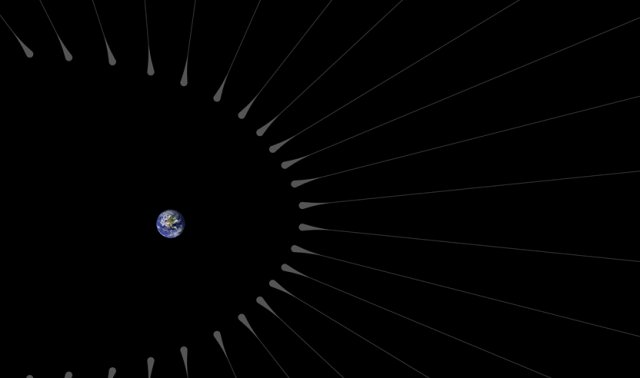
This illustration shows Earth surrounded by filaments of dark matter called "hairs." (credit: NASA/JPL-Caltech)
There are few fields like theoretical astrophysics, where public perception so radically departs from reality. Society generally considers its practitioners—scientists like Stephen Hawking and Kip Thorne—to be among the most brilliant people in the world. They are the great sages to whom we turn with the universe’s deepest questions. Yet in reality, astrophysicists are mired in ignorance.
When a theoretical astrophysicist looks up at the nighttime sky, he or she will see the stars shining overhead. But what concerns the physicist is not what he or she sees but rather what is unseen. Based upon different kinds of observations, such as how galaxies rotate and how they are flying apart from one another, scientists know that 95 percent of the of the universe is made of up stuff we cannot see. Of the universe's mass, physicists say 27 percent is dark matter, and 68 percent is dark energy. And researchers have no idea what this stuff is or where to find it.
Yet a scientist at NASA’s Jet Propulsion Laboratory has now provided a clue about where dark matter—and lots of it—might be found. In a new study published in the Astrophysical Journal, Gary Prézeau has proposed that Earth and other planets and stars in the Milky Way galaxy are surrounded by theoretical filaments of dark matter called "hairs.” By finding the roots of these hairs, he reports, physicists could uncover a trove of dark matter.
Read 9 remaining paragraphs | Comments

 Panels für Automotive, Fernsehgeräte, Smartwatches und eventuell auch iPhones: LG investiert rund neun Milliarden US-Dollar in die Errichtung einer Fabrik, die OLED-Displays produzieren wird. (

 Die Telekom bietet mit Data Start einen Mobilfunktarif, der auch als Tagesflatrate nutzbar ist. Für 24 Stunden fallen 2,95 Euro an. Doch einmalig müssen 10 Euro bezahlt werden. (
 Erst Bilanzfälschungen und nun eine Rekordstrafe: Toshiba muss Millionen US-Dollar zahlen, weswegen der Hersteller erwägt, seine Chipsparte zu veräußern. Die Flash-Speicher-Abteilung soll aber bleiben. (
 Gemeinsam mit anderen IT-Unternehmern wie Mark Zuckerberg und Hasso Plattner startet Bill Gates ein Projekt namens Mission Innovation. Es soll im Kampf gegen die Klimakatastrophe neue Technologien zur Energiegewinnung erforschen. (

 Auf die gefährlichen Root-Zertifikate hat Dell inzwischen reagiert, doch zu einer weiteren Sicherheitslücke in vorinstallierter Dell-Software ist die Informationslage ausgesprochen verwirrend: Die Dell Foundation Services erlauben eine eindeutige Identifizierung von Dell-Nutzern. (