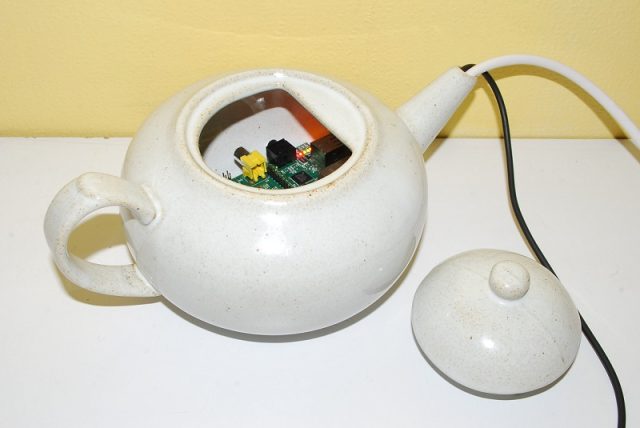
The Internet of Things. A tempest in a teapot?
The US Department of Homeland Security has announced that its Silicon Valley Office (SVO)—the agency's liaison point with the technology industry—will hold an event on December 10 to kick off a recruiting drive for startups and "non-traditional small businesses" interested in latching onto government funding. The Industry Day, being held at the Menlo Park, California, offices of SRI International, will be focused on the current leading source of worry for DHS officials: the "Internet of Things" (IoT).
The DHS posting describes the three-hour event as a time to:
1)Describe the homeland security challenges associated with IoT
2) Describe the benefits of the SVO Innovation Program to startups
3) Show you how to apply for funding
And IoT is high on the DHS' funding list. Earlier this year, the agency's Science and Technology Directorate launched a Cyber Physical Systems Security (CPSSEC) program intended to spur development of security measures as part of the design process for IoT devices. In an amendment to a DHS five-year procurement program, the S&T Directorate described the crux of the problem: the "cyber physical" systems hitting the market now have largely "not been subjected to comprehensive threat analyses, have both known and unknown vulnerabilities, and lack security as an integral part of design." The more IoT devices that are deployed, the bigger the problem will be, DHS officials noted.
Read 2 remaining paragraphs | Comments

 Silent-Freunde, aufgepasst: Der Le Grand Macho ist Thermalrights neuer semi-passiver CPU-Kühler, der sich gut für Systeme nur mit Gehäuselüftern eignet. Erste Tests bescheinigen dem Le Grand Macho eine gute Kühlleistung selbst mit einem 140-Watt-Chip. (


 Unimate war der erste Industrieroboter, Unimation das erste Unternehmen, das Roboter gebaut hat. Gegründet wurde es von Joseph Engelberger. Der Pionier der Robotik ist jetzt im Alter von 90 Jahren gestorben. (

 Eigentlich sollte sie eine Sicherheitslücke schließen: Mit der neuen Version der Dell Foundation Services können über das Netz Informationen über die Hardware, laufende Prozesse, Metadaten von Dateien und vieles mehr ausgelesen werden. (