BlackBerry Priv coming to Verizon, T-Mobile, and Sprint

BlackBerry Priv coming to Verizon, T-Mobile, and Sprint

BlackBerry’s first Android phone is no longer an AT&T exclusive in the United States. The Blackberry Priv will be available for use with Verizon, T-Mobile and Sprint starting January 26th. The phone is also already available in the UK from Vodafone. The BlackBerry Priv features a 5.4 inch, 2560 x 1440 pixel display, a Qualcomm Snapdragon […]

BlackBerry Priv coming to Verizon, T-Mobile, and Sprint is a post from: Liliputing

Samsung unveils Chromebook 3 with a matte screen, Celeron N3050 processor

Samsung unveils Chromebook 3 with a matte screen, Celeron N3050 processor

Samsung’s latest Chromebook features a simple design, a reasonably light-weight body, and long battery life. The Samsung Chromebook 3 is an 11.6 inch notebook that measures 0.7 inches thick, weighs 2.5 pounds, and should get up to 11 hours of battery life. Samsung says it will be available for purchase in early 2016, but the company […]

Samsung unveils Chromebook 3 with a matte screen, Celeron N3050 processor is a post from: Liliputing

VR sticker shock: How Oculus failed to prepare the world for a $599 Rift

Pre-order launch is an object lesson in failed expectations management.

On Monday, when Oculus first announced that it would finally be taking consumer Oculus Rift pre-orders later in the week, I tweeted an over/under prediction that the Rift itself would come in at $500. Nearly 1,000 Twitter poll voters seemed to converge on that same expectation, with almost equal proportions guessing the price would be higher or lower than $500 (and 19 percent thinking the $500 guess was exactly right). It's not a random, scientific sample or anything, but the wisdom of crowd effect suggests $500 was a decent average expectation for the Rift price as of earlier this week (at least among the generally tech-savvy audience that would see my tweet).

Those baseline expectations were extremely important this morning when Oculus announced a $599 price for the first consumer edition of the Oculus Rift. It's not hard to find people online complaining that the price tag is just too much money to pay for an unproven device like the Rift, especially when you consider the added cost of the decently powerful PC needed to use the device. Comparisons to the PS3's famously derided "Five hundred and ninety-nine US dollars" announcement are already rampant.

It's also not hard to find early adopters admitting that they're willing to pay the perhaps higher-than-expected price—the ever-receding "expected ship date" on the Oculus Shop page suggests sales are surpassing inventories so far, at least. Everyone's budgetary threshold for VR is going to be different, and there's no reason that the early adopter, day-one price for a new category of consumer hardware should be the same as the eventual "mass market" price brought on by scale and technological advancement.

Read 13 remaining paragraphs | Comments

Android N switches to OpenJDK, Google tells Oracle it is protected by the GPL

Google hopes to dodge issues in the Oracle lawsuit, and it gets a superior codebase.

The Oracle v. Google legal battle over the use of Java in Android keeps on going, but this week Google made a change to Android that it hopes will let the company better navigate its current legal trouble.

Google told VentureBeat that it in "Android N," the next major version of Android, it is swapping Android's Java libraries from its own Apache Harmony-based implementation to one based on Oracle's OpenJDK—yes that Oracle, the same company suing Google. OpenJDK is the "official" open source version of the Java Platform, and Oracle makes it available under the GPL with a linking exception.

Google next told the court that it had "released new versions of the Android platform that are expressly licensed by Oracle for use by Google under the free, open source license provided by Oracle as part of its OpenJDK project. Specifically, these newly released versions of Android utilize the method headers (and the associated sequence, structure, and organization of those method headers) at issue in this litigation under the open source OpenJDK license from Oracle."

Read 7 remaining paragraphs | Comments

Hands-on with E Fun Nextbook Windows laptops and 2-in-1s

Hands-on with E Fun Nextbook Windows laptops and 2-in-1s

Budget tablet maker E Fun is becoming a budget laptop maker in 2016. The company recently introduced a new line of 2-in-1 Windows tablets as well as a set of Windows notebooks with 11.6 inch and 14 inch displays, and E Fun is showing off some of each at CES in Las Vegas this week. […]

Hands-on with E Fun Nextbook Windows laptops and 2-in-1s is a post from: Liliputing

Chevrolet’s Bolt is an electric vehicle for the masses—and we’ve driven it

200-mile range, sub-$30,000 price tag, and production begins this year.

Jonathan test drives a pre-production Chevy Bolt. Video shot/edited by Jennifer Hahn, additional camera by Nathan Fitch. (video link)


LAS VEGAS—Today at CES, General Motors' CEO Mary Barra will formally unveil one of the most significant new cars in the company's history. It's called the Chevrolet Bolt, and when it goes on sale later this year it will be the first long-range battery electric vehicle that's truly affordable. In fact, GM says that after the $7500 IRS EV tax credit, the Bolt will cost under $30,000, making it cheaper than the average new-car price ($33,560 in 2015, according to Kelley Blue Book). Not bad at all for an EV with a 200-mile range.

Read 6 remaining paragraphs | Comments

The birth of Debian, in the words of Ian Murdock himself

Way back in 1999, I spoke to Murdock about Debian’s package-based genesis.

As we reported a few days ago, Ian Murdock, the creator of the Debian GNU/Linux distribution project, died in rather unclear circumstances last week. Until more details emerge, it seems wise to refrain from speculation about what really happened. Far better to celebrate what is not in doubt: his important contribution to free software at a critical period in its growth.

In November 1999, I spoke to Murdock at length, during one of the 50 interviews that form the backbone of my book Rebel Code: Linux and the Open Source Revolution. Inevitably, I was only able to use a few quotations from Murdock in the book's text, and now seems an appropriate moment to give a more complete version of how Murdock came to create Debian, told in his own words.

Murdock first came across GNU/Linux in 1993, when he was a 20-year-old student at Purdue University, studying accountancy: "This was around the time that PCs were just starting to get fast enough to actually run things like Unix. I'd been using Unix and I saw Linux as a way to have more convenient access to it." He said that the software at that time was "pretty rough around the edges," but that helping to fix that was part of the fun: "one of the great things about Linux is it was one of the first operating systems that you could actually not only see what it was doing but you could get in there and tinker around with it."

Read 16 remaining paragraphs | Comments

Lawsuit claims Fitbit devices dangerously underestimate heart rate

Three plaintiffs say Fitbits fail during exercise, worthless as heart monitors.

With some Fitbit devices, every beat may not get counted, according to claims in a proposed nationwide class action lawsuit filed Tuesday.

Three plaintiffs claim that their Fitbit wrist-based heart monitors, “Charge HR” and “Surge,” do not and cannot accurately measure heart rate as advertised. Those sales pitches claim that both products, which are sold for around $150 and $250, respectively, can continuously and accurately monitor heart rate, even during exercise—under tag lines such as “every beat counts.” But the lawsuit claims that the heart rate monitors, which tout “PurePulse Tracker” technology, seem particularly incapable of accurately measuring elevated heart rates, often reading dangerously underestimated rates during workouts.

In the lawsuit, plaintiff Teresa Black, of Colorado, claimed that her Charge HR device was off by 78 beats per minute (bpm) during one workout. Her personal trainer recorded her heart rate at 160 bpm, while her Fitbit read 82 bpm. “Plaintiff Black was approaching the maximum recommended heart rate for her age, and if she had continued to rely on her inaccurate PurePulse Tracker, she may well have exceeded it, thereby jeopardizing her health and safety,” the lawsuit stated.

Read 6 remaining paragraphs | Comments

Razer launches Nabu Watch, says it’s smart, but not a smartwatch

Razer launches Nabu Watch, says it’s smart, but not a smartwatch

Razer’s latest entry into the wearable space is a watch. But it isn’t a smartwatch. The Razer Nabu Watch is a digital watch with Razer’s distinctive black and green color scheme. But it also has sensors for fitness tracking and Bluetooth connectivity for notifications, communications, and a few other features. Razer is taking orders for a […]

Razer launches Nabu Watch, says it’s smart, but not a smartwatch is a post from: Liliputing

New study hints that we’re closing in on metallic hydrogen

It’s taken 80 years, but high pressure may be breaking down hydrogen molecules.

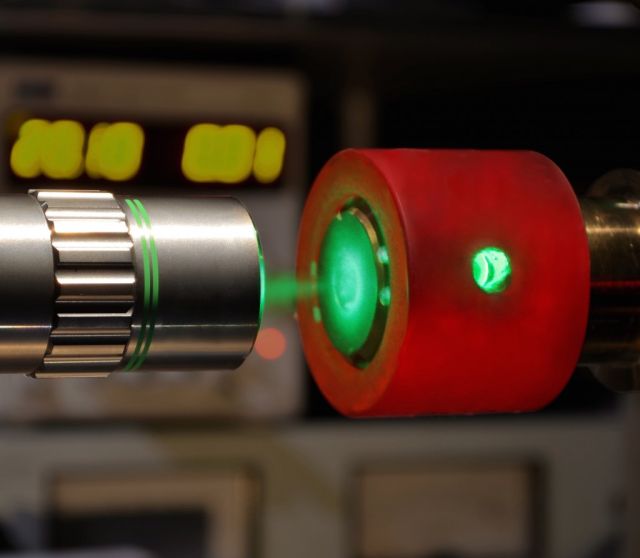
Raman spectroscopy and a diamond anvil were used to identify and characterize a new phase of hydrogen. (credit: Philip Dalladay-Simpson and Eugene Gregoryanz)

We tend to think of the properties of the chemical elements as immutable—a metal is a metal, and a gas is a gas. But all those properties are what we experience on Earth. The Universe, on the other hand, is filled with extremes of temperature and pressure that cause elements to defy our expectations. Pluto is covered in nitrogen ice, while some exoplanets are likely to experience rains of liquid metal.

Close to the cores of gas giants, elements are squeezed by unimaginable pressures, capable of rearranging electron orbitals and playing havoc with the chemical bonding we see on Earth. Here, theorists have predicted, the electrons of hydrogen could be set free, converting the gas into a solid or liquid metal. But while researchers first predicted the existence of metallic hydrogen 80 years ago, the element has stubbornly refused to appear, even after we've raised pressures well above where it was expected to appear.

Now, three Edinburgh-based researchers report placing hydrogen under the highest pressures yet achieved. Scans of the resulting material suggest that the chemical bonds that normally link hydrogen into a molecule are starting to break down, heralding the possible appearance of a metallic form.

Read 9 remaining paragraphs | Comments