John Legere asks EFF, “Who the f**k are you, and who pays you?”

T-Mobile CEO takes on digital rights group that objected to video throttling.

T-Mobile USA CEO John Legere has spent much of today defending the carrier's controversial "Binge On" program, and he didn't hold much back when answering his critics.

The Electronic Frontier Foundation (EFF), which has criticized T-Mobile for throttling video streams down to 480p, asked him on Twitter whether T-Mobile is altering the video streams or just limiting their bandwidth.

Legere responded in a video:

Read 7 remaining paragraphs | Comments

Asmodee becomes board gaming’s new monster, acquires English rights to Catan

Had already acquired American tabletop giants Fantasy Flight, Days of Wonder.

Thanks to today's announcement, future English-language copies of Settlers of Catan will probably have that giant "M" for Mayfair removed or changed to reflect Asmodee's acquisition. (credit: Sam Machkovech)

The modern board game renaissance can trace many of its origins to the nation of Germany—whose annual Spiel des Jahres awards are arguably as big there as the Oscars are in the United States—but one major tabletop gaming producer has begun an aggressive push to get France in the conversation.

In addition to putting out critically acclaimed games of its own, French game producer Asmodee has been on a game and company acquisition tear for the past two years. On Thursday, the company pulled off its biggest acquisition yet: the English-language rights to the German board gaming sensation that is Catan. A press release from Asmodee North America clarified that the deal with current publisher Mayfair Games will transfer "publishing, commercial, and brand rights" for all English-language Catan products to Asmodee—and specifically, its new Catan Studio, Inc. imprint, headed by former Mayfair CEO Peter Fenlon—after an undefined "transitional period." (Asmodee did not publicly publish its press release, but Mayfair posted its own similar one shortly afterward.)

This follows Asmodee's acquisition of major North American game publishers Days of Wonder and Fantasy Flight in 2014, along with the Spot-It! casual games series in 2015, meaning one company now controls the rights to critical darlings Ticket to Ride, Dixit, Citadels, Talisman, Small World, 7 Wonders, and the monster that is Catan's ever-expanding presence in English-speaking countries. In Catan terms, that means the company is pretty much steeped in a figurative surplus of wood, sheep, ore, brick, and grain.

Read 1 remaining paragraphs | Comments

Governor declares state of emergency in connection with California methane leak

No state funds will be used to fix it, but some gas storage sites must now be monitored.

Governor Brown Visits Aliso Canyon. (credit: Governor's Office of Emergency Services)

On Wednesday evening, California Governor Jerry Brown declared a state of emergency in Los Angeles County in connection with a massive natural gas leak that’s ongoing at a Southern California Gas Company storage facility. The leak, which began on October 23, has been spewing methane into the air at a rate of tens of thousands of kilograms (PDF) per hour.

Governor Brown’s declaration of a state of emergency requires that SoCal Gas and other gas storage facility operators throughout California start conducting daily inspections of well heads and implement infrared imaging technology to detect leaks. Facility operators will have to monitor the wells for mechanical integrity, gas pressure, and safety on an ongoing basis.

The emergency declaration doesn’t earmark any state funds to help fund a cleanup, but it orders the California Public Utilities Commission to "ensure that Southern California Gas Company covers costs related to the natural gas leak and its response, while protecting ratepayers.”

Read 6 remaining paragraphs | Comments

Judge: Lawyer who filed class-action suit against Apple is “manifestly incompetent”

Paralegal buys AppleCare with boss’ cash, then sues over the “fraudulent scheme.”

(credit: Alper Çuğun)

On Tuesday, a federal judge rejected a proposed class-action lawsuit targeting Apple's extended service plan. US District Judge William Orrick shot down (PDF) all five of the plaintiff's legal theories and also had scathing words for the Texas lawyer who filed the suit.

English v. Apple was originally filed in 2013 in Galveston, Texas, and the case was later transferred to California. The three named plaintiffs, Patricia Adkins, Jennifer Galindo, and Fabrienne English, all said that Apple's AppleCare extended service plans amounted to a "fraudulent and unlawful scheme" because the company sometimes uses refurbished iPhones as replacement units.

But none of the plaintiffs were disgruntled consumers who went looking for a lawyer after getting bad service. Galindo was a paralegal for Renee Kennedy, the lawyer who filed the lawsuit, and Adkins had also worked for Kennedy in the past. Kennedy gave them both "monetary gifts to thank them for their excellent work," and both women used those "gifts" to buy AppleCare Plus, referred to as "AC+" in court papers.

Read 13 remaining paragraphs | Comments

8S Mobile shows off a dual-screen (E Ink and LCD) phone with premium specs

8S Mobile shows off a dual-screen (E Ink and LCD) phone with premium specs

Over the past few years we’ve seen a few different dual-screen phones with color displays on one side and E Ink screens on the other. But a Chinese manufacturer called Shenzhen Hexiang Elecronics (or 8SMobile) is showing off the most powerful model I’ve seen so far. The 4G LTE 8S105 smartphone features a 5.2 inch, […]

8S Mobile shows off a dual-screen (E Ink and LCD) phone with premium specs is a post from: Liliputing

WebOS 3.0 angeschaut: LGs Smart TVs werden Smartphone-freundlicher

Die neue WebOS-Version für LGs Smart TVs sieht zwar auf den ersten Blick aus, wie ihr Vorgänger – neue Funktionen wie eine bessere Anbindung von Smartphones oder ein Musik-Player, der mit ausgeschaltetem Bildschirm funktioniert, verbessern das Nutzungserlebnis aber merklich. (CES 2016, Heimkino)

Die neue WebOS-Version für LGs Smart TVs sieht zwar auf den ersten Blick aus, wie ihr Vorgänger - neue Funktionen wie eine bessere Anbindung von Smartphones oder ein Musik-Player, der mit ausgeschaltetem Bildschirm funktioniert, verbessern das Nutzungserlebnis aber merklich. (CES 2016, Heimkino)

Major piracy group warns games may be crack-proof in two years

The never-ending game-cracking battle may be tilting toward digital protection.

I'm free... free from piracy!

In the never-ending battle between pirates and game makers, it often seems like the pirates have the upper hand, releasing DRM-breaking cracks within hours or days of a game's official release. Now, the founder of a major Chinese piracy group is warning that it is losing the battle against a specific DRM protection scheme, to the point where game piracy may no longer be possible within two years.

TorrentFreak reports on a recent post by Bird Sister, the founder of Chinese cracking message board 3DM forum, that says the recent release of Just Cause 3 has pushed the group's cracking abilities practically past their limits. "The last stage is too difficult and Jun [cracking guy] nearly gave up, but last Wednesday I encouraged him to continue,” she wrote.

"I still believe that this game can be compromised. But according to current trends in the development of encryption technology, in two years' time I’m afraid there will be no free games to play in the world," she continued.

Read 3 remaining paragraphs | Comments

Intel launches $399 RealSense/Project Tango smartphone for developers

Intel launches $399 RealSense/Project Tango smartphone for developers

Intel has introduced a smartphone with an Atom x7-Z8700 Cherry Trail processor, a 6 inch, 2560 x 1440 pixel display, 2GB of RAM, and 64GB of storage. And the company’s going to sell it for $399. There’s one small catch though: the target market is developers, and the phone is really a development kit designed […]

Intel launches $399 RealSense/Project Tango smartphone for developers is a post from: Liliputing

US fails its annual broadband deployment test at FCC

Despite improvement, FCC says broadband still not being deployed to all in US.

(credit: Marcelo Graciolli)

The Federal Communications Commission's annual review of broadband deployment says that advanced Internet service is still not being offered to all Americans.

34 million Americans, about 10 percent of the country, "still lack access to fixed broadband at the FCC’s benchmark speed of 25Mbps for downloads, 3Mbps for uploads," the FCC said in a fact sheet released today. This isn't a question of not being able to afford broadband or deciding to go without—when the FCC says you don't have access, that means no providers are willing to serve your home at modern broadband speeds at any price.

There is good news, though. In 2012, a full 20 percent of Americans could not buy 25Mbps/3Mbps broadband. The number dropped to 17 percent in 2013 and then to 10 percent in 2014. Data for 2015 isn't available yet. The annual Broadband Progress Report is based on filings by Internet service providers, and it takes a while to crunch all the numbers, so the reports are always a little behind.

Read 15 remaining paragraphs | Comments

Malicious apps in Google Play made unauthorized downloads, sought root

Apps with as many as a million downloads removed following their discovery.

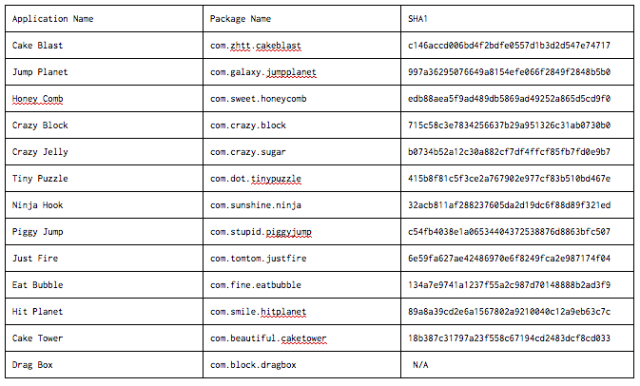
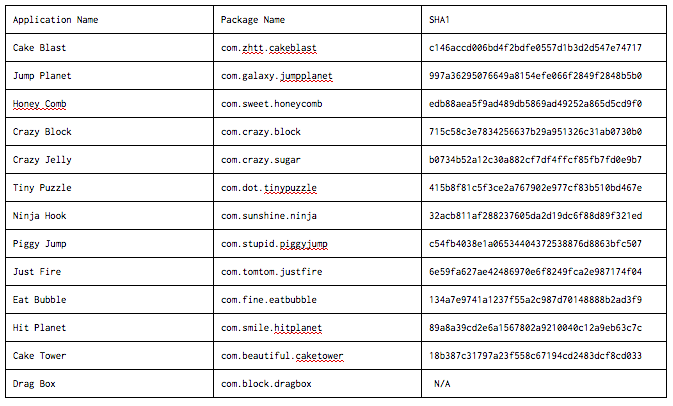
Enlarge / A list of the 13 malicious apps in the Brain Test family found hosted on Google Play. (credit: Lookout)

Google has banished 13 Android apps from its Play marketplace after security researchers found the apps made unauthorized downloads and attempted to gain root privileges that allowed them to survive factory resets.

One of the 13 apps, which was known as Honeycomb, had as many as one million downloads before it was removed, according to researchers from Lookout, the mobile security provider that spotted the malicious entries. The apps boasted a large number of downloads and highly favorable user ratings, presumably thanks to the ability of one app to automatically download other apps and then leave rave user reviews for them. In a blog post, Lookout researcher Chris Dehghanpoor wrote:

The explanation for the apps’ high ratings and hundreds-of-thousands of downloads is the malware itself. First off, some of the apps are fully-functioning games. Some are highly rated because they are fun to play. Mischievously, though, the apps are capable of using compromised devices to download and positively review other malicious apps in the Play store by the same authors. This helps increase the download figures in the Play Store. Specifically, it attempts to detect if a device is rooted, and if so, copies several files to the /system partition in an effort to ensure persistence, even after a complete factory reset. This behavior is very similar to several other malware families we’ve seen recently, specifically Shedun, ShiftyBug, and Shuanet.

As Ars reported in November, members of the Shedun, Shuanet, and ShiftyBug families expose phones to potentially dangerous root exploits that can make app removal extremely hard for many users. That's because the apps are often able to root the infected device and install themselves as system applications. That can make them hard to remove using conventional methods, such as the uninstall button or factory reset in the Android options menu.

Read 2 remaining paragraphs | Comments