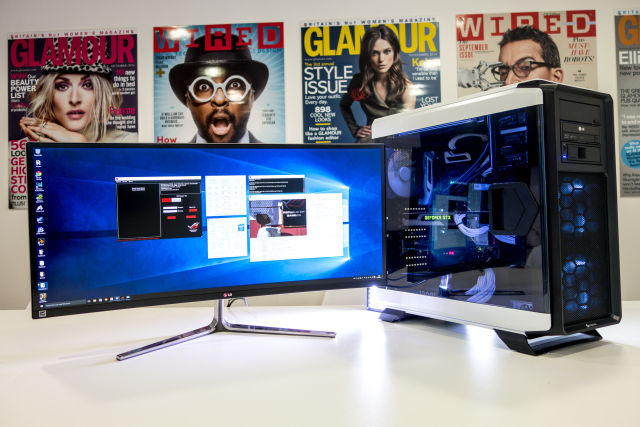
Remember when affordable UHD monitors were the new hotness and everyone desperately tried to figure out how to push their games to run at obscenely large (3840×2160) resolutions? How about when everyone realised they'd need at least two GTX 980 Ti graphics cards to do it, and thus decided that high-res 21:9 "ultrawide" monitors (3440×1440) were the real sweet spot between performance and resolution, with extras like G-Sync, 144Hz refresh rates, and curved panels making them even more expensive than UHD displays?
Well, good news everyone! UHD and 21:9 are dead to us now. The new, new display hotness—according to a report by TFCentral— is LG's upcoming LM375UW1, a 37.5-inch panel sporting a 2.4:1 aspect ratio at the unusual resolution of 3840×1600 pixels. For those keeping count, that's basically a very high-res ultrawide, with slightly less pixels than a UHD monitor. While it'll be a little easier to drive than a full 16:9 UHD display, the LM375UW1 isn't geared towards gaming (it has a 14ms response time). It's likely gaming-focused displays will appear at a later date, though.
That is unless Samsung's new super-ultrawide 32:9 displays take off. Yes, the new, new, new display hotness for 2016 is Samsung's as-yet-unnamed and absurdly large 41-inch 32:9 FHD+ panel. It'll be joined by an even bigger 49-inch version, which is likely to stretch almost the entire width of a desk. The exact specs and resolution of the displays haven't been confirmed, but a 32:9 aspect ratio works out to a 3840×1080 resolution. That might not make for the most practical desktop use, or the most compelling pixel density, but for games where you want a broad field of view it'll be quite something. The LG and Samsung panels are due for release this year.
Read 2 remaining paragraphs | Comments


 Nach einer Verdopplung im vergangenen Jahr rechnet Owncloud auch für 2016 mit 100 Prozent Umsatzwachstum auf insgesamt 16 Millionen US-Dollar. Zu den Großkunden des Unternehmens zählt auch die Deutsche Bahn. (

 Unter bestimmten Umständen sind Skylake-Prozessoren bei AVX-Berechnungen abgestürzt. Intel hat ein Microcode-Update für Mainboard-Hersteller bereitgestellt, um den Fehler zu korrigieren. (


 Er gilt als einer der Begründer der künstlichen Intelligenz. Aber Marvin Minsky hatte noch mehr drauf: Er baute das erste Head-mounted Display sowie einen Synthesizer und spielte virtuos Klavier. Am 24. Januar 2016 starb der vielseitige Wissenschaftler. (


 Linksys hat einen High-End-Router vorgestellt, der in die Kategorie AC5400 eingestuft wird. Er ist auf dem Papier schneller als Netgears Nighthawk x8, der nur zu den AC5300-Geräten gehört. Das liegt aber vor allem daran, dass Linksys großzügiger mit den 802.11ac-Wave-2-Zahlen spielt. (

 Die Krypto-Arbeitsgruppe der IETF hat RFC 7748 veröffentlicht. Darin spezifiziert sind die zwei elliptischen Kurven Curve25519 und Curve447. Sie sind das Ergebnis einer langen Diskussion. (
