
Google Removed 749 Million Anna’s Archive URLs from its Search Results

Popular shadow library Anna’s Archive has become a top target for copyright holders. In just three years, publishers and authors have prompted Google to remove 749 million of the site’s URLs from its search results. Despite this immense takedown campaign, which accounts for 5% of all URLs reported to Google on copyright grounds, the site itself remains easily discoverable through the search engine.

From: TF, for the latest news on copyright battles, piracy and more.

archiveAnna’s Archive is a meta-search engine for shadow libraries that allows users to find pirated books and other related sources.

The site launched in the fall of 2022, just days after Z-Library was targeted in a U.S. criminal crackdown, to ensure continued availability of ‘free’ books and articles to the broader public.

In the three years since then, Anna’s Archive has built up quite the track record. The site has been blocked in various countries, was sued in the U.S. after it scraped WorldCat, and actively provides assistance to AI researchers who want to use its library for model training.

Despite legal pressure, Annas-archive.org and the related .li and .se domains remain operational. This is a thorn in the side of publishers who are actively trying to take the site down. In the absence of options to target the site directly, they ask third-party intermediaries such as Google to lend a hand.

749 Million URLs

Google and other major search engines allow rightsholders to request removal of allegedly infringing URLs. The aim is to ensure that pirate sites no longer show up in search results when people search for books, movies, music, or other copyrighted content.

The Pirate Bay, for example, has been a popular target; Google has removed more than 4.2 million thepiratebay.org URLs over the years in response to copyright holder complaints. While this sounds like a sizable number, it pales in comparison to the volume of takedowns targeting Anna’s Archive.

Google’s transparency report reveals that rightsholders asked Google to remove 784 million URLs, divided over the three main Anna’s Archive domains. A small number were rejected, mainly because Google didn’t index the reported links, resulting in 749 million confirmed removals.

The comparison to sites such as The Pirate Bay isn’t fair, as Anna’s Archive has many more pages in its archive and uses multiple country-specific subdomains. This means that there’s simply more content to take down. That said, in terms of takedown activity, the site’s three domain names clearly dwarf all pirate competition.
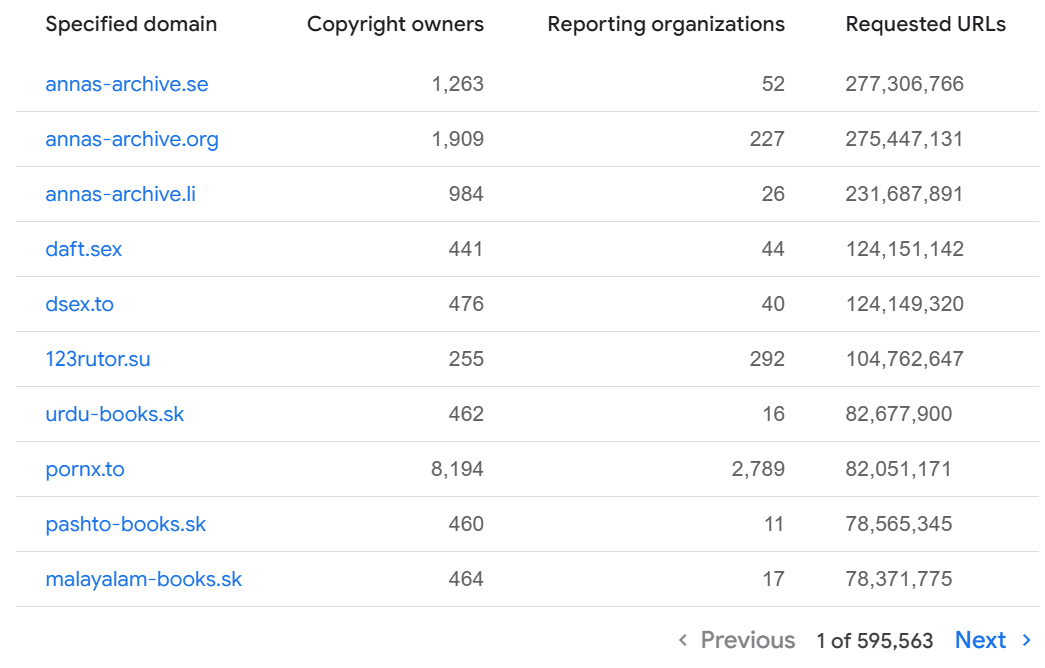
Top targeted domains (Google)

Top targeted domains (Google)

5% of All Google Takedowns, Ever

Since Google published its first transparency report in May 2012, rightsholders have flagged 15.1 billion allegedly infringing URLs. That’s a staggering number, but the fact that 5% of the total targeted Anna’s Archive URLs is remarkable.

Penguin Random House and John Wiley & Sons are the most active publishers targeting the site, but they are certainly not alone. According to Google data, more than 1,000 authors or publishers have sent DMCA notices targeting Anna’s Archive domains.

Yet, there appears to be no end in sight. Rightsholders are reporting roughly 10 million new URLs per week for the popular piracy library, so there is no shortage of content to report.

With these DMCA takedown notices, publishers are aiming to make it as difficult as possible for people to find books on the site using Google. This works, as many URLs are now delisted while others are actively being demoted by the search engine for book-related queries.

That said, the Anna’s Archive website is certainly not unfindable. Searching for the site’s name in Google still shows the main domain as the top search result.
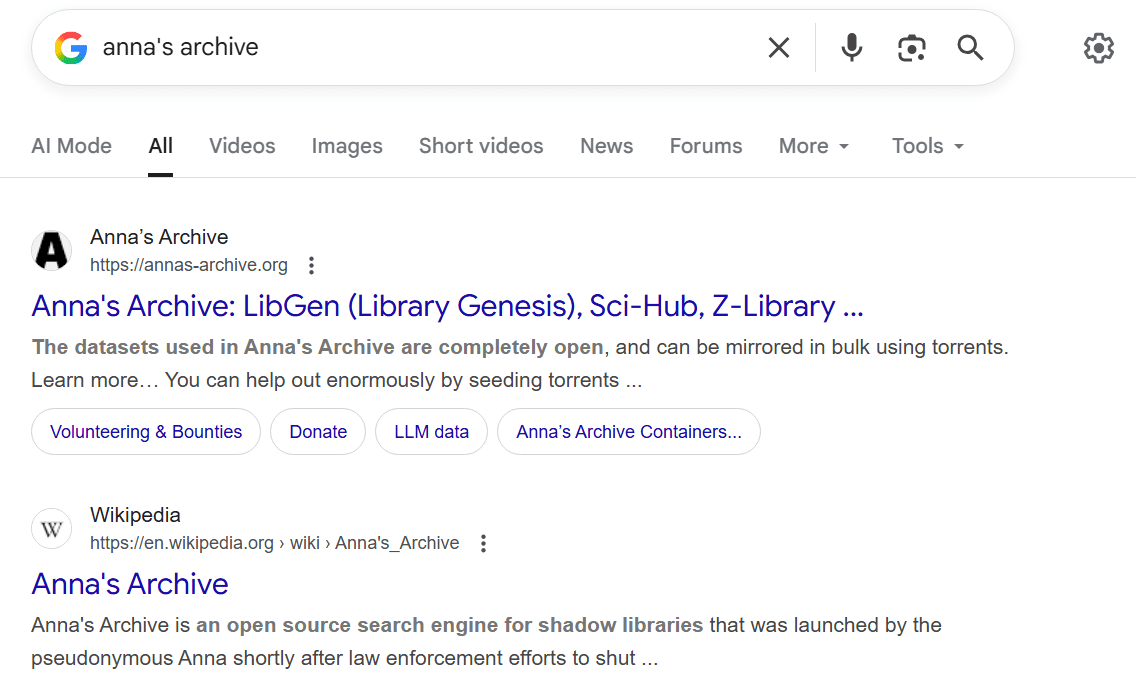
Search: Anna’s Archive

Search: Anna's Archive

From: TF, for the latest news on copyright battles, piracy and more.

Google removes Gemma models from AI Studio after GOP senator’s complaint

Sen. Marsha Blackburn says Gemma concocted sexual misconduct allegations against her.

You may be disappointed if you go looking for Google’s open Gemma AI model in AI Studio today. Google announced late on Friday that it was pulling Gemma from the platform, but it was vague about the reasoning. The abrupt change appears to be tied to a letter from Sen. Marsha Blackburn (R-Tenn.), who claims the Gemma model generated false accusations of sexual misconduct against her.

Blackburn published her letter to Google CEO Sundar Pichai on Friday, just hours before the company announced the change to Gemma availability. She demanded Google explain how the model could fail in this way, tying the situation to ongoing hearings that accuse Google and others of creating bots that defame conservatives.

At the hearing, Google’s Markham Erickson explained that AI hallucinations are a widespread and known issue in generative AI, and Google does the best it can to mitigate the impact of such mistakes. Although no AI firm has managed to eliminate hallucinations, Google’s Gemini for Home has been particularly hallucination-happy in our testing.

Read full article

Comments

OpenAI signs massive AI compute deal with Amazon

Deal will provide access to hundreds of thousands of Nvidia chips that power ChatGPT.

On Monday, OpenAI announced it has signed a seven-year, $38 billion deal to buy cloud services from Amazon Web Services to power products like ChatGPT and Sora. It’s the company’s first big computing deal after a fundamental restructuring last week that gave OpenAI more operational and financial freedom from Microsoft.

The agreement gives OpenAI access to hundreds of thousands of Nvidia graphics processors to train and run its AI models. “Scaling frontier AI requires massive, reliable compute,” OpenAI CEO Sam Altman said in a statement. “Our partnership with AWS strengthens the broad compute ecosystem that will power this next era and bring advanced AI to everyone.”

OpenAI will reportedly use Amazon Web Services immediately, with all planned capacity set to come online by the end of 2026 and room to expand further in 2027 and beyond. Amazon plans to roll out hundreds of thousands of chips, including Nvidia’s GB200 and GB300 AI accelerators, in data clusters built to power ChatGPT’s responses, generate AI videos, and train OpenAI’s next wave of models.

Read full article

Comments

“Unexpectedly, a deer briefly entered the family room”: Living with Gemini Home

Gemini for Home unleashes gen AI on your Nest camera footage, but it gets a lot wrong.

You just can’t ignore the effects of the generative AI boom.

Even if you don’t go looking for AI bots, they’re being integrated into virtually every product and service. And for what? There’s a lot of hand-wavey chatter about agentic this and AGI that, but what can “gen AI” do for you right now? Gemini for Home is Google’s latest attempt to make this technology useful, integrating Gemini with the smart home devices people already have. Anyone paying for extended video history in the Home app is about to get a heaping helping of AI, including daily summaries, AI-labeled notifications, and more.

Given the supposed power of AI models like Gemini, recognizing events in a couple of videos and answering questions about them doesn’t seem like a bridge too far. And yet Gemini for Home has demonstrated a tenuous grasp of the truth, which can lead to some disquieting interactions, like periodic warnings of home invasion, both human and animal.

Read full article

Comments

Lilbits: A new handheld Linux PC, Google opens up the Play Store (a little), Samsung’s web browser comes to PCs

In many ways, handheld gaming PCs are the modern descendants of the UMPCs (ultra mobile PCs) from twenty years ago. But with a few exceptions, most don’t have the keyboards or long battery life that you’d want for general purpose computing….

In many ways, handheld gaming PCs are the modern descendants of the UMPCs (ultra mobile PCs) from twenty years ago. But with a few exceptions, most don’t have the keyboards or long battery life that you’d want for general purpose computing. Fortunately for fans of handheld computing, we’ve also seen a number of DIY solutions […]

The post Lilbits: A new handheld Linux PC, Google opens up the Play Store (a little), Samsung’s web browser comes to PCs appeared first on Liliputing.

Leaker reveals which Pixels are vulnerable to Cellebrite phone hacking

Cellebrite can apparently extract data from most Pixel phones, unless they’re running GrapheneOS.

Despite being a vast repository of personal information, smartphones used to have little by way of security. That has thankfully changed, but companies like Cellebrite offer law enforcement tools that can bypass security on some devices. The company keeps the specifics quiet, but an anonymous individual recently logged in to a Cellebrite briefing and came away with a list of which of Google’s Pixel phones are vulnerable to Cellebrite phone hacking.

This person, who goes by the handle rogueFed, posted screenshots from the recent Microsoft Teams meeting to the GrapheneOS forums (spotted by 404 Media). GrapheneOS is an Android-based operating system that can be installed on select phones, including Pixels. It ships with enhanced security features and no Google services. Because of its popularity among the security-conscious, Cellebrite apparently felt the need to include it in its matrix of Pixel phone support.

The screenshot includes data on the Pixel 6, Pixel 7, Pixel 8, and Pixel 9 family. It does not list the Pixel 10 series, which launched just a few months ago. The phone support is split up into three different conditions: before first unlock, after first unlock, and unlocked. The before first unlock (BFU) state means the phone has not been unlocked since restarting, so all data is encrypted. This is traditionally the most secure state for a phone. In the after first unlock (AFU) state, data extraction is easier. And naturally, an unlocked phone is open season on your data.

Read full article

Comments

Google makes first Play Store changes after losing Epic Games antitrust case

Google is begrudgingly letting developers lead users away from the Play Store.

Since launching Google Play (née Android Market) in 2008, Google has never made a change to the US store that it didn’t want to make—until now. Having lost the antitrust case brought by Epic Games, Google has implemented the first phase of changes mandated by the court. Developers operating in the Play Store will have more freedom to direct app users to resources outside the Google bubble. However, Google has not given up hope of reversing its loss before it’s forced to make bigger changes.

Epic began pursuing this case in 2020, stemming from its attempt to sell Fortnite content without going through Google’s payment system. It filed a similar case against Apple, but the company fell short there because it could not show that Apple put its thumb on the scale. Google, however, engaged in conduct that amounted to suppressing the development of alternative Android app stores. It lost the case and came up short on appeal this past summer, leaving the company with little choice but to prepare for the worst.

Google has updated its support pages to confirm that it’s abiding by the court’s order. In the US, Play Store developers now have the option of using external payment platforms that bypass the Play Store entirely. This could hypothetically allow developers to offer lower prices, as they don’t have to pay Google’s commission, which can be up to 30 percent. Devs will also be permitted to direct users to sources for app downloads and payment methods outside the Play Store.

Read full article

Comments

After teen death lawsuits, Character.AI will restrict chats for under-18 users

AI companion app faces legal and regulatory pressure over child safety concerns.

On Wednesday, Character.AI announced it will bar anyone under the age of 18 from open-ended chats with its AI characters starting on November 25, implementing one of the most restrictive age policies yet among AI chatbot platforms. The company faces multiple lawsuits from families who say its chatbots contributed to teenager deaths by suicide.

Over the next month, Character.AI says it will ramp down chatbot use among minors by identifying them and placing a two-hour daily limit on their chatbot access. The company plans to use technology to detect underage users based on conversations and interactions on the platform, as well as information from connected social media accounts. On November 25, those users will no longer be able to create or talk to chatbots, though they can still read previous conversations. The company said it is working to build alternative features for users under the age of 18, such as the ability to create videos, stories, and streams with AI characters.

Character.AI CEO Karandeep Anand told The New York Times that the company wants to set an example for the industry. “We’re making a very bold step to say for teen users, chatbots are not the way for entertainment, but there are much better ways to serve them,” Anand said in the interview. The company also plans to establish an AI safety lab.

Read full article

Comments

TV-focused YouTube update brings AI upscaling, shopping QR codes

YouTube seeks a more couch-friendly experience.

YouTube has been streaming for 20 years, but it was only in the last couple that it came to dominate TV streaming. Google’s video platform attracts more TV viewers than Netflix, Disney+, and all the other apps, and Google is looking to further beef up its big-screen appeal with a new raft of features, including shopping, immersive channel surfing, and an official version of the AI upscaling that had creators miffed a few months back.

According to Google, YouTube’s growth has translated into higher payouts. The number of channels earning more than $100,000 annually is up 45 percent in 2025 versus 2024. YouTube is now giving creators some tools to boost their appeal (and hopefully their income) on TV screens. Those elaborate video thumbnails featuring surprised, angry, smiley hosts are about to get even prettier with the new 50MB file size limit. That’s up from a measly 2MB.

Video upscaling is also coming to YouTube, and creators will be opted in automatically. To start, YouTube will be upscaling lower-quality videos to 1080p. In the near future, Google plans to support “super resolution” up to 4K.

Read full article

Comments

AI-powered search engines rely on “less popular” sources, researchers find

Generative search engines often cite sites that wouldn’t appear in Google’s Top 100 links.

Since last year’s disastrous rollout of Google’s AI Overviews, the world at large has been aware of how AI-powered search results can differ wildly from the traditional list of links search engines have generated for decades. Now, new research helps quantify that difference, showing that AI search engines tend to cite less popular websites and ones that wouldn’t even appear in the Top 100 links listed in an “organic” Google search.

In the pre-print paper “Characterizing Web Search in The Age of Generative AI,” researchers from Ruhr University in Bochum and the Max Planck Institute for Software Systems compared traditional link results from Google’s search engine to its AI Overviews and Gemini-2.5-Flash. The researchers also looked at GPT-4o’s web search mode and the separate “GPT-4o with Search Tool,” which resorts to searching the web only when the LLM decides it needs information found outside its own pre-trained data.

The researchers drew test queries from a number of sources, including specific questions submitted to ChatGPT in the WildChat dataset, general political topics listed on AllSides, and products included in the 100 most-searched Amazon products list.

Read full article

Comments