Climate simulations show effects of releasing permafrost carbon

Best match yet for ice core data during the last deglaciation.

Enlarge / Lakes formed by melting permafrost, on peatland. In Hudson Bay, Canada. (credit: Steve Jurvetson)

During the last deglaciation, between roughly 21,000 and 10,000 years ago, there was a rise in atmospheric carbon. This surge brought CO2 levels up to where they were in preindustrial times and contributed to the warming that ended the glacial period. But there's a significant item missing from this picture: we don't know where the carbon came from.

Researchers had suggested that changes in the distribution of ice, driven by alterations in Earth's orbit and tilt, altered the ocean’s capacity to absorb CO2. But a new paper performed a model-driven analysis of past changes in carbon levels and come up with a somewhat different answer. The authors' simulations showed that, when a permafrost carbon component was included, it was possible to reproduce the atmospheric CO2 levels seen in ice core measurements—suggesting that carbon released by melting permafrost contributed to the rise of CO2.

Carbon accounting

Data from the ice cores can help narrow down the possibilities, because it records something called δ13C (delta-thirteen-C), which is essentially a measure of the ratio of carbon-13 to carbon-12 in the atmosphere. (It’s mathematically a bit more complicated, but that’s the basic idea). As this ratio is influenced by biological activity, it can give some clues about the carbon's source. Even with these clues, however, previous simulations have failed to narrow down the possibilities. The researchers suspected that was because these weren't taking into account an important mechanism: change in permafrost.

Read 10 remaining paragraphs | Comments

The saga of DC’s never-ending universe

Turns out the company most known for rebooting has never rebooted.

(credit: DC Comics)

Any comics fan will tell you: DC has a reputation for rebooting its line often. With its headline-grabbing "New 52" initiative as recent example, the company seems to enjoy starting their stories from the beginning and discarding previously established continuity. Critics point to the company’s massive, universe-shattering crossover epics as prime examples: Crisis on Infinite Earths, Zero Hour, Infinite Crisis, and most recently Flashpoint, which ushered in that controversial New 52 era. This happens so much, many readers now treat the next reboot as inevitable.

It may come as a surprise, then, to hear the DC Universe (DCU) has never been rebooted. While the company has absolutely tweaked its continuity, there's never been a full reboot on the entire universe. Not once. Geoff Johns, DC’s Chief Creative Officer, recently remarked that the DCU has “an umbilical cord that goes all the way back to "Action Comics" #1, that connects the whole DC Universe." And that wasn’t just a catchy marketing phrase: it’s a fact.

This summer as DC rolled out its latest “Rebirth” line, which purports to restore lost connections to the past, it’s a good time to dive into the history of DC’s continuity and see how accurate Johns' remarks are. Has it really been one big story all along?

Read 47 remaining paragraphs | Comments

Neutrinos traveling through the Earth’s core show no sign of sterility

Another blow to hopes of new physics beyond the Standard Model.

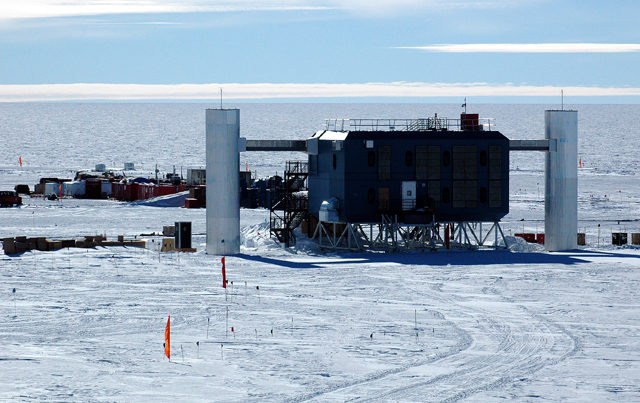
The building that houses the IceCube servers. (credit: USAP.gov)

Tantalizing hints have regularly turned up to indicate the existence of a sterile neutrino—a theoretical fourth type of neutrino separate from the three predicted by the Standard Model. Researchers have now searched for it using the IceCube Neutrino Observatory, a powerful neutrino detector in Antarctica that is able to spot neutrinos of cosmic origin. Could this particle finally be found, ushering in a thrilling new era of physics?

No. IceCube’s search has turned up nothing, as revealed in results published today. The lack of detection doesn’t necessarily mean sterile neutrinos don’t exist, but it does put the strictest constraints on them yet, narrowing down the range of energies they could have and informing future studies on where to look.

Had sterile neutrinos been found, they would have explained anomalies in old research, revealed new physics beyond the Standard Model, and potentially provided clues for mysteries such as the nature of dark matter and the imbalance between matter and anti-matter in the Universe. “If you throw in a fourth neutrino, it changes everything,” said Francis Halzen, principal investigator for IceCube and one of the paper’s authors.

Read 18 remaining paragraphs | Comments

Dawn glimpses Ceres’ internal structure

Spacecraft measures its gravity to learn about its internal structure.

An “approximately” true color image of Ceres taken by the Dawn spacecraft as it approached the dwarf planet in May, 2015. (credit: NASA)

A team of researchers has used data from the Dawn spacecraft to piece together clues about the interior of the dwarf planet Ceres. The new data indicates that while Ceres, which is the largest body in the asteroid belt, was once warm enough for water to have shifted internally, those temperatures were never high enough for an iron core to separate from the rest of the dwarf planet's interior.

Measuring gravity

The new information comes in part from an estimate of Ceres' moment of inertia, a measure of a body’s resistance to being spun on its axis. A body's moment of inertia depends on two factors. First is the variation of its gravity field over its surface: even though Ceres is roughly spherical, its gravitational strength isn’t uniform. These variations can’t be measured from Earth, though.

The second factor is whether Ceres’ gravity is strong enough to collapse it into a roughly spherical shape, bringing the internal forces into balance with each other. This state is called hydrostatic equilibrium, and it can only be estimated if researchers can determine Ceres’ precise precession rate, which is too small to observe from Earth.

Read 11 remaining paragraphs | Comments

Searching the cosmos from under the ice of Antarctica

Antarctic neutrino detector could find the origins of cosmic rays, dark matter.

The building that houses the IceCube servers. (credit: USAP.gov)

Neutrinos have precious little mass and no charge, meaning the usual ways of accelerating particles won't work on them. Yet something, somewhere out in space pushed one to energies a thousand times higher than we can reach in the Large Hadron Collider. And we only know that because we finally built a detector that could spot high-energy neutrinos when they travel through the Earth.

In a recent paper in the journal Nature Physics, Francis Halzen, the principal investigator for the IceCube detector, discussed current efforts to learn about the Universe using neutrinos. As it turns out, neutrinos are surprisingly informative about the origins of cosmic rays and potentially about dark matter as well.

Neutrinos are a fantastic tool for astronomy. Their properties—no charge and very little mass—mean that they can arrive here on Earth unobstructed by almost anything in between their source and Earth. Neutrinos generated inside the Sun, for instance, can travel right out far faster than photons, which spend time interacting with the Sun's matter.

Read 24 remaining paragraphs | Comments

ALMA captures first-ever image of a protostar’s snow line

It might be time to revise our models of planet formation.

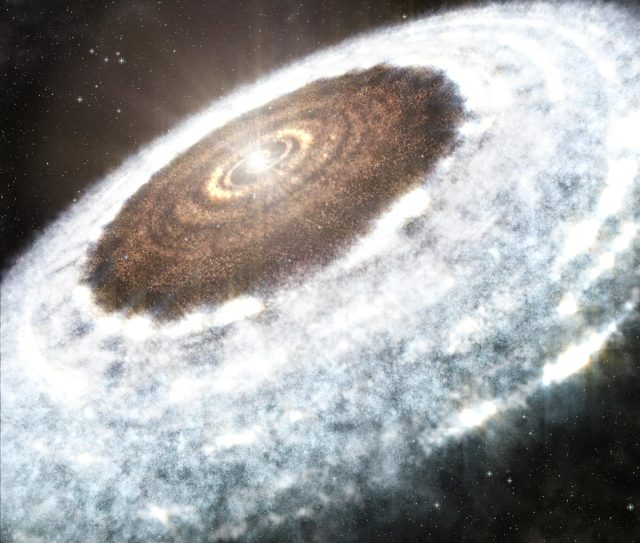
Artist's conception of the water snow line around V883 Orionis. (credit: A. Angelich (NRAO/AUI/NSF))

A team of researchers has imaged the water snow line in a forming exosolar system for the first time. The system in question, V883 Ori, is only about half a billion years old and is in an early stage of development, with planet formation probably not yet started. The observations, taken in radio wavelengths by the Atacama Large millimeter/submillimeter Array (ALMA), identify where in the system it gets cool enough for water to freeze out into a solid, influencing the formation and composition of bodies within the exosolar system.

Liquid water can’t exist in space, so ice that gets close enough to its star or protostar will heat up enough to sublimate—going from its solid form straight to gas. The snow line is the distance from the protostar where this transition takes place. Other substances, like carbon dioxide and carbon monoxide, have their own snow lines at varying distances from the protostar; the one discussed here is for water.

It has been difficult to image snow lines previously because they’re so close to their protostar, usually within about five astronomical units (AU) of it. For comparison, the Earth is only one AU from the Sun.

Read 7 remaining paragraphs | Comments

Most distant oxygen ever detected sheds light on the Universe’s dark ages

ALMA peers into the early Universe, gaining clues to how reionization happened

Artist's conception of the galaxy SXDF-NB1006-2, the subject of this study. Green represents the light that indicates the presence of ionized oxygen; purple shows ionized hydrogen.

In a new study, researchers describe observations of a distant galaxy, far enough away to be seen as it was a mere 700 million years after the Big Bang (As of this writing, it’s been about 13.8 billion years since the Big Bang). These observations turned up both the most distant oxygen ever observed and new clues about the cosmic phase shift known as reionization.

Early in the Universe’s history, there were no stars and little of any elements heavier than hydrogen and helium. When the first stars began to appear, they made two changes in the Universe around them. First, they began to create some of the heavier elements. Second, they started ionizing the hydrogen gas, stripping the electrons off it and leaving it electrically charged.

This second process is called reionization, since hydrogen started out ionized after the Big Bang, and only turned neutral after the Universe cooled. We don't fully understand the reionization era of the Universe’s history, making it a major point of study.

Read 14 remaining paragraphs | Comments

Reasoning poetically to tackle The Big Picture

Sean Carroll’s latest book unites all sorts of ideas into one cohesive Universe.

The title of physicist Sean Carroll’s latest book, The Big Picture: On the Origins of Life, Meaning, and the Universe Itself, is proof of its ambition. This book wants to tie together, well, everything. That’s no surprise; many popular science books have wide scopes and aim to tie together disparate scientific information.

But The Big Picture is more philosophical than scientific, which is a bit of a departure for Dr. Carroll. Another of his books, From Eternity to Here: The Quest for the Ultimate Theory of Time, is equally ambitious but heavy on the science. That book was largely about examining and weighing various scientific possibilities. His new book takes a step back and asks how we should be thinking about these possibilities in the first place.

But don’t be discouraged if you prefer science over philosophy: Carroll seamlessly weaves the two together. The Big Picture lives up to its title. It starts at the Big Bang, explains how time works (drawing on ideas from Carroll's previous book), passes through chemistry, biology, computer science, evolution, abiogenesis (the study of how life on Earth started), quantum mechanics, and neuroscience, all before finally arriving at a discussion of how consciousness is possible.

Read 12 remaining paragraphs | Comments

MACHOs make a return with gravitational wave discovery

Researchers ask whether LIGO discovered both dark matter and gravitational waves.

An animation of the black hole in action.

Back in February, researchers at LIGO made the historic discovery of gravitational waves, predicted a century earlier. The waves were generated by a pair of black holes in their final in-spiral before an inevitable collision and merger.

Now, a group of researchers is investigating the possibility that the discovery may have been even more historic than we thought. Last week, Physical Review Letters published a paper titled “Did LIGO detect Dark Matter?” It explores the possibility that dark matter could really be black holes, such as the pair seen by LIGO, provided enough are distributed throughout the halos of galaxies. If so, in addition to finally observing the long-sought gravitational waves, we may have simultaneously discovered dark matter.

But we shouldn’t break out the champagne just yet. Black holes aren’t among the leading candidates for dark matter, and there are good reasons for that.

Read 20 remaining paragraphs | Comments
Black hole outburst may starve it of matter in the future

Two-week outburst event from black hole sheds light on black hole processes.

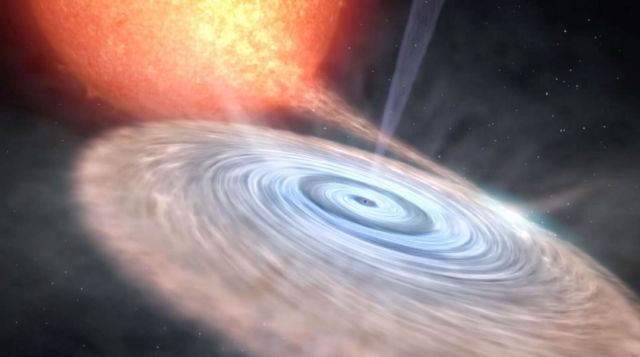
Artist's conception of V404 Cygni's accretion disk, which is being fed by its companion star. (credit: Gabriel Pérez, SMM (IAC).)

For 25 years, the black hole V404 Cygni was silent; in June of last year, it suddenly flared up. For the next two weeks, it released an “intensely, violently, variable” barrage of light, as a research team studying the event described it in their paper. Its brightness increased by a million times over a few days, making it the brightest X-ray source in the sky for a short time. And then, unceremoniously, it ended.

Luckily, NASA’s Swift spacecraft detected the strange outburst as soon as it began, and researchers quickly trained the Gran Telescopio CANARIAS (GTC) and other instruments on the event, allowing them to examine the spectrum of light emitted by V404 Cyg.

This isn’t the first time a black hole has been observed to have a period of extreme activity. V404 Cyg itself had a similar burst in 1989 before its quarter-century of quiescence. However, this one is different from the others in a few respects: it was much shorter (others have been known to last months to a year) and it stopped abruptly. The study of this event allowed researchers to gain important insights into the processes surrounding black holes.

Read 14 remaining paragraphs | Comments