HDR10+ Advanced joins Dolby Vision 2 in trying to make you like motion smoothing

Can more creator control fix the soap opera effect?

Motion smoothing has a bad reputation among most cinephiles, as well as many home theater enthusiasts and content creators. Also known as motion or video interpolation, motion smoothing is available in virtually every modern TV today. It’s supposed to remove judder from films and TV shows that are shot with 24p (24 frames per second) or 25p film and displayed on 60Hz or 120Hz TVs. But motion smoothing often results in the dreaded soap opera effect and unwanted visual artifacts.

Two upcoming HDR standards, HDR10+ Advanced and Dolby Vision 2, are looking to change how we perceive motion smoothing and more closely align motion interpolation with a creator’s vision. However, it’s unclear if these standards can pull that off.

HDR10+ Advanced’s Intelligent FRC

Today, Samsung provided details about the next version of the HDR10 format, which introduces six new features. Among HDR10+ Advanced’s most interesting features is HDR10+ Intelligent FRC (frame rate conversion), which is supposed to improve motion smoothing.
Read full article

Comments

Disney+ gets HDR10+ via “over 1,000” Hulu titles

Disney+ joins Netflix, Apple TV in supporting the Dolby Vision rival.

Disney+ has started streaming movies and shows in the HDR10+ format.

Support is somewhat limited for now. Only certain content from Hulu, which The Walt Disney Company acquired in June, is available in HDR10+. In an announcement today, Samsung said that “over 1,000” Hulu titles are available in HDR10+ and that “additional Disney+” content will support HDR10+ “in the future.” Previously, Disney+ only supported the HDR10 and Dolby Vision HDR formats.

Samsung TVs are the first devices to gain the ability to stream HDR10+ content from Disney+, according to an announcement from Samsung today. The electronics company said that its Samsung Crystal UHD TVs and above from 2018 onward, including its OLED TVs, The Frame TVs, QLED TVs, and Micro RGB TV, support HDR10+.

Read full article

Comments

Samsung makes ads on $3,499 smart fridges official with upcoming software update

Update introduces two ways for the fridges to show ads.

After kicking off an unpopular pilot test last month, Samsung made the practice of having its expensive smart fridges display ads official this week.

The ads will be shown on Samsung’s 2024 Family Hub smart fridges. As of this writing, Samsung’s Family Hub fridges have MSRPs ranging from $1,899 to $3,499. The ads will arrive through a software update that Samsung will start issuing this month and display on the fridge’s integrated 21.5- or 32-inch (depending on the model) screen. The ads will show when the fridges are idle and display what Samsung calls Cover Screens.

As part of the Family Hub software update, we are piloting a new widget for select Cover Screens themes of Family Hub refrigerators. The widget will display useful day-to-day information such as news, calendar and weather forecasts, along with curated advertisements.

Samsung also said that its fridges will only show contextualized ads, instead of personalized ads, which rely on collecting data on users.

Read full article

Comments

AWS outage reminds us why $2,449 Internet-dependent beds are a bad idea

“Would be great if my bed wasn’t stuck in an inclined position …”

This week’s Amazon Web Services outage had some people waking up on the wrong side of the bed.

A Domain Name System (DNS) resolution problem affected AWS cloud hosting, resulting in an outage that impacted more than 1,000 web-based products and services and millions of people.

Perhaps one of the most avoidable breakdowns came via people’s beds. The reliance on the Internet for smart bed products from Eight Sleep resulted in people being awoken by beds locked into inclined positions and sweltering temperatures.

Read full article

Comments

Warner Bros. Discovery raises HBO Max prices as it puts itself up for sale

HBO Max subscription fees have risen every year for the past three years.

HBO Max subscriptions are getting up to 10 percent more expensive, owner Warner Bros. Discovery (WBD) revealed today.

HBO Max’s ad plan is going from $10 per month to $11/month. The ad-free plan is going from $17/month to $18.49/month. And the premium ad-free plan (which adds 4K support, Dolby Atmos, and the ability to download more content) is increasing from $21 to $23.

Meanwhile, prices for HBO Max’s annual plans are increasing from $100 to $110 with ads, $170 to $185 without ads, and $210 to $230 for the premium tier.

Read full article

Comments

Ring cameras are about to get increasingly chummy with law enforcement

Amazon’s Ring partners with company whose tech has reportedly been used by ICE.

Law enforcement agencies will soon have easier access to footage captured by Amazon’s Ring smart cameras. In a partnership announced this week, Amazon will allow approximately 5,000 local law enforcement agencies to request access to Ring camera footage via surveillance platforms from Flock Safety. Ring’s cooperation with law enforcement and the reported use of Flock technologies by federal agencies, including US Immigration and Customs Enforcement (ICE), has resurfaced privacy concerns that have followed the devices for years.

According to Flock’s announcement, its Ring partnership allows local law enforcement members to use Flock software “to send a direct post in the Ring Neighbors app with details about the investigation and request voluntary assistance.” Requests must include “specific location and timeframe of the incident, a unique investigation code, and details about what is being investigated,” and users can look at the requests anonymously, Flock said.

“Any footage a Ring customer chooses to submit will be securely packaged by Flock and shared directly with the requesting local public safety agency through the FlockOS or Flock Nova platform,” the announcement reads.

Read full article

Comments

12 years of HDD analysis brings insight to the bathtub curve’s reliability

Backup firm brings a unique, informed perspective to HDD failure rates.

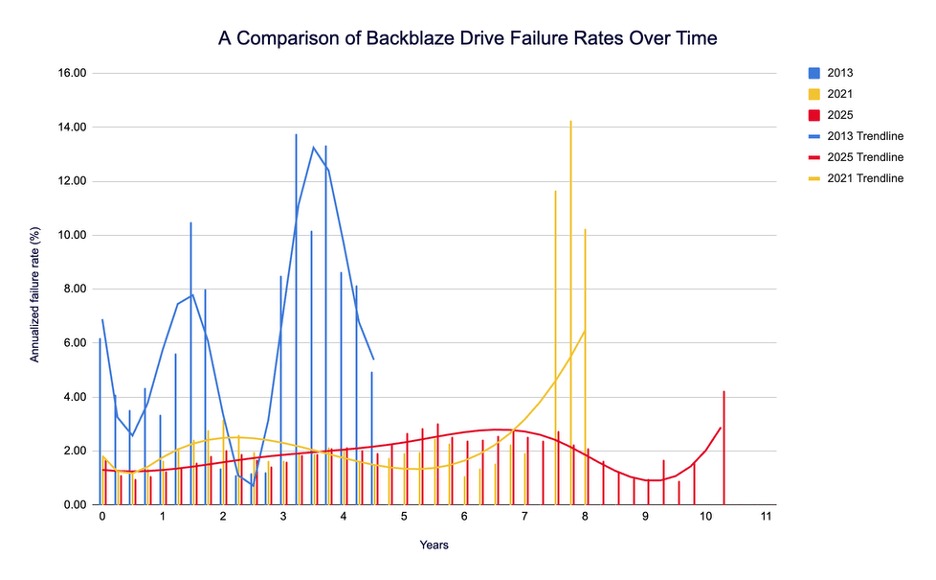
Backblaze is a backup and cloud storage company that has been tracking the annualized failure rates (AFRs) of the hard drives in its datacenter since 2013. As you can imagine, that’s netted the firm a lot of data. And that data has led the company to conclude that HDDs “are lasting longer” and showing fewer errors.

That conclusion came from a blog post this week by Stephanie Doyle, Backblaze’s writer and blog operations specialist, and Pat Patterson, Backblaze’s chief technical evangelist. The authors compared the AFRs for the approximately 317,230 drives in Backblaze’s datacenter to the AFRs the company recorded when examining the 21,195 drives it had in 2013 and 206,928 drives in 2021. Doyle and Patterson said they identified “a pretty solid deviation in both age of drive failure and the high point of AFR from the last two times we’ve run the analyses.”

A graph entitled "A Comparison of Backblaze Drive Failure Rates Over Time" Credit: Backblaze

Read full article

Comments