Cyanogen launches the “Mod” platform, with lots of Microsoft integration

Cyanogen launches an app store for apps that are “deeply integrated” into the OS.

Cyanogen Inc. has announced a new feature for the upcoming Marshmallow version of its commercial Android skin, Cyanogen OS. The company is launching the "Mods" platform, a way to build apps "directly into the OS." The platform's biggest participant is none other than Microsoft, which has built Skype, Cortana, OneNote, and Hyperlapse apps for Cyanogen's platform.

Cyanogen and Microsoft previously announced a "Strategic Partnership," which explains the two companies' almost joint rollout of this feature. The partnership covers "Bing services, Skype, OneDrive, OneNote, Outlook, and Microsoft Office," and it seems that most of those products are represented here. Four of the six announced Mods are Microsoft products. Configure the Mod platform appropriately and it almost seems like a Microsoft version of Android with Cyanogen as the intermediary.

Cyanogen's branding of this feature is rather confusing. "Cyanogen Inc.," the company, already makes an open source Android skin called "CyanogenMod." Cyanogen then takes CyanogenMod and adds some proprietary features to make "Cyanogen OS," a commercial version of its Android skin that it tries to license to manufacturers. That was hard enough for some people to keep straight, and now this new feature is only for Cyanogen OS, and it's called "Mods." If you're keeping track, Cyanogen Inc., Cyanogen OS, CyanogenMod, and Cyanogen's Mod platform are now all separate entities.

Read 5 remaining paragraphs | Comments

LG jumps on the VR bandwagon with the LG 360 VR

LG shows off a pair of slim VR glasses that tether to a smartphone.

LG's biggest announcement today is undoubtedly the LG G5, but next to the company's flagship smartphone, it was also demoing this crazy VR headset called the "LG 360 VR." It requires a smartphone to work, but unlike Galaxy Gear-style headsets that require you to slot the phone into the headset, this headset is just tethered to the LG G5 via a USB cable.

The device is basically an external display for the G5, allowing the headset to have a slimmer profile while cutting the weight down to only 118g. LG isn't offering many specifics about the display inside the headset, only saying it has a resolution of 639 ppi. LG also isn't saying much in the way of pricing, a launch date, or even capabilities, but it does mention that it "is compatible with 360-degree images as well as all Google Cardboard content."

We were able to briefly check out prototype hardware at LG's G5 event, and we can say the big, face-engulfing VR headsets are that size for a reason—namely blocking out the light in the room. This was more like wearing a pair of opaque eyeglasses; allowing light to gush in from the top and bottom of the device. For the most part, the headset didn't work yet, but it did briefly mirror the G5's home screen when we plugged in the USB cable. The display area is about what you would expect from looking at the outside of the device. It's a long, thin screen the fills maybe half your vertical vision. It won't be a device for immersion, but LG says it will "simulate a 130-inch TV viewed from two meters."

Read 2 remaining paragraphs | Comments
LG G5 hands-on—LG may have made the most innovative phone of MWC

LG’s flagship impresses with a removable battery, microSD slot, and a metal body.


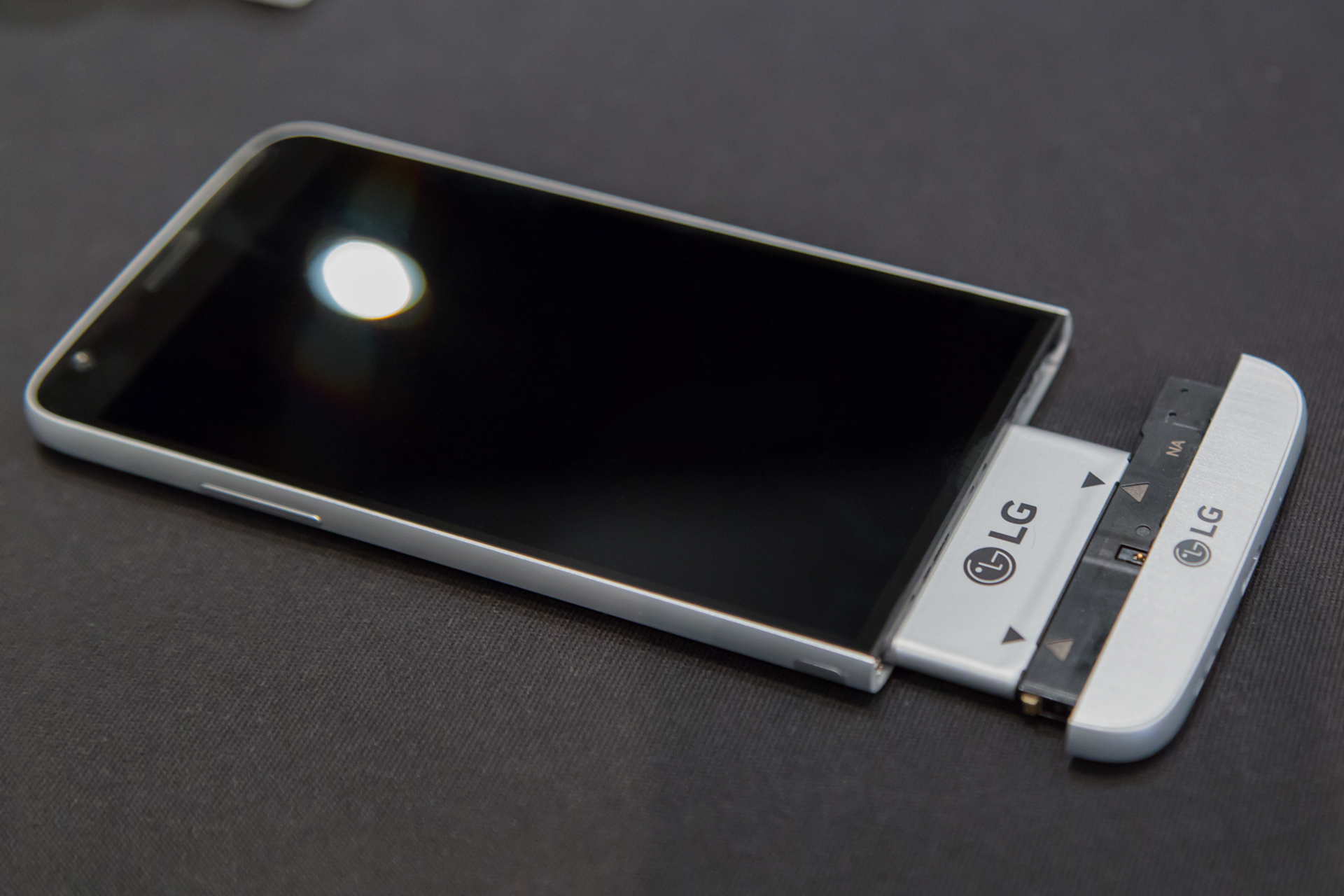
NEW YORK—If you're tired of samey smartphones that change little from year-to-year other than the obligatory internal spec bump, get a load of LG's latest flagship, the G5. Phone manufactures have been making us choose between either a plastic phone with a removable battery or a more premium feeling metal device with sealed components, but the G5 brings the best of both worlds. This is a metal phone with a removable battery, thanks to an innovative modular design.

The G5 is basically an aluminum rectangular tube with a removable bottom cap. The phone is one solid part from top of the device to the bottom of the 5.3-inch LCD. Hold down a button on the side of the phone, and you'll be able to pull off the entire bottom bezel and the attached internal battery. From there you can detach the battery from the bottom bezel of the phone and swap in a fresh one.

The bottom bezel houses the USB Type C port, microphone, and speaker, necessitating an internal data connection with the rest of the phone. Besides replacing the battery, you can also replace the bottom bezel with something else entirely—LG plans to build several modular accessories that clip on to the bottom of the phone, replacing the stock bezel. So far LG has announced a camera grip accessory and a DAC attachment.

Read 9 remaining paragraphs | Comments

The “world’s cheapest smartphone” is looking awfully shady

Different hardware, a logo fix with Wite-Out, and iOS icons raise a lot of questions.

A few days ago, an Indian device called the "Freedom 251" surfaced, so named because it only cost Rs. 251 (About $3.64), making it the "world's cheapest smartphone." If you thought a $4 smartphone seemed a little too good to be true, you may be right. There are now all sorts of questionable issues popping up with this device.

First up, it looks like the company might have done at least a visual switcheroo. When the product site first launched, it looked like this, showing a modern, high-end looking phone with very thin side bezels and three capacitive buttons on the bottom. After news coverage of the phone spread, the site was updated and all the phone images were replaced with a much uglier, much cheaper looking device with thick bezels and a single hardware home button.

Testers in India have gotten their hands on the device, and sure enough, it sports the newer, uglier design. The oddities don't stop there. The company selling the Freedom 251 is called "Ringing Bells" but the hardware sent to testers was actually built by Adcom and carries Adcom branding. On the front of the device is an Adcom logo, which was obscured with...Wite-Out? The the Adcom logo is actually covered up with a white blob right on top of the bezel. This editing can be easily removed to show the logo beneath.

Read 3 remaining paragraphs | Comments

MWC 2016—What to expect at the world’s biggest smartphone show

Flagships from Samsung, LG, and Xiaomi are all expected to be at the show.

Mobile World Congress is easily the biggest mobile phone show of the year. While its January cousin, CES, may be waning in mobile relevance, MWC still reliably brings us major new flagship smartphones every year. Last year saw the launch of the Samsung Galaxy S6 and HTC One M9, but what should we expect this year? What follows is a roundup of the more believable rumors that are floating around out there.

Samsung, LG, and Xiaomi all have events at the show, and are all expected to launch their new flagships. The major additions to just about every 2016 Android flagship will be the new Snapdragon 820, and with the addition of Android 6.0 Marshmallow's fingerprint reader support, if a device didn't come with a fingerprint reader before, it will now.

Samsung Galaxy S7—The S6 design gets a spec bump and 3D Touch

Samsung typically headlines the MWC festivities, and this year a big "Galaxy Unpacked 2016" press event is scheduled for February 21. Samsung launched the all-new Galaxy S6 and Galaxy S6 Edge at Mobile World Congress 2015, and this year we can expect it to follow the same formula with the Galaxy S7 and S7 Edge.

Read 26 remaining paragraphs | Comments

Nextbit Robin review: Novel hardware, absurd cloud storage

Nice hardware, but new OEM’s cloud setup doesn’t make sense when microSD cards exist.


SPECS AT A GLANCE: Nextbit Robin
SCREEN 1920×1080 5.2" (423ppi) LCD
OS Android 6.0 Marshmallow
CPU Six-core Qualcomm Snapdragon 808 (two 1.8 GHz Cortex-A57 cores and four 1.4 GHz Cortex-A53 cores)
RAM 3GB
GPU Adreno 418
STORAGE 32GB
NETWORKING 802.11b/g/n/ac, Bluetooth 4.0, GPS
BANDS GSMA Version

GSM 850/900/1800/1900

HSPA 850/900/1700/1900/2100

LTE Bands 1/2/3/4/5/7/8/12/17/20/28

CDMA Version

CDMA 800/1900

GSM 850/900/1800/1900

HSPA 1700/1800/1900/2100

LTE Bands 1/2/3/4/7/13/20/25/26/41

PORTS USB 3.0 Type-C, 3.5mm headphone jack
CAMERA 13MP rear camera with phase detection autofocus, 5MP front camera
SIZE (not official) 149.3 x 72.1 x 7.2 mm
WEIGHT  ????????
BATTERY 2,680 mAh
STARTING PRICE $399
OTHER PERKS NFC, quick charging, fingerprint sensor, white notification LED

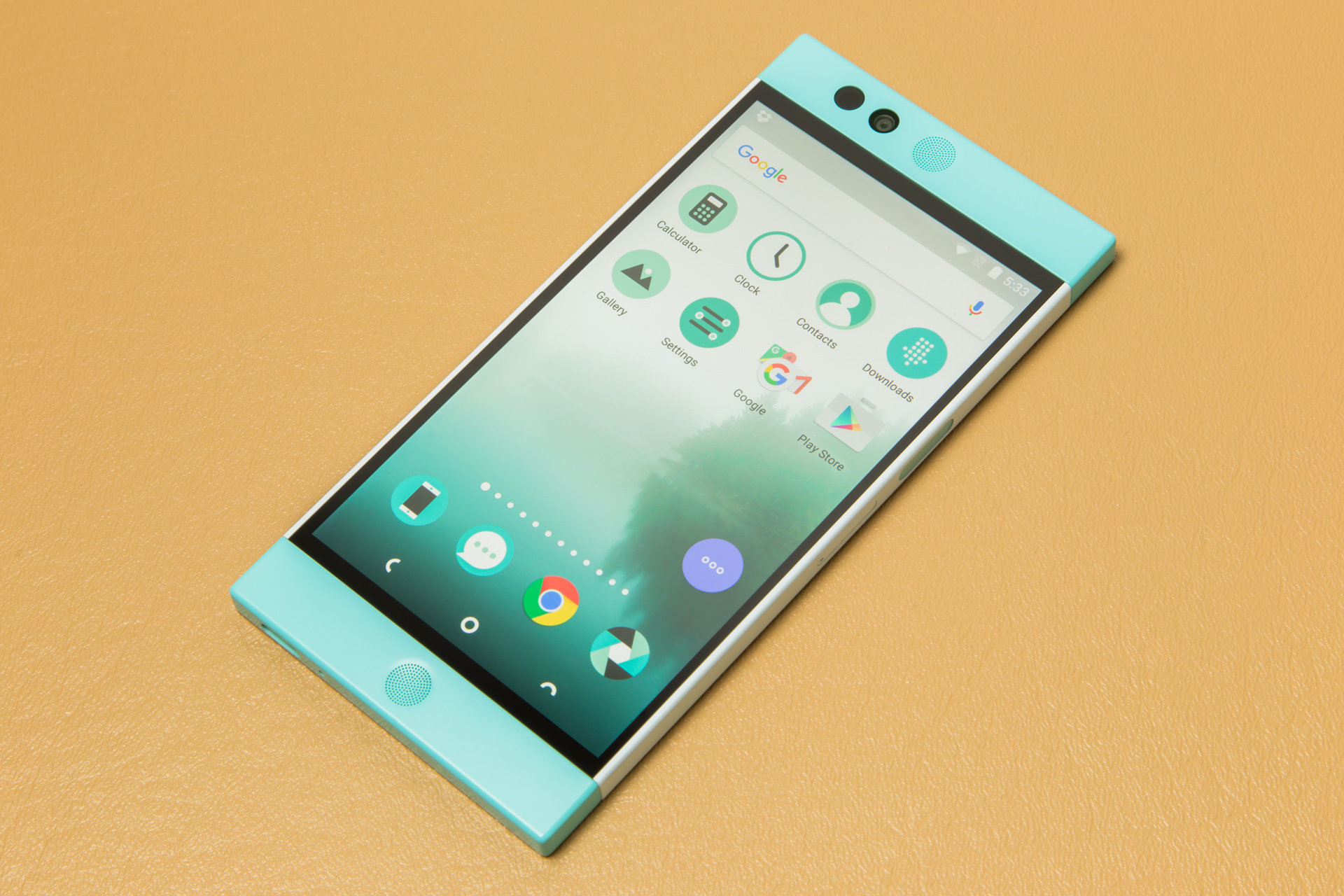
Now here's something you don't see every day: a brand new smartphone company. "Nextbit" is a San Francisco-based OEM that was only founded in 2013. Today, thanks to the magic of Kickstarter, the company has shipped its first-ever smartphone called the Nextbit Robin.

While the name is new, the company is made up of some notable industry veterans. The founders, Tom Moss and Mike Chan, are both former Googlers from the Android team. Moss is also a founding board member of Cyanogen, Inc. Nextbit's lead designer, Scott Croyle, was snatched away from HTC where he was responsible for everything from the legendary HTC Evo to the HTC One M8.

Read 56 remaining paragraphs | Comments

Four months later, first Samsung Marshmallow update comes to Galaxy S6

Android 6.0 finally comes to a Samsung device, but it’s a longer wait than ever.

Samsung's Galaxy S6. (credit: Ron Amadeo)

Samsung has announced that it will ship its first Android 6.0 Marshmallow update today. The newest version of Android will be coming to the Galaxy S6 and Galaxy S6 Edge, with the announcement saying that "other Galaxy devices will soon follow."

Samsung doesn't explicitly say so, but we would guess today's rollout is only for unlocked, "International" devices. The announcement cryptically states that Samsung will "make separate announcements on details of OS updates schedule for each market according to market situation and carriers’ requirements."

Last year, Samsung started rolling out Lollipop to the flagship Galaxy S5 just 31 days after launch. For Marshmallow, that delay increased to a whopping 133 days. Of course, this number only pertains to unlocked devices. If you bought a device through a carrier, it's up to the company to stick its fingers in the update pie.

Read 1 remaining paragraphs | Comments

Report: Google planning a standalone VR headset

Google is reportedly building a VR headset that doesn’t need a PC or smartphone.

The Samsung Gear VR.

The Wall Street Journal is reporting that Google is developing an "all-in-one" virtual reality headset that doesn't rely on a computer or smartphone to function.

You might have a bit of deja vu reading this post, since earlier this week we posted about Google's supposed other VR headset in the works, a plastic "successor" to Google Cardboard. This would be a plastic shell with lenses and a few extra sensors, with the display and processing coming from a slotted-in smartphone—basically a Samsung Gear VR competitor. This new VR headset from Google would be a completely standalone device, with the screen, processor, and storage permanently embedded in the headset. The Journal backed up this earlier report, and says that Google is working on both the smartphone-centric and standalone headsets.

A VR headset in this form factor this hasn't really been announced by any other major players. The Oculus Rift and HTC Vive both strap a screen and sensors to your head, but require a PC to run. Google's headset would essentially be a game console for your face.

Read 6 remaining paragraphs | Comments

Google display ads going all-HTML, will ban Flash in 2017

Acceptance of new Flash ads ends in June; old Flash ads can remain until January.

On the Adwords Google+ page, Google just announced a timeline for banishing Flash from its advertising network, announcing that "Google Display Network and DoubleClick Digital Marketing are now going 100% HTML5."

Starting on June 30, 2016, Google will no longer accept new Flash display ads from advertisers. On January 2, 2017, even old Flash ads will be blocked from appearing, making Google's ad network mostly Flash-free. The one exception seems to be video ads, as Google notes "Video ads built in Flash will not be impacted at this time."

Google has been trying to wean advertisers off of Flash for some time, providing tools and best practices for switching. Now it apparently feels good enough about the switch to force it on everyone.

Read 1 remaining paragraphs | Comments

Report: Google to launch a Gear VR competitor, build VR into Android OS

Google’s successor to Cardboard supposedly comes out “later this year.”

The Samsung Gear VR. (credit: Kyle Orland)

We've said a few times now that Google's virtual reality initiative is too big for the company to just be working on Google Cardboard, and now the Financial Times has published a report detailing what seems to be the next phase of Google's VR push. The report says that Google is working on "a successor to Cardboard," creating a higher-quality headset and building VR software directly into Android.

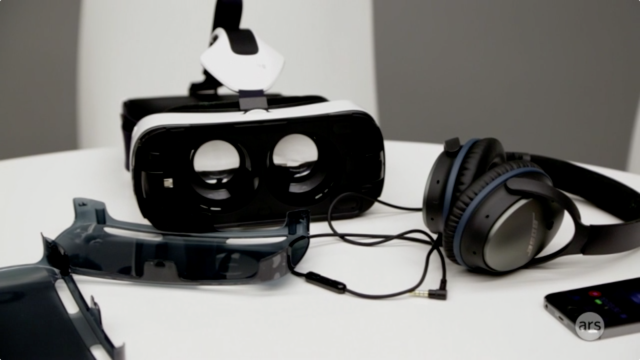
The device sounds like a Google version of Samsung's Gear VR. Like Cardboard, the headset will be powered by your existing smartphone, with a "more solid plastic casing" along with better lenses and sensors. Also like Cardboard, this won't be limited to just a handful of devices, with the report saying that the headset "will be compatible with a much broader range of Android devices than Gear VR."

Such a device sounds like it would occupy a compelling spot in the market. The Gear VR is a great device—the $100 headset is a powerful entry-level VR experience—but it only works with Samsung phones. Cardboard has much wider phone compatibility, but it comes with a huge list of compromises that lead to a subpar experience. Taking the Gear VR model and expanding it to accept most popular smartphones sounds like a solid idea.

Read 3 remaining paragraphs | Comments