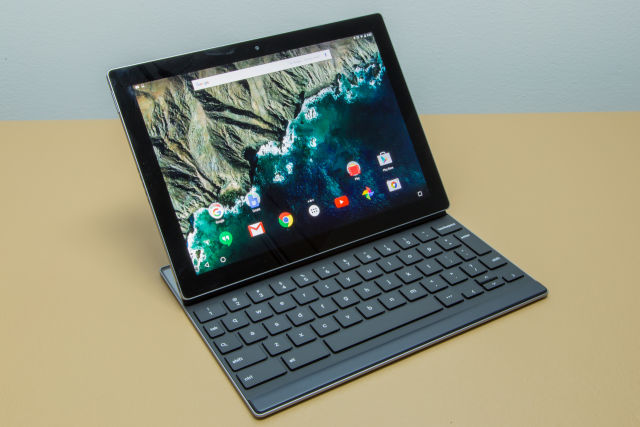
Google is offering $150 off a Pixel C—just $349 for Google’s latest tablet

With Android N, the Pixel C is looking better than ever, and now it’s cheaper than ever.

This is the fully assembled Pixel C—for $349, you'd just get the tablet part.

With the release of the Android N Developer Preview and split screen coming to Android, Google's Pixel C is looking more promising than ever. To celebrate the release of the Android N Developer Preview, Google is offering a "Developer Discount" on the device—$150 off, making it $349 for the 32GB tablet. Google wants to encourage more developers to buy the tablet, but it doesn't actually require any proof of your development chops—anyone can wander over to the special site to get the discount.

The tablet is usually paired with a keyboard, but for $349 you'll just get the tablet—the keyboard is still another $149. The device is only about three months old, and it sports an Nvidia Tegra X1 SoC, 3GB of RAM, and a 10.2-inch 2560×1800 LCD.

In our review, we were fans of the all-metal body and high-res display, but we also ran into some problems. We encountered several bugs with keyboard pairing and touchscreen responsiveness, but Google has spent the past few months ironing out all of those bugs. There was also the issue of Android not being great for tablets, but with split screen coming in Android N, that looks to improve a bit. With a little more time for software debugging and the launch of (a still in development) split screen mode, it seems like now is the Pixel C's time to shine, and now you can get it for the lowest price ever.

Read on Ars Technica | Comments
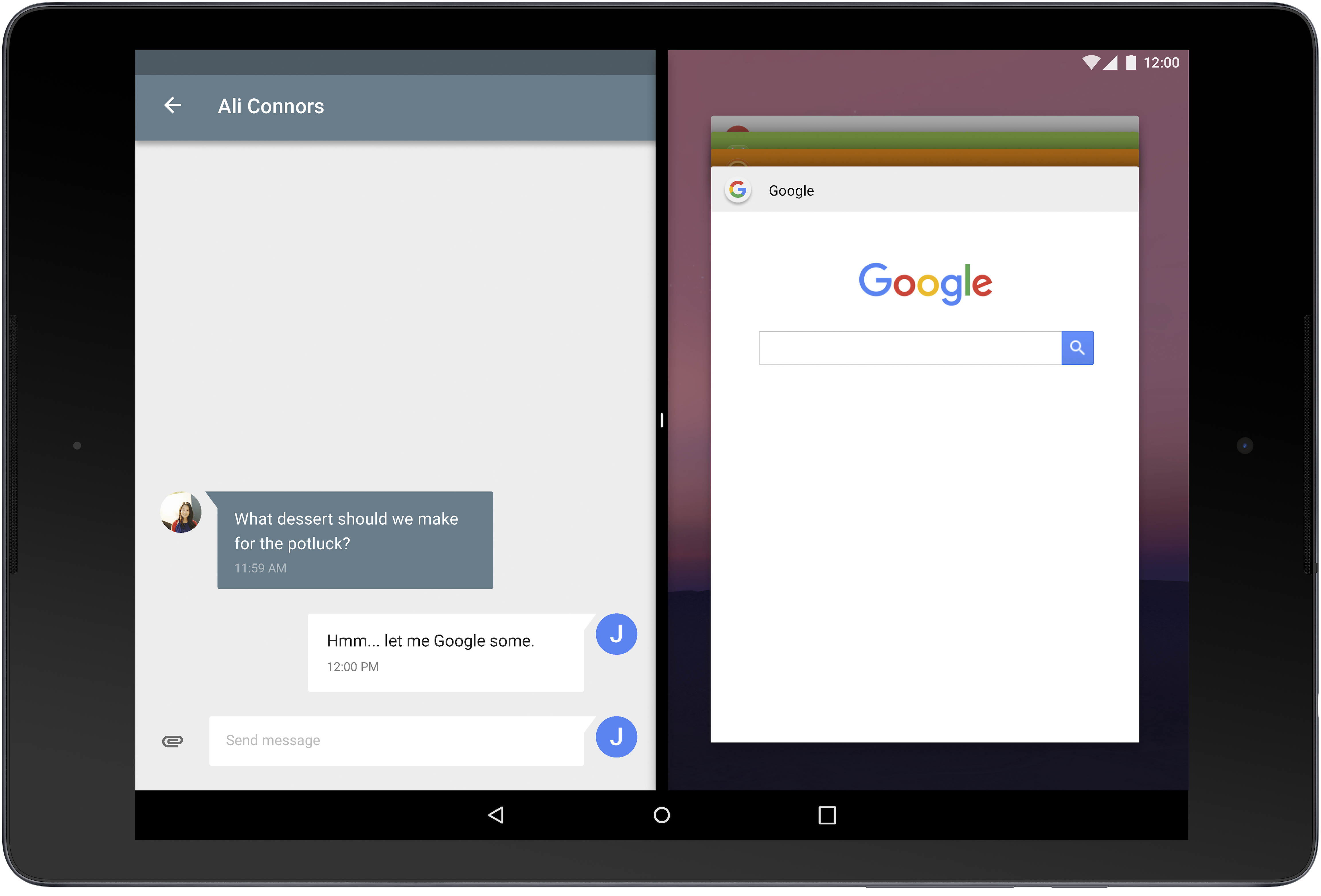
Surprise! The Android N Developer Preview is out right now

Android N brings split-screen, redesigned notifications, and more power savings.

Google I/O is happening on May 18-20, but forget Google I/O—the developer preview of the next version of Android is launching right nowGoogle has posted the Android N Developer Preview for the Nexus 6P, Nexus 5X, Nexus 6, Pixel C Nexus 9, and the Nexus Player.

Before you get too invested in the interface on display here, it's worth noting that the Android M Developer Preview has gone through several designs (like the weird letter-indexed app drawer) and features (day/night mode) that have not made it to the Developer Preview. In fact, the whole point of this super-early preview seems to be to gather as much feedback as possible. "The sooner we hear from you, the more of your feedback we can integrate," Google says.

As we saw in the Android M Developer Preview, Google has been working hard on matching Windows and iOS by building a native side-by-side app mode in Android. For Android N, the feature is apparently ready for prime time. The gallery above shows off the feature, which works on tablets and phones—it looks a lot like what is currently shipping on Samsung phones. The one question mark is how to actually turn it on and control it. On Samsung phones and in the Android N app preview, for instance, buttons on the recent app screen would trigger split-screen mode. There are no such buttons in the screenshots.

Read 10 remaining paragraphs | Comments

The founder of 4chan joins Google, presumably to work on Google+

Experience “building online communities” earns Chris Poole a job at Google.

Google's newest hire is coming from a very unlikely place: 4chan. Chris Poole—AKA "moot"—the founder of the controversial anonymous message board, has joined Google. Poole posted the announcement on his blog:

Today I’m excited to announce that I’ve joined Google.

When meeting with current and former Googlers, I continually find myself drawn to their intelligence, passion, and enthusiasm—as well as a universal desire to share it with others. I’m also impressed by Google’s commitment to enabling these same talented people to tackle some of the world’s most interesting and important problems.

I can’t wait to contribute my own experience from a dozen years of building online communities, and to begin the next chapter of my career at such an incredible company.

Poole didn't explicitly say which part of Google he'll be joining, but he did mention "building online communities," which suggests he's joining the Google+ team. Bradley Horowitz, the head of Google+, also announced Poole's hiring—first on Twitter, of course—further pointing to a new G+ hire. Poole announced his retirement from running 4chan just over a year ago.

In the past, Poole has criticized Google and Facebook for their user identification policies on the Internet. Poole disagreed with the push for a universal, real-life identity system, saying, "consolidating identity makes us more simple than we really, truly are."

Read 2 remaining paragraphs | Comments

Project Fi drops invite program, offers $150 off a Nexus 5X with service

Score a Nexus 5X for just $199—if you get it with a month of Project Fi.

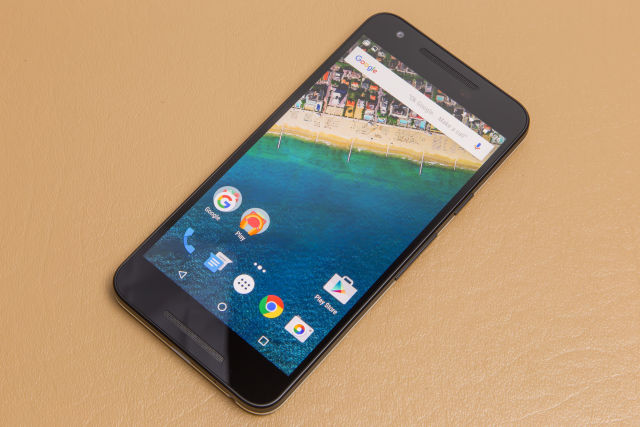
Enlarge / The Nexus 5X. (credit: Ron Amadeo)

Google's Project Fi cellular service is dropping its invite requirement. And to celebrate, the company just announced the deepest discount ever on the Nexus 5X. If you buy the phone through Project Fi and activate it, you can get the normally $349 Nexus 5X for just $199. The offer is valid from today until April 7, 2016.

The deal conjures up images of the two-year contract pricing carriers used to offer on phones, but Project Fi is a pre-pay service with no contracts, so it seems you can cancel at any time. The fine print only says "You must then activate Fi service on the same account within 30 days of device shipment." We guess that you'd then be on the hook for a month of service, which at the minimum pricing will cost about $30. So even if you have no desire to join Project Fi, around $230 for a 5X while cancelling Project Fi is still a deal.

Project Fi is Google's MVNO service that continually switches between Sprint and T-Mobile, while only charging you for the exact amount of the data you use, down to the megabyte. The service also combines all the best features Google Voice, like visual voicemail, number forwarding, and the ability to send and receive SMS messages from any computer and via the Google Hangouts app. The only real downside is the extremely limited device compatibility—the Network switching feature means Fi only works on the Nexus 5X, 6, and 6P. Project Fi charges a $20 base fee for unlimited texting and calls, plus $10 per GB of data you use. We've got a full breakdown of the pricing here.

Read 1 remaining paragraphs | Comments

“Google Posts” embeds a one-way social network directly into search results

Google’s “experimental new podium” looks like a Google+ reboot just for brands.

There's a weird new feature popping up in Google search results called "Google Posts." It seems to be a place for Google to directly host content in a post-Google+ world and to embed this content directly into search results. Imagine orphaned Google+ posts with the Google+ branding stripped out, and you're most of the way there.

Over at Google.com/posts, Google has a landing page for this feature, calling it "an experimental new podium on Google" that allows you to "hear directly from the US presidential candidates in real time on Google." It's a believable explanation until you see this Google Posts profile from "Andrew Jewelers" in Buffalo, New York, (spotted by Mike Blumenthal), which is definitely not a presidential candidate.

The landing page says the "experimental" feature is "only available to the 2016 US presidential candidates" (Andrew Jewelers for president!), but those of us not running for office can join a waitlist as Google plans to "make it available to other prominent figures and organizations."

Read 5 remaining paragraphs | Comments

DJI shows off the semi-automated Phantom 4—leave the flying to the drone

The new Phantom has a computer vision system that can detect and avoid objects.

Video shot/edited by Nathan Fitch. (video link)

NEW YORK—DJI has just announced the Phantom 4, the latest in the company's line of camera-equipped quadcopters. Of course the newer version flies faster for longer and has a better camera, but the headline feature is the addition of new autonomous flight features that make the drone easier to fly, easier to film, and harder to crash.

Two optical sensors now sit just above the two front legs of the Phantom 4. Combined with a computer vision system, these sensors make a volumetric map of the environment in front of the drone. This allows it to "see" and react to objects in front of it, allowing the drone to take measures to avoid a crash while flying.

Read 10 remaining paragraphs | Comments

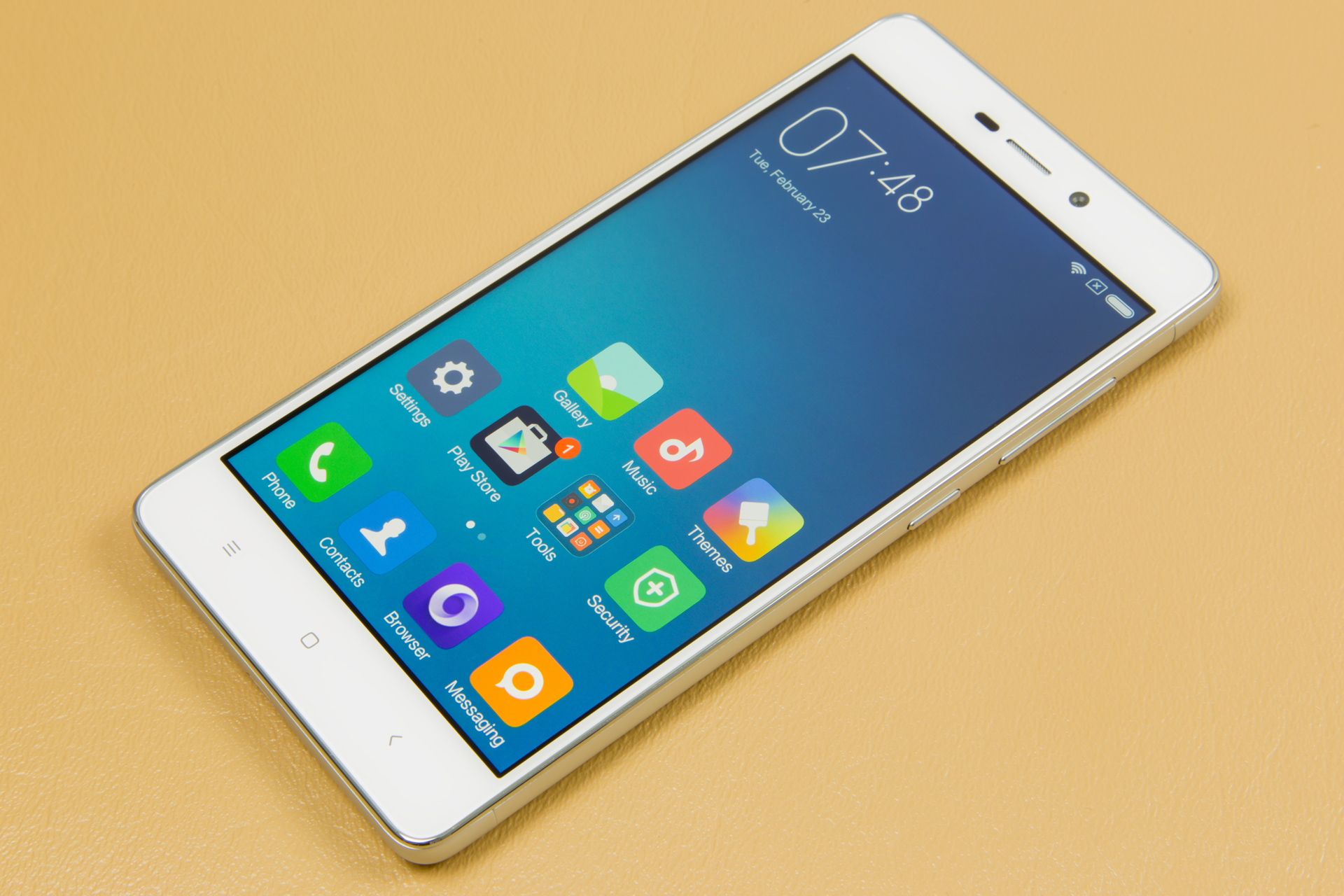
Xiaomi Redmi 3 review: A $100 metal phone that crushes other $100 phones

It delivers specs that other OEMs struggle to match at twice the price.


Xiaomi is one of the most exciting Android OEMs in the industry—despite the fact that you can't buy the company's phones in the US or Europe. It has redefined the term "bang for your buck" for smartphones, offering low-cost unlocked devices with great specs and build quality.

Previously, we were impressed with the Mi 4 and Mi Note, both of which offered relatively high-end specs for under $400. The Xiaomi Mi 5 will follow a similar pattern, offering the brand new Snapdragon 820 for less than the competition. Xiaomi doesn't just live in the high end of the market, though—today we're asking "What can you build us for about a hundred bucks?" Xiaomi's answer is the astoundingly good Redmi 3.

Read 36 remaining paragraphs | Comments

Dive into the uncanny valley with Boston Dynamics’ newest bipedal robot 

Watch the next-generation Atlas robot take a stroll through the snow.

Boston Dynamics—part of Google's robotics division—has shown off the newest version of its "Atlas" bipedal robot. In a video posted to the company's YouTube page, the next-generation Atlas takes a stroll through the snow, recovers from a few slips, and even squats down to pick up a 10 pound-box.

This "next-generation" Atlas is a refinement of the old Atlas model, which was unveiled to the world in 2013. The old Atlas was a bit of a giant—it was 6 feet tall and weighed 330 pounds. The new Atlas is a lot closer to an average human, at just 5 feet 9 inches tall and weighing 180 pounds. This is also the first Atlas model to be equipped with a LIDAR system—a spinning metal can embedded in the robot's head.

The new Atlas goes through quite a gauntlet of tests in the video. After taking a walk over some rough, snowy terrain, a Boston Dynamics employee pushes it backwards with a hockey stick and smacks its toy box out of its hands. After being pushed so hard and taking a header into the floor, the robot shows it is still capable of picking itself up and going back to work.

Read on Ars Technica | Comments

The LG G5 and Galaxy S7 won’t support Android 6.0’s adoptable storage

OEMs add expandable storage, but limit functionality to media only—no apps.

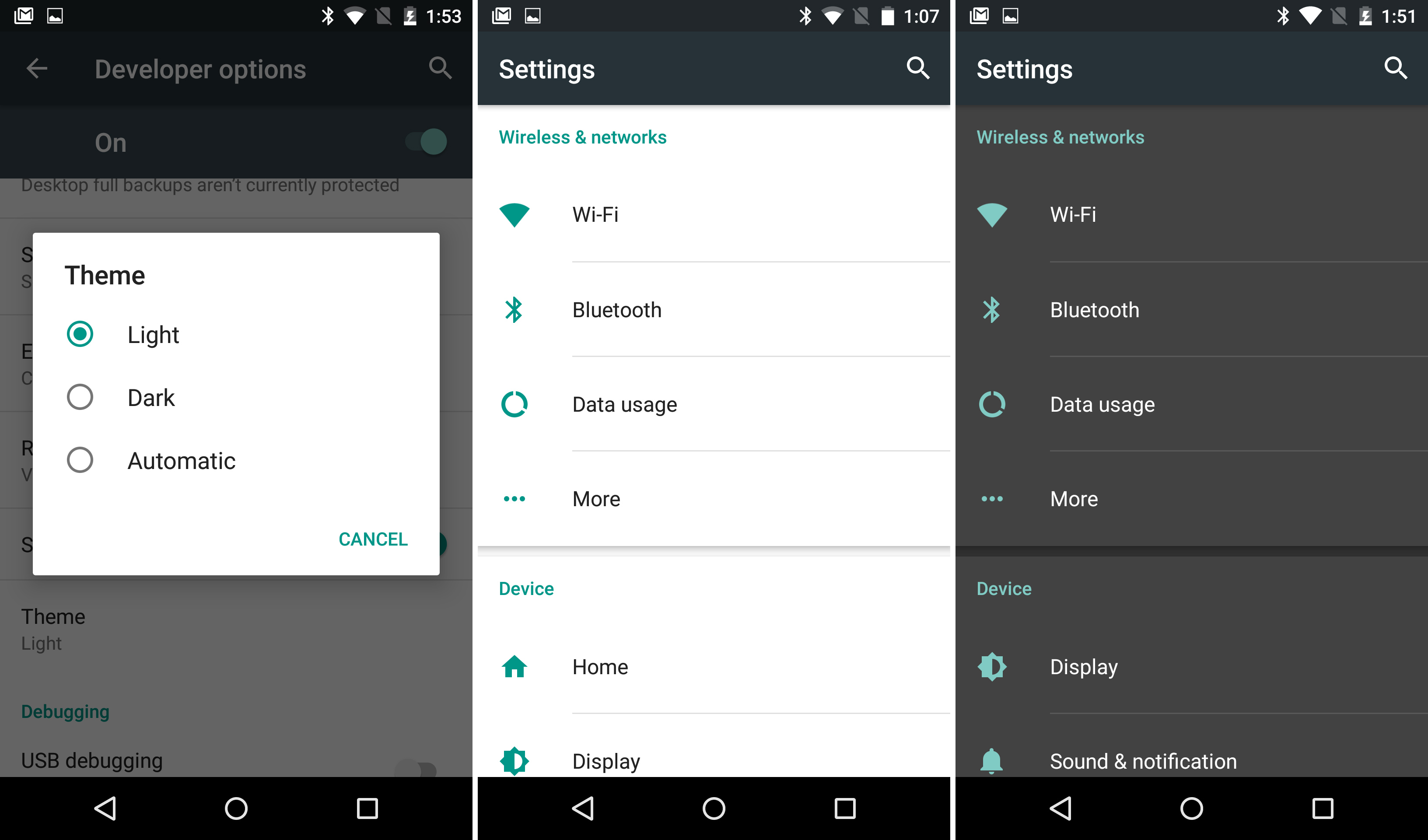
This is what the "Adoptable Storage" setup looks like in Android 6.0. Just replace "USB Drive" with "SD card."

With both the Galaxy S7 and LG G5 sporting expandable storage, and Google adding great SD support to Android 6.0, this year it seemed like storage enthusiasts would get everything they could ever want. Apparently that's not the case though, as both OEMs have shunned Google's new "Adoptable Storage" feature.

Android 6.0 Marshmallow added an adoptable storage feature, which allows you to format a microSD card as internal storage. Android will then merge the microSD card and internal storage into a single storage pool, allowing you to seamlessly install as many apps as you want, or load it with media. Samsung and LG don't appear to be a fans of the feature, though. Android Central tried the feature on G5 at MWC, and it didn't support adoptable storage, and when we asked Samsung about the feature, the company laid out its thoughts about the feature:

Samsung decided not to use the Android Marshmallow “adoptable storage” model. We believe that our users want a microSD card to transfer files between their phone and other devices (laptop, tablet, etc), especially the photos and videos they shoot with the camera.

With adoptable storage, first of all the card may be erased the first time it is inserted into the device. This behavior may be unexpected by many users and we don’t want our users to lose their files. Second, once Marshmallow starts using a card for adoptable storage, it cannot be read by other devices, so it loses this ability to be used for file transfer. Adoptable Storage is also primarily targeted towards emerging markets where devices with only 4-8GB of onboard storage are common. We think that our model of using microSD for mass storage is more in-line with our owner’s desires and expectations for how microSD should behave.

Before OEMs changed the feature, users could pick which mode they wanted the storage to be in and format it appropriately. There was both "Portable" mode, which treated an SD card like normal removable storage, and the new "Internal storage" mode. With "Internal" mode disabled for both devices, the SD cards will only be able to be used for media—no apps allowed.

Read 1 remaining paragraphs | Comments

US pre-orders for the Galaxy S7 go up, but only the 32GB version for now

Shipping and pricing for the S7 hit, but larger storage options will come later.

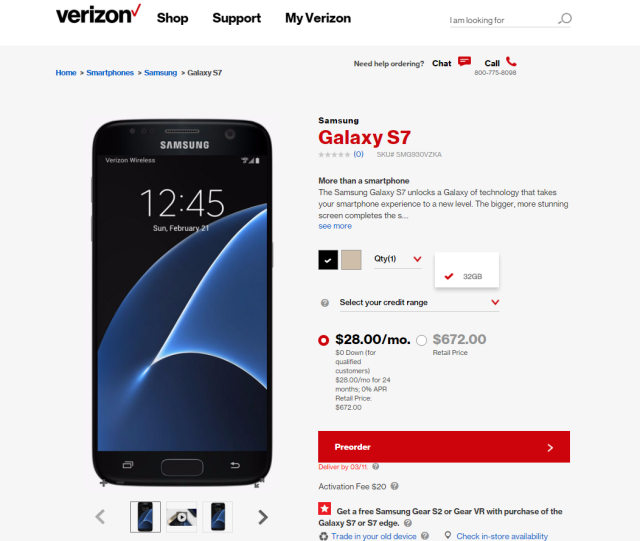
Verizon's pre-order page.

If you've had $700 burning a hole in your pocket since the announcement of the Galaxy S7 and S7 Edge, Samsung is now ready to take your money. This page at Samsung.com will direct you to the Galaxy S7 and S7 Edge pre-order pages from Verizon, AT&T, Sprint, T-Mobile, US Cellular, and Best Buy. You might have a small problem with the storage options, though—only the 32GB version is currently for sale.

Samsung added a microSD card to the Galaxy S7, so you aren't quite as limited with the 32GB version as you would expect. If you wanted a 64GB and 128GB version of the Galaxy S7 and S7 Edge, though, it seems you'll have to wait. A representative from T-Mobile told us the higher storage configurations "will be available as soon as the device is released," and we'd imagine other retailers will be in a similar situation.

With the pre-orders up, this is also the first time we've seen actual prices for the Galaxy S7 and S7 Edge. The carriers haven't really agreed on how much they should charge, so things are complicated.

Read 4 remaining paragraphs | Comments