Windows 10 Anniversary Update coming August 2 for 350 million Windows 10 users

It should ship simultaneously for PC, phone, and Xbox.

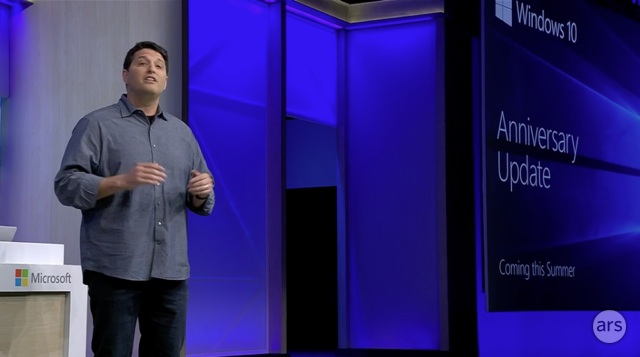
Microsoft's Terry Myerson details the Windows 10 Anniversary Update. (credit: Microsoft)

The next major Windows 10 update, the Anniversary Update, is going to be released just slightly too late for its namesake event. The operating system first shipped on July 29, 2015. The Anniversary Update will come a few days after the first anniversary of that release, on August 2.

To celebrate the update, Microsoft is running a promotion until August 14: buy a Surface Pro 4 or Surface Book along with an Xbox One from the Microsoft Store and you'll get $300 off the price. Dell is offering a free TV to students buying any system costing more than $699, and other OEMs are likely to run promotions, too.

The current intent is for the PC release to be simultaneous with the phone release and the Xbox One release. The software isn't done yet, so it's always possible that last-minute bugs will derail this plan, but with PC, phone, and console all building from a common base, Microsoft should be able to update them all in tandem.

Read 4 remaining paragraphs | Comments
Windows 10 upgrade will soon be easier to reject

Pressing the X will close the window, as it should.

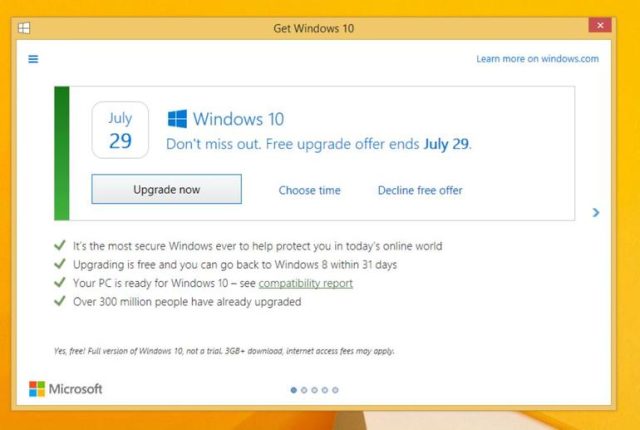
The updated Get Windows 10 app, with its decline option.

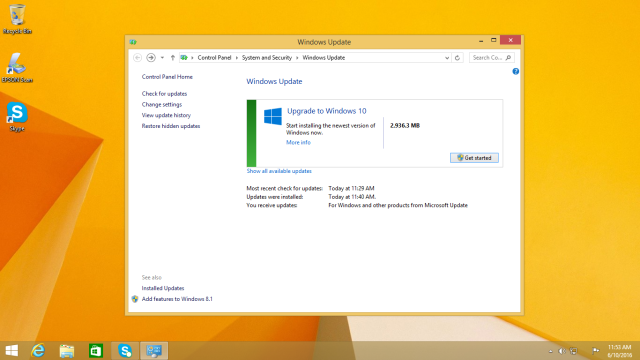
Microsoft is finally ending the malware-like trickery of the "Get Windows 10" upgrade offer that's shown to Windows 7 and Windows 8.1 users.

Mary Jo Foley reports that a clearer upgrade promotion will roll out this week. It will have three options—"Upgrade now," "Choose time," and "Decline free offer"—with the last of these options dismissing the update altogether. Critically, pressing the X in the corner of the window will have the same effect as the decline option.

This change addresses one of the most unpleasant features of the promotion: some weeks ago, Microsoft changed the behavior of the X button to make it simply defer the upgrade rather than decline it altogether. This behavior was contrary to any reasonable expectations Windows users might have, and contrary to the way the promotion behaved at its introduction.

Read 3 remaining paragraphs | Comments

Unwanted Windows 10 upgrade costs Microsoft $10,000

Microsoft drops its appeal, pays out for lost wages and a replacement PC.

It's chosen by default, ready to download and install if you're not paying attention.

Microsoft has paid a California woman $10,000 over an unwanted Windows 10 upgrade, reports the Seattle Times.

Teri Goldstein's computer, used to run her travel agency business, was apparently upgraded to Windows 10 shortly after Microsoft made the free upgrade available to Windows 7 and 8.1 users last year. Goldstein said this update was so problematic that it left her computer crashing and unusable for days at a time. After Microsoft's tech support was unable to assist, Goldstein sued the software company, asking the court to award her compensation for lost wages and the cost of a new computer.

Goldstein won and was awarded a $10,000 judgement. Microsoft appealed this decision but then dropped this appeal. According to a Microsoft spokesperson, the company still denies any wrongdoing but dropped the appeal to avoid the expense of further litigation.

Read 2 remaining paragraphs | Comments

.NET Core 1.0 released, now officially supported by Red Hat

And Samsung is joining the .NET Foundation.

Version 1.0 of .NET Core, the open source, cross-platform .NET runtime platform that was first announced in 2014, has been released today. .NET Core is arriving alongside ASP.NET Core 1.0, the open source, cross-platform version of Microsoft's Web development stack.

Microsoft picked an unusual venue to announce the release: the Red Hat Summit. One of the purposes of .NET Core was to make Linux and OS X into first-class supported platforms, with .NET developers able to reach Windows, OS X, Linux, and (with Xamarin) iOS and Android, too. At the summit today, Red Hat announced that this release would be actively supported by the company on Red Hat Enterprise Linux.

After many years of non-cooperation between Microsoft and the largest of the open source commercial Linux companies, Microsoft and Red Hat announced a new partnership in November 2015. This union heralded official support for Red Hat virtual machines in Azure and closer cooperation on .NET. Full support for .NET Core 1.0 marks the next step in that partnership.

Read 1 remaining paragraphs | Comments

Surface 3 stocks dwindling as Microsoft plans system’s demise

Hardware is getting old, but with no suitable processors, there’s no way to update it.

The Surface 3's non-LTE version.

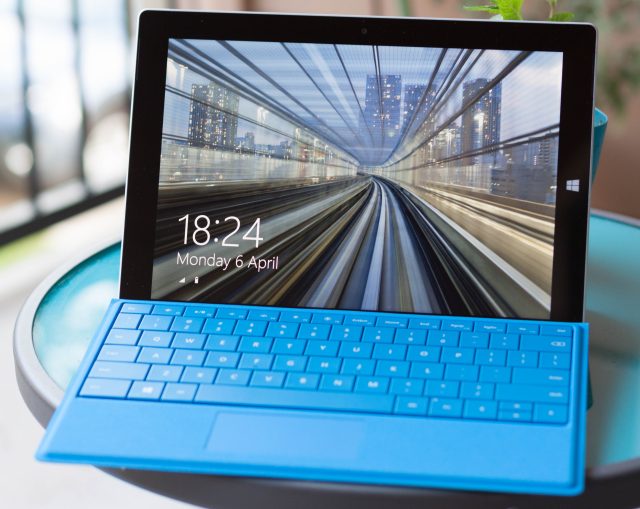
Microsoft's Surface 3 impressed us when it launched last spring. It's a smaller, cheaper iteration of its Surface Pro concept, and this setup struck us as a pretty compelling mix. But there are signs that the device is not long for this world. Brad Sams at Thurrott.com writes that many versions are listed as out of stock in Microsoft's online store, with no expected availability. Online, only the 2GB RAM/64GB storage/LTE version is in stock.

In-store stock levels show a bit more availability, but the Surface 3 remains limited, with only some configurations on offer.

This kind of shortage at this stage in a device's life is generally an indication that manufacturing is slowing down or stopping entirely, and evidence points to this possibly being the case. In a statement, Microsoft said:

Read 6 remaining paragraphs | Comments

Edge lasts longer on battery? Not so fast, says Opera

Is this the opening of a new front in the browser wars?

(credit: Opera)

Earlier this week, Microsoft made some bold claims about the battery life of its Edge browser, saying that laptops running Edge lasted much longer during video playback and used less energy during normal browsing operations than Chrome and Opera.

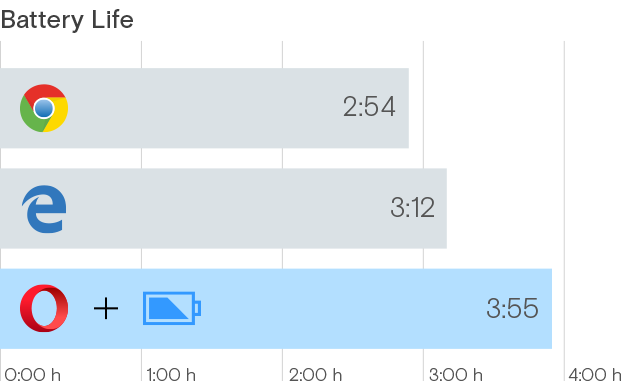
Opera, however, disagrees. The company has run its own tests and has written up the results: with power saving mode, Opera offered 22 percent more battery life than Edge and 35 percent more than Chrome. Unlike Microsoft, Opera has provided a lot more information about what its test did and how someone might replicate it. The test loaded a number of pages into different tabs and simulated button presses to scroll up and down.

While Microsoft hasn't yet formally responded, Edge Program Manager Kyle Pflug tweeted to point out that Opera's testing enabled not just power saving mode but also its built-in ad blocker, which is off by default. The test also compares Opera's latest developer build to Edge's current stable build. The latest Edge developer build supports ad blocking (through its extension mechanism) and makes a number of optimizations to further reduce battery drain.

Read 1 remaining paragraphs | Comments

Azure Information Protection makes warding off data leaks easier

Based on tech bought last year, new system builds on Azure Rights Management.

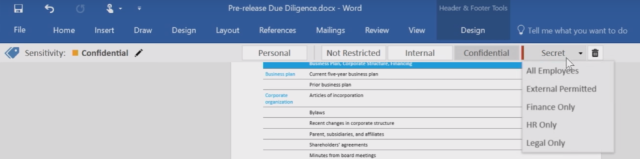
Picking the right classification made easy.

Today, Microsoft announced Azure Information Protection (AIP), a new system to help protect sensitive data even as it moves between applications and organizations. AIP builds on the existing Azure Rights Management (RMS) system to add data labelling and classification to ensure that the right protection policies are applied to sensitive data at the time it is created, to help restrict data leaks.

Azure RMS provides a cloud-based system for performing rights management of sensitive information. With RMS, documents are encrypted and restricted in various ways; opening them requires authentication against Azure Active Directory (AD), allowing the usage of the documents to be tracked and recorded. Once opened, the documents can have their usage restricted to prevent, for example, printing or editing.

Unlike a traditional password-protected document, where knowing the password is sufficient to give permanent access to the file, the online authentication used by RMS means that access can be controlled on a more continuous basis. Accounts showing suspicious behavior such as impossible travel (where logins are made from different places around the world faster than one could travel between those places) can be locked out, blocking access to protected data.

Read 6 remaining paragraphs | Comments

Using Edge instead of Chrome will add hours of extra battery life

According to company tests, Microsoft’s browser even beats Opera’s battery saver mode.

It's no big secret that Google's Chrome browser is a bit of a battery hog. The native browsers on both Windows and macOS (Edge and Safari) are widely reported to outlast Google's offering. In its latest campaign, Microsoft is quantifying this difference: in a test that cycles through some common sites including Facebook, YouTube, Wikipedia, and Amazon, Microsoft's latest browser lasted 7 hours and 22 minutes on a Surface Book system. Chrome lasted just 4 hours and 19 minutes.

Between these extremes were Firefox, at 5 hours and 9 minutes, and Opera in battery-saving mode, at 6 hours and 18 minutes.

Microsoft has gone a step beyond just measuring how long each system runs by measuring the power draw of the Wi-Fi, CPU, and GPU during its test workload. A task that drew 2.1W in Edge pulled 2.8W in Chrome, 3.1W in Opera, and 3.2W in Firefox. This lower draw translates to the longer battery life.

Read 5 remaining paragraphs | Comments

Microsoft tests new tool to remove OEM crapware

For Insiders, there’s now an app to perform clean operating system installs.

Windows 10 already includes ways to clear out applications and data to repair misbehaving systems or prepare them to be sold, courtesy of the Refresh and Reset features added in Windows 8. Microsoft is now adding a third option: a new refresh tool.

Currently available only for Windows Insiders, the new tool fetches a copy of Windows online and performs a clean installation. The only option is whether or not you want to preserve your personal data. Any other software that's installed will be blown away, including the various applications and utilities that OEMs continue to bundle with their systems.

The tool is currently in preview and has some quirks; it installs a preview build from the fast track, but Microsoft notes that the new tool can sometimes install a version older than the one currently installed. When this kind of version mismatch occurs, the option to preserve your files is removed.

Read 1 remaining paragraphs | Comments

Microsoft will use Steam to sell Windows games, not just its own store

Forza 6 Apex and Killer Instinct have done well on the Store, but Quantum Break did not.

Quantum Break: not available on Steam.

While some of Microsoft's older game titles, such as Age of Empires II HD (a 2013 update of a 1999 game) are found on Valve's Steam platform, its latest high-profile titles, such as Forza 6 Apex and Quantum Break, are exclusive to the Windows Store. But this is going to change, with Microsoft planning to release more titles on the popular store.

Phil Spencer, head of the Xbox team at Microsoft, was talking on Giant Bomb's E3 stream, via GameSpot. When it comes to PC gaming, the Windows Store is very much an also-ran, with Steam the dominant force. As Spencer noted, "I don't think Valve's hurt by not having [Microsoft's] first-party games in their store right now. They're doing incredibly well." Accordingly, Spencer said that Microsoft "will ship games on Steam again."

Meanwhile, Microsoft's own experience had been more inconsistent. While some games have done well in the Windows Store, with Spencer naming both Forza 6 Apex and Killer Instinct as successful titles, he said that "Quantum Break wasn't our best PC release" and that Gears of War Ultimate Edition was merely "OK."

Read 3 remaining paragraphs | Comments