AMD’s datacenter ARM processors finally hit the market

“Seattle” processors combine 8 cores with lots of networking.

Is this chip going to be the one to make ARM a serious force in the datacenter? (credit: AMD)

AMD has started volume shipments of its "Seattle" Opteron A1100 ARM processors, designed for high density server systems.

First announced in 2014, the processors have four or eight 64-bit A57 ARM cores running at 1.7 or 2GHz. The chips have up to 4MB of level 2 cache (organized as 1MB per core pair), 8MB of level 3 cache, and two memory channels supporting both DDR3 and DDR4. With 32GB registered DDR4 DIMMs, the chips support a total of 128GB RAM. The chips also include a secondary A5 processor for system control and a coprocessor with accelerated encryption and compression capabilities. The processor cores are paired with a ton of I/O. There are 8 PCIe 3 lanes, 14 SATA3 ports, and two 10GbE ports.

There are three models in total. Two are 8-core parts, both with a 32W TDP, running at 2 or 1.7GHz. The third is a 4-core, 1.7GHz part, with a 25W TDP.

Read 4 remaining paragraphs | Comments
Microsoft finally has a proper way to opt out of Windows 7/8 to Windows 10 upgrades

The upgrade will also now be offered to eligible domain-joined systems.

Microsoft has announced its intent to make the Windows 10 upgrade for existing Windows 7 and 8.1 users more widely available. In tandem with this, the company has also, at last, offered a good way of rejecting the upgrade and making the notifications about it go away forever.

The free upgrade is available to anyone not running an Enterprise version of Windows 7 or 8.1. Home users that update their systems through Windows Update have received a range of quite persistent advertisements in their system tray and the Windows Update app itself to encourage them to upgrade. However, domain joined systems have so far been excluded from this advertising.

Microsoft is changing this imminently. Domain-joined eligible systems that use regular Windows Update for their updates (which is to say, systems that do not have their updates managed by WSUS or SCCM) will start receiving the upgrade offer in the US later this month and worldwide thereafter.

Read 1 remaining paragraphs | Comments

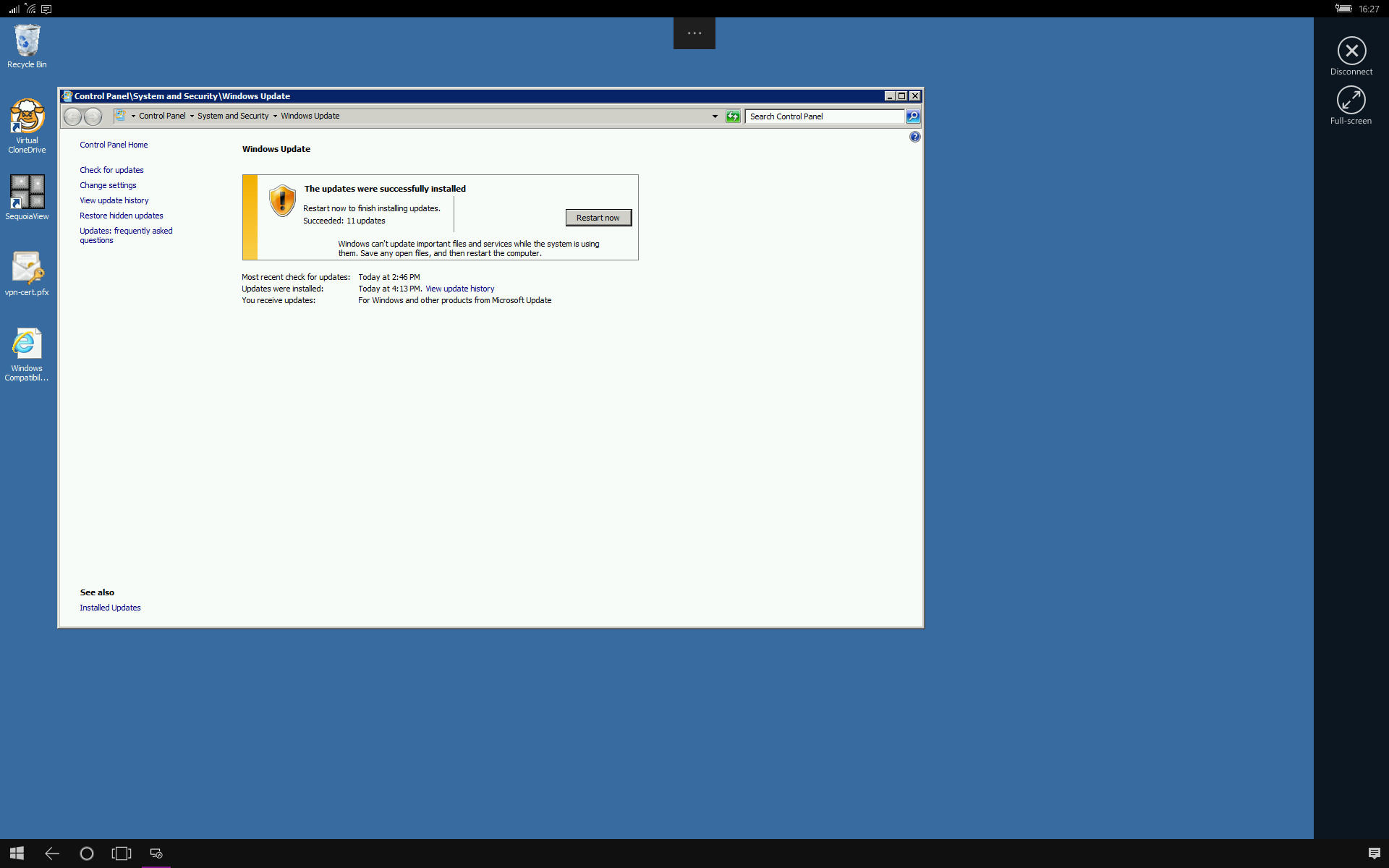
New Remote Desktop client could almost make me a Continuum believer

This almost feels like a killer feature.

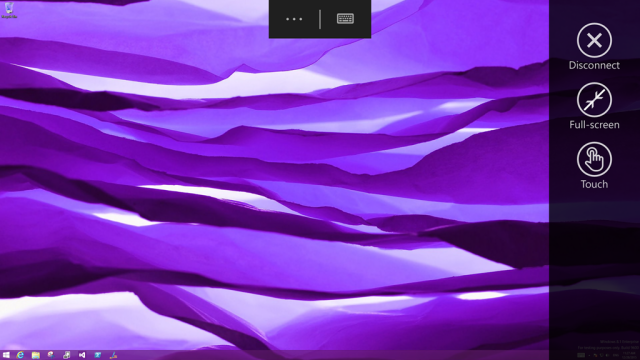
Remote desktop on the phone screen. (credit: Microsoft)

One of Windows 10 Mobile's truly distinctive and unusual features is Continuum. If you hook a phone up to a screen and, optionally, a mouse and keyboard, you can run desktop-style apps, albeit still powered by the phone. The connection to the screen and other peripherals can be wireless, using Miracast and Bluetooth, or wired, using the USB 3 Display Dock.

While the novelty of this is appealing, I'm not altogether sure that it's ever going to be a major selling point. There are a couple of reasons: first, it requires quite specific hardware (although Miracast with Bluetooth is quite widely available); second, it requires Universal Windows Apps that specifically enable the ability to run on a large screen.

A new preview app has me feeling a little more excited about Continuum. Microsoft has released a preview of the Remote Desktop client for Windows 10 Mobile that includes Continuum support. The value of this is obvious: you can connect to a desktop PC running desktop apps, but unlike traditional smartphone remote desktop apps, you don't have to try to use those desktop apps from the small screen of a phone. Just Miracast the display to a big screen, and those desktop apps will look and work exactly the way they should.

Read 2 remaining paragraphs | Comments

Windows 8, Internet Explorer 7, 8, 9, and 10 (mostly) consigned to the dustbin of history

Only the newest Internet Explorer version is now supported.

Microsoft's new support policy for Internet Explorer, announced all the way back in 2014, kicks in today. From now on, Microsoft will only support the newest version of Internet Explorer on each supported version of Windows.

Windows Vista, for example, shipped with Internet Explorer and had downloadable updates to Internet Explorer 8 and Internet Explorer 9. Today, Microsoft patched Internet Explorer 7, 8, and 9 on Windows Vista. But next month, with the new policy, only Internet Explorer 9 will receive updates. Versions 7 and 8 have dropped out of support. On Windows 7 and 8.1 the only supported version will be Internet Explorer 11.

At the same time, Microsoft is also dropping support for Windows 8. To continue to receive security updates, Windows 8 users will have to install the free Windows 8.1 update (or, of course, the Windows 10 upgrade). That's because Microsoft is treating the 8.1 update as if it were a Service Pack. Microsoft's policy when a Service Pack is released is to support the old version and the new version in parallel for at least 24 months and then force the use of the new version.

Read 5 remaining paragraphs | Comments

HP Spectre x2 review: All the quality of the Surface Pro, hundreds of dollars less

Microsoft has defined a market. Now the other PC OEMs are getting in on the action.

It took Microsoft three attempts to come up with a Surface concept that had broad appeal. With the combination of screen size, resolution, system flexibility, and performance, the Surface Pro 3 became a PC that worked for a lot of people. As a tablet, it was thinner and lighter and better to use handheld than any laptop, but its kickstand and magnetic keyboard meant that it offered much of the productivity that laptops boast.

Now that Microsoft has found a formula that works and demonstrated that it has some user appeal, we've seen a proliferation of similar devices from other manufacturers. The Spectre x2 is HP's consumer-oriented iteration of the concept: a 12-inch tablet with an integrated kickstand, a magnetically attached keyboard, an x86 processor, and a full desktop operating system.

Nailing the basics

Specs at a glance: HP Spectre x2
Base Best As reviewed
Screen 1920×1280 12.0" (192 PPI), 10-point capacitive WLED-backlist IPS touchscreen
OS Windows 10 Home
CPU Intel 6th generation Core m3 Intel 6th generation Core m7 Intel 6th generation Core m7
RAM 4GB 8GB 8GB
GPU Intel HD Graphics 515
SSD 128GB 512GB 256GB
Networking 802.11ac/a/b/g/n with 2x2 MIMO antennas, Bluetooth 4.0
Ports 2 USB Type-C, microSD
Cameras Rear: 8MP autofocus, plus 1920×1080 stereoscopic
Front: 5MP
Size 11.81×8.23×0.31" (tablet only)
11.81×8.23×0.52" (tablet with keyboard)
Weight 1.84lb (tablet only)
2.68lb (tablet with keyboard)
Battery 42Wh
Warranty 1 year
Price $799 $1,399 $1,149
Other features 45W charger, TPM 2.0, integrated LTE, keyboard

For me, the most important parts of just about any computer are the parts you have to touch and look at; the keyboard, the touchpad, and the screen. These things have to be done right before I ever care about what's on the inside of the system, because if I hate using a computer, I don't really care about its speed.

Read 30 remaining paragraphs | Comments

Norwegian high school puts e-sports and gaming on the timetable

Students will have five hours a week of reflex training, nutrition advice, and game study.

Most of us have tried to sneak a quick game of Minesweeper in during our computer classes at school, but for students at Garnes High School in Norway, playing games won't be something they'll have to hide. Garnes Vidaregåande Skole, a public high school in the city of Bergen, Norway, is to start teaching e-sports to its students starting in August. The elective class puts e-sports on the same footing as traditional sports such as soccer and handball at the school. 30 or so students enrolled in the program will study five hours a week during the three-year program.

Folk High Schools—boarding schools that offer one year of non-examined training and education—have already offered some e-sports training, but this will be the first time that e-sports find a place in a regular high school.

Students on the program will not simply spend five hours a week playing games at school. While gaming skills are important, the classes will include 90 minutes of physical training optimized for the games in question, with work on reflexes, strength, and endurance. Each class will be split; 15 students will play while the other 15 perform physical exercise. In an interview with Dotablast, Petter Grahl Johnstad, head of the school's science department, says that the students will have their performance graded, with game knowledge and skills, communication, co-operation, and tactical ability all being assessed.

Read 3 remaining paragraphs | Comments

Want to buy a data plan? There’s a Microsoft app—and SIM card—for that

Contract-free connectivity for select LTE devices.

Cellular Data.

The Verge has spotted a mysterious app in the Windows Store. Published by Microsoft, the "Cellular Data" app "allows you to connect to a trusted nationwide mobile data network using only your Microsoft account."

The app, which seems to work in the UK, US, and France, says that connectivity bought this way requires no contracts or long-term commitment, allowing short-term access to LTE data at your convenience. This will be a useful addition for systems like the Surface 3, which come with integrated LTE support.

While this seems useful already, the unusual part is a sentence in the app's description: "This app is designed to work solely with specific Windows 10 devices and requires a Microsoft SIM card" (emphasis ours). The implication here is that Microsoft will be offering some kind of carrier-independent SIM card, with the app providing the necessary configuration to plumb it in to a network. This sounds similar to what Apple started doing when it updated the iPads in late 2014, though Microsoft has yet to formally announce any intent to offer anything comparable.

Read 1 remaining paragraphs | Comments

Google Translate dubs Russia “Mordor” and Russians “occupiers”

Ukrainian-to-Russian translation shows the limits of automated services.

Google Translate has been making some rather unflattering conversions when going from Ukrainian to Russian. "Russia" became "Mordor," "Russians" became "occupiers," and Sergey Lavrov, Russia's foreign minister, became "sad little horse."

Mordor is, of course, a fictional land from JRR Tolkien's Lord of the Rings series.

Screenshots of the bad translations were captured and passed around Russian social media site VKontakte.

Read 2 remaining paragraphs | Comments

Netflix now everywhere except North Korea, China, Syria, Crimea

Overnight the service goes from 60 countries to almost all of them.

Netflix has decided that it's no longer interested in incremental expansion to reach new markets. Over the nine years since its 2007 launch, the service—once used to mail DVDs to you but now better known for online streaming of TV shows and films—has grown to cover 60 different countries, with North and South America, Western Europe, Australia, New Zealand, and Japan all covered. At CES today, CEO Reed Hastings opened the floodgates: Netflix will now be available in almost every country on Earth.

The expansion includes Africa, Eastern Europe, and almost all of Asia and the Middle East in one fell swoop giving Netflix greater reach than any traditional broadcaster. The only exceptions will be China, though the company says that it is still investigating ways of selling there, and North Korea, Syria, and Crimea, because of US government restrictions. To support this new larger market, the company also added support for Arabic, Korean, and Simplified and Traditional Chinese, with further languages in development.

The selection of shows and films available in each country will continue to vary on a country-by-country basis. Netflix says that its own content, including such shows as Jessica Jones and Sense8 will be available everywhere at the same time, presumably without any kind of geographical restriction.

Read 1 remaining paragraphs | Comments

Twitter’s reported plans to remove Twitter’s defining feature are terrible

Latest rumors point to 10,000-character tweets, possibly by the end of the quarter.

Some dude named Shakespeare once wrote: brevity is the soul of tweet. Smart fellow. The 140-character limit is not merely some incidental feature of Twitter; it's the very essence of the service. The mandate to be concise means that Twitter distinguishes itself from abundant conventional blogging platforms. Tweets can be observations, jokes, questions, or carefully distilled ideas, but they cannot be lengthy treatises or complex arguments.

This essential feature is under threat. Re/code is reporting that Twitter is considering removing the 140-character limit and replacing it with a 10,000-character cap. This isn't the first time we've heard such reports; Re/code wrote the same thing in September.

The report suggests that long tweets will be hidden behind some kind of user interaction to expand them, meaning that Twitter timelines will continue to pack in multiple tweets, and we won't be forced to scroll past long essays on the service. This means that the Twitter experience with longer tweets will be similar to the current one.

Read 12 remaining paragraphs | Comments