Moore’s law really is dead this time

The chip industry is no longer going to treat Gordon Moore’s law as the target to aim for.

Gordon Moore's original graph, showing projected transistor counts, long before the term "Moore's law" was coined. (credit: Intel)

Moore's law has died at the age of 51 after an extended illness.

In 1965, Intel co-founder Gordon Moore made an observation that the number of components in integrated circuits was doubling every 12 months or so. Moreover, as this site wrote extensively about in 2003, that the number of transistors per chip that resulted in the lowest price per transistor was doubling every 12 months. In 1965, this meant that 50 transistors per chip offered the lowest per-transistor cost; Moore predicted that by 1970, this would rise to 1,000 components per chip, and that the price per transistor would drop by 90 percent.

With a little more data and some simplification, this observation became "Moore's law": the number of transistors per chip would double every 12 months.

Read 16 remaining paragraphs | Comments
Intel to shut down renegade Skylake overclocking with microcode update

Skylake’s design opened the door to easier overclocking; Intel is closing it back up.

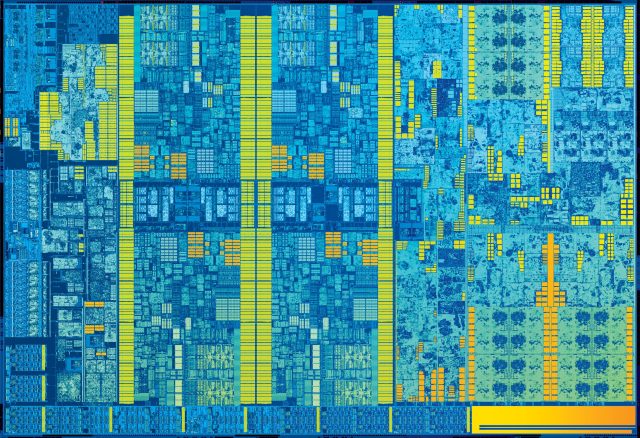
Intel Skylake die shot. (credit: Intel)

Skylake processors that were discovered to be readily overclockable are having their speeds locked back down, with Intel shipping a new microcode update for the chips that closes a loophole introduced in Intel's latest generation of processors, according to PC World.

Intel has a funny relationship with overclocking. On the one hand, the company doesn't like it. Historically, there have been support issues—unscrupulous companies selling systems with slower processors that are overclocked, risking premature failure, overheating, and just plain overcharging—and more fundamentally, if you want a faster processor, Intel would prefer that you spend more money to get it. On the other hand, the company knows that overclocking appeals greatly to a certain kind of enthusiast, one that will show some amount of brand loyalty and generally advocate for Intel's products. Among this crowd there's also a certain amount of street cred that comes from having the fastest chip around.

To address this duality, Intel does a couple of things. Most of its processors have a fixed maximum clock multiplier, capping the top speed that they'll operate at. But for a small price premium, certain processors have "K" versions that remove this cap, allowing greater flexibility for PC owners to run their chips at above the rated maximum speed. This way, most processors can't be readily overclocked, but for those enthusiasts who really want to, an official option exists (although even with these chips, Intel recommends that people do not overclock).

Read 6 remaining paragraphs | Comments

Windows 10 updates finally get some release notes

Microsoft responds to customer feedback, tells us what goes in each update.

With Windows as a Service, Microsoft has delivered a steady stream of monthly updates to Windows 10, along with a more substantial upgrade in November. The monthly updates and periodic upgrades bring with them a wide collection of security fixes, stability improvements, and new features.

Until now, however, it has been hard to know exactly what each update and upgrade contains. While security fixes were enumerated—as they have been for Patch Tuesday for many years—information about the non-security portion of the updates was scant. Microsoft's public release notes for each update package were virtually non-existent—and this in spite of the company producing internal documentation to tell its OEM partners what was changing. After pushback from IT departments and end users alike, the company announced in October that it was going to change its policy and provide some documentation of what these monthly updates actually contain.

The first set of these release notes has now been published. Windows 10 version 1511 is being updated to build 10586.104, and because of the new release notes, we know that this update includes some quality-of-life fixes and the obligatory security updates but no new features. The most notable non-security update is a fix to the Edge browser that prevents it from caching visited URLs when using InPrivate mode.

Read 1 remaining paragraphs | Comments

Ballmer: Hardware, mobile strategy essential for Microsoft’s future

Former Microsoft CEO says company needs clear paths for both parts of “mobile first, cloud first” strategy.

Microsoft's hardware—Surface, HoloLens, and Xbox—is "absolutely essential" to its future, according to former CEO Steve Ballmer in a new interview with Business Insider. That's because of the interrelationship between devices and the cloud: so many devices are supported by and dependent on cloud software, Ballmer feels that the company needs to participate both on the cloud side and on the device side.

Consistent with this idea, Ballmer continues to believe that mobile is an essential part of this hardware lineup. He says he "put the company on a path" toward having its own mobile devices and platform but that current Microsoft CEO Satya Nadella has "certainly changed that" by firing most Nokia staff and greatly scaling back Microsoft's phone-building ambitions. In the ex-Microsoft man's view—one shared by industry watchers, including this author—the new CEO "needs to have a clear path forward." Ballmer is "sure he'll get there," but he's not there yet.

The lack of mobile vision becomes particularly acute with Nadella's "mobile first, cloud first" slogan, which Ballmer describes as an "important perception point" which Nadella has done a "brilliant job on." He says that he meets with Nadella "four or five times a year," both to "brainstorm" and in his role as a shareholder. His position as a large shareholder affords a certain level of access to the company, but he says he's now an outsider: no longer working at Microsoft, he isn't privy to any confidential data.

Read 2 remaining paragraphs | Comments

Chrome picks up bonus security features on Windows 10

The browser is now hardened against some classic Windows security flaws.

(credit: Moyan Brenn)

The Windows 10 November update (version 1511, build 10586) included a handful of new security features to provide protection against some security issues that have kept on popping up in Windows for a number of years. Google yesterday added source code support for these features to the Chrome browser, making Windows 10 the best version of Windows to use with Google's browser.

Over the last few years, Windows has had a number of flaws that relate to its font handling. The TrueType and PostScript fonts that Windows supports are complex things, and for historic reasons, much of the code used to handle these fonts runs in Windows' kernel mode. This makes it attractive to attackers: if a bug exists in this font-handling code, it can be used to obtain kernel-level privileges.

Compounding this, the code is also quite exposed: a Word document, for example, can contain its own embedded fonts, and opening the document means that those embedded fonts will be loaded into the kernel. If the fonts are malicious, constructed to exploit bugs in the font-handling code, this can compromise your system simply by opening a document.

Read 11 remaining paragraphs | Comments

Super Bowl concept video shows a bright HoloLens augmented reality future

It’s almost enough to make non-sports fans watch sports.

Microsoft: Imagining the future for NFL fans

I won't be watching Super Bowl 50 this coming weekend. But if I were, I'd want to be watching it in augmented reality.

Microsoft's concept video, above, shows what that might look like. The first generation HoloLens developer units shown in the video, though, are perhaps a little bulkier and heavier than will be acceptable for a mass market mainstream AR headset. Nonetheless, the ideas shown within the video all feel within reach—and they all look rather compelling. Sports, with their abundant facts and figures, multiple camera angles, and action replays, make for a great showcase for high-tech products: there's so many snazzy visualizations, 3D reconstructions, pictures, and statistics to draw on. The concept video shows this in a stylish and accessible way.

Of course, it'll be some years before all this is really possible. Microsoft plans to have HoloLens development kits out this quarter for $3,000 each; mainstream units at mainstream prices are clearly still some way off. This kind of experience also needs a ton of software to be written, and it needs clever integration with TV broadcasters. The augmentations all need to be synchronized with and react to the broadcast images, which sounds like a great opportunity for things to go wrong. But while this technology doesn't look like something we can get today, we could get it within a few years.

Read on Ars Technica | Comments

Ready or not, here comes Windows 10

Windows 10 will be automatically offered to even more people as a “recommended” update.

With about six months left on Microsoft's free Windows 10 upgrade promotion, Redmond is stepping up its efforts to get Windows 7 and Windows 8.1 users to upgrade to its newest operating system.

Windows Update has three classes of update: important, recommended, and optional. The first category is always downloaded and (if preferred) installed automatically. The last category always requires manual downloading and installation. The middle, "recommended," is by default treated the same as "important," but users can also opt to treat it as equivalent to "optional."

As announced last October, the free Windows 10 update has been promoted from an "optional" update to being a "recommended" one. This means that with the default Windows Update settings, the new operating system will be downloaded automatically, and its installer will be started.

Read 2 remaining paragraphs | Comments

Microsoft’s new way of cooling its data centers: Throw them in the sea

Company says that the units can be built more quickly than typical data centers.

Lowering Leona Philpot into the water. (credit: Microsoft)

Air conditioning is one of the biggest costs in running data centers. Traditional data centers use as much electricity for cooling as they do for running the actual IT equipment. Accordingly, much of the innovation seen in the high-density cloud server space has been to develop data centers that are cheaper to cool and hence cheaper to run. With its much higher heat capacity than air, water has become the coolant of choice, pumped around and between the computers to transport their heat outside.

Project Natick

Microsoft has demonstrated an experimental prototype of a new approach: instead of pumping water around the data center, put the data center in the water. Project Natick is a research project to build and run a data center that's submerged in the ocean. The company built an experimental vessel, named the Leona Philpot, and deployed it on the seafloor about 1 kilometer off the Pacific coast. It ran successfully from August to November last year.

As well as the obvious cooling advantage this brings, Microsoft argues that this kind of data center will bring other benefits, too. About half of the world's population lives within 200km of the ocean, and so the ability to put data centers in the water means that they can always be located close to major population centers. This in turn ensures that they offer low latency connections. The company also says that the self-contained units can be deployed quickly, within 90 days, rather than the 2 years it takes to build a conventional building, or the 1 year that Microsoft says its fourth generation data centers take. The units could also be paired with tidal power generation to further reduce their environmental impact.

Read 3 remaining paragraphs | Comments

Azure Stack, Microsoft’s on-premises cloud service, is now available as a preview

It’s the Azure platform for your private cloud.

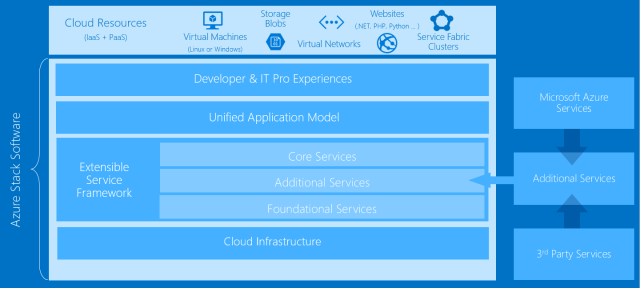
A block diagram that is supposed to clarify what Azure Stack does and is. (credit: Microsoft)

Microsoft today released a preview of Azure Stack, a version of the Azure services and infrastructure that you can run in your own datacenters.

Azure Stack was announced at the Ignite conference last year. It's an Azure-flavored counterpart to OpenStack, offering enterprises the ability to use the same services and management systems for both local on-premises deployments and true cloud deployments.

Currently, the Azure Stack offers only a subset of Azure services, and it runs on just a single server. Its full release is planned for the fourth quarter, but even this will not have parity with the full Azure service. Microsoft's aim for the initial release is to provide all the major parts to support deploying platform-as-a-service Web Apps and infrastructure-as-a-service virtual machines. It will also include components for storage and virtualized networking. The Azure Portal front-end for managing the service will also be included.

Read 1 remaining paragraphs | Comments

Cloud, Surface are the highlights of Microsoft’s $23.8 billion quarter

Earnings continue to suffer the effects of a strong dollar and a weak PC market.

Microsoft posted revenue of $23.8 billion in the second quarter of its 2016 financial year, down 10 percent from the same quarter a year ago. Operating income was $6.0 billion, a 23 percent drop, and net income was $5.0 billion, a 15 percent fall. Earnings per share were $0.78, representing a 13 percent decline.

Just as it has done for the past few quarters, and mirroring Apple's earnings release earlier this week, Microsoft attributed a substantial part of the decline to the strong dollar. With prices outside the US being increased to preserve their dollar value, non-US sales are becoming decreasingly valuable to Microsoft. This depressed revenue by an estimated $1.2 billion. The company also reports that there was a further $1.9 billion impact from revenue deferrals related to Windows 10 and bundled software.

The cloud annualized revenue run rate—a conjectural number that former CEO Steve Ballmer described as "bullshit"—across all commercial offerings now stands at $9.4 billion, reflecting growth both in Office 365 and Azure. Current CEO Satya Nadella says that the opportunity represented by the enterprise cloud market is "larger than any market [Microsoft] has ever participated in."

Read 8 remaining paragraphs | Comments