Microsoft joins the Eclipse foundation, open sources some of its plugins

The open source love affair continues.

The Eclipse Foundation, the organization that oversees development of the Eclipse development environment, has a new member: Microsoft announced Tuesday that it is joining so that it can more easily collaborate with the Eclipse community.

Simultaneous with that move, the company open sourced its Team Explorer Everywhere plugin for Eclipse, which allows Eclipse users to use Team Foundation Server for their version control and bug tracking. The code is now up on GitHub. The Team Explorer Everywhere plugin joins the Azure Toolkit for Eclipse, which is already open source.

To further streamline integration with Microsoft's services for Eclipse users, there is new support for Codenvy in Visual Studio Team Services. With the Codenvy extension, VSTS can generate an Eclipse workspace on demand, quickly setting up a virtual machine with all the right plugins and build tools to work on a project. Codenvy VMs can also now be provisioned on Azure thanks to a new Codenvy VM in the Azure Marketplace.

Read 1 remaining paragraphs | Comments

SQL Server for Linux coming in mid-2017

Will follow the release of SQL Server 2016 for Windows later this year.

Apparently. (credit: Microsoft)

It's not April 1. Scott Guthrie, executive vice president of Microsoft's Cloud and Enterprise Group, announced today that next year Microsoft will be releasing a version of SQL Server that runs on Linux. A private preview is available today that includes the core relational database features of SQL Server 2016.

The announcement implies two things. Either there is a large number of Linux-using corporations out there that are desperate for SQL Server's feature set (as opposed to open source databases such as PostgreSQL, MySQL, or MaxDB, or the proprietary ones such as IBM's DB2 and, of course, Oracle's Oracle), or there is a large number of SQL Server-using organizations out there that are keen to ditch the cost of their Windows licenses but happy to continue to pay for their SQL Server licenses. Neither seems obvious to us.

The Windows version will go into general availability later this year, with a wave of launch-related events starting on Thursday. SQL Server 2016 boasts new in-memory database capabilities that can make some workloads 30-100 times faster and support for encryption for data at rest, in memory, and on the wire. It also offers analytics support using R.

Read on Ars Technica | Comments

Tim Sweeney is missing the point; the PC platform needs fixing

Op-ed: Bringing the console model to Windows wasn’t an accident.

Gears of War: Ultimate Edition for Windows 10 is one of the few UWP games currently available. (credit: Microsoft Studios)

Epic Games' Tim Sweeney wrote an opinion piece in The Guardian saying that Microsoft's Universal Windows Platform (UWP)—the common development platform that covers Windows, Windows Mobile, HoloLens, and soon, Xbox One—"can, should, must, and will die." Sweeney's complaint is that UWP is locked down. By default, UWP apps can only be installed and purchased through Microsoft's store, and they have to run from a sandboxed environment. So some Windows features are, or will be, only available to UWP apps. In this way, Sweeney says that Microsoft is "curtailing users' freedom to install full-featured PC software, and subverting the rights of developers and publishers to maintain a direct relationship with their customers," especially as Microsoft makes some Windows features UWP-only.

Sweeney wants UWP to either be destroyed or made "open" in the same way that the traditional Win32 API is "open." This is in three parts: he wants UWP apps to be downloadable and installable from the Web by default (without needing to change any settings or enable sideloading), he wants third parties to be able to create their own storefronts for UWP apps, and he wants it to always be possible for developers to sell directly to users without Microsoft taking a 30 percent cut.

This is a strange complaint for two main reasons. The first issue is that the UWP lock-down is, overall, a positive thing. The second is that there doesn't appear to be anything preventing third-party downloads, third-party storefronts, and third-party billing right now.

Read 25 remaining paragraphs | Comments

Samsung’s monstrous 15TB SSD is now shipping

Samsung isn’t saying how much it costs, though. Probably “a lot.”

The 16TB Samsung PM1633a SSD (credit: Golem.de)

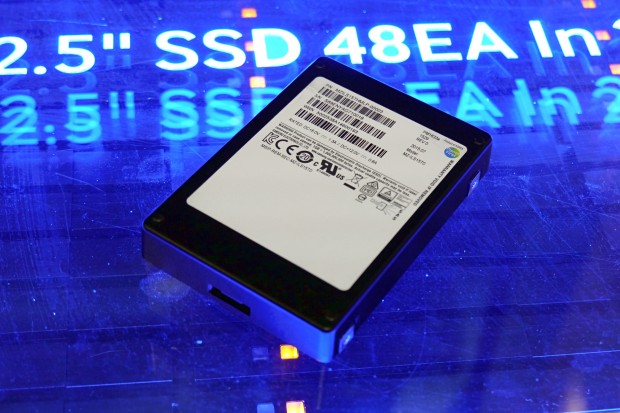
Samsung has announced that it is now shipping its PM1633a SSD. That's a boringly mundane name for a drive that's anything but: the PM1633a isn't just the biggest SSD around, it's straight up the biggest drive around. At 15.36TB, it dwarfs other SSDs and surpasses the capacity even of the very latest magnetic spinning disks. Remarkably, it packs all this storage into a conventional 2.5-inch package.

The company explained how this was done in August last year. While traditional integrated circuits (whether processors or flash memory or RAM or anything else) have a flat, essentially 2D structure, this drive uses Samsung's 3D V-NAND technology, which vertically stacks 48 layers of NAND cells to greatly increase the storage density. The highest performance flash memory stores a single bit in each flash cell; Samsung's trades a bit of performance for density, storing three bits per cell. Each die using this technology stores 256Gb (32GB) of data.

The company then adds a second level of layering: 16 of the 256Gb dies themselves are stacked up, creating a package with a 512GB capacity. 32 of these packages are used in the PM1633a to give it its total 15.36TB capacity. Samsung plans future versions with 7.68TB, 3.84TB, 1.92TB, 960GB, and 480GB capacities. The 15.36TB unit also has 16GB of RAM embedded.

Read 2 remaining paragraphs | Comments

John McAfee better prepare to eat a shoe because he doesn’t know how iPhones work

John McAfee’s plan to crack the iPhone will not even begin to work.

John McAfee announces a rather implausible plan.

Former antivirus developer and presidential wannabe John McAfee claimed a couple of weeks ago to have the perfect solution to the FBI-Apple stand-off. He offered to crack the iPhone for the FBI for free. This would let the government agency gain access to the phone while freeing Apple from any demands to assist. So confident was McAfee of his ability to help out that he said he'd eat a shoe on TV if he couldn't get into the phone.

It will probably not come as much of a surprise to anyone to learn that the FBI has not been beating down McAfee's door.

Perhaps they were unconvinced by the strategy that the man outlined. He said that he and his team would primarily use "social engineering," which is to say, manipulating people into telling you what you want to know through gaining their trust. It can be a powerful technique, but it certainly isn't a panacea. It's often less effective when the victims are aware that you're trying to socially engineer them (for example, by announcing your intent to do so on the Internet). It's less effective still when the people holding the information are in fact dead. McAfee may be persuasive, but probably not so persuasive as to be able to coax a corpse to give up its PIN.

Read 12 remaining paragraphs | Comments

Windows Defender Advanced Threat Protection uses cloud power to figure out you’ve been pwned

New service can detect network breaches by spotting unusual system behavior.

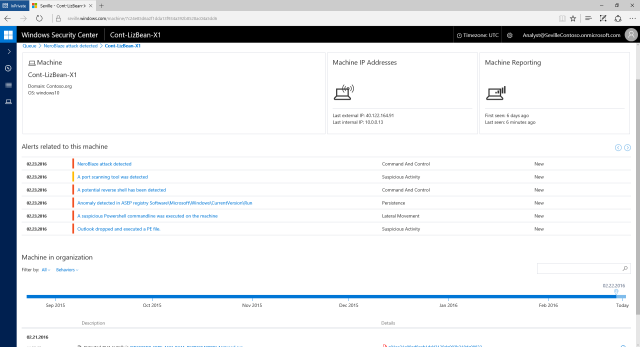
WDATP can detect anomalous behavior even when the malware scanner doesn't find anything wrong. (credit: Microsoft)

Microsoft is beefing up Windows Defender, the anti-malware program that ships with Windows 10, to give it the power to tell companies that they've been hacked after it has happened.

Attacks that depend on social engineering rather than software flaws, as well as those taking advantage of unpatched zero-day vulnerabilities, can evade traditional anti-malware software. Microsoft says that there were thousands of such attacks in 2015, and that on average they took 200 days to detect, and a further 80 days to contain, giving attackers ample time to steal data, and incurring average costs of $12 million per incident. The catchily named Windows Defender Advanced Threat Protection is designed to detect this kind of attack, not by looking for specific pieces of malware, but rather by detecting system activity that looks out of the ordinary.

For example, a social engineering attack might encourage a victim to run a program that was attached to an e-mail, or execute a suspicious looking PowerShell command. The Advanced Persistent Threat (APT) software that's typically used in such attacks may scan ports, connect to network shares to look for data to steal, or to remote systems to seek new instructions and exfiltrate data. Windows Defender Advanced Threat Protection can monitor this behavior and see how it deviates from normal, expected system behavior. The baseline is the aggregate behavior collected anonymously from more than 1 billion Windows systems. If systems on your network start doing something that the "average Windows machine" doesn't, WDATP will alert you.

Read 6 remaining paragraphs | Comments

$3,000 HoloLens dev kit available for pre-order now, shipping March 30

Futuristic hardware finally gets into developers’ hands.

HoloLens Development Edition. (credit: Microsoft)

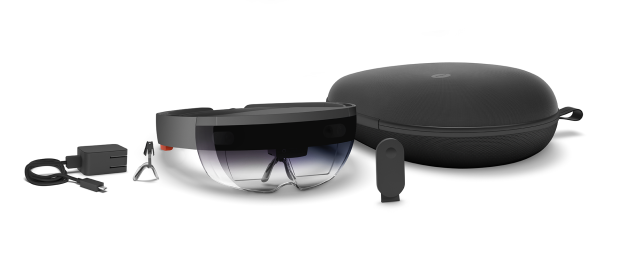
If you want to get your hands on Microsoft's holographic headset, the company is now taking pre-orders for the HoloLens Development Edition. Hardware will be shipping to the US and Canada on March 30, just scraping in to Microsoft's first-quarter deadline. As previously announced, the hardware will cost $3,000.

As pictured, the development kit appears to be relatively barebones, containing the HoloLens, a charger, the Bluetooth 4.1 Clicker that leaked earlier this week, a carrying case, a microfiber cloth, and replacement nose pieces. While the HoloLens itself is fully self-contained, running wirelessly and independently, developing HoloLens software will require a PC that can run Windows 10 and Visual Studio 2015.

Microsoft is being a little more forthcoming with some of the HoloLens hardware specs, though there are some oddities in there. We learned last year that the system was x86 powered with 2GB RAM, 802.11ac, and a 60Hz refresh rate. That hasn't changed, but now we have some more detail, particularly around its sensors. The headset is chock full of cameras—four to "understand" the environment, one to build depth maps of the world, and a 2MP camera for photography and video capture. It also incorporates four microphones, an ambient light sensor, and an inertial measurement unit that combines accelerometers and gyroscopes to detect movement.

Read 6 remaining paragraphs | Comments

Microsoft confirms: Android-on-Windows Astoria tech is gone

And it’s not coming back. Or is it?

(credit: Sean Gallagher)

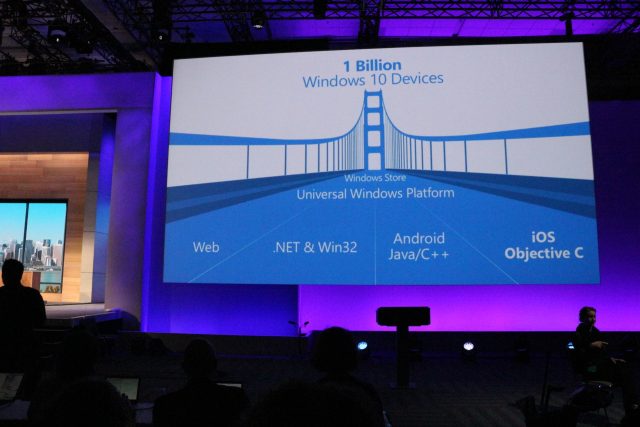
At its Build developer conference last year, Microsoft announced four "bridges" designed to help developers bring applications into the Windows Store. Three of these—for porting Web, Win32, and iOS applications to Windows (codenamed "Westminster," "Centennial," and "Islandwood," respectively)—are still around. But the company confirmed on Thursday that the fourth bridge, Astoria, intended to help bring Android apps to Windows, is no longer in development.

Early builds of Windows 10 Mobile included a version of Astoria, which essentially did exactly what it was supposed to: it enabled Android apps to run on Windows phones. But last November, the Android layer was quietly removed, with Microsoft saying that it was "not ready yet."

Thursday's announcement suggests that it's never going to be ready. The company writes, rather peculiarly, that choosing between Astoria and Islandwood "could be confusing" and that having two systems for porting non-Windows applications was "unnecessary." Accordingly, Islandwood is the only bridge, and Astoria is being abandoned.

Read 7 remaining paragraphs | Comments

Microsoft at last buys .NET-for-iOS, Android vendor Xamarin

Two become one as Microsoft strengthens .NET’s cross-platform reach.

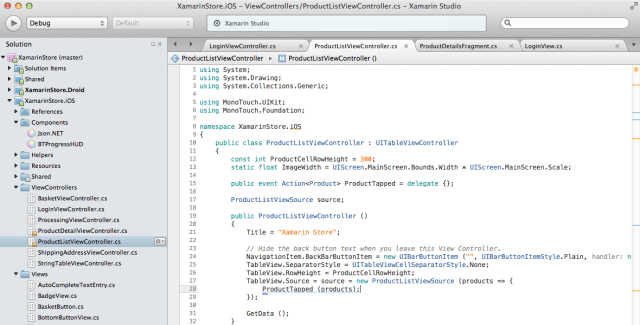
Xamarin Studio, Xamarin's development environment. (credit: Xamarin)

Microsoft will buy Xamarin, maker of .NET tooling that can build apps for iOS, Android, and OS X, for an undisclosed sum.

When Microsoft first launched .NET in the early 2000s, it promised a cross-platform environment that could reach beyond Windows. The company did publish an early FreeBSD-compatible version of .NET named Rotor, and it produced versions of its Silverlight plugin for OS X, but functionally, .NET was a Windows-only affair, with the other platforms distant memories.

In parallel with Microsoft's efforts, an open source version of .NET named Mono was created by Ximian, an open source company founded by Miguel de Icaza and Nat Friedman. Ximian was acquired by Novell in 2003, and Novell was bought by Attachmate in 2011. Attachmate laid off all Mono staff shortly after the acquisition, and de Icaza and Friedman founded Xamarin later that same year to continue their work with Mono.

Read 3 remaining paragraphs | Comments

HoloLens leaks show a mixed reality video app, holo-Start menu, Bluetooth clicker

Next week, we should find out the date that developer units will start shipping.

The video introducing testers to Actiongram.

The $3,000 HoloLens developer units are due to arrive within the next few weeks, but it seems that a few of them have been in the hands of closed beta testers since January, and some information about the devices has leaked courtesy of Twitter user WalkingCat.

The leaked material includes lots of information about a new, not yet publicly demonstrated holographic app called Actiongram (codenamed Project Burbank). The beta testers have been given an early version of this app and are on the hook to create a bunch of videos over the next ten weeks that will presumably showcase the app itself and HoloLens in general. Actiongram is a mixed reality app that overlays videos and animations on the real world, enabling, for example, Deal With It sunglasses to drop down onto a real person's face, or an astronaut to bounce around on your sofa, or all sorts of other things.

The leaked materials include a handful of as yet unreleased pieces of HoloLens information. A video that's used to introduce the beta testers to the platform includes a look at the holographic iteration of the Windows Start menu. An accompanying document describes a Bluetooth clicker peripheral that can be used to interact with holograms—presumably a more convenient alternative to Microsoft's index finger "tap" gesture that has previously been used in demos—and also includes a screenshot of the holographic iteration of the Photos app used in Windows 10.

Read 1 remaining paragraphs | Comments