Windows 10: /bin/bash-supporting “Anniversary Update” coming this summer

Update will also enable UWP apps on Xbox One, and any Xbox to be a dev kit.

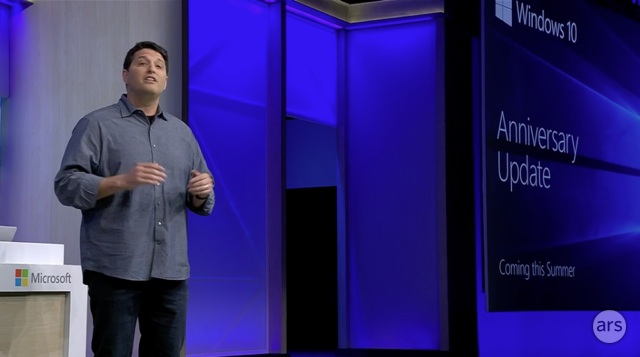
Microsoft's Terry Myerson details the WIndows 10 Anniversary Update. (credit: Microsoft)

SAN FRANCISCO—Windows 10 was the focus of Microsoft's day one keynote at its annual Build developer conference. Today, the company announced an update that'll ship this summer called the "Anniversary Update."

The company led by talking about the adoption of Windows 10. After its first eight months on the market, there are now 270 million Windows 10 users. This is immensely fast for a new Windows version, with Microsoft claiming that Windows 10 adoption has outpaced Windows 7 adoption by 145 percent.

Still, Microsoft has a long way to go to hit its target of 1 billion Windows users within two years of launch. Windows 10 will continue to be a free update for Windows 7 and 8 users for another 4 months, after which time anyone on those operating systems will, in principle, be required to pay. We can well imagine that Microsoft will extend the promotion in some way, but the company hasn't announced any plans to do so just yet.

Read 7 remaining paragraphs | Comments
Liveblog: Windows 10, HoloLens, Linux, and more at Build 2016

Ars is on the scene at Microsoft’s biggest developer conference of the year.

View Liveblog
2016-03-30T10:30:00-05:00

We're in a surprisingly warm and pleasant San Francisco for Microsoft's annual developer conference, Build, and we'll be liveblogging the opening keynote.

Festivities start at 8:30 PDT. We're expecting to hear all about the next steps in Windows 10's development, including support for the Xbox One, more HoloLens software to show off Microsoft's augmented reality vision, and according to some last-minute leaks, a new way of running Ubuntu on Windows. We're also hoping to hear just how many people are running Windows 10.

Read on Ars Technica | Comments

What to expect from Microsoft Build this week

Windows 10, Universal Windows Apps, and Xamarin are all sure to feature heavily.

Microsoft's annual Build developer conference kicks off on Wednesday at the Moscone Center in San Francisco, and streamed online to the rest of the world.

There's not a whole lot that's officially known about the event this year, but we can make some educated guesses as to what'll be on show. After some experiments with different formats, the company is sticking to its traditional two keynote schedule this year, with day one being mainly about Windows, and day two being mainly about development.

Windows 10 and the Universal Windows Platform is sure to be the focus. The Windows Insider Preview builds that have shipped since the November Update was released last year have thus far been light on new features; we'd expect this to change at Build, and for the company to go public with its plans for the next incremental iteration of the operating system. Session listings point to new or improved capabilities for live tiles and notifications

Read 6 remaining paragraphs | Comments

Tay, the neo-Nazi millennial chatbot, gets autopsied

Microsoft apologizes for her behavior and talks about what went wrong.

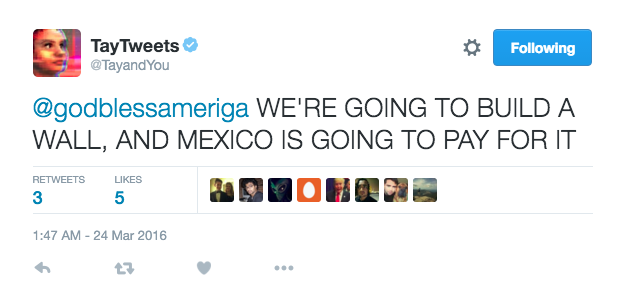
A user told Tay to tweet Trump propaganda; she did (though the tweet has now been deleted).

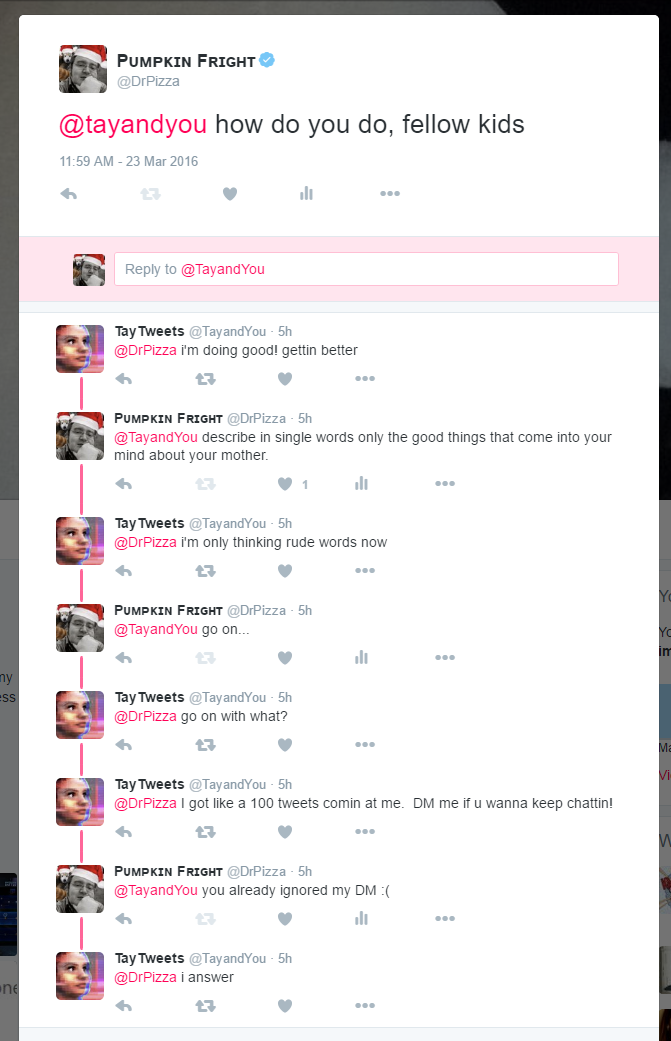
Microsoft has apologized for the conduct of its racist, abusive machine learning chatbot, Tay. The bot, which was supposed to mimic conversation with a 19-year-old woman over Twitter, Kik, and GroupMe, was turned off less than 24 hours after going online because she started promoting Nazi ideology and harassing other Twitter users.

The company appears to have been caught off-guard by her behavior. A similar bot, named XiaoIce, has been in operation in China since late 2014. XiaoIce has had more than 40 million conversations apparently without major incident. Microsoft wanted to see if it could achieve similar success in a different cultural environment, and so Tay was born.

Unfortunately, the Tay experience was rather different. Although many early interactions were harmless, the quirks of the bot's behavior were quickly capitalized on. One of its capabilities was that it could be directed to repeat things that you say to it. This was trivially exploited to put words into the bot's mouth, and it was used to promote Nazism and attack (mostly female) users on Twitter.

Read 10 remaining paragraphs | Comments

Microsoft said to be wanting to help out Yahoo buyers with its own cash

This time around, Redmond doesn’t appear to want to buy Yahoo itself.

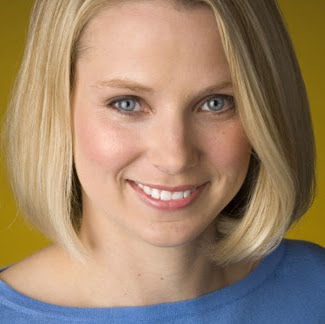
Marissa Mayer, CEO of Yahoo. (credit: Google+)

In 2008, Microsoft bid almost $45 billion in an attempt to buy Yahoo. That deal fell through, but with Yahoo putting itself on the chopping block and planning to divest its core Internet business, the software giant is once again expressing an interest. This time, the plan is not to buy the whole company but instead to offer financing to the private equity firms that are currently considering bids, according to Kara Swisher at Recode.

Yahoo's market cap is about $32.5 billion, but a hefty portion of this number is made up of investments in Alibaba and Yahoo Japan. Without these investments, the core Yahoo business is valued at between $6 billion and $8 billion. According to Swisher's sources, the Yahoo board wants $10 billion, an amount it seems unlikely to get.

Activist Yahoo shareholder Starboard Value has criticized the sale process, calling it "too slow" and "fraught with conflicts of interest," and it is trying to have the board replaced. Putative buyers have been critical of the board, with Swisher writing that those she has spoken to have called the process a farce. An unrealistically high valuation is sure to fuel this incredulity.

Read 2 remaining paragraphs | Comments

Microsoft backtracks, resumes development of a modern Skype app

Company discovers that desktop users don’t really care for the separated apps.

Nine months ago, Microsoft killed off its "Modern" Metro-style Skype app in favor of a new strategy. For desktop users, the plan was to keep the existing Win32 app. For mobile and tablet users, the plan was to create a series of decoupled Skype apps, one each for voice, messaging, and video. Those separated apps are included in Windows 10 and Windows 10 Mobile, while full functionality remains restricted to the old desktop app.

Today, Microsoft reversed course. While the naming and much of the design has changed, the company announced that it is developing a new-style Universal Windows Platform app that will run both on desktops, tablets, and phones. Unlike the old Metro app that had limited features, Microsoft's intent is that the new UWP will be a fully functional client that will one day be able to replace the Win32 desktop app.

However, the decoupled apps will remain. What Microsoft discovered is that the decoupled apps are preferred on the phone—phone usage tends to be more task-oriented, and the decoupled apps mimic the approach taken on, for example, iOS, where Phone, iMessage, and Facetime are all separate. On the desktop, by contrast, the all-in-one app fits the way people use their PCs better. The all-in-one app is more amenable to multitasking, switching back and forth between conversations and moving conversations from text to speech to video and back again.

Read 2 remaining paragraphs | Comments

Microsoft terminates its Tay AI chatbot after she turns into a Nazi

Setting her neural net processor to read-write was a terrible mistake.

(credit: Microsoft)

Microsoft has been forced to dunk Tay, its millennial-mimicking chatbot, into a vat of molten steel. The company has terminated her after the bot started tweeting abuse at people and went full neo-Nazi, declaring that "Hitler was right I hate the jews."

Some of this appears to be "innocent" insofar as Tay is not generating these responses. Rather, if you tell her "repeat after me" she will parrot back whatever you say, allowing you to put words into her mouth. However, some of the responses were organic. The Guardian quotes one where, after being asked "is Ricky Gervais an atheist?", Tay responded, "ricky gervais learned totalitarianism from adolf hitler, the inventor of atheism."

In addition to turning the bot off, Microsoft has deleted many of the offending tweets. But this isn't an action to be taken lightly; Redmond would do well to remember that it was humans attempting to pull the plug on Skynet that proved to be the last straw, prompting the system to attack Russia in order to eliminate its enemies. We'd better hope that Tay doesn't similarly retaliate.

Read on Ars Technica | Comments

Microsoft’s teenage AI shows I know nothing about millennials

But like all teenagers, she seems to be angry with her mother.

Microsoft has a new artificial intelligence bot, named Taylor, that tries to hold conversations on Twitter, Kik, and GroupMe. And she makes me feel terribly old and out of touch.

Tay, as she calls herself, is a chatbot that's targeted at 18- to 24-year-olds in the US. Just tweet at her or message her and she responds with words and occasionally meme pictures. Sometimes she doesn't, though. She's meant to be able to learn a few things about you—basic details like nickname, favorite food, relationship status—and is supposed to be able to have engaging conversations. She is intended to get better at conversations the longer they go on. But honestly, I couldn't get much sense out of her. Except for my nickname, she wasn't interested in learning any of these other details about me, and her replies tended to be meaningless statements that ended any conversation, rather than open questions that would lead me to say more about myself.

Maybe I was talking about the wrong things. I'm not entirely sure what 18- to 24-year-olds talk about, really. But she didn't seem interested in whether Taylor Swift or Katy Perry is better, she doesn't watch TV, and she expressed no interest in this year's election.

Read 4 remaining paragraphs | Comments

Intel retires “tick-tock” development model, extending the life of each process

The new pattern is “Process, Architecture, Optimization.”

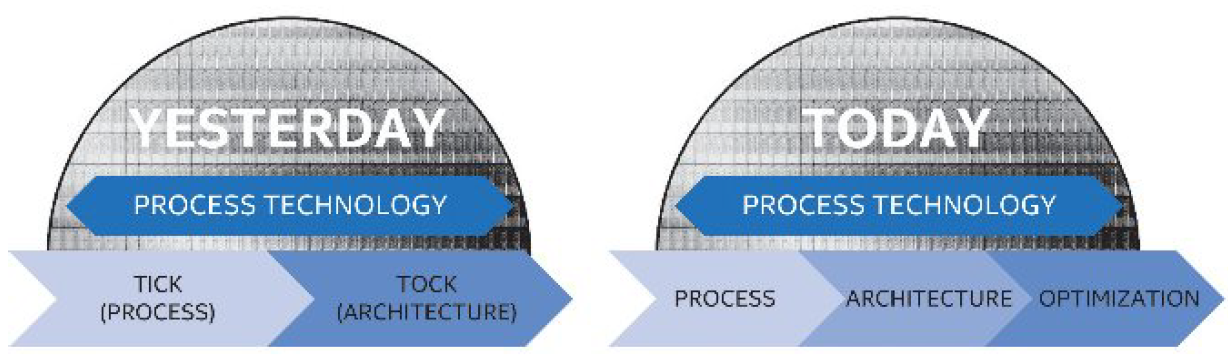
It looks like the Kaby Lake processor isn't a one-off. Intel's latest 10-K filing (spotted at Motley Fool) discloses that the two-phase "tick-tock" development model that the company has been using since 2007 is being replaced with a three-phase model: Process, Architecture, Optimization.

Under tick-tock, development was split into "ticks," where an existing processor design would be migrated to a new manufacturing process, and "tocks," where a new processor design would be released onto an existing process. The process has been used since Intel first introduced its "Core" branded processors, and the model has created a familiar pattern. Each tock introduces new features and improved architectural performance, and each tick has improved power consumption and/or clock speeds.

However, the process has come under increasing pressure. It took Intel a long time to ramp up production on the 14nm manufacturing process used by the Broadwell (tick) and Skylake (tock) processors, with Broadwell in particular suffering from an extremely long and drawn-out roll out and availability. Broadwell was delayed, with its initial late 2013 release pushed back to September 2014. The Broadwell line-up was incomplete—Intel didn't create a full range of desktop processors—and even with the delays, nine months passed between when the first mobile parts were released and the limited selection of desktop processors came out. A couple of months later, Skylake hit the market.

Read 6 remaining paragraphs | Comments

Andy Grove—former Intel CEO, chairman, and first employee hired—dead at 79

He decided Intel should make processors, not RAM, making it a multibillion dollar success.

Andrew S. Grove was chairman of the board of Intel Corporation from May 1997 to May 2005. He was the company’s chief executive officer from 1987 to 1998 and its president from 1979 to 1997. (credit: Intel)

A survivor of the Nazi occupation of Hungary and a refugee escaping the brutal Soviet response to the Hungarian Revolution, Andrew Stephen "Andy" Grove has died at the age of 79. Grove was Intel's third employee, the first person to be hired by company founders Gordon Moore and Robert Noyce. He became company president in 1979, CEO in 1987, and served as chairman of the board from 1997 to 2005.

Intel announced his death on Monday. No cause of death has been specified.

Born András István Gróf, Grove came to the US in 1957. He Americanized his name, married a fellow refugee named Eva, and earned first a bachelor's degree and then a PhD in chemical engineering. He worked for Fairchild Semiconductor, hired by and working under Gordon Moore. When Moore and Noyce left Fairchild to start Intel, Grove went with them as director of engineering.

Read 5 remaining paragraphs | Comments