First Windows 10 preview with bash support is out now

Windows’ emojis have been redesigned, too.

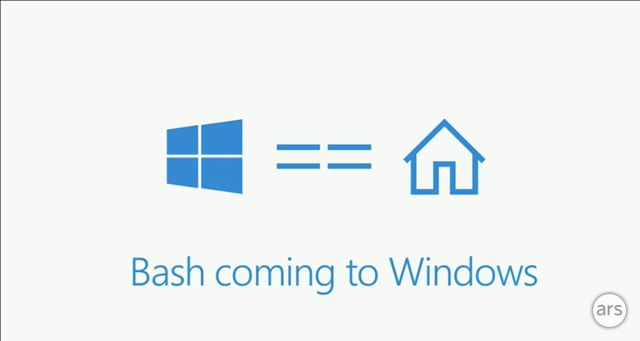
It's bash, and it's on Windows. (credit: Microsoft)

The first Windows 10 Insider Preview build that includes support for native Linux bash on Windows is now out. This was some of the biggest news to come out of Build last week, as Microsoft works to make Windows even more attractive to developers.

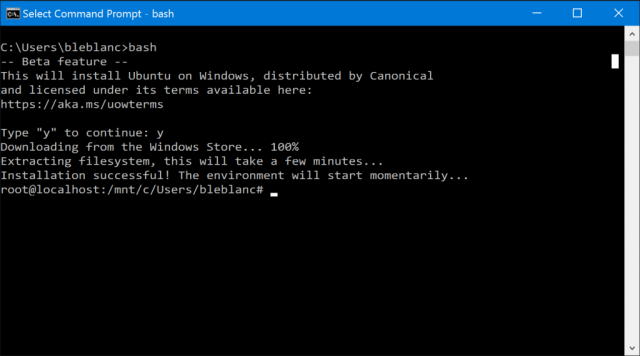
The full install process is described on Microsoft's blog post, but the important part is that in order to use the Windows Subsystem for Linux, the system will have to be put into developer mode through the Settings app (instead of its default sideloading mode). Then the feature will need to be added from Windows Features, and finally the runtime environment will have to be fetched from the store. This process is a little convoluted, but it underscores that Microsoft is positioning the Linux support as a developer feature, not meant for production deployments yet.

The new build looks to be the most significant update since the release of the November Update last year. In addition to the Windows Subsystem for Linux, a bunch of other changes are included. Cortana is smarter, able to sync phone status and notifications between Windows and Android phones and Windows on the PC. She can also help you find your phone by making it ring when you've lost it, and if you look up directions on your PC, she can beam them to your phone for you.

Read 3 remaining paragraphs | Comments

Startup hopes to make you care about all of your notifications again

Wouldn’t it be great if notifications were useful and not annoying?

One of the most important features of mobile platforms is notifications. Our phones, and sometimes even our watches, are forever buzzing and bleeping to tell us that someone, somewhere, has done something that we should know about, right now. Whether you use iOS, Android, or even Windows Mobile, there's a common theme to these notifications: they're deeply annoying. We get notifications when we can't do anything about them, we get too many notifications, and we get notifications that we just don't care about.

This problem is just getting worse, too. Instagram users are begging their followers to turn on notifications for their accounts so that they ensure their pictures are seen in spite of the use of an algorithmic timeline. Even when we think we have our notification settings at just the right balance, an unexpected event—a tweet going viral and getting retweeted all over the Internet, say—can throw things off.

A new startup, Projector, which today announced that it had received $4.5 million in seed financing, is hoping to give mobile app developers the tools to make their notifications actually good by making them a whole lot smarter. The Projector service sits between existing application servers and the notification servers, providing a place for rules and machine learning to be applied to the notifications. There's also a client-side library for displaying and reacting to the notifications.

Read 7 remaining paragraphs | Comments

Why Microsoft needed to make Windows run Linux software

And how it could leapfrog Apple as the dev platform of choice.

It's bash, it's Windows, it's not a virtual machine.

Perhaps the biggest surprise to come from Microsoft's Build developer conference last week was the Windows Subsystem for Linux (WSL).

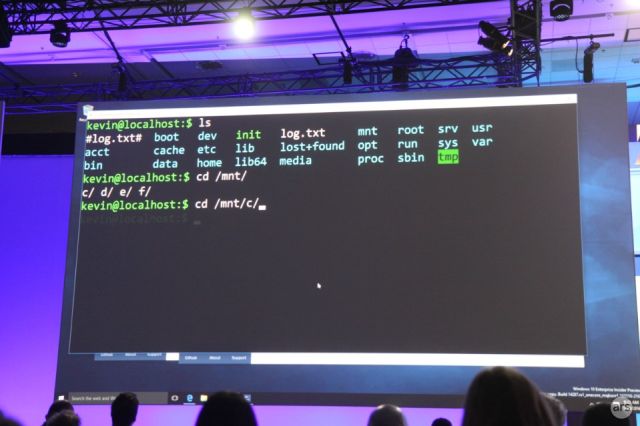
The system will ship as part of this summer's Anniversary Update for Windows 10. WSL has two parts; there's the core subsystem, which is already included in Insider Preview builds of the operating system, and then a package of software that Canonical will provide. The core subsystem is what provides the Linux API on Windows, including the ability to natively load Linux executables and libraries. Canonical will provide bash and all the other command-line tools that are expected in a Linux environment.

Microsoft is positioning WSL strictly as a tool for developers, with a particular view to supporting Web developers and the open source software stacks that they depend on. Many developers are very familiar with the bash shell, with building software using make and gcc, and editing text in vi or emacs. WSL will give these developers versions of these tools that are equal in just about every regard to the ones you get on Linux, because they'll be the ones you get on Linux running unmodified on Windows.

Read 22 remaining paragraphs | Comments

Hands-on with HoloLens: On the cusp of a revolution

It’s an amazing device, and now it needs amazing software to go with it.

The HoloLens in action. Filmed by Esy Casey, edited by Nathan Fitch (video link)

Since it was first revealed in Redmond at the start of last year, I've used HoloLens a couple more times. I did a development session that walked through developing a simple app for the headset using Unity, and I've also seen Microsoft's touring HoloLens experience that it was offering developers last year. Each time I've been subject to tight controls; all usage of the device was strictly supervised, and I wasn't permitted to take pictures or video of the device, nor even take screenshots of the images it produces.

With the HoloLens Developer Edition starting to make its way into developers' hands, Microsoft has at least eased up on the restrictions, and earlier this week I was able to use the device for a couple of hours on my own; not in a tightly scripted, controlled environment, but without any supervision at all. And for the first time, we were allowed to take pictures and photographs when we did.

Read 34 remaining paragraphs | Comments

Azure picks up its own AWS Lambda equivalent

And Microsoft is still trying to position Office as a development platform.

SAN FRANCISCO—Yesterday at its Build developer conference, the topic was Microsoft's first major platform: Windows. Today, it was the turn of the other platform, Azure, with Microsoft talking up its cloud service.

Much of the news today was that services that were previously in preview have now gone live. Azure Service Fabric was announced at last year's event, and Microsoft described it as being its second generation platform-as-a-service offering. Service Fabric was already being used to power services such as Cortana and Skype for Business, and it offers useful features such as automatic scaling and phased deployments of new versions with automatic rollback in case of problems. It's designed to allow developers to handle dozens or hundreds of both stateless and stateful microservices. Service Fabric is now in general availability, making it production ready and widely available.

The company did mention one new service: Azure Functions. This is designed to further abstract away the details of the platform. Users of Functions don't need to provision storage or compute resources or anything like that. They just write a function in C# or JavaScript (using node.js) and plumb that function into events or data sources. The resources for that function are provisioned automatically, and scaling is handled by the system. If the event volume goes up, causing the function to be triggered more often, more resources will be allocated; as volume drops, resources will be cut, possibly to zero. Functions are strictly pay-per-use, meaning that if a function isn't called, it costs nothing.

Read 5 remaining paragraphs | Comments

Xamarin now free in Visual Studio

The Xamarin SDK is also being open sourced.

(credit: Nic Wise)

SAN FRANCISCO—Microsoft bought Xamarin, the popular C#-and-.NET-on-iOS-and-Android, last month. At its Build developer conference today, the company announced the first big step for its new acquisition: Xamarin is now included in every Visual Studio version.

This announcement means that every Visual Studio, from the free Community edition right up to the Enterprise edition, now has access to the Xamarin tooling so that developers can build applications for Android and iOS (though iOS development continues to need access to an OS X machine) using the .NET and C# tools they love.

There are no restrictions to this inclusion, either. As an independent company, Xamarin did have a free version to give developers a taste of what it offered, but the product was historically restricted to only support small executables, with anything larger requiring a paid license. That's not the case today; even Visual Studio 2015 Community has no size or other restrictions. Some enterprise-oriented Xamarin features are still restricted, and developers will need a Visual Studio Enterprise subscription to use these.

Read 3 remaining paragraphs | Comments
UWPs on Xbox: Microsoft wants apps, not games

Game development will still be restricted to certain developers.

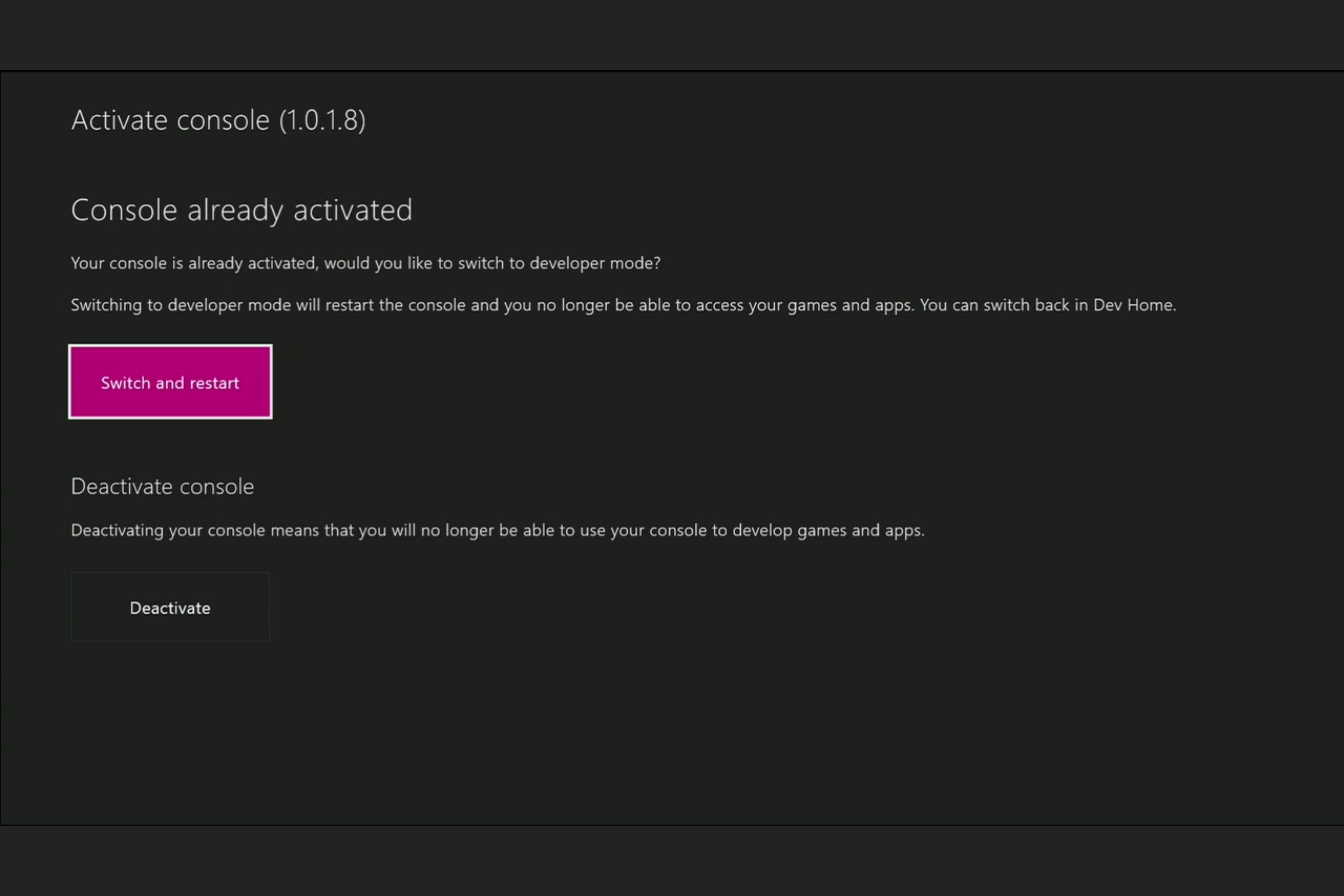
The Xbox One is about to become a development platform for everyone. With this summer's anniversary update, developers creating UWPs will be able to turn their Xbox Ones into a development unit and use them to debug and test applications, and all they'll need is a Windows developer registration (a one-off $19 for individuals, $99 for corporations).

But there's one category of application that they won't be able to write: games. Microsoft already has schemes for creating games on Xbox, with its existing partner program and independent developer scheme, ID@Xbox. Any developers that want to submit UWP games will have to be a member of ID@Xbox. While that doesn't cost anything, it's also not open to everyone in the way that Windows developer registration is. Companies have to be approved for ID@Xbox and subsequently agree to an NDA.

This stands in contrast to desktop Windows, where UWP games are open to any developer, and Microsoft is doing its best to actively encourage their development. The company is making UWPs in Windows 10 better for gaming in the Anniversary Update, by giving developers control of v-sync and access to G-Sync and FreeSync, the adaptive frame rate technology from Nvidia and AMD, respectively.

Read 4 remaining paragraphs | Comments

Liveblog: Dev tools, Xamarin, and Azure at Build 2016

Ars is on the scene to bring you the latest from Build.

View Liveblog
2016-03-31T10:30:00-05:00

San Francisco is still pleasingly sunny, and we're still on the scene for Microsoft's Build developer conference. Day 2 brings another keynote and we'll be liveblogging it from Moscone Center.

Starting at 8:30am PDT, we're expecting to see a fair bit of coding on stage, lots of Visual Studio, and the latest new features to be added to Microsoft's Azure platform. The ability for Windows to run Linux apps is sure to be shown off, something that will no doubt make many developers very happy.

This is the first Build since Microsoft bought Xamarin, and we'd expect at least some time spent talking about just what that's going to mean both for Xamarin developers and existing Windows ones.

Read on Ars Technica | Comments

Developers excited about HoloLens, say it needs a whole new way of thinking

The Development Edition starts shipping today.

8ninths virtual workstation. Video shot by Esy Casey and edited by Nathan Fitch. (video link)

The first HoloLens Development Edition kits are shipping today to developers selected to be in the first wave of availability. Over the weekend, the $3,000 kits should get into the hands of developers not bound by NDAs and other restrictions, making this the first time we'll start to see and understand just what the device can be used for.

However, these aren't the first developers outside of Redmond to use the HoloLens. The company has been working with a select group of teams to develop apps for the augmented reality headset and to better learn how to use the hardware.

Read 7 remaining paragraphs | Comments

Ubuntu’s bash and Linux command line coming to Windows 10

Rising from the ashes of Project Astoria.

Yes, bash is coming to Windows. (credit: Microsoft)

Microsoft built a Linux subsystem for Windows for Project Astoria, its system for running Android apps on Windows 10 Mobile.

But in February the company confirmed that Astoria was dead, as it rather undermined the Universal Windows Platform concept. At the time, we speculated that portions of Astoria might live on, as portions of it had mysteriously started showing up in Windows Insider Previews. And today, that has come to pass, with Microsoft saying that the Windows 10 Anniversary Update will include the ability to run the popular bash shell from Unix, along with the rest of a typical Unix command-line environment.

We're still trying to get the inside story on what Microsoft has done here, but what we've known for several months now is that the company has developed some Windows kernel components (lxcore.sys, lxss.sys, presumably standing for "Linux core" and "Linux subsystem," respectively) that support the major Linux kernel APIs. These components are not GPLed and do not appear to contain Linux code themselves; instead, they implement the Linux kernel API using the native Windows NT API that the Windows kernel provides. Microsoft is calling this the "Windows Subsystem for Linux" (WSL).

Read 5 remaining paragraphs | Comments