YouTubers under fire for promoting their own CS:GO gambling site in videos

Syndicate and TmarTn promoted CSGO Lotto, but didn’t disclose that they own it.

(credit: Justin Tallis/AFP/Getty Images)

Until yesterday, if you were to browse the video pages of popular gaming YouTubers Trevor "TmarTn" Martin and Tom "Syndicate" Cassell, you'd have found a string of videos about the about Counter-Strike: Global Offensive gambling site CSGO Lotto. These videos showed the pair gambling weapon skins on the site, which allows anyone over 13 years of age to trade their hard-earned weapon skins for actual money. They often won big, resulting in videos with titles like "HOW TO WIN $13,000 IN 5 MINUTES."

Ordinarily, such a video would be regarded as little more than clickbait, the sort of thing you might see on a banner ad while browsing unscrupulous websites. But, with millions of subscribers, both Martin and Cassell have a captive audience who watch the videos in their hundreds of thousands. Now, these same subscribers have been turning out in their droves to launch allegations of unethical behaviour and a complete lack of disclosure.

It turns out the owners of the CSGO Lotto website are none other than Martin and Cassell.

Read 14 remaining paragraphs | Comments

Chris Evans quits Top Gear following lowest ratings ever

“Gave it my best shot but sometimes that’s not enough.”

(credit: Ray Crowder / Getty Images)

Chris Evans is stepping down from his role as a presenter on Top Gear after just one season. He tweeted: "Stepping down from Top Gear. Gave it my best shot but sometimes that's not enough. The rest of the team are beyond brilliant, I wish them all the best."

In an official statement, Evans said: "I feel like my standing aside is the single best thing I can now do to help the cause. I remain a huge fan of the show, always have been, always will be. I will continue to focus on my radio show and the allied events that it encompasses.”

Evans' departure came just after the final episode of the current season of Top Gear aired on BBC2 on Sunday, which reached an average of just 1.9 million viewers. While that overnight figure does not yet include views on iPlayer or outside the UK, it still marks the lowest ever rating for the modern version of the show.

Read 6 remaining paragraphs | Comments

Are two RX 480s faster than a single GTX 1080?

In a word: no.

(credit: Mark Walton)

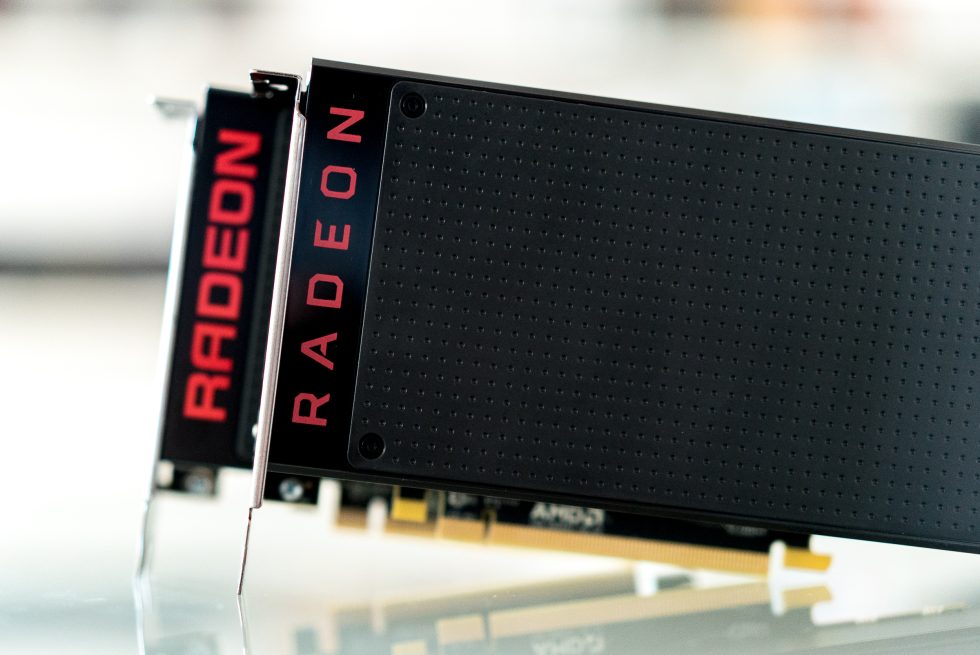
I love a good PR stunt or outlandish claim as much as the next guy. You know, where a company decides that the best way to tell people about a new product is to slaughter a few goats and serve fake entrails up to guests, or declare that a certain developer is going to make you his bitch. That sort of thing. Imagine my delight, then, when AMD's Raja Koduri took to the stage during the unveiling of the RX 480 to declare that, with two of them in Crossfire, they were faster than Nvidia's GTX 1080, and would cost far less. Everyone was intrigued.

Here's the thing about making bold claims involving competitor products, though: you'd better be damn sure those claims stand up under scrutiny, because sooner or later, someone is will actually test it.

So with the RX 480 in shops, and the initial batch of press reviews near universally declaring it an excellent graphics card for the budget-minded gamer (something I agreed with too), it's time to put AMD's bold claims to the test. Are two AMD RX 480s faster than a GTX 1080?

Read 13 remaining paragraphs | Comments

AMD admits RX 480 power tuning is “not optimal”

Following reports that the RX 480 exceeds 150W TDP, AMD begins work on software fix.

Last week, AMD released its budget-minded RX 480 graphics card to largely critical acclaim. Unfortunately, the positive reception has been overshadowed by reports that the RX 480 exceeds its 150W target TDP. Furthermore, that extra power draw seems to be coming from the PCIe bus, with the card pulling as much as 90W from its PCIe slot, far exceeding the specified 75W maximum and potentially causing stability issues with certain motherboards.

The tests, conducted by Tom's Hardware, caused quite the stir over on Reddit. Some Reddit users even conducted their own tests on retail versions of the RX 480, with some (though not all) throwing up similar results. AMD has now issued a statement, admitting that the tuning on certain RX 480 cards is "not optimal."

As you know, we continuously tune our GPUs in order to maximise their performance within their given power envelopes and the speed of the memory interface, which in this case is an unprecedented 8Gbps for GDDR5. Recently, we identified select scenarios where the tuning of some RX 480 boards was not optimal. Fortunately, we can adjust the GPU's tuning via software in order to resolve this issue. We are already testing a driver that implements a fix, and we will provide an update to the community on our progress on Tuesday.

While AMD's statement doesn't indicate precisely what's causing the issues with the RX 480, if it is exceeding its 150W target, either something is causing the card to run in the wrong power state, or it's exceeding its power limit and needs to be throttled back. There's some speculation that AMD was simply too ambitious with the RX 480's power draw, and that the addition of an 8-pin power connector would solve the issue, as well as open up far more headroom for overclocking.

Read 2 remaining paragraphs | Comments

AMD RX 480 review: The best budget graphics card—but for how long?

Solid 1080p, VR performance overshadowed by subpar efficiency improvements.

Specs at a glance: AMD RX 480
COMPUTE UNITS 36
TEXTURE UNITS 144
ROPS 32
CORE CLOCK 1120MHz
BOOST CLOCK 1266MHz
MEMORY BUS WIDTH 256-bit
MEMORY SPEED 8GHz or 7GHz
MEMORY BANDWIDTH 320GB/s or 224GB/s
MEMORY SIZE 8GB GDDR5 or 4GB GDDR5
Outputs 3x DisplayPort 1.3, 1x HDMI 2.0b with support for 4K60 HDR
Release date June 29
PRICE 8GB (as reviewed): £215, $230. 4GB: £180, $200

Brave? Foolhardy? Desperate? Whatever you might think about AMD's decision to cede the top end of the graphics card market (at least for now) to Nvidia and launch the mainstream-focused RX 480 instead, the fact remains that for £180/$200 it's the best graphics card you can buy. It's faster than Nvidia's GTX 970, and (mostly) faster than an R9 390, making it more than powerful enough to meet the minimum spec for virtual reality—and it'll blitz through demanding 1080p games at a smooth 60FPS too. It even does a decent job at 1440p, so long as you're fine with dialling down a few settings.

As a consumer product, then, the RX 480 is a success, even if one of AMD's core pitches—that it'll help drive VR adoption—is a little suspect. VR headsets still cost well over £500, after all.

But—and sadly, there always seems to be but with AMD—the RX 480 is not a great debut for Polaris 10, its first GPU based on an all-new, theoretically-more-efficient 14nm FinFET manufacturing process. At 150W, the RX 480 sits in the same power envelope as the GTX 1070, yet offers less performance. It runs hotter too, hitting 80 degrees Celsius, even struggling to hit its advertised boost clock at times—and that's in a big, well ventilated case. Compared to AMD's previous cards, it's an improvement, but those were always power-hungry beasts, and the bar has since been raised.

Read 31 remaining paragraphs | Comments

Chrome DRM bug makes it easy to download streaming video

Netflix, Amazon could face increased piracy if Google doesn’t fix the problem.

(credit: Valentina Palladino)

Security researchers have discovered a vulnerability in the Google Chrome browser that could allow users to bypass itscopy protection system and download content from streaming video services like Netflix and Amazon Prime Video. According to Wired, Google was alerted to the problem on May 24, but is yet to issue a patch.

The vulnerability centers around the Widevine digital rights management system—which Google owns and has implemented into Chrome—and specifically how it handles decryption of encrypted media streams. Widevine uses two pieces of tech to protect content: the encrypted media extensions (EME), which handle key exchanges and other high-level functions, and a content decryption module (CDM), which unscrambles encrypted video for playback in the browser.

Unfortunately for Google, the researchers discovered it's possible to hijack the decrypted movie stream right after the CDM decrypts the film, before it's displayed in the browser. With the right software—and let's face it, it doesn't take long for pirating software to appear following the discovery of a vulnerability—any user would be able to download streaming content for keeps.

Read 6 remaining paragraphs | Comments

Many UK voters didn’t understand Brexit, Google searches suggest

“What happens if we leave the EU?” and “What is Brexit?” were top search terms.

(credit: Mark Walton)

In the wee hours of Friday morning, the people of the UK voted to leave the European Union with a majority of 52 percent—and according to Google, they don't really know why. Two hours after the referendum polls closed, roughly midnight UK time, the Google Trends Twitter account reported a 250 percent increase in people searching "what happens if we leave the EU." "Are we in or out of the EU?" spiked by 2,450 percent.

Other search terms that peaked following the result include "what happens to foreigners if we leave the EU," "what happens if we stay in the EU," and—perhaps most worryingly considering the gravity of the decision—"what is Brexit?"

Earlier in the evening, the top search in Sunderland (one of the first cities to declare its results) was "How do I vote in the EU referendum?"

Read 7 remaining paragraphs | Comments

How to make your own mixed reality VR setup (It’s surprisingly easy)

All you need is a camera, a capture card, and one spare Vive controller.

How HTC makes mixed reality VR. (video link)

Just how do you show people what virtual reality is like? Valve, along with the help of some games developers and skilled video producers came up with an answer earlier this year: using a green screen and some video know-how, it transposed players from the real world into the virtual world, displaying the results onto a separate monitor. With mixed reality, it's possible for onlookers to see what it's like to blast drones inside Space Pirate Trainer, or pet a robotic dog inside The Lab—the results are hugely impressive.

And yet, despite looking rather difficult in the Valve video, doing this sort of production work yourself is not only possible, it's surprisingly easy. At E3 2016, HTC showed off its own mixed reality solution, one that's been developed specifically for showcasing VR at events. That means it's portable, easy to set up, and relatively cheap, showing everyone the wonder of immersive VR without necessarily having to put a headset on.

Read 5 remaining paragraphs | Comments

Star Trek: Bridge Crew lets you go where no man has gone before (in VR)

Four-player co-op with tactical, helm, engineering, or captain roles—the game is awesome.

There's nerding out, and then there's playing Star Trek: Bridge Crew. But oh man is four-player VR co-op fun. (video link)

When you've spent the best part of your day playing collectible card games with a man cosplaying as Geralt from The Witcher, it takes a special something to make you feel like maybe, just maybe, you're a bit too nerdy. That special something is Ubisoft's Star Trek: Bridge Crew, a four-player VR co-op game for the Oculus Rift, HTC Vive, and PlayStation VR that lets you live the dream of captaining a Federation starship through deep space. Even the most hardened of Star Trek haters are going to love this.

Star Trek: Bridge Crew puts you in one of four roles: Captain, Helm, Tactical, or Engineering. If you're playing on your own, AI fills in for the other roles, but ideally you want to find a group of well-heeled friends with enough disposable income to buy both a great gaming PC and a VR headset (at least until PS VR comes out). From there, invite everyone over to your place and have one big nerdy Star Trek: Bridge Crew LAN party. That, not so coincidentally, is the exact setup on show at E3 2016.

Read 9 remaining paragraphs | Comments

Gwent: The collectible card game that’s more than just a Witcher spin-off

If you’re not into multiplayer, there’s a robust RPG-style single-player mode, too.

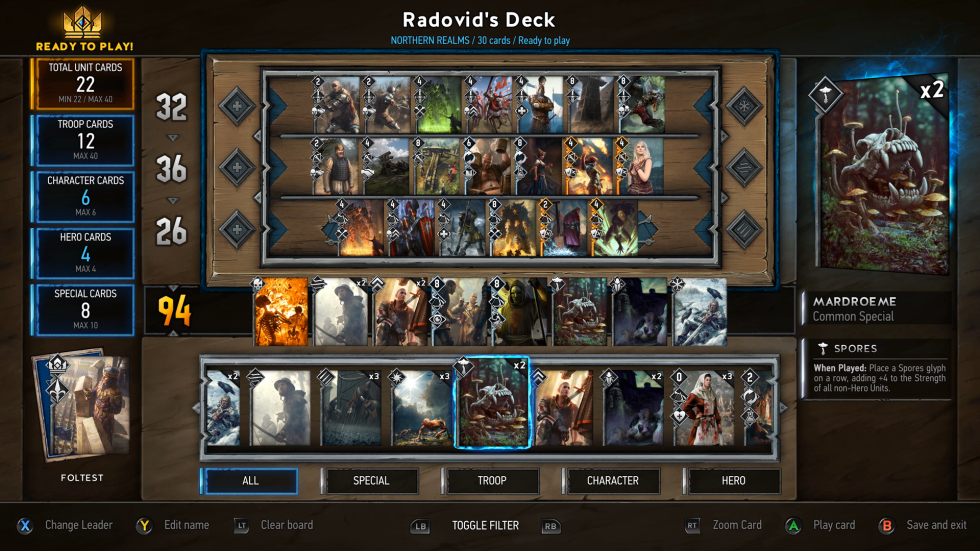
Didn't you hear? Collectible card games are all the rage these days, what with Blizzard's Hearthstone sporting over 20 million players, Magic: The Gathering going through some kind of renaissance, and publishers like Bethesda definitely not trying to cash in on the whole thing with games like The Elder Scrolls: Legends. And so at this year's E3 we have yet another entry in the genre from developers CD Projekt Red, a Witcher 3 spin-off called Gwent. The difference is, Gwent is far more than just a collectible card game. This one has an honest-to-god proper storyline. There's even an open-world map to explore.

For the uninitiated, Gwent was originally a collectible card game embedded into the vast world of The Witcher 3. Only, as player data began to trickle in, CD Projekt Red discovered that many players were spending hours roaming inns during quests just to play Gwent. Some even ignored the main game entirely. This was more than enough incentive for the developer to spin Gwent off into its own free-to-play game across PC, Xbox One, and PlayStation 4. And in true CD Projekt Red fashion, it's gone a little overboard in the process.

Instead of just pitching players against each another in one-on-one card battles, Gwent features several single-player campaigns, each of of which has its own unique storyline and lead character, is fully voice acted, and is brought to life via some highly stylised 2D drawings that gently slide across the screen. There's even an overworld map where, in the demo I was shown at least, you control a cute 2D Geralt to explore and find hidden snippets of story, or extra cards to add to your deck. Each campaign is said to last a whopping 10 hours or so too.

Read 9 remaining paragraphs | Comments