HP’s new Omen X gaming PC is a tilted homage to the NeXTcube

Striking looks don’t come cheap: $1,799 for pre-built system; $599 for barebones.

COLOGNE, Germany—While common wisdom suggests that your average gamer would prefer a smaller PC over a larger one—see Nvidia shrinking down its desktop graphics cards to fit inside laptops—HP is bucking the trend with its imposing Omen X PC.

While it only houses a micro-ATX motherboard, the Omen X's tilted cube design with separate compartments for motherboard, power supply, and storage, makes it far larger than your average micro-ATX PC. Inside the motherboard compartment there's space for up to two full-length graphics cards, and three 120mm fans that can be used together to fit in a 360mm radiator or all-in-one watercooler. There's room in the PSU compartment for monster 1500W units, while the storage compartment houses four neat hot swap hard drive bays that'll take 3.5- or 2.5-inch drives.

Unusually for a PC from an OEM, the Omen X is designed to be taken apart by users. On the back of the case is an eject button that pops off the side cover with little effort, revealing the internals. On the front, behind one of the four squares outlined by customisable RGB LED lighting (because everything has to have RGB lighting these days) is a tool kit containing a screwdriver and extra screws. That's particularly handy given that the Omen X will be sold both as a complete PC, with prices starting at €2299 (~£2000), and as a standalone chassis for an extremely pricey €599 (~£500).

Read 3 remaining paragraphs | Comments
Final Fantasy 15 hands-on: Brave new direction or just pandering to fans?

Plus, one whole hour of FF15 gameplay footage from the start of the game.

Get a sneak peek at one whole hour of Final Fantasy 15 from the very beginning of the game. Naturally, the video contains some spoilers. The text below is spoiler-free. (video link)

COLOGNE, Germany—It finally happened, a decade's worth of expectation fulfilled with a simple push of a button. Though I still can't quite believe it (and a recent delay hasn't helped) Final Fantasy XV, a game that's taken on near mythical status alongside the likes of The Last Guardian, Beyond Good and Evil 2, and Half Life 3, is finally being released on November 29—and I've already played it.

Selecting "New Game" has never been quite as satisfying before.

Read 11 remaining paragraphs | Comments

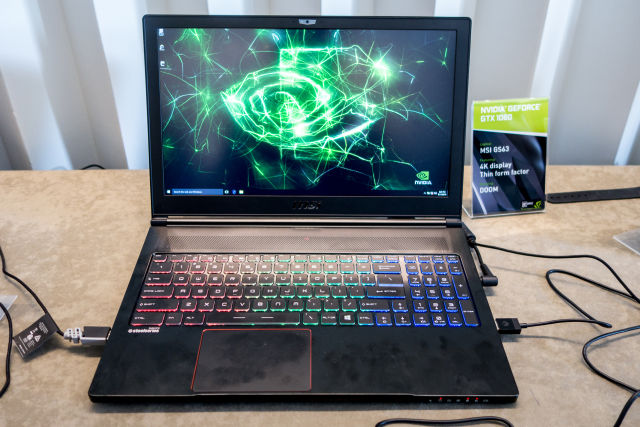
Nvidia stuffs desktop GTX 1080, 1070, 1060 into laptops, drops the “M”

In everything from 4K thin-and-lights to huge machines with 120Hz G-Sync screens.

Just under a year since Nvidia brought the full desktop version of the GTX 980 to laptops, it is beginning to put an end to cut-down laptop chips altogether. Starting today, the desktop versions of the GTX 1080, GTX 1070, and GTX 1060—with some very slight tweaks—are inside laptops from the likes of MSI, Asus, Alienware, Lenovo, and Razer, to name but a few. They're even overclockable. Yes, if you want the very best graphics card outside of a Titan X inside something you can carry around with you to LAN parties, Nvidia has you covered.

Well, I say carry around, but just like laptops kitted out with a desktop GTX 980, those with a GTX 1080 inside aren't exactly thin-and-light ultrabooks. Indeed, most laptop makers are reusing the same chassis as they did for the GTX 980, resulting in systems that are insanely thick, heavy, and about as portable as carrying around a sack of bricks. Oh, and don't forget the power adaptor, which—as I saw with some models in performance demos—is literally the size of a brick. But hey, at least if someone tries to mug you for your expensive laptop, you'll have something to clobber the assailant with.

Still, stuffing a desktop GTX 1080 inside a laptop is an impressive technical achievement. The mobile GTX 1080 is based on the same 16nm Pascal architecture GP104 chip as its desktop counterpart, and features the same 2560 CUDA cores, the same 256-bit memory interface, and the same 8GB of GDDR5X memory running at 10GHz for 320GB/s of bandwidth. It's available in both the MXM form factor as well as integrated solutions. The GTX 1080 supports everything the other Pascal cards support too, including recent inventions such as Simultaneous Multi-Projection and Ansel (which you can read more about in our GTX 1080 review), as well as old standbys like G-Sync and GameStream.

Read 16 remaining paragraphs | Comments

PS4 Neo: Sony confirms PlayStation event for September 7

Sony says PS4 updates will be part of event; we’ll probably see the 4K-capable Neo.

Sony's upcoming 4K-capable PlayStation 4 Neo console looks set for a September reveal. The company has began sending out invites to a "PlayStation" meeting taking place in The PlayStation Theatre, New York on September 7 at 3pm (8pm UK time). It has also confirmed that updates on the PS4 and the PlayStation business are part of the event.

The invite follows several reports that Sony would unveil Neo in September, with French gaming website Gameblog even nailing down the exact date earlier this week. While Sony's Andrew House confirmed the existence of the console to the Financial Times in June, it has yet to detail any of its specifications, or what sort of performance players can expect from its upgraded hardware.

That said, an earlier report from gaming website GiantBomb—which was corroborated by several other publications—detailed the specifications of the console, which included a boost in CPU clock speed, more and faster GPU cores, and increased memory bandwidth. All is said to be based on AMD's technology, which is used in the current PS4.

Read 3 remaining paragraphs | Comments

No Man’s Sky patch removes exploits, dramatically changes the game

Prerelease players will have to erase saved games in order to see most changes.

Enlarge

No Man's Sky developer Hello Games has published the complete release notes for the game's day-one patch, and suffice it to say, it contains more than just bug fixes.

The 1.03 update—which goes live August 8 for reviewers and those with early copies—makes fundamental changes to how the game plays. Mostly notably, there are now three set paths through which players explore the procedurally generated universe of No Man's Sky, each of which will have a "significant impact on what you see later in the game." The story has been rewritten to accommodate the change and allow for multiple endings.

The new universe and planet generation criteria has also been changed; there's a deeper trading system; and new combat mechanics that include critical hit systems in space fights. Plus, lone explorers now have a greater chance of running into other players thanks to a tweaked player "collision" system that lets you scan for areas visited by other players. A full list of changes is posted below.

Read 6 remaining paragraphs | Comments

Corsair Lapdog vs. Razer Turret: Which mouse and keyboard wins for couch gaming?

Two different takes on a keyboard and mouse for the living room—and one clear winner.

(video link)

Making a keyboard and mouse for PC gaming in the living room is hard. Just ask the infamous company Phantom Entertainment which—after blowing tens of millions of dollars trying and failing to release a PC-based console—settled on releasing the ergonomic monstrosity that was the Phantom Lapboard instead. Since then, few companies have taken the challenge on. Sure, Valve had a stab at it with its Steam Controller, and while that functions as a good substitute for a keyboard and mouse in certain games, it's not quite the same as tapping away on some WASD keys.

Fortunately, thanks to the buoyant PC gaming scene, there's been a renewed interest in developing a keyboard and mouse that work well on a couch—and as someone who built a gaming PC specifically to use in the living room, only to resort to using an Xbox controller, I was particularly keen to try them out. Enter the Corsair Lapdog "gaming control centre" and Razer Turret, two very different takes on a keyboard and mouse for the lounge.

Read 18 remaining paragraphs | Comments

Overcooked review: Meet the new couch co-op champion

A charming slice of culinary kitchen chaos from one of the UK’s newest indie devs.

It's not often that I sit down to play a video game with my significant other. Oh sure, we'll play through Until Dawn together, taking turns to steer characters to their deaths, or turn into a crack crime-fighting detective duo to solve the mysteries of Her Story. But there's only so long that you can sit and watch another person play a game before it gets, well...boring.

Worldwide, simultaneous online multiplayer might have made playing games a more exciting experience for the lonesome couch competitor, but for the guy or gal that wants to sit and play a game with someone in the same room, the options are a tad limited.

Which is why I'm so enamoured with Overcooked. It is the quintessential couch co-op experience, a game with a simple premise that's easy to pick up and play, and that brings out the absolute best and worst in those who play it. Oh sure, you'll start out as best friends, gently encouraging each other as you laugh off early mishaps. A dropped onion here, a mishandled plate there—who cares right? But then the washing piles up. No one is chopping lettuce. There's a batch of french fries in the deep fat fryer that a certain someone was supposed to be watching and now they've caught fire. Tempers fray, panic ensues, expletives are hurled.

Read 11 remaining paragraphs | Comments

PS Vita jailbreak finally lets you run emulators and homebrew software

After years of lockdown, enterprising devs release simple browser-based hack.

(credit: Sony)

If you see someone still playing on a PSP, chances are it's because it's been hacked to hell. Sony's trusty handheld might not have been the sales sensation the company had hoped for, but—despite its best efforts—the PSP became the handheld to own if you were into homebrew software or retro gaming thanks to the ease with which it was hacked, the quality of the hardware, and a steady stream of unofficial software and emulators.

There was hope that the follow up to the PSP, the PlayStation Vita, would be similarly hacked, the improved hardware and additional analogue stick allowing for the emulation of more sophisticated consoles. Unfortunately, the Vita has been a much tougher nut to crack. Despite some early efforts, the best anyone had come up with was an exploit that only worked on an older version of the Vita firmware, and that required it to be tethered to a PC—hardly ideal for a portable console.

Fortunately, some clever folks at the hacking collective Team Molecule have come up with a solution that fully unlocks the Vita hardware for homebrew developers. Dubbed HENkaku, the jailbreak exploit not only works on the latest 3.60 Vita firmware, it requires very little user intervention to execute. All you have to do is head over to the official HENkaku website on the Vita, tap on the install button, and then sit back and let the hack work its magic. The one drawback is that the jailbreak isn't permanent, so if the Vita is fully powered off it needs to be reinstalled.

Read 4 remaining paragraphs | Comments

Pokémon Go update removes nearby monster tracking, improves stability

New versions more stable, but how are players supposed to find pokémon?

(credit: YOSHIKAZU TSUNO/AFP/Getty Images)

Despite the popularity of Pokémon Go, the game is flaky at best. Numerous bugs and glitches not only make it difficult to find Pokémon—giving rise to Pokemon tracking sites like PokéVision—but also to play the game without it crashing periodically. Fortunately, developer Niantic has pushed out the first major update to Pokémon Go, one that promises to nix several of the smaller, more irritating bugs, as well as remove features that were causing players issues.

The most surprising change—particularly since Niantic has been trying to shut down sites like PokéVision—is the removal of the footprint feature, which was supposed to help players find pokémon by displaying a set of paw prints in the nearby pokémon tracker. Unfortunately, the feature never worked, and rather than hack a fix together, Niantic has pulled it completely. Whether it makes a return or not Niantic isn't saying, but hopefully something comes along to replace it: currently the only way to find pokémon is through blind luck, or word of mouth.

Indeed, numerous players took to Twitter and Reddit over the weekend to express their frustration with Niantic removing the three steps feature and shutting down Pokémon Go tracking sites, leaving them with no way of accurately tracking down the pokémon they need. That said, while PokéVision has been shut down, the similar Trackémon website is still up and showing the real-time location of Pokémon.

Read 6 remaining paragraphs | Comments

Nintendo suffers huge first-quarter loss as Wii U and 3DS sales tumble

Lack of new games causes slow software growth, while Pokémon Go Plus is delayed.

While Nintendo tried to temper expectations and the impact of augmented reality game Pokémon Go ahead of its financial results, its latest quarterly earnings still make for surprisingly bad reading. Compared to the same quarter last year, Nintendo saw net sales drop 31 percent from ¥90 billion (£651 million, $853 million) to ¥62 billion (£448 million, $587 million) with an operating loss of ¥5.1 billion (£37 million, $48 million).

While the company blames "foreign exchange rates" and "significant yen appreciation" for the loss, the reality is that hardware and software were down across the board, and software growth has been minimal. Nintendo sold 220,000 Wii U consoles, a 53 percent decrease year-on-year, bringing the total number of consoles sold to just over 13 million. Wii U software sales rose a mere three percent to 4.7 million units.

Meanwhile, 3DS hardware sales dropped seven percent to 940,000 units, but software fared a little better, rising seven percent to 8.5 million units off the back of games like Kirby: Planet Robobot and Fire Emblem Fates: Birthright/Conquest. Even Amiibo sales, which have been a bright spot for the company of late, remained flat due to "a lack of new titles that are compatible with Amiibo." Sales of downloadable games and content were also down year-on-year.

Read 5 remaining paragraphs | Comments