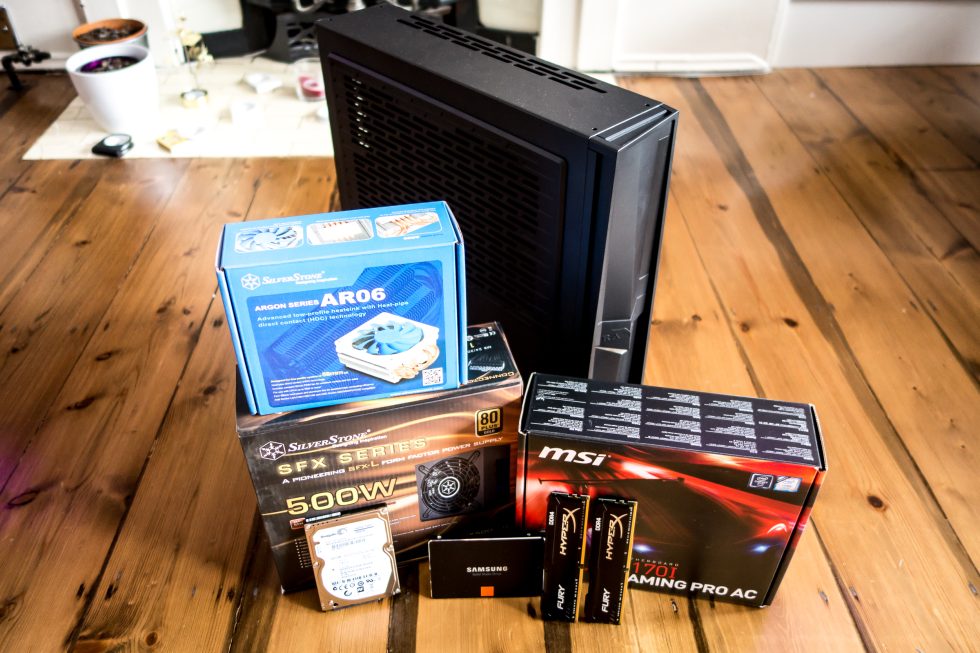
Enough of this console nonsense: It’s time to put a gaming PC in my living room

My living room setup was in need of a complete overhaul—a new gaming PC and a killer NAS.

Way back at the beginning of 2015 I tasked myself with building a gaming PC for the living room. 12 months later and finally—after coming to work for Ars, travelling halfway around the world a few times over, and patiently waiting for someone to release a console-like case that didn't suck—it is done.

As is usually the case when embarking on some half-baked idea to use technology to improve your life—or in my case, provide a prettier way to procrastinate—there's a tendency to over-complicate things. Case in point: I already had a PC in my living room; a very old, very loud, but still perfectly functional HP Microserver that I used as a NAS and media player. The gaming PC could replace the media player part, but what about the storage?

So I needed a gaming PC, and some sort of network-attached storage (NAS)—either one built out of old parts, or something shiny and new from Amazon. Then I remembered that thanks to my recent acquisition of various bits of IoT gear, adding two new devices instead of one would leave me short an Ethernet socket—and no, even with a router capable of 802.11ac, Wi-Fi still doesn't trump good ol' fashioned cables for speed and reliability.

Read 36 remaining paragraphs | Comments

Reddit publishes real-life dead-tree book of its “best” AMAs

Includes the likes of Sir Attenborough, Denzel Washington, and “Double Dick Dude.”

In a rather odd move, community hub Reddit has published a book of what it believes to be its best Ask Me Anything subreddit snippets. For the princely sum of $34.99 in the US only (or $4.99, £3.28 for an e-book version in the UK) you too can be the proud owner of a collection of soundbites from Reddit oddities and famous celebrities immortalised in physical form.

Split into categories that include "Inspiring," "Ingenious," and "Fascinating," the book includes contributions from the likes of Idris Elba, Sir David Attenborough, and Denzel Washington, the latter of which spills the beans on "Why he doesn't want movie star friends," and what his favourite pizza topping is (it's plain old tomato and mozzarella, in case you were wondering).

Some of the wackier AMAs make an appearance too, including "The Man Who Died Twice," "My Ex Tried to Kill Me," and of course "Double Dick Dude." There's also neat artwork and introductions from redditors at the beginning of each AMA. Naturally, you can just read all the AMAs in the book online for free over at Reddit, although, given Reddit's AMA navigation isn't exactly simple, that they've been collated and edited down does make them easier to digest.

Read 3 remaining paragraphs | Comments

The legendary Technics SL-1200 turntable is back and better than ever

With vinyl sales continuing to grow, Panasonic says it’s time to revive a classic.

In 2010, Panasonic made the odd decision to stop producing the Technics SL-1200MK2, a turntable that's as much a part of pop culture as it is one of the most revered and reliable ever made. DJs, who depended on the 1200's powerful direct drive motor and solid tone arm to manipulate the sound of records without skipping, had to rely on the second hand market or alternative brands if they needed a new scratch machine. Although, given that units made in the '70s are still going strong, perhaps there wasn't as big a need for Panasonic to keep making the 1200s as the online petitions claimed.

Still, six years on, Panasonic has decided that now's the time to bring back the legendary SL-1200 turntable, Technics branding included. There is a limited-edition 50th Anniversary Grand Class SL-1200GAE, which is limited to 1200 units and goes on sale this summer, and a non-limited Grand Class 1200G, which goes on sale towards the tail end of the year. Panasonic promises DJ-level reliability and audiophile-grade sound quality from both models.

Audiophile-grade sound quality isn't typically associated with the 1200, thanks to its use of a direct drive motor, as opposed to the belt-driven motor often used in an audiophile turntable. The high-torque direct drive motor is excellent for stability, very low wow and flutter (how much the pitch varies during playback), and swift start/stop speeds, but has been criticised in the past for suffering from "cogging," where small speed fluctuations from the motor are transferred though the stylus, causing a degradation in sound quality.

Read 5 remaining paragraphs | Comments

The Town of Light: A psychological thriller with a mental health message

Preview: A dark horror game not afraid to take on complex and sensitive topics.

Despite how common mental health problems can be, understanding them, or even just discussing them without prejudice, is something of a modern invention. Unsurprisingly then, as a relatively young medium, video games haven't had the best track record when it comes to dealing with such complex issues. Games like Far Cry 3 and Call of Duty: Modern Warfare (to name but a few) have used insanity as a cheap tool and catch-all synonym to explain away the actions of a homicidal villain, which does a great injustice to those suffering from real, treatable conditions.

That's not to say some games haven't tried, though. 2013's Depression Quest successfully achieved empathy through perspective, while Square Enix's Life Is Strange treated its delicate mental health subject matter with the utmost of care. (To say more would be to enter spoiler territory.) UK studio Ninja Theory, makers of DMC: Devil May Cry and Enslaved, is even trying to tackle mental health in the action genre with the upcoming swordplay epic Hellblade. Few games, however, have dared to take the horror genre—the worst offender of all when it comes to the cheapening of mental health issues—into such brave new territory.

Screenwriter Luca Dalcò hopes to change that. His new game The Town of Light, due out on Steam in February, is undeniably a horror experience, and one that at first glance appears to walk the same clichéd path as others in the genre. It's set in an abandoned mental asylum, players take on the role of a former patient, and—thanks to said patient's psychological problems—lots of scary stuff happens.

Read 7 remaining paragraphs | Comments

Buy a 4K TV for Christmas? Bet it wasn’t a new “UHD Premium” set

Devices bearing the new logo will offer the best in 4K and HDR content.

The UHD Alliance (UHDA), a who's who of the TV and movie industries, has unveiled Ultra HD Premium, a new standard for UHD (4K) TVs that arrives just in time for everyone to regret picking up a new 4K TV for Christmas.

While the core resolution of UHD remains unchanged at 3840×2160 pixels, any device bearing the UHD Premium logo will have to meet minimum specs for high dynamic range (HDR), peak luminance, black levels, and wide colour gamut, among others (full specs below). Effectively, the UHD Premium logo guarantees that the TV, device (such as a UHD Blu-ray player), or content fully supports HDR, and will work with UHD streaming services from the likes of Netflix and Amazon.

That's not say that a device without the shiny new logo won't be up to scratch—LG has already announced that its 2016 OLED 4K lineup "exceeds" the specification—but it should help clear up consumer confusion surrounding various standards like UHD and HDR. The UHDA promises that certified devices will be be put through their paces via "independent centres around the globe."

Read 2 remaining paragraphs | Comments

Nvidia outs Pascal GPU in new “supercomputer” for self-driving cars

Drive PX 2 has dual SoCs, dual GPUs: “the processing power of 150 MacBook Pros.”

As with last year's CES, Nvidia devoted its keynote this year to machine learning and self-driving cars, unveiling a new version of its Drive PX system. But while Drive PX 2—which Nvidia describes as a "self driving supercomputer that fits nicely in your trunk," with the "processing power of 150 MacBook Pros"—will no doubt help partner Volvo with its first public trial of autonomous driving, it's what's under the bonnet that's exciting.

Drive PX 2, which consists of two SoCs paired to two graphics cards, is the first device from Nvidia to feature its new Pascal GPU and the first to be fabricated on TSMC's 16nm FinFET process. Not only that, but the new SoC is also quite exciting, mashing together two of the company's custom Denver CPU cores (as used in the Nexus 9 tablet) with four ARM Cortex A57 cores. The two GPUs are connected to the SoCs via a pair of discrete MXM (Mobile PCI Express Module) cards.

This configuration is a marked departure from the original Drive PX, which sported dual Tegra X1 SoCs with four Cortex A57s cores and four Cortex A53s cores along with an integrated Maxwell GPU.

Read 4 remaining paragraphs | Comments

AMD’s new graphics architecture is called Polaris

4th-gen GCN, 14nm FinFET, big perf-per-watt improvements, “mid-2016” availability.

The rumours were true: AMD's new graphics architecture is called Polaris (it previously went under the codename Arctic Islands), it's based on a 14nm FinFET process, and it'll ship in "mid-2016." Given that AMD's GPUs—and indeed Nvidia's—have been stuck at the larger 28nm process node for several years, the move to 14nm should bring huge improvements in power consumption and performance per watt.

Details are thin on the ground—AMD has promised to go into much greater detail at a later date—but for now the company has confirmed that Polaris is the fourth generation of its Graphics Core Next (GCN) architecture. The current GCN architecture, GCN 1.2, is used by the likes of the Radeon R9 285 and R9 Fury. Improvements to the command processor, geometry processor, L2 cache, memory controller, multimedia cores, and display engine are promised in fourth-gen GCN, as well as to the all important compute units at the heart of the GPU.

Polaris will support hardware 4K h.265 encoding and decoding at 60 FPS, DisplayPort 1.3, and, at long last, HDMI 2.0a. The latter was missing from AMD's recent Fury and 300-series of GPUs, which instead featured HDMI 1.4a that limited 4K signals to 30 FPS at 60Hz, making them less than ideal for use in the living room with 4K TVs.

Read 4 remaining paragraphs | Comments

Report: Major League Gaming shuttered after $46 million Activision buyout

Majority of the cash will go towards paying off MLG’s mounting debts.

Major League Gaming, the once mighty American e-sports organisation, has been bought by Activision Blizzard in a $46 million (£31 million) deal. MLG will be dissolved as part of the deal, with Activision Blizzard picking up most of its remaining assets.

MLG has struggled in recent years following its early success organising tournaments for the likes of StarCraft 2 and Call of Duty, and has had to seek debt financing to the tune of $6 million (£4 million) to meet its financial obligations. In October, MLG also lost the hosting rights to the Call of Duty World League's Pro Division to rival ESL (Electronic Sports League).

According to a report from eSports Observer, which claims to have obtained documents detailing the sale, the majority of the $46 million will go towards paying off MLG's debts, leaving little for stockholders. Unsurprisingly, many shareholders are disappointed with the deal, which went ahead without their consent thanks to a legal loophole in Delaware General Corporation Law.

Read 4 remaining paragraphs | Comments

Xbox Live pummeled by DDoS attack; hacker group claims responsibility

Phantom Squad had threatened to mimic Lizard Squad, take down gaming services.

In an attack aping the work of the infamous Lizard Squad hacking group, the similarly titled Phantom Squad has claimed responsibility for a DDoS attack on Microsoft's Xbox Live service. While the service is now currently back up, some users experienced problems logging in overnight. Sony's PlayStation Network was not affected.

The attacks follow threats issued by Phantom Squad on its now suspended Twitter account. The group threatened to take down both Xbox Live and PlayStation Network over the Christmas period for as long as a week. Responding the criticism over the threats, the group said: "Why do we take down PSN and Xbox Live? Because cyber security does not exist," and "Some men just want to watch PSN and Xbox Live burn."

This was followed by a tweet yesterday reading "Xbox Live #Offline," coinciding with the reported Xbox Live problems. "Maybe if you guys didn't talk shit about us, we would not hit Xbox Live this early," read another tweet. The group then threatened to take down PlayStation Network next, before its Twitter account was taken offline.

Read 5 remaining paragraphs | Comments

Ex-employee: Rare’s management to blame for Kinect focus, not Microsoft

In hindsight, Rare should also have continued development of older franchises.

Microsoft is often blamed for the once-legendary Nintendo developer Rare moving away from games like Banjo-Kazooie and Perfect Dark and into Kinect development. But in an interview with Eurogamer, ex-Rare designer and current Playtonic studio director Gavin Price explained that it was Rare's management and not Microsoft that chose to put all of the the company's resources into Kinect.

"Everybody likes to create this narrative that Microsoft are evil, but that's not the case," Price told Eurogamer. "Phil Spencer taking the mantle of Xbox is one of the best things that could have happened for Rare, because he's always said to people at Rare [as general manager of Microsoft Studios], 'Do what you want to do and we'll back you.'"

"It was people in Rare's management at the time who said: 'Well, Kinect is a great opportunity for the studio—go all in on it.' So when executives at Microsoft see that the management team are passionate about doing that, they back them. Microsoft to their credit did that, and perhaps the story online isn't quite reflective of the truth."

Read 7 remaining paragraphs | Comments