Handheld ZX Spectrum brings ‘80s gaming to your morning commute

The $150 ZX Spectrum Vega+ features a 4:3 screen, smart design, and 1,000 games.

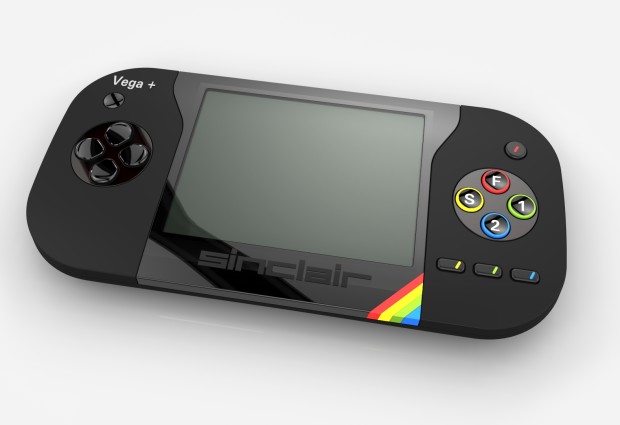
While last year's officially licensed ZX Spectrum Vega—a plug-and-play games-only version of the UK's finest 1980s home computer—didn't quite live up to expectations, creator Retro Computers is hoping that a that new portable version will be more successful. The Sinclair ZX Spectrum Vega+ ditches the boxy design of the Vega in favour of Vita-like curves and a built-in LCD screen that lets you play the 1000 pre-installed licensed games on the go.

The smart design features a segmented D-pad on the left, four face buttons on the right, and a row of smaller rectangular buttons underneath. Up top there are volume buttons, a headphone jack that can also output composite video to your TV, a micro SD card slot for loading extra games, a charging port, and an as yet unused "Ext" port. With a simple button layout and a standard 4:3 aspect ration screen, the Vega+ could prove to be quite the portable retro gaming machine, so long as both are up to snuff.

Unfortunately, Retro Computers hasn't yet revealed exactly what's inside the Vega+, and whether or not it has the processing chops to run anything other than Spectrum games. The original Vega featured a speedy-enough ARM chip, but suffered from poor video quality thanks to the composite output and a flaky power supply. Hopefully the internal display of the Vega+ will fare better.

Read 3 remaining paragraphs | Comments

Vulkan now official, with 1.0 API release and AMD driver

But don’t expect any games to make use of the Khronos Group tech anytime soon.

After missing its planned release date last year, the Khronos Group has released version 1.0 of the Vulkan API specification, the next-generation version of OpenGL. Based on AMD's proprietary Mantle API, Vulkan (previously known as GLNext) is an open-source, low-overhead API that promises huge performance gains in 3D applications by giving developers low-level control of graphics and CPU hardware, much in the same way that games consoles like the PlayStation 4 and Xbox One do.

To accompany the launch of Vulkan, AMD is releasing a beta driver for its Radeon graphics cards, which enables the use of the new API on PC. Rival Nvidia has also promised to support Vulkan with a driver update, although the company hasn't yet announced when it will be released. Both companies have pledged to support Vulkan's predecessor OpenGL for the foreseeable future too, which—given that OpenGL has been used in a huge amount of games and 3D applications since its release in 1992—should come as a relief to developers and consumers alike.

Vulkan is the latest in a number of modern graphics APIs that promise improved performance on modern multicore systems and graphics cards. They allow developers to manage memory and commands themselves, rather than leave it up to the driver, as well as allow the GPU to process commands in parallel, amongst other improvements. Microsoft released DirectX 12 as part of Windows 10 last year, with early tests showing huge frame rate improvements for AMD. No DX12-compatible games have yet been released, however.

Read 3 remaining paragraphs | Comments

EA lets slip lifetime Xbox One and PS4 consoles sales

55 million units combined, minus Sony’s 36 million, leaves 19 million for Microsoft.

Lifetime Xbox One sales have reached 19 million units—at least if EA's CFO is to believed. During a financial call last night, Blake Jorgensen said the combined install base of the Xbox One and PlayStation 4 had hit an estimated 55 million units, a mere two years into the life of the current generation.

While Microsoft has long stopped reporting on the absolute number of Xboxes sold, Sony continues to push out its own figures. Most recently, Sony revealed it has sold an impressive 35.9 million PS4s, which—when deducted from EA's 55 million figure—leaves around 19 million units for the Xbox One.

"I think our business seems to be operating pretty consistent as it has been over the last couple of years," said Jorgensen. "The console purchases are up through the end of calendar year '15. Our estimate is 55 million units out there which has exceeded virtually everyone's forecast for the year and now almost 50 percent higher than previous console cycle so, all of that is very, very positive."

Read 4 remaining paragraphs | Comments

Zotac’s new Steam OS box isn’t worth the headaches

SN970 is great hardware, but Valve needs to take a long, hard look at Steam OS.

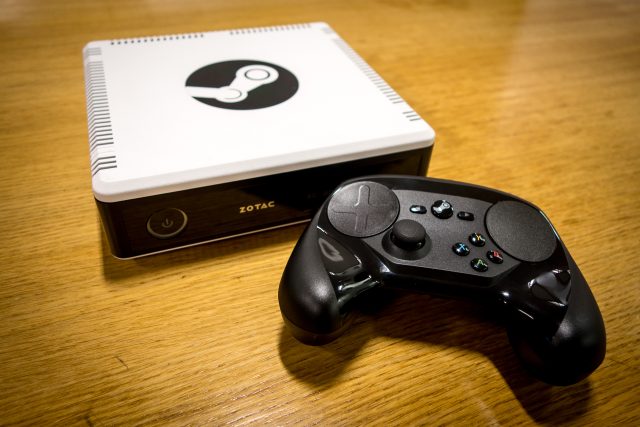
Pulling Zotac's SN970 Steam Machine from its box, first impressions are good. Despite the garish Steam logo on top, its small white case with black side panels is pleasingly understated. It's weighty, too—the "wow, this thing must be expensive!" kind of weighty that you'd hope for from a device that costs a substantial £900.

Despite being smaller than a PlayStation 4—and tiny compared to the hulking mass of an Xbox One—Zotac's Steam Machine is far more powerful thanks to the Intel Core i5 processor and Nvidia GTX 960 graphics card inside. I was really quite eager to plug it in and play some games. Then the problems started.

The last time I used Steam OS was in 2014, back when it was still in beta, and everyone was falling over themselves to declare Valve's latest invention the best thing to happen to video games since the d-pad. Since then, Steam Machines—the console-like PCs that ship with Steam OS—have been released... and the reviews haven't been kind, to put it mildly. But I figured, how bad can it be? After all, we complain about Windows all the time and its constant need for updates and new graphics card drivers that can often make things worse rather than better. An OS designed to just get out of the way and let me play games? That can only be a good thing.

Read 11 remaining paragraphs | Comments

Sony moves PlayStation to the US with new Sony Interactive Entertainment

SIE merges Sony Computer Entertainment and Sony Network Entertainment.

(credit: Flickr)

Electronics giant Sony has formed Sony Interactive Entertainment LLC (SIE), a new company that combines Sony Computer Entertainment (PlayStation hardware and software) with Sony Network Entertainment (services like PlayStation Vue and the PlayStation Store).

That these were separate companies at all has always been odd given the close relationship between the two, but perhaps the most interesting part of SIE's formation is that it won't be headquartered in Sony's home country of Japan. SIE will be based in San Mateo, California, with Andrew House—the current president and CEO of Sony Computer Entertainment Inc. in Tokyo—serving as its CEO. Sony Corporation CEO Kazuo Hirai will sit on the board.

It's no secret that videogame sales in Japan have been on the decline—2014 saw its console market drop to its lowest point in 24 years. Notably, its top ten selling games for the year were for Nintendo platforms, eight of which were on 3DS, reflecting Japan's preference for handheld and mobile gaming. Meanwhile, the PlayStation 4 continues to fly off Western shelves. Sony has sold 35 million units to date, far outpacing the sales performance of the PS2, the best-selling console of all time.

Read 4 remaining paragraphs | Comments

Samsung, LG going ultrawide with upcoming 32:0 and 2.4:1 displays

2.4:1 display features 3840×1600 resolution, 32:9 checks in at 49 inches.

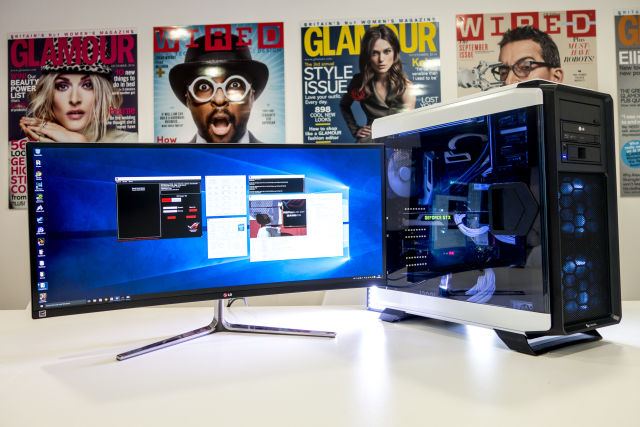
Remember when affordable UHD monitors were the new hotness and everyone desperately tried to figure out how to push their games to run at obscenely large (3840×2160) resolutions? How about when everyone realised they'd need at least two GTX 980 Ti graphics cards to do it, and thus decided that high-res 21:9 "ultrawide" monitors (3440×1440) were the real sweet spot between performance and resolution, with extras like G-Sync, 144Hz refresh rates, and curved panels making them even more expensive than UHD displays?

Well, good news everyone! UHD and 21:9 are dead to us now. The new, new display hotness—according to a report by TFCentral— is LG's upcoming LM375UW1, a 37.5-inch panel sporting a 2.4:1 aspect ratio at the unusual resolution of 3840×1600 pixels. For those keeping count, that's basically a very high-res ultrawide, with slightly less pixels than a UHD monitor. While it'll be a little easier to drive than a full 16:9 UHD display, the LM375UW1 isn't geared towards gaming (it has a 14ms response time). It's likely gaming-focused displays will appear at a later date, though.

That is unless Samsung's new super-ultrawide 32:9 displays take off. Yes, the new, new, new display hotness for 2016 is Samsung's as-yet-unnamed and absurdly large 41-inch 32:9 FHD+ panel. It'll be joined by an even bigger 49-inch version, which is likely to stretch almost the entire width of a desk. The exact specs and resolution of the displays haven't been confirmed, but a 32:9 aspect ratio works out to a 3840×1080 resolution. That might not make for the most practical desktop use, or the most compelling pixel density, but for games where you want a broad field of view it'll be quite something. The LG and Samsung panels are due for release this year.

Read 2 remaining paragraphs | Comments

Apple hires top virtual and augmented reality expert, FT reports

Apple’s plans for former Virginia Tech professor Doug Bowman are a mystery.

(credit: Steve Rhodes)

While nearly all of the big tech companies have some sort of plan in place to deal with the upcoming onslaught of virtual reality and augmented reality technology, there's been one rather large holdout: Apple. According to a report from the Financial Times, however, Apple now has its own VR/AR expert. Doug Bowman is joining Apple following a sabbatical from his position as a professor of computer science and the director of the Center for Human-Computer Interaction at Virginia Tech.

Bowman, who was the lead author of 3D User Interfaces: Theory and Practice, has an impressive background in virtual reality tech, with research focused on "three-dimensional user interface design and the benefits of immersion in virtual environments," according to his academic profile. He also collaborated on numerous articles, including Virtual Reality: How Much Immersion Is Enough? (PDF), 3D User Interfaces: New Directions and Perspectives (PDF), and The Effects of Visual Realism on Search Tasks in Mixed Reality Simulation (PDF).

Notably, last year Bowman was the recipient of a $100,000 (£70,000) research grant from Microsoft for using its HoloLens headset for a study on "collaborative analysis of large-scale mixed reality data."

Read 4 remaining paragraphs | Comments

Nintendo removes controversial “gay conversion” scene in Fire Emblem: Fates

US, European version won’t show female gay character getting drink spiked by male.

Nintendo has altered a controversial scene for the western version of Fire Emblem: Fates, a 3DS RPG originally released in Japan last year. The scene features a gay character who has her drink spiked by a male protagonist.

In the Japanese version, players are able to bond two characters together in battle, which can result in marriage. A gay female character, Soleil, is shown to have difficulty talking to other women, so a male protagonist secretly spikes her drink with a "magic powder" to make women appear to as men, and men appear at women.

Once the magic wears off, Soleil is then attracted to the male protagonist, and ends up proposing, saying that she fell in love with the female version of him, but now loves him as a male.

Read 4 remaining paragraphs | Comments

Foxconn bids $5.3 billion to take over Japan’s embattled Sharp

iPhone manufacturer may want Sharp’s display tech to extract more cash from Apple.

Foxconn, the Taiwanese company that assembles Apple's iPhones, has made a ¥600 billion bid (about £3.6 billion) to purchase troubled Japanese electronics maker Sharp, according to reports from Bloomberg and The Wall Street Journal. While the acquisition hasn't yet been approved, a decision to accept or reject the bid is expected before the end of January.

The ¥600 billion bid is the latest in a string of attempts to take over the embattled Japanese company, which received a ¥225 billion (£1.4 billion) bailout from banks last year following what it described as "very severe conditions." In 2012, Foxconn made an offer of $806 million (£569 million) for a 10 percent stake in Sharp, which quickly fell apart. This was followed by Foxconn founder Terry Gou purchasing a minority stake in a Sharp subsidiary for $617 million (£436 million). The company was also in talks to acquire Sharp's LCD business unit in September of last year.

According to The Wall Street Journal, Foxconn may receive pushback from the Japanese government, which doesn't want to cede control of Sharp to a foreign company. The Innovation Network Corp. of Japan, a government-backed investment fund, is said to be making its own bid of ¥300 billion (£1.8 billion). While the INCJ bid would keep Sharp under Japanese control, Foxconn's higher bid and willingness to take on the company's debt could see officials side in its favour.

Read 5 remaining paragraphs | Comments

Graphics cards with 1024GB/s bandwidth? Samsung begins HBM2 production

New 4GB stacks could allow for 16GB of memory on a single card.

Samsung has begun mass production of 20nm second-generation High Bandwidth Memory (HBM2), which features up to 256 gigabytes-per-second (GB/sec) of available bandwidth per memory stack—double that of the first generation HBM used in AMD's Fury graphics cards.

HBM2 will also allow for HBM-equipped graphics cards to be packed with more memory—as much as 16GB—surpassing the 4GB limit that AMD ran into with its early adoption of the technology.

Like HBM, HBM2 is a form of stacked memory, where the individual DRAM chips are placed on top of each other, rather than side by side. Those chips are connected together vertically using through-silicon vias (TSVs)—wires that are threaded through the DRAM stack—while an interposer at the bottom of the stack routes the connections from the memory directly to the GPU. Because the chips are closer together and the interconnects are shorter, throughput is increased and power consumption is reduced.

Read 7 remaining paragraphs | Comments