Valve releases tool to test whether your PC is VR ready

See if your system is up for the upcoming HTC Vive.

(credit: Valve)

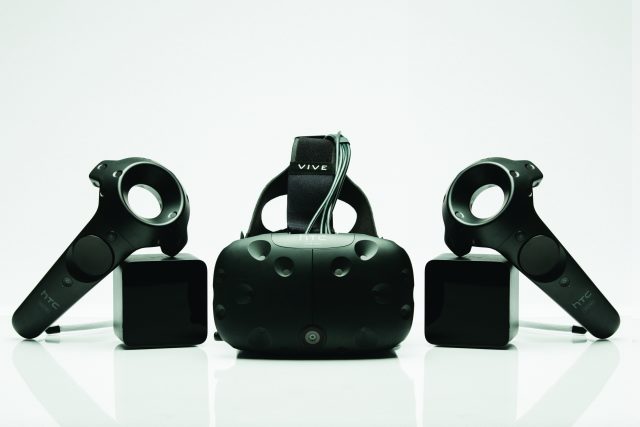
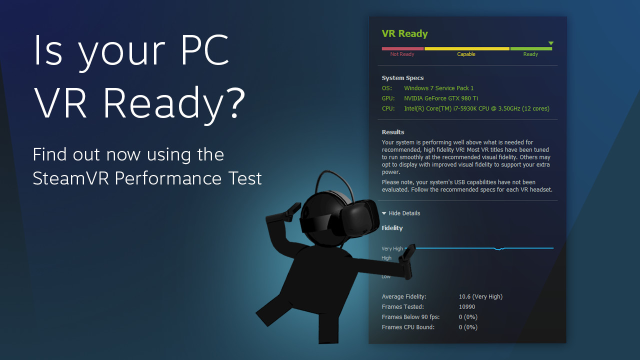
With HTC beginning to take pre-orders for the SteamVR-powered Vive headset in just one week, you may well be wondering if your PC tower is up for running high-end VR without any distracting lag. Worry not: Valve has just released a SteamVR Performance Test Tool to determine whether you are technologically ready to shell out $799 for an HTC Vive.

Unlike Oculus' own Rift Compatibility Tool, which just seems to check your PC parts against a list without actually running a diagnostic, Valve's tool takes a few minutes to run through a small, non-interactive animation of a GLaDOS robot repair facility. The goal is to "determine whether your system is capable of running VR content at 90fps and whether VR content can tune the visual fidelity up to the recommended level," according to a Valve blog post.

Afterwards, the tool gives an average fidelity rating (on a numerical and Low/Medium/High/Very High scale). It also tells you what percentage of tested frames dipped below the recommended 90 fps for a smooth VR experience and whether any of those frames were bound by the CPU, rather than the GPU. The tool does warn that "the varying CPU cost of positional tracking and processing-intensive applications" could mean actual software runs worse than the test would suggest and warns that it doesn't test for available USB slots either.

Read 2 remaining paragraphs | Comments
Will high-priced headsets kill mass-market virtual reality in its crib?

At $799, the HTC Vive isn’t exactly at a consumer-friendly price point… yet.

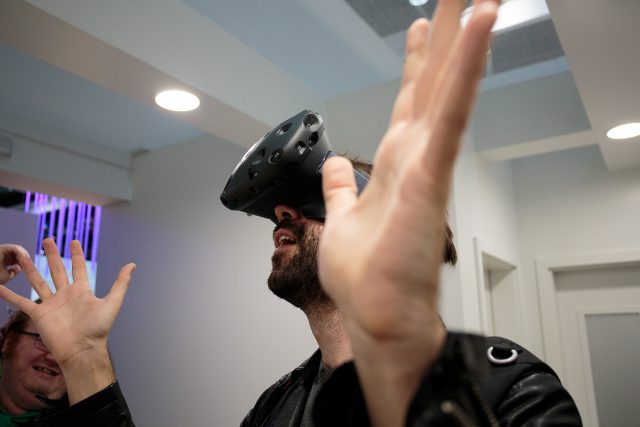
Any excuse to show Ars' Sebastian Anthony in a Vive headset is a good one. (credit: Sebastian Anthony)

When Oculus announced that the first consumer edition of the Rift headset would launch at $599 (rather than the $300 to $350 the dev kits cost), many potential consumers and observers experienced some well-justified sticker shock. So when word leaked yesterday that Valve and HTC's Vive VR headset would launch in April at $799, it was easy to assume that they had just priced themselves out of the market.

But that's probably an overreaction when you consider the potential added value the Vive brings over the Rift. After all, the Vive package comes with two completely trackable handheld controllers as well as the "Lighthouse" laser boxes that help measure the positions of those controllers and the headset itself. It's hard to overstate just how important this kind of built-in hand-tracking is to making a compelling VR experience. Being able to simply reach out and instantly grab something in the virtual world is much more direct and intuitive than fiddling with the kind of controllers that have been designed for 2D monitors.

Oculus hasn't priced out its similar Oculus Touch controllers, which won't launch until the second half of the year, but when you consider that a plain old Xbox One controller routinely retails for $50, it's easy to see the Touch package adding an extra $100 or more to the Rift's price (especially considering that the Touch system requires a second Oculus camera).

Read 8 remaining paragraphs | Comments

Samsung Galaxy S7 pre-orders come with free Gear VR headset

Offer heralds an aggressive move to push virtual reality to the masses.

The future's so bright, I gotta wear these free VR shades Samsung included with my phone pre-order. (credit: Kyle Orland)

With all the talk of the impending Oculus Rift and HTC Vive, it's easy to forget that the Samsung Gear VR already provides a consumer-grade virtual reality experience for a relatively low price and without the need for a pricey desktop PC. Samsung seems intent on not letting the tech world forget about its mobile VR solution, though, announcing at Mobile World Congress Sunday that pre-orders for its new flagship Galaxy S7 and S7 Edge phones will include a free Gear VR headset.

On the one hand, adding a useful $100 accessory to these pre-orders seems like a good, synergistic way to generate interest in both virtual reality and in Samsung's new top-of-the-line phones, possibly pushing both to critical mass more quickly than they could unbundled. On the other hand, the fact that Samsung is willing to essentially give away a significant number of these $100 headsets suggests the Gear VR might not be selling as well as Samsung had hoped.

Business concerns aside, the pack-in deal is great for VR-curious consumers that are ready for a phone upgrade. Sure, the Gear VR might not have the head-tracking or hand-tracking capabilities of its PC-based counterparts. And the Galaxy phones can't really match the sheer pixel-pushing power of the GTX980 graphics cards needed to power tethered PC headsets.

Read 2 remaining paragraphs | Comments

$799 SteamVR-powered HTC Vive to start shipping April 1

Preorders will reportedly start Feb. 29, headset includes mobile phone integration.

The Vive Pre dev kit looks much more like a consumer product than early prototypes from last year.

The HTC Vive virtual reality headset, the first such headset powered by Valve's SteamVR technology, will ship starting on April 1 for $799 (~£650), according to leaked reports ahead of an official Mobile World Congress announcement expected Monday. Pre-orders will reportedly be offered starting on February 29.

That price comes in significantly higher than the $599 (£499) price Oculus revealed for the Rift last month, but an HTC executive warned us months ago to expect "a slightly higher price point" for the Vive at launch. Keep in mind as well that the Vive's price includes two hand-tracking wand-like controllers—Oculus' similar, optional Touch controllers won't be available for sale until the second half of the year at an unknown price. The Vive package also comes with two Lighthouse laser tracking boxes, used to measure the position of the headset and controllers as a user walk around the room.

The news, which comes nearly a year after the HTC Vive was first revealed at GDC 2015, was leaked ahead of an apparent embargo by German site ComputerBild, leading other outlets to confirm the same info. The Vive was originally announced for a late 2015 release, but that launch plan was severely scaled back in August before being officially delayed in December to the current April window..

Read 3 remaining paragraphs | Comments

DICE bait: How open-world adventures took over gaming’s academy awards

Our definition of “Game of the Year” is getting a tad narrow and predictable.

Finally... I have destroyed every other type of game that might stand in my way.

LAS VEGAS—In the Academy Awards season, the term "Oscar bait" has developed as a somewhat derogatory term for the kind of overwrought period dramas that seem tailor-made to take home a Best Picture statuette. After attending last night's DICE Awards ceremony in Las Vegas (put on by the Academy of Interactive Arts and Sciences for 19 years now), I'm beginning to think we should start similarly referring to a certain type of open-world role-playing and adventure game as "DICE bait."

Fallout 4's Game of the Year win last night (and the strong performance of The Witcher 3: Wild Hunt in other categories) cements the open-world, single-player RPG as the genre to beat at the DICE Awards. Four of the last seven DICE Game of the Year recipients have fit that same broad gameplay mold: Dragon Age: Inquisition in 2014, The Elder Scrolls V: Skyrim in 2011, and Mass Effect 2 in 2010. All four games also won in the Best Role-playing Game category, and these games tended to clean up in the less specific categories focused on general art and design, too.

If you expand the definition of DICE bait slightly to include more linear (but equally cinematic and character-driven) adventure games, you'll find two more recent DICE Game of the Year winners: Naughty Dog's Uncharted 2 in 2009 and The Last of Us in 2013. It's not just limited to DICE either; top picks at ceremonies like the Game Developers Choice Awards and The Game Awards show a similar bias to just a couple genres.

Read 7 remaining paragraphs | Comments
Kojima, del Toro vow to work together again after Silent Hills debacle

Pair of unlikely friends still eager to collaborate after Konami troubles.

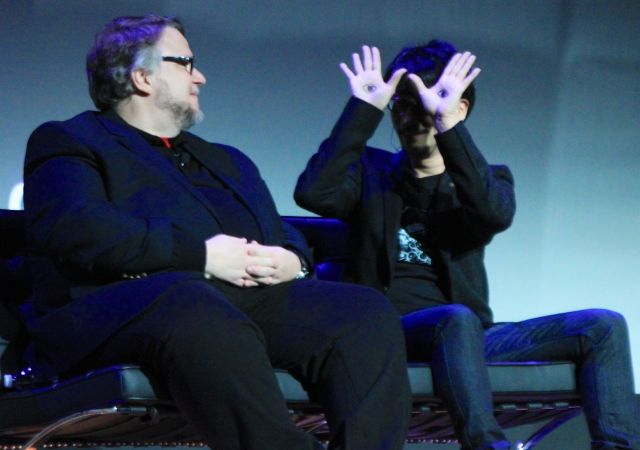
Kojima does his best impression of his favorite character from del Toro's Pan's Labyrinth. (credit: Kyle Orland)

LAS VEGAS—Japanese game developer Hideo Kojima and Mexican filmmaker Guillermo del Toro might seem like an odd professional and artistic partnership. In a wide-ranging talk on the DICE stage Thursday, though, both creators detailed a working friendship that has grown out of a shared respect and mutual admiration.

Del Toro and Kojima say they have been fast friends since meeting during del Toro's Japanese promotion of Hellboy 2 in 2008. In addition to a shared "a passion for melancholic ideas," del Toro said much of their connection comes from a surprising shared culture. Del Toro said both he and Kojima grew up with the same Japanese cartoons, which were being imported to Mexico when they were both young in the '60s.

As such, when the pair goes to karaoke together, they can both sing anime theme songs together. "I sing them in Spanish, he sings them in Japanese, we don't understand shit," del Toro said.

Read 11 remaining paragraphs | Comments

Warren Spector returns to game development for System Shock 3

Storied developer leaves academia to work with Otherside Entertainment.

Warren Spector

With nearly 17 years having passed since the well-remembered launch of System Shock 2, we've been having some trouble believing that newly launched studio Otherside Entertainment could recall the series' former glories for the recently announced System Shock 3. Our skepticism is at least a little reduced today, though, with the news that original System Shock producer Warren Spector has joined the Otherside team as studio director.

Spector, who's also known for his work on the Deus Ex, Thief, and Epic Mickey series, was already serving as a creative advisor for Otherside along with his current academic role at the University of Texas Austin. As Spector told GamesIndustry.biz:

"I've loved working with students as Director of the Denius-Sams Gaming Academy in the University of Texas' Moody College of Communication," Spector said. "But when the opportunity to have a bigger role in bringing Underworld Ascendant to life, as well as playing in the System Shock universe once again, helping to bring these games to a 21st century audience, I just couldn't say no. Working on System Shock was one of the most fulfilling things I've done in my career and it's hard to describe how much I'm looking forward to sharing with players what SHODAN has been up to since the last game was released."

While there are still precious few details known about System Shock 3, the array of well-known names being lined up behind the game's development is certainly starting to impress. At Otherside, Spector joins studio founder Paul Neurath, whom he worked with on games like Thief and Ultima Underworld at Looking Glass.

Read 1 remaining paragraphs | Comments

Penn Jillette: With game design, “the challenge is precisely the same as magic”

Penn Jillette and Randy Pitchford talk misdirection, artistic escape in Vegas.

Enlarge / Jillette (left) and Pitchford (center) perform a card trick on stage with an audience volunteer. (credit: Kyle Orland)

LAS VEGAS—For all the clichéd talk of the "magic of video games," we don't often think of the similarities between those games and the kind of magic tricks done on stage. But to kick off the annual DICE Summit Wednesday morning, magician Penn Jillette and Gearbox CEO Randy Pitchford (who are working together on a new virtual reality version of Desert Bus) came together to discuss exactly that—how video games can learn from the tricks stage magicians use to play with audience attention.

While many people think of misdirection as essentially pointing and saying "look over there" to fool someone, Jillette stressed that's not actually the case. Instead, misdirection is about studying and learning where people's attention naturally goes and becoming an expert at controlling that. "It's not misdirection; it's direction."

"We've been playing around in VR and traditional games, and one of the challenges is precisely the same as magic," Jillette said. "How to have someone make a totally free choice—put their attention where they want—and have us know where that is."

Read 9 remaining paragraphs | Comments

Blizzard execs want to reinvent real-time strategy on mobile phones

Company is also taking wait-and-see attitude on VR.

For years now, dedicated PC gamers have known Blizzard as one of the few large publishers that has kept an almost singular focus on their platform of choice. So it might come as a surprise that the company seems to be thinking about mobile platforms as the focus for its upcoming real-time strategy plans.

Speaking to VentureBeat recently, a trio of Blizzard executives suggested that the idea of bringing real-time strategy (RTS) to mobile platforms deserves "conscious evaluation," as Senior Vice President and co-founder Frank Pearce put it. That means potentially changing up the way the genre has been known to work in its home on PC, he said.

"If we were going to continue to evaluate experiences in real-time strategy, I think we’d have to figure out what that means to the current player space," Pearce said. "Legacy of the Void is great. [But] I don’t think that people want to sit down and play 45 minute missions any more. I think that space might need some reinventing."

Read 4 remaining paragraphs | Comments

Ubisoft earnings suggest Xbox One players spend more than those on PS4

Microsoft’s players seem to spend more per capita than Sony’s.

(credit: Ars Technica/Aurich Lawson)

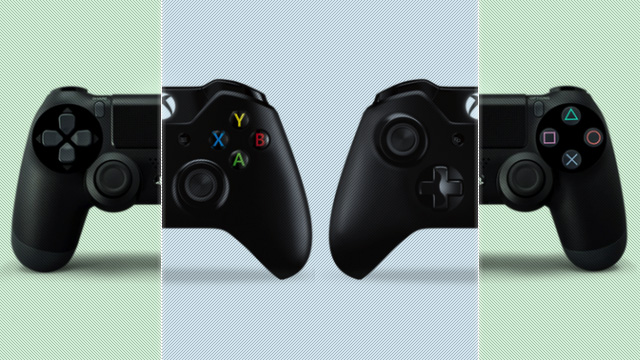
Ubisoft's latest earnings report shows that the French mega-publisher is making significantly more money from selling PS4 games than Xbox One games. That's not surprising, considering that the PS4 is handily outselling the Xbox One worldwide. What is somewhat surprising is that the Xbox One owners appear to be spending more on Ubisoft games on a per user basis (as VentureBeat noticed).

Ubisoft didn't break out this per-user stat in its most recent earnings report, but it did report that 41 percent of its holiday quarter 2015 revenue came from PS4 game sales versus 27 percent of revenue from Xbox One games. So in their entirety, the PS4 market is currently worth about 52 percent more to Ubisoft than the Xbox One market (all of Ubisoft's recent games have come out for both platforms).

The best available hardware sell-through estimates, though, suggest that there were 35.9 million PS4s in homes worldwide at the end of 2015 compared to 19.1 million Xbox One units. Based on those figures, the size of the PS4 market should be 88 percent bigger than the Xbox One market all things being equal (the ratio changes only slightly if you look at estimates for consoles shipped to stores by the end of the year).

Read 4 remaining paragraphs | Comments