Self-driving tractors and data science: we visit a modern farm

Farming isn’t the low-tech endeavor some might think.

Despite misperceptions to the contrary, farming in the 21st century is a high-tech endeavor. We're not just talking about genetically modified crops or biotech-derived pesticides though; farm vehicles like tractors and combines are now networked to the cloud and in many cases are even capable of driving themselves. To find out more about what the modern technofarm is all about, I drove up to Clear Meadow Farm in Harford County, Maryland to meet farmer Greg Rose and his self-driving John Deeres.

Rose and his family have been farming in the area for decades, and Clear Meadow is an 8000-acre farm that grows corn, soy, wheat, barley, sunflowers and sorghum in addition to raising Black Angus cattle (which you might find in Whole Foods). "We first dipped our hand into precision agriculture with yield monitors in 2000," Rose told me as I checked out a gigantic combine, its tires taller than me. His description of the job is as much data science as it is field work. Complex field maps are informed by a multitude of sensors from different farm machines, all gathering data to feed it to Rose via the cloud. The setup allows for extremely precise seed and nutrient prescriptions that can vary multiple times across the same field.

"The combine has load sensors in it that sense the volume of crop coming in, recording that as you go across the field," Rose said. That tells him how many bushels per acre each field is producing, data that gets fed into multi-year maps of each field that are color-coded to indicate different yields. "We take several years of data and make composite maps of a given field, then divide it into zones. You can manage those zones individually—taking soil samples to measure nutrient levels, and from there you know how much nutrients you need to apply in different areas," he told Ars.

Read 10 remaining paragraphs | Comments

Cats may have a rudimentary grasp of physics, study finds

Research from Japan suggests cats know when causal relationships aren’t working.

(credit: Jonathan Gitlin)

When it comes to cats and physics, most people don't get much further than Erwin Schrödinger and his gedankenexperiment involving a feline locked in a box. But research from Saho Takagi and her colleagues at Kyoto University in Japan suggests that cats don't just star in physics thought experiments, they may also have an innate understanding of (some of) the physics, too.

We're not suggesting that SpaceX or Blue Origin is looking to hire feline rocket scientists any time soon or that the cats know what to do with Schrödinger's wave function. But Takagi's study provides evidence that our furry little friends might have a better understanding of causal relationships than previously thought, and they may also have a "rudimentary understanding of gravity."

The study involved 30 Japanese cats—eight house pets and 22 residents of cat cafes. The researchers tested the cats using a plastic box containing some iron balls. Normally the balls were free to rattle around in the container, falling out when the box was inverted. But on the opposite side to the box's open end, they added an electromagnet. When turned on, the magnet stopped the balls from rattling or falling out.

Read 7 remaining paragraphs | Comments

A quadruple amputee will be competing in the 24 Hours of Le Mans this weekend

Thigh paddles and a prosthetic allow him to drive the car, and there’s an ejector seat.

One of the cooler things about the 24 Hours of Le Mans is called Garage 56. The name dates to 2012, when Le Mans only had room for 55 cars in its pitlane, but the ACO (the race organizers) added one extra spot for a car which, according to the ACO's Sporting Director Vincent Beaumesnil, "explores the automobile technology of tomorrow and beyond." In the past, Garage 56 entries have gone to cars that have been pushing the envelope on fuel saving (the Deltawing) or electrification (the ZEOD RC), but this year the focus is rather different.

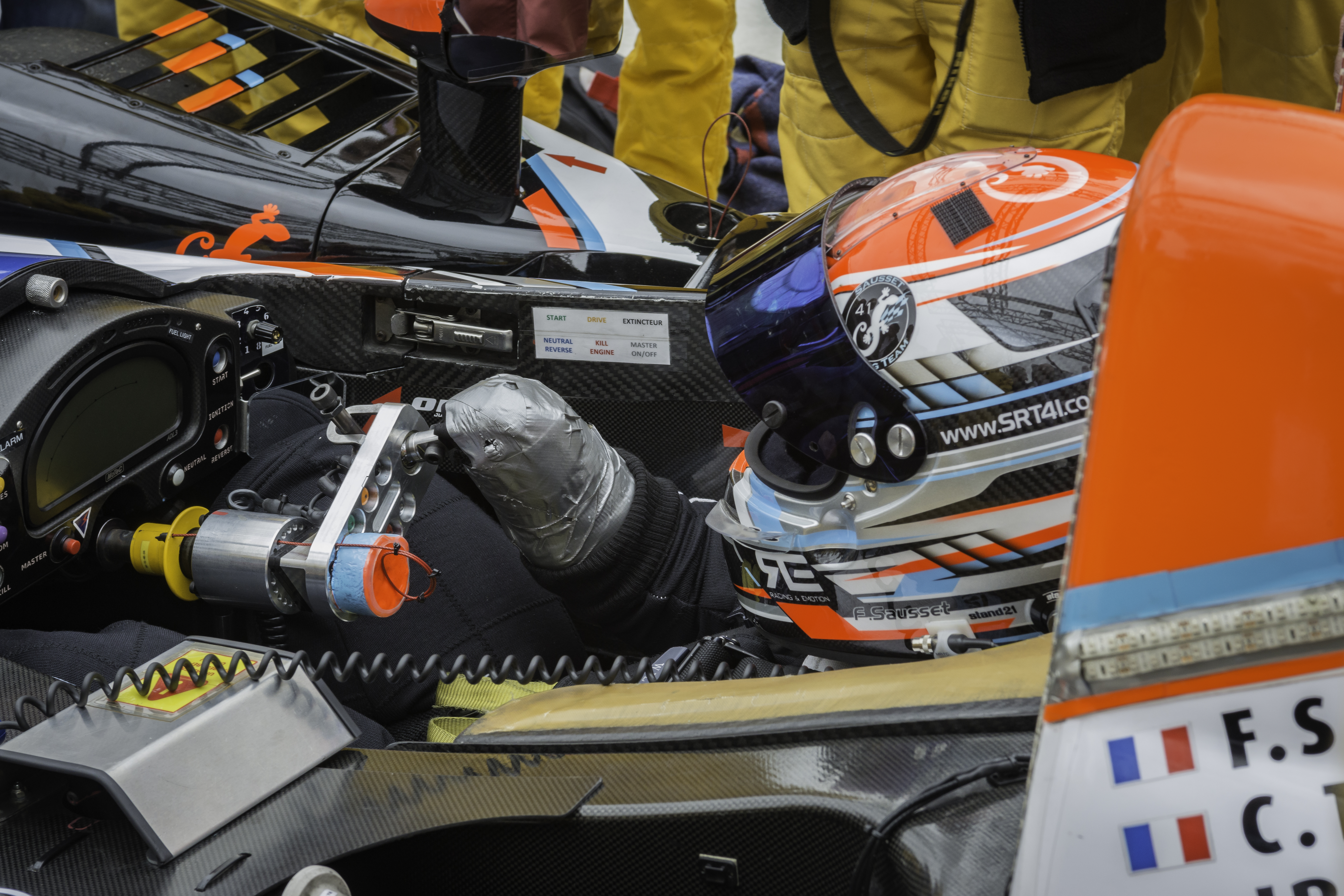
In 2012, a French businessman called Frédéric Sausset scratched his finger while on vacation in the southwest of France. Tragically, the scratch rapidly led to a life-threatening infection (necrotizing fasciitis) which left Sausset a quadruple amputee. At the point where many of us might just give up and wallow in depression, Sausset instead decided he wasn't going to let the lack of hands or feet get in the way of a life-long ambition—racing in the 24 Hours of Le Mans. And this coming weekend, he's going to do just that.

Sausset's team, SRT41, had a tricky job. A 24-hour race like Le Mans isn't a solo effort—each car has three drivers who split the race between them, swapping in and out during pitstops. The team had to convert its Morgan-Nissan LMP2 car (the slower of the two prototype classes at Le Mans, intended for pro-am teams) so that Sausset could drive it, without compromising the ability of his two able-bodied teammates Jean Bernard Bouvet and Christophe Tinseau from being able to do the same.

Read 4 remaining paragraphs | Comments

Top Gear finds its feet, and Chris Harris will be making more videos

Following this week’s episode, we were left wondering what the fuss was about.

(credit: BBC)

A few weeks ago, the BBC's new season of Top Gear debuted, complete with a brand new cast (and an online addition, Extra Gear). We weren't too impressed with the premiere, suggesting that it was time for the broadcaster to think outside its (gear)box. But three episodes in, we're happy to relay that the rebuilt transmission appears to be bedding in, and things are looking up. And even better, Chris Harris and Neil Carey will be working together again to produce more of the long-form car videos beloved by car nerds on the Internet.

Back to the main event. After the stilted and at times boring season opener, Top Gear appears to be finding its feet (tires?). We got to see Sabine Schmitz make Chris Evans lose his breakfast—strawberries, in case you were curious—by lapping Laguna Seca in an Audi R8. Harris also made his first appearance on the big show, driving a Ferrari 250 Tour de France back to back with its new descendent, the F12 TdF. Rory Reid gave us a great piece on the Ford Focus RS, a car that apparently anyone can drift like the Stig. (We'll be putting that to the test next month when Ford lets us drive the Focus RS, and the company is even bringing one of the former Stigs along to offer some tuition.)

We also got to see the piece that caused a media scandal in the UK earlier this year. Months before Top Gear's new season started, the show was making negative headlines after Ken Block (the hoonatic with a billion YouTube views) showed off his drifting skills in London. Burning rubber and doing donuts within sight of the Cenotaph (a war memorial) did not go down well with UK "Red Tops" that were already on the hunt for bad news about Top Gear.

Read 5 remaining paragraphs | Comments

Review: Hands-on mandatory, but Ars lets Volvo’s XC90 drive itself in traffic

“With the XC90, we take the first step towards self-driving cars. “

We put Volvo's new XC90 T8 Hybrid to the test. Video shot and edited by Jennifer Hahn. (video link)


Volvo's XC90 SUV marks a new chapter for the Swedish automaker. It's the first vehicle to be built using Volvo's new Scalable Product Architecture (SPA), a platform that's also used by the new S90 sedan and V90 station wagon. The XC90 is also destined to be Volvo's best-selling vehicle here in the US—by April of this year, the company had already found customers for almost 11,000 XC90s in one of the most competitive segments in the market.

The XC90 is a vehicle packed with clever technology. Much of this technology has to do with Volvo's core focus on safety of course—which now means lots of active semi-autonomous driver assists—but this SUV marks the debut of the company's new Sensus infotainment system, too. On top of all that, the T8 variety of this range-topping vehicle is a hybrid. After spending several hundred miles in both T6 and T8 versions of the XC90, it was easy to come away with an appreciation for Sweden's latest.

Read 28 remaining paragraphs | Comments

Can Google’s Larry Page make flying cars a reality?

The Google founder owns not one but two flying car startups.

(credit: Warner Brothers Animation)

Like the robber barons of the Gilded Age, some of the tech billionaires of Silicon Valley are using their vast wealth to try to transform the world according to their vision(s). Bill Gates has his foundation. Elon Musk wants us to ditch the fossil-fueled car. Both Musk and Jeff Bezos want space colonies. And Google's Larry Page? He wants those flying cars we were promised.

This week Bloomberg told us that Page owns not one but two flying car startups: Zee.Aero and Kitty Hawk. Both companies appear rather media shy, but they seem to be working on small passenger aircraft that can take off and land vertically, according to reports from former employees, patent filings, and eye-witness accounts from Hollister Municipal Airport in California (where Zee.Aero is testing). The vehicles are probably using electric motors as well. "When the aircraft take off, they sound like air raid sirens," Bloomberg wrote.

Page's companies are but two among a score or more working on flying cars. There are old doyens of the field like Moller, which has been at it for more than 40 years, as well as more recent upstarts like Terrafugia and Aeromobil. It's certainly a lofty goal, but will it succeed? At the very least, it feels like some of the necessary enabling technologies are getting closer to being ready. Battery powered flight is achievable, as last year's English Channel crossing(s) demonstrated. Electric motors are smaller, lighter, and much less complex than jets, and the drone explosion serves as evidence that we can make ungainly shapes fly well even in the hands of amateurs, thanks to software.

Read 3 remaining paragraphs | Comments

There’s a new entry-level Tesla Model S, and it’s even cheaper

Tesla unveils new entry-level Model S 60, available in July.

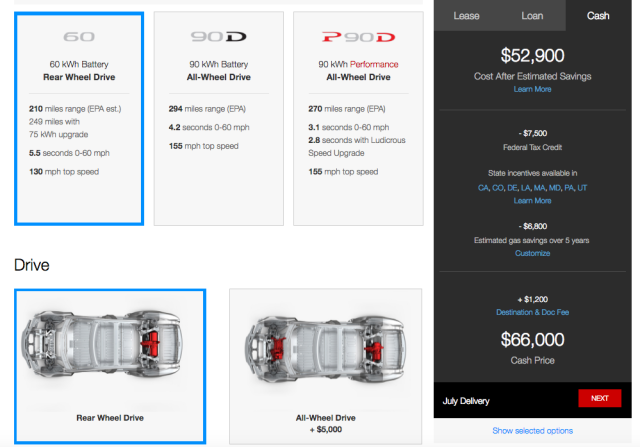
On Thursday, Tesla filled the gap in its range with a new entry-level Model S 60. The car starts at $66,000 before tax incentives. Tesla previously discontinued the Model S 70 due to lack of demand, but this new model is several thousand dollars cheaper. Once rebates and gas savings factor in, the company says "the effective cost of owning Model S 60 comes to about $50k."

The Model S 60 gets a 60kWh battery, good for 0-60mph (0-96km/h) in 5.5 seconds and 200 miles of range between charges. It comes with the full suite of driver assists, and if you decide at some point you want more juice, a software upgrade will unlock the battery to 75kWh.

Tesla's approach to selling electric vehicles has been fascinating. Launching straight into the upper end of the market with the Model S was clever, and it laid the groundwork for the Model 3 mass-market follow-up. With the top and bottom ends covered (reminiscent of Shaka Zulu's "Buffalo Horns" strategy perhaps?), Tesla has moved in for the kill at the middle. This new Model S fits nicely between the $35,000 Model 3 and $89,500 Model S 90D, and the price is aimed squarely at buyers of mid-level luxury cars like the A6, 5 Series, and E-Class.

Read on Ars Technica | Comments

Tech firms want to save the auto industry—and the connected car—from itself

We crash test cars, but we don’t crash test the code they run.

As we've noted before, Ars readers are extremely skeptical about the whole "connected car" thing. That's not because Ars is a technology site for luddites—the sad truth is that the car industry's approach to security lags far behind its desire to expose the inner thoughts of our cars to us via the cloud.

As the tech and auto industries collide, the tech crowd is hoping that its more farsighted approach to ensuring secure hardware and code will start to rub off on its new bedfellow. On Wednesday and Thursday this week, the two have come together in Michigan for TU-Automotive Detroit, a conference that's focusing in part on this very topic. And tech firms—from established players like Symantec to startups like Karamba Security—want to help the automakers find their way.

The glaring lack of connected security for our cars got mainstream attention last year when Fiat Chrysler had to recall 1.4 million vehicles, but despite the FBI's plea to motorists to remain aware of security issues in cars, the driving public doesn't seem too concerned. Earlier this week, research firm Forrester announced that more than one in three Americans wants their next car to have better Internet connectivity. Meanwhile, the hacks keep happening. Nissan's API for its Leaf electric vehicle allowed completely anonymous requests to cars. Mitsubishi might have decided to enable connected car services for its Outlander via the vehicle's Wi-Fi in part to safeguard against attacks in the cloud, but it forgot that Wi-Fi needs some common sense security protections, too.

Read 9 remaining paragraphs | Comments

Hackers break the connected Mitsubishi Outlander hybrid wide open

Mitsubishi went for local Wi-Fi instead of LTE, but it’s not secure.

Remote functions via Wi-Fi, but easily hacked. (credit: Mitsubishi)

According to research firm Forrester, 35 percent of Americans—few of them Ars readers, we think—want Internet connectivity in their next vehicle. The car and tech industries are busy trying to make that happen. New cars increasingly come with their own LTE modem (and monthly bill), enabling remote apps that can give you a vehicle diagnostic or unlock your doors from the comfort of your phone or smartwatch. This is usually done in the cloud with plenty of thought given to security we're told—except in cases where there's no security at all.

But Mitsubishi's Outlander hybrid does things a bit differently, as the people over at PenTestPartners recently discovered. Instead of fitting the Outlander with a cellular modem for connectivity, you access its remote functions by connecting to the car's own Wi-Fi network. No monthly data plan needed, at the cost of connectivity only within range of the vehicle. Oh, and apparently Mitsubishi did a really bad job securing things.

The outfit bought its own Outlander to investigate the car's security, finding the pre-shared key easily crackable and the default SSID too formulaic. Once connected to a vehicle, one can play with the lights or climate control—similar to the Nissan exploit. But the researchers also discovered they could lock or unlock the doors remotely, and, perhaps more seriously, they were also able to disable the car's alarm.

Read 1 remaining paragraphs | Comments

The best of British aviation: the Imperial War Museum Duxford

A look at some of the stars of the UK’s largest aviation musuem

A recent trip to the UK meant we happened to be near the Imperial War Museum Duxford, the Cambridgeshire outpost where the Imperial War Museum keeps over 200 of its airplanes. It's not just the UK's largest aviation museum—it's a thoroughly good day out for anyone who like things with wings. The site itself has its own share of history, too. It was an RAF base until 1961 and was crucial to the Battle of Britain (as well as starring in the movie of that name).

The gallery above includes some (but not all) of the wonderful (and in some cases not-so-wonderful) flying machines. The hangar of American planes was being refurbished on the day we visited, so you won't see photos of Duxford's B-52 or SR-71. However, you will see plenty of Cold War hardware from both the Royal Air Force and the Royal Navy's Fleet Air Arm.

And we'll wager that some of these planes will not be familiar to our readers, like the ill-fated BAC TSR-2. But the museum has more than a few icons of British aviation history, including Concorde, the spectacularly fast English Electric Lightning, and a pair of "V Force bombers," the Avro Vulcan and Handley Page Victor. Enjoy the photos!

Read on Ars Technica | Comments