After Comcast complains, Verizon is told to alter deceptive “#1” speed ads

Verizon doesn’t offer fastest Internet, but it finished #1 in customer survey.

(credit: Verizon)

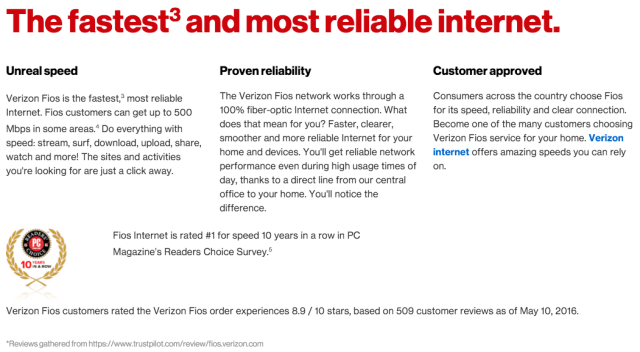
Verizon ads claiming that FiOS fiber service "is rated #1 in Internet speed" are misleading and should be changed, the National Advertising Review Board (NARB) said this week.

Verizon doesn't actually offer the fastest speeds, but the company justifies the claim based on PC Magazine’s Readers’ Choice Survey. NARB's decision—which came after a complaint filed by Comcast—noted that ranking "was not based on a comparison of objective Internet speed performance and/or a head-to-head comparison of different Internet service providers." Instead, it was based on customers' perceptions.

Verizon ads do note that the #1 claim is based on "customer satisfaction studies," but the board ruled that Verizon's ads made it seem as if the company actually offers the industry's fastest speeds.

Read 6 remaining paragraphs | Comments

Municipal fiber network will let customers switch ISPs in seconds

Ammon’s open access network lets residents switch ISPs with click of a mouse.

Website where Ammon customers will choose an ISP. (credit: City of Ammon, Idaho)

Most cities and towns that build their own broadband networks do so to solve a single problem: that residents and businesses aren't being adequately served by private cable companies and telcos.

But there's more than one way to create a network and offer service, and the city of Ammon, Idaho, is deploying a model that's worth examining. Ammon has built an open access network that lets multiple private ISPs offer service to customers over city-owned fiber. The wholesale model in itself isn't unprecedented, but Ammon has also built a system in which residents will be able to sign up for an ISP—or switch ISPs if they are dissatisfied—almost instantly, just by visiting a city-operated website and without changing any equipment.

Ammon has completed a pilot project involving 12 homes and is getting ready for construction to another 200 homes. Eventually, the city wants to wire up all of its 4,500 homes and apartment buildings, city Technology Director Bruce Patterson told Ars. Ammon has already deployed fiber to businesses in the city, and it did so without raising everybody's taxes.

Read 25 remaining paragraphs | Comments

After net neutrality loss, ISPs get ready to take case to Supreme Court

FCC won in all facets of today’s decision, but ISPs are not out of options.

The next stop for net neutrality? (credit: Joe Ravi (CC-BY-SA 3.0))

Today's court decision upholding net neutrality rules is a huge legal milestone for the Federal Communications Commission's attempt to more strictly regulate Internet service providers. But as you might expect, the fight is not over, and it could end up being decided by the Supreme Court.

The FCC won a 2-1 decision (full text) from a three-judge panel at the US Court of Appeals for the District of Columbia Circuit, as judges rejected challenges to the FCC's reclassification of broadband as a Title II common carrier service and imposition of net neutrality rules. But ISPs and their lobby groups are not out of legal options: they can ask the same court for an "en banc" review in front of all of the court's judges instead of just a three-judge panel. If that fails, they could appeal to the Supreme Court, or they could skip the en banc step and go straight to the nation's highest court.

The Supreme Court can pick and choose what cases it wants to hear, so there's no guarantee ISPs would even get in front of the justices. Law professors interviewed by Bloomberg said chances of a high court review are so slim that ISPs would be best served by asking for an en banc review first. The fact that it was a 2-1 decision instead of 3-0 may increase the chances of an en banc review, but there's no reliable way to predict how it will turn out.

Read 12 remaining paragraphs | Comments

Adios apt and yum? Ubuntu’s snap apps are coming to distros everywhere

More secure replacement for debs coming to Fedora, Arch, Debian, and more.

(credit: Canonical)

Ubuntu's "snappy" new way of packaging applications is no longer exclusive to Ubuntu. Canonical today is announcing that snapd, the tool that allows snap packages to be installed on Ubuntu, has been ported to other Linux distributions including Debian, Arch, Fedora, and Gentoo among others.

If you have no idea what the above paragraph means, here's a summary. Traditionally, applications for Ubuntu and similar distributions are packaged in the deb (short for Debian) format. These packages consist of the application a user wants to install, and they can also install other things that the package depends on in order to run (libraries, other applications, scripting, support files, and so on). Applications often require a lot of dependencies, making things more complicated, for example, when one application needs one version of another piece of software and a second application needs a different version of that other piece of software.

"Snap packages solve this problem by creating self-contained packages," we noted in our review of Ubuntu 16.04, which brought snaps to servers and desktops. "With snap packages, applications are installed in their own container, and all the third-party applications are installed with them so there are no version conflicts. Snap packages are also smart enough to not install a package more than once, meaning applications installed via Snappy don't take any more disk space than regular applications."

Read 19 remaining paragraphs | Comments

Tom Wheeler defeats the broadband industry: Net neutrality wins in court

Appeals court decision upholds FCC’s net neutrality order.

A November 2014 rally at the White House. Public input played an important role in the net neutrality debate. (credit: Stephen Melkisethian)

The US broadband industry has lost its lawsuit attempting to overturn the Federal Communications Commission's net neutrality rules and the related reclassification of Internet service providers as common carriers.

ISPs' First Amendment claims (among others) were rejected. "Because a broadband provider does not—and is not understood by users to—'speak' when providing neutral access to Internet content as common carriage, the First Amendment poses no bar to the open internet rules," judges wrote said a decision released today by the US Court of Appeals for the District of Columbia Circuit (full text).

The net neutrality order, passed over a year ago, is FCC Chairman Tom Wheeler's signature move during a whirlwind time as head of the commission.

Read 9 remaining paragraphs | Comments

Apple announced iOS 10 for iPhones and iPads at WWDC today

Smarter Siri, redesigned Photos and Music, and Maps Extensions for developers.

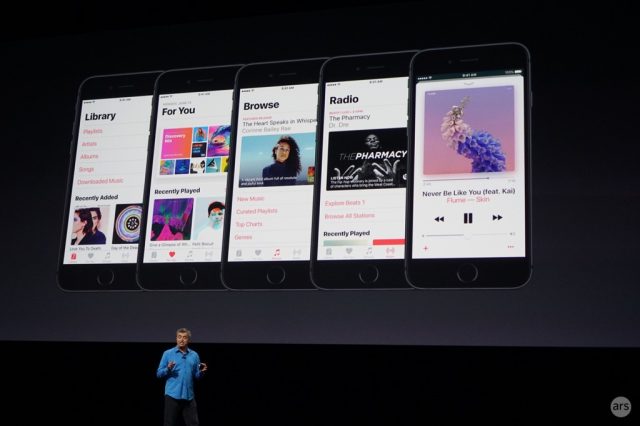
Apple Music on iOS 10. (credit: Andrew Cunningham)

Apple today announced iOS 10, a new major version of its operating system for iPhones, iPads, and iPod Touches.

There is a redesigned control center with interactive notifications, and improvements to widgets (such as those that show calendar and weather information). 3D Touch can now do more: For example, you can press your screen to clear all notifications at once.

Siri is getting improvements, with the ability to book rides on services like Uber and Lyft, the ability to start and pause workouts, and make payments to send money to friends with SquareCash and other services. Siri's will be more intelligent in messaging. For example, if a friend asks for the contact information of another friend, Siri can automatically provide the contact. Siri can also pull up calendar availability in message threads, and let you do multilingual typing without switching the keyboard language.

Read 8 remaining paragraphs | Comments

In shocking twist, senators scrutinize cable companies instead of FCC

Congress takes break from castigating FCC to focus on cable TV’s bad behavior.

(credit: Getty Images | chargerv8)

When US lawmakers hold public hearings about the cable TV and broadband industries, their main goals are usually to criticize regulators and try to strip the Federal Communications Commission of its consumer protection powers.

But in an unusual twist, senators are actually planning to force cable companies to explain why they offer such poor customer service. US Senators Rob Portman (R-Ohio) and Claire McCaskill (D-Mo.) yesterday announced a hearing in which cable TV and satellite TV companies will answer questions about "practices involving billing, fees, refunds, and other customer service issues."

Comcast, Charter, Time Warner Cable (now owned by Charter), DirecTV (owned by AT&T), and Dish Network were all called to testify at the June 23 hearing of the Permanent Subcommittee on Investigations. These companies account for more than 70 million TV subscribers, more than half of all US households, and over 70 percent of homes with TV service, the senators said.

Read 4 remaining paragraphs | Comments

How much do ISPs hate competition? They’ll sue the FCC to prevent it

Requirement that Charter “overbuild” competitors challenged by small ISPs.

(credit: Getty Images | eccolo74)

Two lobby groups representing small and medium-sized Internet service providers have taken the first step toward suing the Federal Communications Commission over a ruling designed to boost competition.

The groups are trying to overturn a condition imposed on Charter's purchase of Time Warner Cable and Bright House Networks. In exchange for approval to buy the cable companies, Charter agreed to compete against other ISPs by building new networks in cities and towns already served by high-speed Internet providers.

The American Cable Association (ACA), which represents smaller cable companies in mostly rural and suburban areas, and NTCA—The Rural Broadband Association, which represents small telcos, each filed petitions to overturn the condition with the FCC last night. This is basically a formality to demonstrate to a court that the groups have exhausted all available options before suing. Assuming the FCC rejects the petitions, the groups will likely file a lawsuit.

Read 13 remaining paragraphs | Comments

New router chips could save open source firmware from FCC rules

Virtualization separates OpenWrt from radio controls, preventing illegal mods.

(credit: Imagination Technologies)

A company that designs MIPS processors for networking hardware says it is developing technology that would allow installation of open source firmware on wireless routers while still complying with the US Federal Communications Commission's latest anti-interference rules.

The FCC now requires router makers to prevent third-party firmware from changing radio frequency parameters in ways that could cause interference with other devices, such as FAA Doppler weather radar systems.

The easiest way for router makers to comply is to simply prevent installation of open source firmware altogether. Linksys came up with its own way of allowing open source firmware, but so far there's no method that scales across the industry, and at least some routers from TP-Link and Asus are being locked down.

Read 11 remaining paragraphs | Comments

Time Warner Cable Internet speeds are “abysmal,” NY AG claims

State official blasts Charter-owned cable company, demands improvement.

(credit: Getty Images | Dimitri Otis)

Internet speed tests have shown that Time Warner Cable has repeatedly failed to provide the speeds it promises customers, according to a New York state government official. New York has not publicly released any data to back up the claim, but apparently shared the results with the cable company. Charter—TWC's new owner—received a letter demanding improvement yesterday from the New York attorney general's office.

"We recently called on New York customers of major broadband providers to use open-source tools to test the Internet speeds they were experiencing," NY Senior Enforcement Counsel Tim Wu wrote to Charter CEO Tom Rutledge. "The results we received from Time Warner Cable customers were abysmal. Not only did Time Warner Cable fail to achieve the speeds its customers were promised and paid for (which Time Warner Cable blamed on the testing method), it generally performed worse in this regard than other New York broadband providers."

The Washington Post published the full letter and has a related article.

Read 8 remaining paragraphs | Comments