NY requires 300Mbps speeds from Charter in TWC merger condition

Charter seeking to become nation’s second biggest ISP with merger.

(credit: Ildar Sagdejev)

Charter gained approval of its Time Warner Cable acquisition from New York state regulators today in exchange for providing 300Mbps speeds to all customers by 2019 and continuation of a cheap (but very slow) entry-level Internet service.

The state Public Service Commission voted 3-0 to approve the merger today, the Times Union of Albany reported. Charter's proposed $56.7 billion acquisition of TWC still needs approval from the Federal Communications Commission, but Charter had to gain approval for license transfers in states where TWC operates as well. TWC is also headquartered in New York City.

TWC already offers 300Mbps speeds in New York City and other major metro areas, and the combined company would have to offer that speed throughout its New York service area under the merger approval. TWC charges $64.99 a month for its 300Mbps downstream and 20Mbps upstream package in New York City, though that price is only good for the first 12 months a customer has service.

Read 6 remaining paragraphs | Comments
John Legere asks EFF, “Who the f**k are you, and who pays you?”

T-Mobile CEO takes on digital rights group that objected to video throttling.

T-Mobile USA CEO John Legere has spent much of today defending the carrier's controversial "Binge On" program, and he didn't hold much back when answering his critics.

The Electronic Frontier Foundation (EFF), which has criticized T-Mobile for throttling video streams down to 480p, asked him on Twitter whether T-Mobile is altering the video streams or just limiting their bandwidth.

Legere responded in a video:

Read 7 remaining paragraphs | Comments

US fails its annual broadband deployment test at FCC

Despite improvement, FCC says broadband still not being deployed to all in US.

(credit: Marcelo Graciolli)

The Federal Communications Commission's annual review of broadband deployment says that advanced Internet service is still not being offered to all Americans.

34 million Americans, about 10 percent of the country, "still lack access to fixed broadband at the FCC’s benchmark speed of 25Mbps for downloads, 3Mbps for uploads," the FCC said in a fact sheet released today. This isn't a question of not being able to afford broadband or deciding to go without—when the FCC says you don't have access, that means no providers are willing to serve your home at modern broadband speeds at any price.

There is good news, though. In 2012, a full 20 percent of Americans could not buy 25Mbps/3Mbps broadband. The number dropped to 17 percent in 2013 and then to 10 percent in 2014. Data for 2015 isn't available yet. The annual Broadband Progress Report is based on filings by Internet service providers, and it takes a while to crunch all the numbers, so the reports are always a little behind.

Read 15 remaining paragraphs | Comments

T-Mobile’s Binge On: When throttling may not break the rules

CEO John Legere says throttling accusation is “semantics” and “bullshit.”

T-Mobile CEO John Legere. (credit: T-Mobile)

T-Mobile USA will soon meet with the Federal Communications Commission about whether its controversial “Binge On” program violates network neutrality rules. But even though T-Mobile is throttling video—and the rules ban throttling—the carrier might be able to convince the FCC that an exception should be made.

The rules—which face a court challenge from a wireless industry trade group that T-Mobile belongs to—say that Internet providers including mobile carriers “shall not impair or degrade lawful Internet traffic on the basis of Internet content, application, or service, or use of a non-harmful device, subject to reasonable network management.”

Binge On throttles content based on its type, forcing a downgrade of all video to lower resolution. That’s a clear violation, right? The Electronic Frontier Foundation (EFF) argues that it is, saying that “throttling all traffic based on application type… obviously violates the FCC’s Open Internet Order.”

Read 32 remaining paragraphs | Comments

T-Mobile added another 8.3 million customers in 2015

T-Mobile posts big growth for a second straight year while Sprint slows.

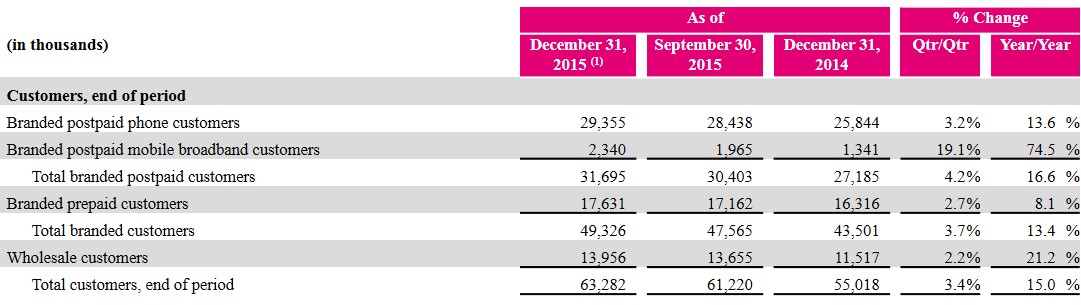
T-Mobile USA added 8.3 million customers last year, including 2.1 million in the fourth quarter, solidifying its position as the country's number three wireless carrier ahead of Sprint and behind Verizon Wireless and AT&T. T-Mobile had 63.3 million customers as of December 31, 2015, up from 55 million customers at the end of 2014, the company announced today in a preliminary earnings report. In total, T-Mobile now has 29.4 million postpaid phone customers, 2.3 million postpaid mobile broadband customers, 17.6 million prepaid customers, and 14 million wholesale customers.

This was the second consecutive year that T-Mobile boosted its customer total by more than 8 million.

(credit: T-Mobile)

T-Mobile has also improved its churn rate—the percentage of subscribers who discontinued service—meaning that fewer customers are leaving for other carriers.

Read 2 remaining paragraphs | Comments

Comcast security flaw could help burglars break into homes undetected

Comcast says industry-standard tech to blame, but will try to fix it.

(credit: Comcast)

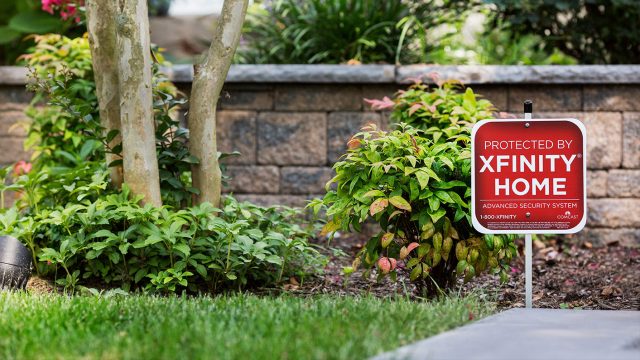
A security vendor says it discovered a flaw in Comcast's home security system that could let criminals break into houses undetected by using radio jamming equipment. The vendor, Rapid7, says it alerted Comcast to the problem two months ago but never received a response from the company. However, Comcast told Ars that Rapid7 e-mailed the wrong address.

Though primarily known for its cable TV and broadband Internet services, Comcast also sells Xfinity-branded home security systems. Rapid7 found the flaw in Comcast's implementation of the ZigBee wireless protocol. Attackers armed with commodity radio-jamming equipment can "cause interference or deauthentication of the underlying ZigBee-based communications protocol," Rapid7 said. When this happens, sensors that detect motion or open doors and windows are unable to communicate with a base station hub in the home that controls the alarm system.

Rapid7 published details of the flaw in an advisory today, in accordance with its policy of giving companies at least 60 days to respond before making a security problem public. That's a pretty standard timeline used by other companies and security research organizations—though it seems Rapid7's attempt to contact Comcast went awry.

Read 13 remaining paragraphs | Comments

T-Mobile throttles all video streams and downloads to 1.5Mbps, EFF says

T-Mobile’s claim that it’s “optimizing” video disputed by EFF tests.

T-Mobile USA CEO John Legere announces Binge On. (credit: T-Mobile USA)

T-Mobile USA's controversial "Binge On" program is throttling all HTML5 video streams and direct video downloads to about 1.5Mbps, according to tests run by the Electronic Frontier Foundation (EFF).

Binge On, unveiled in November, is enabled by default for all T-Mobile customers and downgrades video resolution to 480p in order to reduce data usage. Companies that cooperate with T-Mobile can stream video without counting against customers' high-speed data limits. That means you can watch Netflix, HBO, Hulu, and about another 20 services without using up your data.

But all video is downgraded, regardless of whether it gets a data cap exemption, which has led to a rift between T-Mobile and Google's YouTube.

Read 13 remaining paragraphs | Comments

Phone contracts now even more dead, with AT&T killing them, too

Buy a phone outright or on an installment plan—those will be your only options.

(credit: AT&T)

AT&T will stop offering phone subsidies with two-year contracts this Friday, requiring customers to purchase phones at full price or on device installment plans.

AT&T has offered the option to buy devices under monthly installment plans since mid-2013. This newer model adopted by all major carriers lets customers trade in their devices for new ones every year or so or eventually pay off the full price and keep the phone. Installment plans let customers avoid signing contracts that have early termination fees, although a customer generally must pay off the full price of the phone in order to switch carriers.

Device subsidies—in which a $650 phone might cost just $200 upfront—are still offered on AT&T's website today. But that option will go away on January 8, Engadget reported last week, citing an internal document sent to AT&T employees. AT&T confirmed the change to Ars, saying that both new and existing customers will have to either pay full price for phones up-front, bring their own, or opt for "AT&T Next" installment plans. There is an exception for business customers.

Read 5 remaining paragraphs | Comments

Complaint factory: Angry Internet subscribers tee off against Comcast, Verizon, TWC

People are really mad about Comcast data caps.

Comcast, the nation’s largest cable company and home Internet service provider, has a lot of angry customers. And instead of just privately fuming, thousands of them have complained to the Federal Communications Commission (FCC).

The deluge of angry customers is so big that the FCC gets more Internet service complaints about Comcast than it does for AT&T, Verizon, and Time Warner Cable (TWC) combined.

We’ve written about complaints filed against Comcast before, but we also wanted to find out how those complaints compared to Comcast’s top rivals. So we filed a Freedom of Information Act request with the FCC, seeking information on three major types of Internet provider complaints: availability, billing, and speed.

Read 48 remaining paragraphs | Comments

YouTube mad at T-Mobile for throttling video traffic

T-Mobile’s “Binge On” reduces quality to 480p to reduce data usage.

(credit: Aurich Lawson)

T-Mobile USA's recently instituted practice of downgrading video quality to 480p in order to reduce data usage now has a prominent critic: YouTube.

“Reducing data charges can be good for users, but it doesn’t justify throttling all video services, especially without explicit user consent,” a YouTube spokesperson said, according to a Wall Street Journal article today.

T-Mobile's "Binge On" program automatically reduces the quality of video while allowing many video services to stream without counting against customers’ high-speed data limits. Video services that cooperate with T-Mobile by meeting the company's "technical criteria" have their videos exempted from customers' data caps. Netflix, HBO, Hulu, and many others worked with T-Mobile to get the exemption.

Read 11 remaining paragraphs | Comments