T-Mobile ties Verizon in US-wide speed test but lags in total coverage

John Legere has something to brag about.

(credit: T-Mobile)

T-Mobile USA has matched Verizon Wireless in a series of crowdsourced speed tests but still trails both Verizon and AT&T in overall network coverage.

The findings come from the company OpenSignal and are based on 377 million data samples from 182,000 users of the OpenSignal Android and iOS apps during the last three months of 2015.

"Verizon is still the operator to beat when it comes to network reliability, but T-Mobile is squaring off against the super-carrier in download speed," OpenSignal wrote. "Nationally both operators are averaging 4G [LTE] connections of 12Mbps, and in a speed comparison in the 11 largest US cities, T-Mobile just barely edged out Verizon. AT&T and Sprint hardly even factored in the contest."

Read 22 remaining paragraphs | Comments
Comcast 2Gbps fiber available to 18M homes; gigabit cable coming soon

Atlanta and Nashville get gigabit cable first; Chicago, Detroit, and Miami next.

(credit: Comcast)

Comcast today announced that its gigabit cable Internet service will be available in Atlanta and Nashville early this year, with the next deployments coming to Chicago, Detroit, and Miami in the second half of 2016. Exact deployment dates haven't been revealed.

Today's announcement also said that Comcast's fiber-based 2Gbps service, which launched last year, is now available to 18 million homes as planned. That's a sizable chunk of Comcast's network, which passes 55 million homes and businesses in 39 states and Washington, DC. The 2Gbps fiber service launched first in Atlanta, spreading next to Chicago, Detroit, Miami, Nashville, and other metro areas.

While Comcast's fiber-to-the-home service—known as Gigabit Pro—delivers 2Gbps both downstream and upstream, it won't be available throughout Comcast's territory. Comcast says it does plan to bring gigabit cable to "virtually" its entire territory over the next two or three years. That's due to version 3.1 of DOCSIS, the Data Over Cable Service Interface Specification, which can bring gigabit download speeds without the need to deploy fiber to homes. New modems will be required.

Read 4 remaining paragraphs | Comments

16 million Americans have no wired broadband access, not even at 4Mbps

Even under the old, slower definition of broadband, many still lack access.

(credit: Marcelo Graciolli)

Internet service providers and Republicans in Congress have been criticizing the Federal Communications Commission for a report that declares broadband service isn't being deployed quickly enough to all Americans.

In particular, ISPs and Republicans are mad that the FCC is defining "broadband" as Internet speeds of at least 25Mbps downstream and 3Mbps upstream. Using that benchmark, the FCC found that 34 million Americans, about 10 percent of the country, live in areas where they can't buy home broadband.

ISPs wanted the FCC to stick with its old standard of 4Mbps down and 1Mbps up, which the commission left behind a year ago. But even if the FCC revived that slower definition of broadband, the commission's annual reports would still find that many Americans lack access, mostly in rural areas.

Read 11 remaining paragraphs | Comments

Angry Comcast customer set up Raspberry Pi to auto-tweet speed test results

Raspberry Pi does hourly speed tests, tweets if speed is lower than advertised.

A Comcast customer who is dissatisfied with Internet speeds set up a Raspberry Pi to automatically tweet at Comcast each time speeds are much lower than advertised.

"I pay for 150Mbps down and 10Mbps up," Reddit user AlekseyP wrote over the weekend. "The Raspberry Pi runs a series of speed tests every hour and stores the data. Whenever the down[load] speed is below 50Mbps the Pi uses a Twitter API to send an automatic tweet to Comcast listing the speeds. I know some people might say I should not be complaining about 50Mbps down, but when they advertise 150 and I get 10-30 I am unsatisfied."

AlekseyP made the Twitter bot's code available on Pastebin. "I am by no means some fancy programmer so there is no need to point out that my code is ugly or could be better," the Redditor wrote. AlekseyP set the tweeting threshold at 50Mbps in part because the Raspberry Pi's Ethernet port tops out at 100Mbps.

Read 12 remaining paragraphs | Comments
Google Fiber testing home phone service to complete triple-play bundle

Google Fiber has Internet and TV, but not voice because of regulatory headaches.

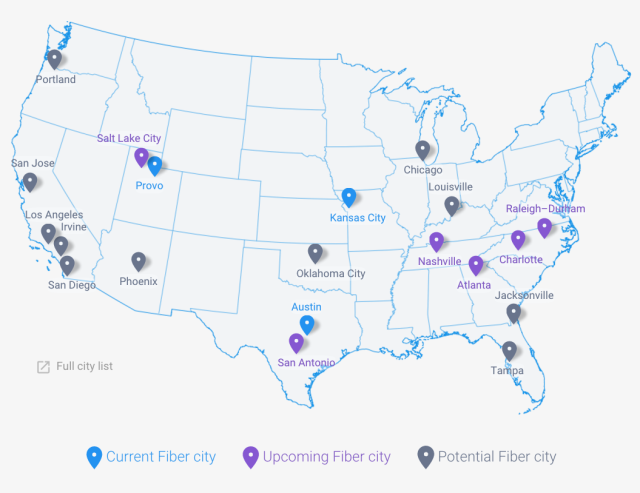
Google Fiber current cities and expansion plans. (credit: Google Fiber)

Google Fiber launched more than three years ago with gigabit Internet and TV, but not phone service.

Now, Google might finally be adding a VoIP phone component in order to duplicate the "triple-play" bundle offered by many ISPs. The Washington Post reported today that Google is sending invitations to try a new home phone service to members of its "Fiber Trusted Tester" program.

"Our latest offering is Google Fiber Phone, which gives you the chance to add home phone service to your current Fiber service plan," the invitation said. (See the full invitation here.)

Read 8 remaining paragraphs | Comments
Tom Wheeler fires back at cable lobby, says cable box fees are too high

As FCC chair, former cable lobbyist fights industry on set-top box competition.

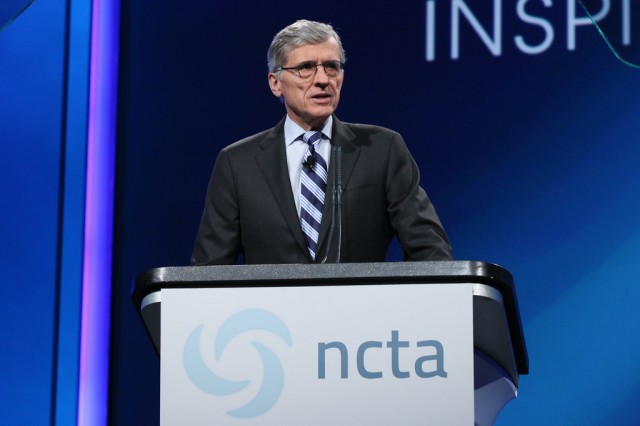
FCC Chairman Tom Wheeler. (credit: NCTA)

As cable industry lobbyists criticize a Federal Communications Commission plan to inject competition into the set-top box market, FCC Chairman Tom Wheeler today said cable company complaints are off-base.

Since becoming FCC chairman in 2013, Wheeler has repeatedly battled the cable industry even though he himself was once a cable lobbyist.

Wheeler's latest plan would force pay-TV companies to make video programming available to makers of third-party hardware or software without requiring a physical CableCard. This would let consumers watch the TV channels they pay for on other devices without having to rent a set-top box from the cable company.

Read 9 remaining paragraphs | Comments

Cable lobby is really mad about FCC’s set-top box competition plan

Cable box rental fee revenue at stake in battle over new rules.

(credit: Steven Depolo)

Cable TV industry lobby groups expressed their displeasure with a Federal Communications Commission plan to bring competition to the set-top box market, which could help consumers watch TV on different devices and thus avoid paying cable box rental fees.

FCC Chairman Tom Wheeler proposed new rules that would force pay-TV companies to give third parties access to TV content, letting hardware makers build better set-top boxes. Customers would be able to watch all the TV channels they're already paying cable companies for, but on a device that they don't have to rent from them. The rules could also bring TV to tablets and other devices without need for a rented set-top box. The system would essentially replace CableCard with a software-based equivalent.

Cable companies hate the plan.

Read 12 remaining paragraphs | Comments

Aereo founder’s next business: Wireless gigabit home Internet

Millimeter wave tech will achieve high speeds, launching first in Boston.

A startup led by the founder of Aereo says it plans to sell wireless Internet service with speeds of 1Gbps in Boston and then other cities.

Project Decibel was founded by Chet Kanojia, the founder and CEO of the ill-fated TV-over-the-Internet startup Aereo. While Aereo was doomed by a copyright battle with television networks, Kanojia is giving it a shot in the home Internet market dominated by cable companies and telcos.

Project Decibel's "Starry" Internet service "will launch its first beta in the Greater Boston area in the summer of 2016," with additional cities being announced later in the year, the company said. Project Decibel is based both in Boston and New York City.

Read 5 remaining paragraphs | Comments

Ignoring cable industry protest, FCC says it will “unlock the set-top box”

Cable TV customers could save a lot of money on set-top box rental fees.

(credit: Iain Watson)

Pay-TV providers would have to make video programming available to the makers of third-party devices and software under a proposal by Federal Communications Commission Chairman Tom Wheeler.

The FCC is planning for a software-based, cardless replacement for CableCard. Without needing a physical card that plugs into a third-party set-top box, consumers would be able to get TV channels on tablets, smart TVs, or set-top boxes that they can buy from other companies instead of renting a box from a cable company.

"Consumers should be able to choose how they access the Multichannel Video Programming Distributor’s (MVPDs)—cable, satellite, or telco companies—video services to which they subscribe," the FCC's summary of the proposal said. "For example, consumers should be able to have the choice of accessing programming through the MVPD-provided interface on a pay-TV set-top box or app, or through devices such as a tablet or smart TV using a competitive app or software. MVPDs and competitors should be able to differentiate themselves and compete based on the experience they offer users, including the quality of the user interface and additional features like suggested content, integration with home entertainment systems, caller ID and future innovations."

Read 17 remaining paragraphs | Comments

Verizon FiOS default speed now 50Mbps—double FCC’s broadband definition

Verizon dumps 25Mbps fiber plan despite complaining about broadband definition.

(credit: bluepoint951)

Despite claiming that the government's definition of "broadband" shouldn't have been increased to 25Mbps,Verizon is now phasing out its 25Mbps fiber service and making 50Mbps the default minimum.

A year ago, the Federal Communications Commission voted to boost the definition of broadband from 4Mbps downstream/1Mbps upstream to 25Mbps/3Mbps. The definition affects policy decisions and the FCC's annual assessment of whether broadband is being deployed to all Americans quickly enough. Verizon unsuccessfully lobbied the FCC to keep the old definition, saying that "a higher benchmark would serve no purpose in accurately assessing the availability of broadband."

Verizon still offers speeds as low as 512kbps downloads and 384kbps uploads in areas where it hasn't upgraded copper DSL lines to fiber. Verizon DSL goes up to 15Mbps/1Mbps, if you're close enough to Verizon Internet facilities. Mayors in 14 East Coast cities including New York City recently criticized Verizon for leaving many customers with copper only.

Read 8 remaining paragraphs | Comments