One year later, net neutrality still faces attacks in court and Congress

FCC’s Title II and muni broadband rulings face uncertain future.

Happy first birthday, net neutrality rules. (credit: Justin McGregor)

Today is the one-year anniversary of two of the biggest decisions made by the Federal Communications Commission under Democratic Chairman Tom Wheeler.

On February 26, 2015, the FCC voted 3-2 along party lines to enforce net neutrality rules and preempt state laws that prevent the expansion of municipal broadband networks. But whether either decision will survive past Wheeler’s chairmanship is still an open question. Republicans in Congress have tried to overturn them, and lawsuits against the commission are still pending.

Trade groups representing Internet service providers sued to halt the net neutrality rules and a related reclassification of broadband as a Title II common carrier service. Judges at the US Court of Appeals in Washington, DC heard oral arguments in December and could issue a decision in the next few months (though no one knows exactly when).

Read 18 remaining paragraphs | Comments

AT&T sues Louisville to stop Google Fiber from using its utility poles

Lawsuit could delay Google construction, give AT&T head start in fiber race.

AT&T today sued the local government in Louisville and Jefferson County, Kentucky to stop a new ordinance designed to give Google Fiber access to utility poles.

AT&T's lawsuit in US District Court in Louisville says the Louisville/Jefferson County Metro Government's ordinance is invalid because it conflicts with and is preempted by the Federal Communications Commission's pole attachment regulations. AT&T also argues that under Kentucky law, only the state Public Service Commission has jurisdiction to regulate pole attachments.

WDRB posted a copy of the lawsuit.

Read 7 remaining paragraphs | Comments
Google Fiber coming to San Francisco, using someone else’s fiber

Fiber deal will let Google serve apartments, condos, and affordable housing.

(credit: Google Fiber)

Google Fiber announced plans on Wednesday to offer Internet service in San Francisco apartments, condos, and affordable housing properties.

Instead of installing its own fiber cables, Google said it will use existing fiber, allowing it to bring service to the city more quickly. Google may need to do some work outside and inside buildings to connect properties to the existing fiber, but otherwise not much construction will be required.

This is similar to a deal Google announced with a city-owned utility in Huntsville, Alabama. But in the San Francisco case, Google is not saying what entity it is leasing or buying fiber from or when it will start offering service.

Read 6 remaining paragraphs | Comments

Verizon faces probe of falling poles, sagging cables, and infested cabinets

Pennsylvania to hold hearings on union allegations against Verizon.

Pennsylvania utility officials will hold hearings to examine the state of Verizon's copper network in response to complaints from a workers' union that Verizon has let older portions of its network fall into disrepair.

The Communications Workers of America (CWA) in October petitioned the state for an investigation, saying that Verizon has done little to maintain copper wires in areas where it hasn't upgraded its telephone and DSL Internet service to fiber. Customers have suffered service outages and other problems as a result, with more than 6,000 Verizon customers submitting quality and reliability complaints to the state since 2012, the CWA says.

"For many years, VZPA [Verizon Pennsylvania] has intentionally failed to maintain its physical plant in non-FiOS areas of the Commonwealth," the CWA wrote. "The state of deterioration is now so advanced that poles are literally falling over, cables are sagging to the ground, animals and insects are infesting broken wiring cabinets, and the safety of VZPA's employees and the public is being jeopardized every day."

Read 7 remaining paragraphs | Comments

Google Fiber joins forces with municipal broadband network

Google will offer Internet service over city-owned fiber in Huntsville, Alabama.

(credit: Google)

Google Fiber said on Monday that it plans to bring its gigabit Internet service to Huntsville, Alabama. But instead of laying its own fiber, Google will offer service over a network that is being built by the city-owned Huntsville Utilities. Huntsville will lease space on the network to Google so it can offer Internet service. But it's not an exclusive deal, so other Internet providers could offer broadband over the same fiber. Huntsville, a city of nearly 190,000 residents, has been planning the fiber build for more than a year.

City officials "see it as a low-risk investment, as compared to administering the gigabit Internet themselves, which would require a massive increase in personnel in an arena where they have limited expertise," local news station WHNT reported today. Google Fiber should be available to the first Huntsville customers by the middle of 2017, but it could take a few years to extend service throughout the city, the report said.

Google Fiber offers service in Kansas City, Kansas and Missouri; Provo, Utah; Austin, Texas; and Atlanta, Georgia. Huntsville is now one of six additional cities where Google says it will offer service. Google lists 11 other cities as "potential" Fiber locations, bringing the total of possible deployments to 21 metro areas.

Read 4 remaining paragraphs | Comments

Cable lobby claimed “voluntary” solution could create cable box competition

But years later, 99% of customers still rent cable boxes from pay-TV companies.

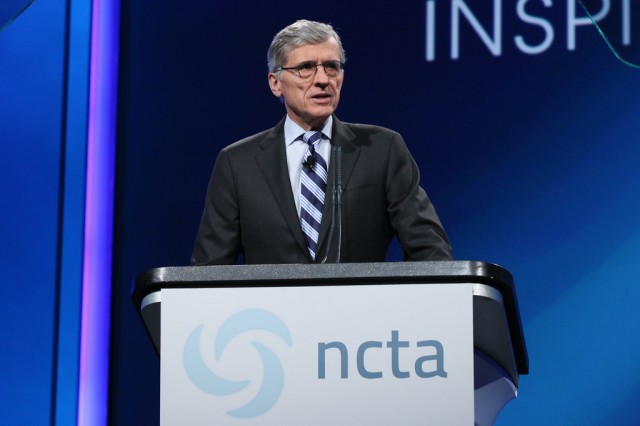
FCC Chairman Tom Wheeler. (credit: NCTA)

Just before yesterday's vote to boost competition in the cable set-top box market, Federal Communications Commission Chairman Tom Wheeler showed the audience a letter that cable lobbyists sent to the FCC in March 2010.

At the time, the FCC was preparing its National Broadband Plan, which among many other things recommended new rules "to ensure a competitive and innovation video set-top box market." The National Cable & Telecommunications Association wrote to then-Chairman Julius Genachowski urging him not to enact any such rules. Genachowski never did.

But what Wheeler pointed out is that the letter said customers should be able to watch their TV channels on set-top boxes that aren't rented to them by the cable company.

Read 11 remaining paragraphs | Comments

FCC votes to “unlock the cable box” over Republican opposition

Customers should be able to watch TV on any device without CableCard, FCC said.

(credit: Mr.TinDC)

The Federal Communications Commission today approved a Notice of Proposed Rulemaking (NPRM) that seeks to give consumers more choices in the set-top boxes they use to watch cable TV.

The vote was 3-2, with Chairman Tom Wheeler and fellow Democrats Mignon Clyburn and Jessica Rosenworcel voting in favor of the proposal, while Republicans Ajit Pai and Michael O'Rielly voted against. An NPRM is not a final vote. Instead, this will kick off a months-long public comment period leading up to a final vote that is likely to happen before the end of this year.

The FCC is essentially trying to create a software-based replacement for CableCard. Pay-TV operators from the cable, satellite, and telco industries would have to provide content and programming information to makers of third-party hardware or applications. Theoretically, customers could then watch their TV channels on various devices without needing to rent a set-top box from their cable company and without buying equipment that is compatible with a physical CableCard.

Read 14 remaining paragraphs | Comments

AT&T trialling 5G, promises speeds 10 to 100 times faster than LTE

5G cellular technology could be used for home Internet service, AT&T says.

Let us show you how fast 5G will be—as you can see, it will be almost half the speed of 11G. (credit: Embassy Pictures)

AT&T is testing an early version of its 5G network this year, saying it will be 10 to 100 times faster than LTE and might be used for home Internet service. "An early use of 5G’s underlying technology could be delivering broadband to homes and businesses, and it’s possible that we could have limited commercial availability this year depending on the trials," an AT&T spokesperson told Ars.

This sounds like it could fit in with AT&T plans to provide fixed wireless Internet to areas without good wired broadband.

AT&T's announcement on Friday said the 5G network will rely on millimeter waves, which are 30GHz and above and require line-of-sight connections. As we've written before, 5G will also likely use spectrum below 1GHz in order to connect areas that can't be covered by extremely high frequencies.

Read 7 remaining paragraphs | Comments

ISPs want “flexible” privacy rules that let them “innovate” with customer data

ISPs should be able to choose how they protect customer data, they tell FCC.

(credit: g4ll4is)

Broadband industry lobby groups urged the Federal Communications Commission on Thursday not to impose privacy rules that dictate "specific methods" of protecting customer data, since that would prevent "rapid innovation."

ISPs should have "flexibility" in how they protect customers' privacy and security, said the letter from the American Cable Association, Competitive Carriers Association, Consumer Technology Association, CTIA, the Internet Commerce Coalition, the National Cable & Telecommunications Association, and USTelecom. Together, these groups represent the biggest home Internet service providers and wireless carriers such as Comcast, AT&T, Verizon, Time Warner Cable, Charter, Sprint, T-Mobile, and many smaller ones.

"Rules dictating specific methods quickly become out of date and out of step with constantly changing technology, and will only hamper innovation and harm consumers," they wrote.

Read 10 remaining paragraphs | Comments

Netflix finishes its massive migration to the Amazon cloud

After move to Amazon, only the DVD business still uses traditional data center.

(credit: Netflix)

Netflix has been moving huge portions of its streaming operation to Amazon Web Services (AWS) for years now, and it says it has finally completed its giant shift to the cloud. “We are happy to report that in early January of 2016, after seven years of diligent effort, we have finally completed our cloud migration and shut down the last remaining data center bits used by our streaming service,” Netflix said in a blog post that it plans to publish at noon Eastern today. (The blog should go up at this link.)

Netflix operates “many tens of thousands of servers and many tens of petabytes of storage” in the Amazon cloud, Netflix VP of cloud and platform engineering Yury Izrailevsky told Ars in an interview.

Netflix had earlier planned to complete the shift by the end of last summer.

Read 20 remaining paragraphs | Comments