FCC admits defeat in municipal broadband, won’t appeal court loss

Cities seeking to expand broadband could still appeal judges’ decision, though.

(credit: Getty Images | Yuri_Arcurs)

The Federal Communications Commission has decided not to appeal a court decision that allows states to impose laws restricting the growth of municipal broadband.

The FCC in February 2015 voted to block laws in North Carolina and Tennessee that prevent municipal broadband providers from expanding outside their territories, but the states convinced a federal appeals court to keep the laws in place. The FCC could have asked for another appeals court review or gone to the Supreme Court but will instead let the matter drop.

"The FCC will not seek further review of the [US Court of Appeals for the] Sixth Circuit's decision on municipal broadband after determining that doing so would not be the best use of Commission resources," an FCC spokesperson told Ars today. The decision was also reported yesterday in The New York Times.

Read 3 remaining paragraphs | Comments
T-Mobile quadruples tethering speed on “unlimited” plan—to 512kbps

Changes are a mixed bag if you want HD video or occasional high-speed tethering.

(credit: T-Mobile)

The new $70-per-month "unlimited data" plans announced by T-Mobile USA this month came with some big limits. Mobile hotspot speeds were to be throttled to 128kbps unless customers paid more, and online video resolution reduced to 480p unless customers paid extra to unlock high-definition video.

But after a wave of criticism from those who think T-Mobile is violating net neutrality and others who think the new deal just isn't that good, the carrier today announced some changes. It's a mixed bag, though, as there is apparently no way to permanently enable high-definition video, and T-Mobile is killing an option that would have let customers buy high-speed hotspot data in 5GB increments.

"The best way to run your company is to shut up, listen to your customers, and then do what they say!" T-Mobile CEO John Legere said in the announcement.

Read 10 remaining paragraphs | Comments

AT&T doesn’t want to repay money it got from alleged overcharges

FCC accused AT&T of overcharging schools, wants to collect fine.

(credit: Mike Mozart)

AT&T is fighting a recent punishment handed down by the Federal Communications Commission. Last month, the FCC issued a Notice of Apparent Liability (NAL) that says AT&T overcharged the Florida school districts of Orange and Dixie by nearly 400 percent.

AT&T filed its response today, saying that there is "no legal or factual basis for liability against AT&T."

The phone service in question is paid for by US citizens through surcharges on phone bills. Those surcharges fund the E-rate program that subsidizes telecommunications for schools and libraries. Under this program, the FCC says AT&T is required to charge schools and libraries the lowest available rates. The commission says AT&T should repay $63,760 it improperly received from the FCC in subsidies and pay an additional fine of $106,425.

Read 7 remaining paragraphs | Comments

AT&T explains why it sometimes delays Google Fiber access to poles

Google Fiber can’t always access AT&T utility poles despite US-wide agreement.

Enlarge (credit: Google Fiber)

Google Fiber has been battling AT&T over access to utility poles for a few years now. During a dispute in Austin, Texas late in 2013, AT&T said it could deny access to its poles because Google wasn't a "qualified" telecom or cable provider.

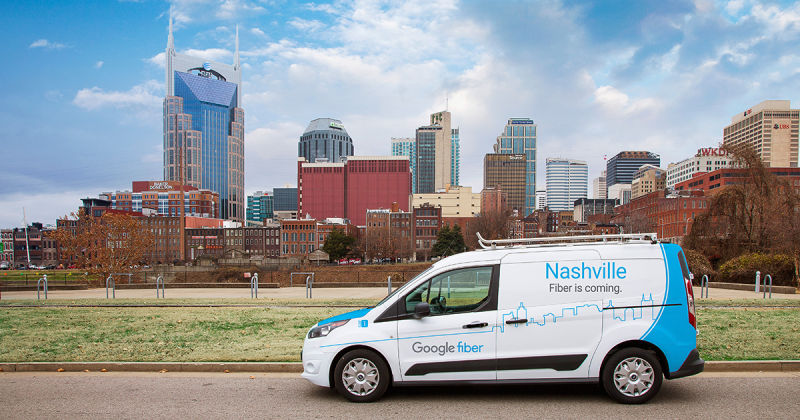
Things have gone a bit smoother since then because the companies signed a nationwide agreement granting Google Fiber access to AT&T poles on a city-by-city basis. But in Nashville, Tennessee, Google Fiber construction has stalled partly because the new ISP still has problems getting access to AT&T poles. AT&T confirmed to Ars earlier this month that the terms of the previous nationwide agreement cover Nashville, but it declined to explain why there are still holdups.

An AT&T executive has now detailed the telco's objections in an interview with FierceTelecom. Google Fiber has been making mistakes in engineering drawings that it needs to submit before attaching fiber to AT&T poles, according to Joelle Phillips, president of AT&T Tennessee.

Read 10 remaining paragraphs | Comments

Google Fiber fails to hit subscriber goal, will reportedly cut staff

Google Fiber is reportedly well short of goal to get 5 million subscribers.

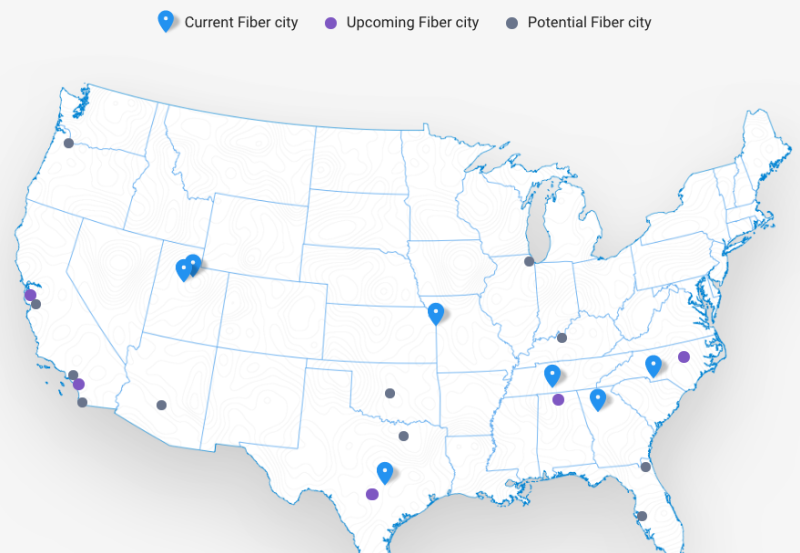
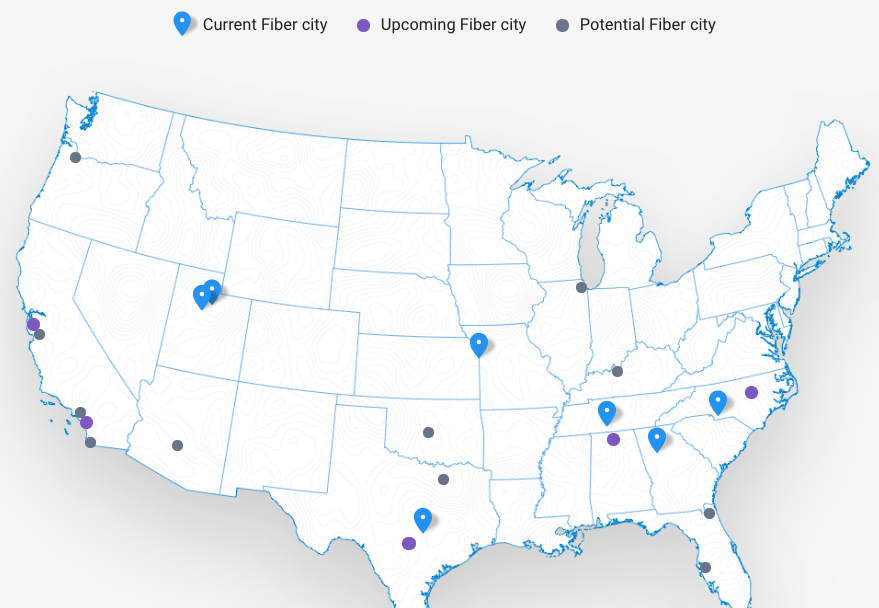
Enlarge / Google Fiber's tentative expansion plans. (credit: Google Fiber)

Google Fiber has reportedly fallen "well short" of its goal of signing up 5 million subscribers and may be on the verge of making significant staff cuts.

"Last month, Alphabet CEO Larry Page ordered Google Fiber’s chief, Craig Barratt, to halve the size of the Google Fiber team to 500 people," according to a paywalled report from The Information that quotes people "close to Alphabet."

The report does not say whether any staff cuts have already occurred.

Read 5 remaining paragraphs | Comments

Google Fiber hits Salt Lake City, now available in seven metro areas

Future cities could get wireless instead of fiber, though.

Today Google Fiber began taking signups in Salt Lake City, Utah, the gigabit ISP's seventh metro area.

Gigabit Internet will be available for $70 a month and 100Mbps will cost $50 a month. Gigabit Internet with TV service is $140 a month. There are no data caps on any of the tiers. Phone service can be added for $10.

The initial deployment "will cover roughly 112 blocks from 100 South to 800 South between 400 West and 1300 East," The Salt Lake Tribune reported today. Assuming demand is high, installations "could take a week or more after customers apply." Google Fiber said that other parts of the city will get the service within months but offered no more specific timeline.

Read 3 remaining paragraphs | Comments
Comcast’s $70 gigabit deal is shockingly difficult to sign up for

The Keyser Söze of Internet offers: Even some Comcast reps don’t know it exists.

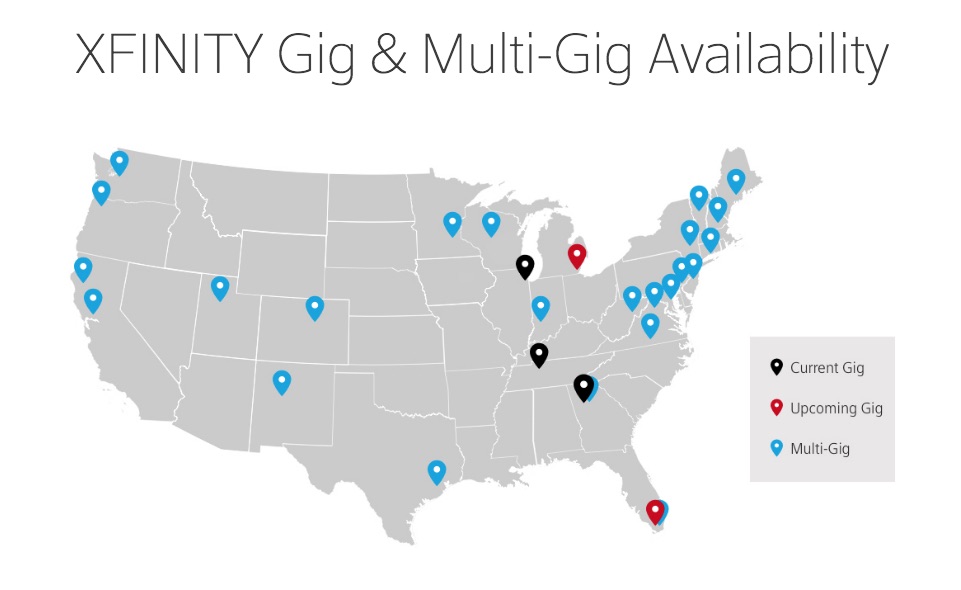
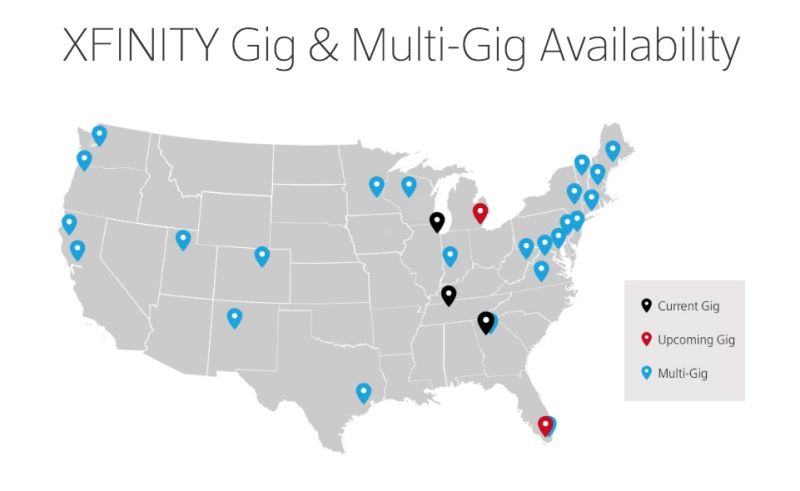
When Comcast brought its gigabit download cable service to Chicago last week, there was plenty of confusion about the price. Comcast initially said it would cost $140 a month, even though a $70 monthly price is available in other cities where Comcast has to compete against Google Fiber.

But after we published a story Friday, a Comcast spokesperson said the $70 offer was available in Chicago after all, contrary to what the company had said earlier that day. But there’s a difference between Comcast telling the media that a great deal is available and customers actually being able to sign up for it.

Comcast told us that customers interested in the offer should sign up at xfinity.com/gig. But when you follow the links, the only pricing listed is $300 a month for 2Gbps fiber Internet and $140 a month for 1Gbps download speeds (with 35Mbps uploads).

Read 22 remaining paragraphs | Comments
Linux turns 25, is bigger and more professional than ever

Just 7.7% of devs are unpaid—because Linux development is worth paying for.

Enlarge (credit: Athanasios Kasampalis)

The Linux operating system kernel is 25 years old this month. It was August 25, 1991 when Linus Torvalds posted his famous message announcing the project, claiming that Linux was "just a hobby, won't be big and professional like gnu."

But now, Linux is far bigger and more professional than Torvalds could have imagined. Linux powers huge portions of the Internet's infrastructure, corporate data centers, websites, stock exchanges, the world's most widely used smartphone operating system, and nearly all of the world's fastest supercomputers. The successes easily outweigh Linux's failure to unseat Microsoft and Apple on PCs, but Linux has still managed to get on tens of millions of desktops and laptops and even runs on Windows.

As its importance has grown, development of Linux has steadily shifted from unpaid volunteers to professional developers. The 25th anniversary version of the Linux Kernel Development Report, released by the Linux Foundation today, notes that "the volume of contributions from unpaid developers has been in slow decline for many years. It was 14.6 percent in the 2012 version of this paper, 13.6 percent in 2013, and 11.8 percent in 2014; over the period covered by this report, it has fallen to 7.7 percent. There are many possible reasons for this decline, but, arguably, the most plausible of those is quite simple: Kernel developers are in short supply, so anybody who demonstrates an ability to get code into the mainline tends not to have trouble finding job offers."

Read 6 remaining paragraphs | Comments
EFF accuses T-Mobile of violating net neutrality with throttled video

T-Mobile throttles video unless users pay extra; EFF considers filing complaint.

Enlarge

The Electronic Frontier Foundation (EFF) has accused T-Mobile USA of violating net neutrality principles with a new "unlimited" data plan that throttles video. The group is weighing whether to file a complaint with the Federal Communications Commission, and the EFF is evaluating a similar offering from Sprint.

T-Mobile's $70-per-month unlimited data plan limits video to about 480p resolution and requires customers to pay an extra $25 per month for high-definition video. Going forward, this will be the only plan offered to new T-Mobile customers, though existing subscribers can keep their current prices and data allotments.

"From what we've read thus far it seems like T-Mobile's new plan to charge its customers extra to not throttle video runs directly afoul of the principle of net neutrality," EFF Senior Staff Technologist Jeremy Gillula told the Daily Dot.

Read 12 remaining paragraphs | Comments
Comcast’s $70 gigabit offer is only good in cities with Google Fiber

Comcast’s only price is $140 when it doesn’t have to compete against Google.

Enlarge (credit: Comcast)

When Comcast launched its gigabit cable service in Atlanta and Nashville earlier this year, the company offered a $70 monthly price for customers who sign three-year contracts, half off the no-contract "every-day" price.

But when Comcast announced gigabit Internet for parts of Chicago this week, the no-contract price of $139.95 was the only one mentioned. The difference, as DSLRreports wrote today, is that there's no Google Fiber providing competition in Chicago yet. While Google Fiber has tentative plans to expand to Chicago, its $70 gigabit Internet service is already available in parts of Atlanta and Nashville.

Comcast's Chicago announcement said the company "will test promotional pricing during the trial period," but didn't name any specific offers that are better than the $140 no-contract price. When contacted by Ars, a Comcast spokesperson said there is "nothing to announce at this time." The Chicago service may also come with a 1TB monthly data cap, as Comcast has previously only provided unlimited data to gigabit customers who sign a three-year contract. Otherwise, unlimited data costs $50 a month extra.

Read 3 remaining paragraphs | Comments