T-Mobile and YouTube compromise on video throttling and zero-rating

YouTube joins Binge On, videos won’t count against T-Mobile data caps.

(credit: T-Mobile US)

T-Mobile USA and YouTube have reached a compromise that will bring YouTube into T-Mobile's Binge On program, which reduces streaming quality but exempts videos from data caps.

The Google-owned YouTube was the most notable absence from Binge On when T-Mobile launched the program in November. YouTube later said that while reducing data charges can be good for customers, "it doesn’t justify throttling all video services, especially without explicit user consent."

But today, T-Mobile announced that YouTube, Google Play Movies, and a few other services have joined Binge On, bringing the total to more than 50 (including its own T-Mobile TV).

Read 7 remaining paragraphs | Comments
Charter/Time Warner Cable merger nearing FCC approval

WSJ: Merger conditions could boost online video and Internet competition.

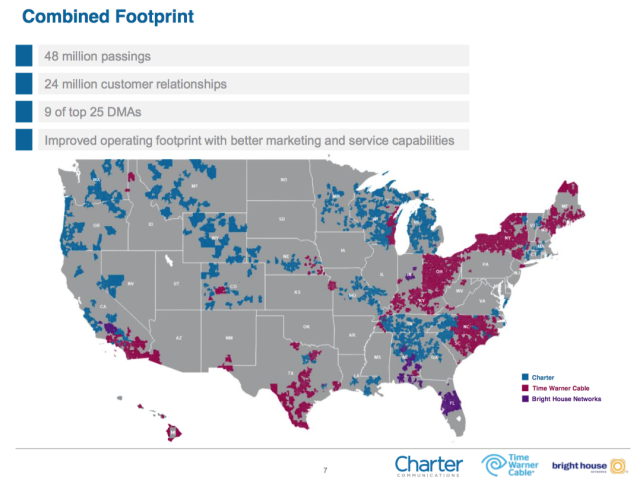
Charter's footprint after the proposed merger. (credit: Charter)

Federal Communications Commission Chairman Tom Wheeler is likely to support Charter's proposed acquisition of Time Warner Cable (TWC) and may circulate a proposal to approve the merger with conditions "as soon as this week," The Wall Street Journal reported last night, citing "people familiar with the matter."

Wheeler would be circulating a draft order to fellow commissioners, a preliminary step to approving the deal.

"The order would impose a number of conditions on the transaction, many of them aimed at boosting online video as a competitor to cable," the Journal reported. "One condition would bar Charter from including clauses in its pay-TV contracts that restrict a content company’s ability to offer its programming online or to new entrants, the people said. FCC officials worry those clauses, which are thought to be widespread in the pay-TV marketplace, could be impeding the growth of online video."

Read 8 remaining paragraphs | Comments

Tennessee kills muni-broadband expansion bill after AT&T opposition

Lawmakers caved to lobbyists, disappointed rep says.

No muni broadband for you. (credit: Aurich Lawson)

Tennessee lawmakers have defeated a proposal to expand municipal broadband, with one state representative accusing fellow elected officials of caving to pressure from lobbyists. "It's a testament to the power of lobbying against this bill and not listening to our electorate," Rep. Kevin Brooks (R-Cleveland) told reporters after the vote, according to a Times Free Press article yesterday.

Brooks didn't name lobbyists for any specific companies but said, "I heard they hired 27 lawyers to fight."

Sen. Todd Gardenhire (R-Chattanooga) last month blamed AT&T for leading efforts to kill the bill. "We're talking about AT&T," Gardenhire said at the time. "They're the most powerful lobbying organization in this state by far."

Read 5 remaining paragraphs | Comments

Why Tom Wheeler rejected broadband price caps and last-mile unbundling

FCC chairman has hammered ISPs, but he could have gone even further.

Protesters rally at the FCC in 2014 in favor of net neutrality rules. (credit: Stephen Melkisethian)

When the Federal Communications Commission voted to regulate Internet providers as common carriers under Title II of the Communications Act last year, Chairman Tom Wheeler made it clear that the FCC could have imposed even stricter requirements.

The commission primarily used Title II to impose net neutrality rules that prevent Internet providers from blocking or throttling traffic or giving priority to Web services in exchange for payment. But the FCC could have also imposed rate regulation and required last-mile "unbundling," which would force Internet providers to let competitors offer service over their networks.

Wheeler rejected that type of heavy-handed utility regulation, instead announcing that there would be "no rate regulation, no filing of tariffs, and no network unbundling." By promising only "light-touch" common carrier rules, Wheeler tried to convince Internet providers that the new regulatory regime wouldn't be that bad. Of course, the FCC was sued by broadband providers anyway. “Everybody sues us about everything,” Wheeler once said after a different decision on prison phone rates.

Read 20 remaining paragraphs | Comments

How a former lobbyist became the broadband industry’s worst nightmare

Tom Wheeler tells Ars why he turned on the cable and wireless industries.

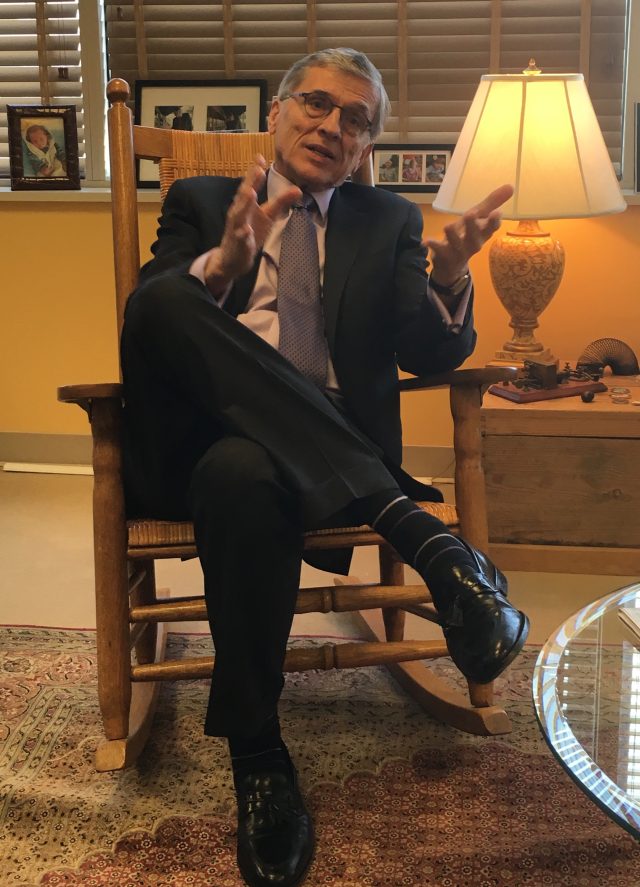
FCC Chairman Tom Wheeler in his Washington, DC, office. (credit: Jon Brodkin)

When President Obama nominated Tom Wheeler to lead the Federal Communications Commission (FCC) in May 2013, there was widespread concern the new chairman would push the interests of telecommunications companies instead of standing up for the American people.

After all, Wheeler had been the top lobbyist for both the cable and cell phone industries, having worked for the National Cable Television Association (NCTA) from 1976 to 1984 and the Cellular Telecommunications & Internet Association (CTIA) from 1992 to 2004. Though he had left those jobs years before, people wondered if a former lobbyist would properly regulate the industries he once represented.

“Obama’s Bad Pick: A Former Lobbyist at the FCC,” said the headline in The New Yorker on the day after Wheeler's nomination. Consumer advocacy groups such as Free Press and the New America Foundation’s Open Technology Institute publicly doubted whether Wheeler would be tough on his previous employers.

Read 79 remaining paragraphs | Comments

Comcast’s gigabit cable has a data cap—unless you sign 3-year contract

As Google Fiber enters Atlanta, Comcast pushes long-term commitments.

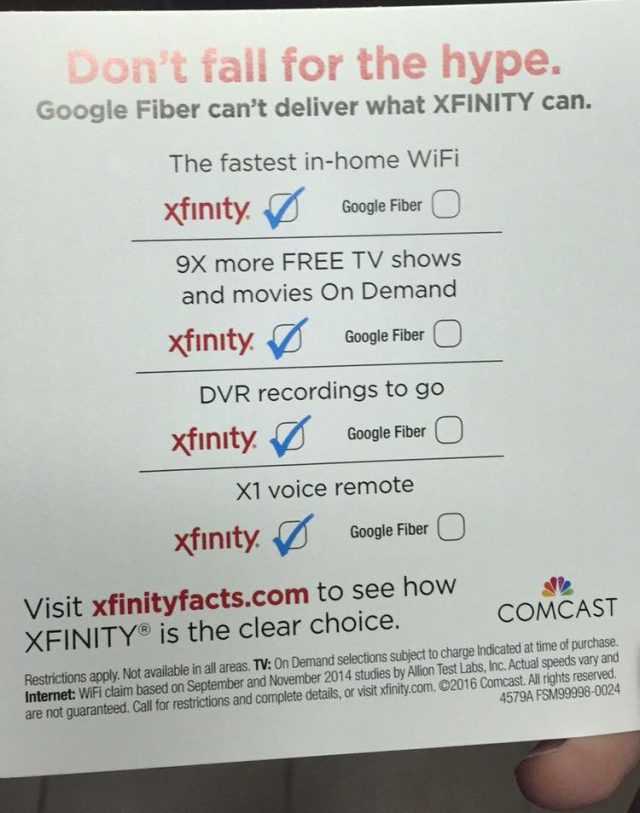
Comcast is mailing this flyer to Atlanta residents. (credit: TheBen91)

Comcast has begun selling its new gigabit cable service in parts of Atlanta, and the company is heavily pushing customers toward three-year contracts as it tries to fend off a challenge from Google Fiber.

Customers will be able to buy the Internet service for $70 a month and not face any data caps if they sign a three-year deal that has an early termination fee. Without a contract, customers would have to pay $139.95 a month and face a 300GB-per-month data cap.

Customers on the no-contract option can upgrade to unlimited data for an extra $35 a month. Thus, Comcast's gigabit Internet service with unlimited data costs $70 per month with a contract and about $175 without. (A DSLReports article described the data cap details today, and Comcast confirmed them to Ars.)

Read 6 remaining paragraphs | Comments

AT&T defeats class action in unlimited data throttling case

Throttled users forced into arbitration, but AT&T still faces FTC and FCC wrath.

(credit: Chris Young)

Customers who sued AT&T over its practice of throttling unlimited data plans will not be able to pursue a class-action lawsuit against the company. AT&T argued that the customers could only have their complaints heard individually in arbitration, and Judge Edward Chen of US District Court in Northern California has sided with the cellular company.

The customers' contracts with AT&T required them to arbitrate disputes with AT&T on an individual basis. But customers argued that the arbitration cause would violate their First Amendment right to petition a court for a redress of grievances. While the arbitration clause allowed claims to be brought in small claims court, the plaintiffs argued that such a court would not be an adequate forum.

But Chen accepted AT&T's argument, noting that the Supreme Court previously upheld AT&T's arbitration provision in a 2011 decision. In the 2011 case, AT&T Mobility v. Concepcion, the Supreme Court found that the Federal Arbitration Act preempted a California state law that limited the power of companies to force customers into arbitration.

Read 7 remaining paragraphs | Comments

TP-Link blocks open source router firmware to comply with new FCC rule

Rules for limiting interference could prevent use of DD-WRT and OpenWRT.

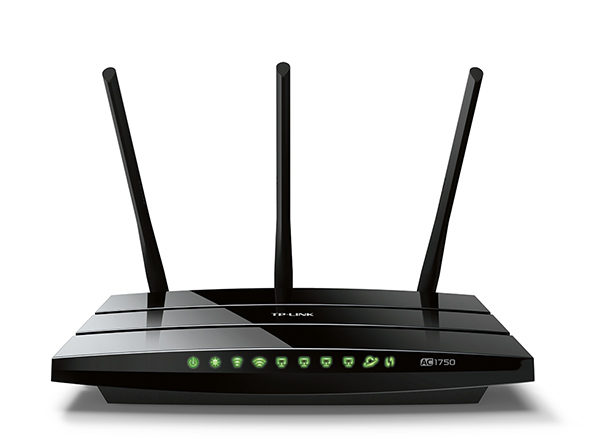
A TP-Link router. (credit: TP-Link.)

Networking hardware vendor TP-Link says it will prevent the loading of open source firmware on routers it sells in the United States in order to comply with new Federal Communications Commission requirements.

The FCC wants to limit interference with other devices by preventing user modifications that cause radios to operate outside their licensed RF (radio frequency) parameters. The FCC says it doesn't intend to ban the use of third-party firmware such as DD-WRT and OpenWRT; in theory, router makers can still allow loading of open source firmware as long as they also deploy controls that prevent devices from operating outside their allowed frequencies, types of modulation, power levels, and so on.

But open source users feared that hardware makers would lock third-party firmware out entirely, since that would be the easiest way to comply with the FCC requirements. The decision by TP-Link—described by the company in this FAQ—shows that those fears were justified. (Thanks to Electronic Frontier Foundation Staff Attorney Nate Cardozo for bringing it to our attention.)

Read 11 remaining paragraphs | Comments

ISPs won’t be allowed to serve targeted ads without customers’ permission

FCC chair proposes new privacy rules for fixed and mobile broadband.

Internet service providers and wireless carriers would have to seek permission from customers before using their private information for certain marketing purposes, if new rules proposed by Federal Communications Commission Chairman Tom Wheeler are approved.

For example, ISPs could only share a subscriber's Internet usage habits with advertising companies or other third parties if the subscriber opts in to such usage. An ISP also wouldn't be able to serve targeted ads to you based on your Web browsing habits without first obtaining opt-in consent.

"Your ISP handles all of your network traffic," Wheeler wrote in a blog post today. "That means it has a broad view of all of your unencrypted online activity—when you are online, the websites you visit, and the apps you use. If you have a mobile device, your provider can track your physical location throughout the day in real time. Even when data is encrypted, your broadband provider can piece together significant amounts of information about you—including private information such as a chronic medical condition or financial problems—based on your online activity."

Read 16 remaining paragraphs | Comments
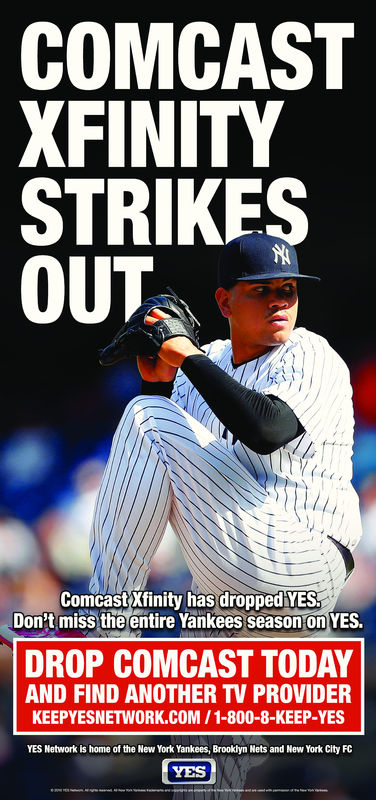
“Drop Comcast today,” Yankees network tells baseball fans

Comcast won’t pay for Yankees games, so network urges viewers to switch.

(credit: YES Network)

New York Yankees fans opening the newspaper this week may see an unusual full-page advertisement urging them to "Drop Comcast today and find another TV provider." The ad points fans to a website that suggests DirecTV, Frontier, and Verizon as alternatives.

It's the latest punch thrown in a fight between Comcast and the YES Network, which broadcasts about 130 Yankees games per season and is owned by Fox and Yankee Global Enterprises. When negotiations for a new carriage deal broke down in November, Comcast dropped the regional sports network, affecting about 900,000 homes in New Jersey, Connecticut, and Pennsylvania, the New York Post reported at the time.

Since there's still no deal and regular season baseball starts in less than a month, the YES Network took out the full-page ads in The New York Times and other newspapers and is also urging fans to drop Comcast with "radio and TV spots, outdoor placements, and an aggressive social media strategy," Variety reported this week.

Read 5 remaining paragraphs | Comments