Dell to sell Perot Systems unit to NTT Data at loss of $800 million

Dell sheds IT services arm for $3.06 billion as it prepares to buy EMC.

Dell founder and CEO Michael Dell. (credit: Oracle PR)

Dell has agreed to sell its IT services subsidiary, Dell Services, to NTT Data for $3.06 billion. Dell Services is the former Perot Systems, a company founded by Ross Perot; Dell purchased it toward the end of 2009 for $3.9 billion.

Dell, which went private in 2013, is trying to raise money as it prepares to complete a $67 billion acquisition of EMC. NTT Data, the systems integration unit of Tokyo-based Nippon Telegraph and Telephone, announced its acquisition of Dell Services today, noting that it still needs regulatory approval.

NTT praised Dell Services as being "an IT services provider recognized for its depth in vertical industries and for its offerings around infrastructure services, cloud services, application services, and business process outsourcing." But under NTT, Dell Services will benefit from "expanded technology resources" and a network of 230 data centers operated by NTT worldwide, the announcement said. The combined company will give NTT Data a greater presence in North America and focus on customers in health care, financial services, insurance, and government.

Read 2 remaining paragraphs | Comments

Court stops FCC’s latest attempt to lower prison phone rates

Rate caps halted by judicial stay for the second time this month.

Alcatraz prison. (credit: Krystian Olszanski)

Prison phone companies have convinced a court to halt new rate caps on inmate calling for the second time this month.

The first stay was issued March 7 and prevented the FCC from implementing new rate caps of 11¢ to 22¢ per minute on both interstate and intrastate calls from prisons. But the stay—which remains in place while the prison phone companies' lawsuit against the FCC is still pending—did not disturb an earlier "interim" cap of 21¢ to 25¢ per minute that applied only to interstate calls, those that cross state lines. The order also didn't specifically object to the FCC changing its definition of "inmate calling service" to include both interstate and intrastate calls.

Seizing on this ambiguity, the FCC decided that it could impose the interim caps on both interstate and intrastate calls. But prison phone companies Securus Technologies, Global Tel*Link (GTL), and Telmate all asked the federal appeals court to stop the caps from being applied to intrastate calls. Securus Technologies CEO Richard Smith argued that confusion about the rate caps could cause "chaos and confusion" in prisons, threatening security.

Read 4 remaining paragraphs | Comments
Netflix throttles video on AT&T and Verizon to keep users under data caps

Netflix limits video to 600kbps and 360p, says “data caps are bad for consumers.”

A message Netflix gave Verizon home Internet customers during a money dispute in 2014. (credit: Yuri Victor)

Netflix has been throttling its video streams on the Verizon Wireless and AT&T mobile networks, reducing the default bitrate to 600kbps in order to help users stay under their data caps.

Netflix's admission yesterday came a week after T-Mobile USA CEO John Legere said that AT&T and Verizon deliver Netflix video at a resolution of only 360p. AT&T and Verizon responded that they don't downgrade the quality of video, and it turns out that Netflix is the one doing the bitrate capping.

Netflix applies this default bitrate worldwide across most mobile carriers and says it has been doing so for more than five years, according to an article in The Wall Street Journal. But Netflix isn't throttling on Sprint and T-Mobile USA, telling the Journal that “historically, those two companies have had more consumer-friendly policies.” Sprint and T-Mobile both offer data plans where customers can exceed their caps without being automatically charged extra fees, but they have to make do with slower speeds the rest of the month unless they purchase more high-speed data.

Read 14 remaining paragraphs | Comments
After Verizon breach, 1.5 million customer records put up for sale

Verizon Enterprise’s security expertise gets put to the test.

Verizon Enterprise offers security services, but it is dealing with a breach of its own this week. (credit: Verizon)

After a data breach at Verizon Enterprise Solutions, a customer database and information about Verizon security flaws were reportedly put up for sale by criminals this week.

According to KrebsOnSecurity, "a prominent member of a closely guarded underground cybercrime forum posted a new thread advertising the sale of a database containing the contact information on some 1.5 million customers of Verizon Enterprise." The entire database was priced at $100,000, or $10,000 for each set of 100,000 customer records. "Buyers also were offered the option to purchase information about security vulnerabilities in Verizon’s Web site," security journalist Brian Krebs reported.

Verizon Enterprise is itself a seller of security products and services, often helping Fortune 500 businesses clean up after data breaches. Verizon Enterprise also sells Internet service to large businesses, along with a variety of other networking products.

Read 4 remaining paragraphs | Comments

Report: Apple designing its own servers to avoid snooping

Apple suspects that servers are intercepted and modified during shipping.

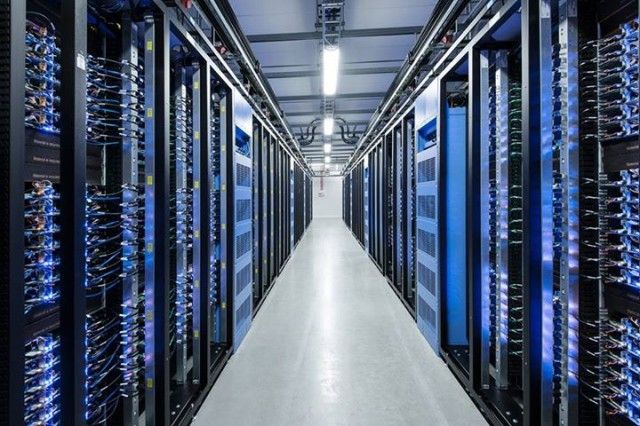
One of Facebook's data centers filled with custom-designed servers. (credit: Facebook)

Apple has begun designing its own servers partly because of suspicions that hardware is being intercepted before it gets delivered to Apple, according to a report yesterday from The Information.

"Apple has long suspected that servers it ordered from the traditional supply chain were intercepted during shipping, with additional chips and firmware added to them by unknown third parties in order to make them vulnerable to infiltration, according to a person familiar with the matter," the report said. "At one point, Apple even assigned people to take photographs of motherboards and annotate the function of each chip, explaining why it was supposed to be there. Building its own servers with motherboards it designed would be the most surefire way for Apple to prevent unauthorized snooping via extra chips."

As we've previously reported, the National Security Agency is known to intercept and modify equipment before it reaches the hands of its intended customers.

Read 6 remaining paragraphs | Comments

Verizon’s fiber network will expand—after three-state sale to Frontier

Frontier “more likely to accelerate broadband than Verizon,” FCC said.

(credit: Verizon)

Verizon is set to complete a sale of its wireline phone, Internet, and TV networks in California, Florida, and Texas to Frontier Communications. The $10.54 billion transaction, announced in February 2015, has received all the necessary regulatory approvals and is scheduled to be finalized March 31.

“We’re buying those assets, we’re bringing them in and actually cutting them into our network so they’ll be ready to go day one, April 1," Frontier VP Chris Gellos said in an interview with Channel Partners last week. Frontier has about 2.4 million Internet customers today, and it will get another 2.2 million or so with the purchase from Verizon.

When it approved the sale last September, the Federal Communications Commission concluded that "Frontier is more likely to accelerate broadband service in the transaction market areas than Verizon would be absent the transaction." The FCC approval said that Frontier plans to "expand fiber-based infrastructure within its network, upgrade network hardware, expand transport capacity in its middle mile and data backbone network in order to expand broadband, increase speeds available to customers, and improve the network for voice services."

Read 6 remaining paragraphs | Comments

FCC’s cable box rules won’t prohibit extra ads around TV channels

Ban unneeded as companies like TiVo “are not disrupting advertising,” FCC says.

(credit: flash.pro)

When the Federal Communications Commission voted for a plan to let consumers watch TV channels on more devices, pay-TV companies complained that makers of third-party set-top boxes might insert their own advertising into cable TV. As a result, the cable TV lobby claimed customers would have to watch the standard television commercials plus see extra advertising distributed by whichever company makes the device or software they're using to watch TV.

FCC Chairman Tom Wheeler dismissed these concerns, and on the day of the vote he said that insertion of additional advertising would be prohibited. But the full text of the notice of proposed rulemaking (NPRM), released after the vote on February 18, shows that there likely won't be a new rule preventing insertion of additional advertising.

The NPRM is a set of proposed rules that asks the public for comment with the goal of issuing final rules by the end of the year.

Read 9 remaining paragraphs | Comments

Verizon kills FiOS live TV apps for Xbox and smart TVs

You can still use FiOS TV mobile apps or rent another set-top box.

Verizon FiOS TV app on Xbox One. (credit: Verizon)

Verizon is telling customers that its FiOS TV apps for Xbox game consoles and smart TVs will be discontinued, limiting the options for hardware on which to view live programming.

Several people have reported receiving an e-mail from Verizon that states the following:

On March 31, 2016, the FiOS TV app you are using to watch your FiOS TV programming through a Smart TV or an Xbox gaming system will be retired and will no longer be available for use. Sorry for the inconvenience.

But we have great news; you can watch your FiOS TV content using our FiOS Mobile app from your smartphone or tablet. This app allows you to stream TV content in and out of your home and so much more.

Verizon's website still lists the FiOS TV app as being available for the Xbox 360, Xbox One, and Samsung's smart TVs and Blu-ray players. Verizon says the "app allows you to enjoy FiOS TV without the need for an additional set-top box"—for the next 10 days, anyway.

Read 6 remaining paragraphs | Comments

Prison phone company says price cap enforcement will cause “jail unrest”

Confusion about rate caps could lead to damage in prisons, CEO tells court.

(credit: Jason Farrar)

Prison phone companies are trying to stop a new Federal Communications Commission effort to impose rate caps on intrastate calls, with one executive claiming that immediate enforcement of new caps will cause "jail unrest."

The phone companies and the FCC have different interpretations of a stay order issued on March 7. Prison phone companies say the court order should mostly preserve the status quo, while the FCC argues that the order lets it apply its existing caps on interstate call rates to intrastate calls.

Securus Technologies CEO Richard Smith filed an affidavit in federal appeals court yesterday, arguing that the FCC has misinterpreted the court order and that imposing the rate caps on intrastate calls will cause problems in prisons and jails. Under a heading titled "Jail Unrest," Smith's affidavit stated:

Read 9 remaining paragraphs | Comments

Comcast failed to install Internet for 10 months then demanded $60,000 in fees

Tech startup needs a new office because it can’t get Comcast Internet.

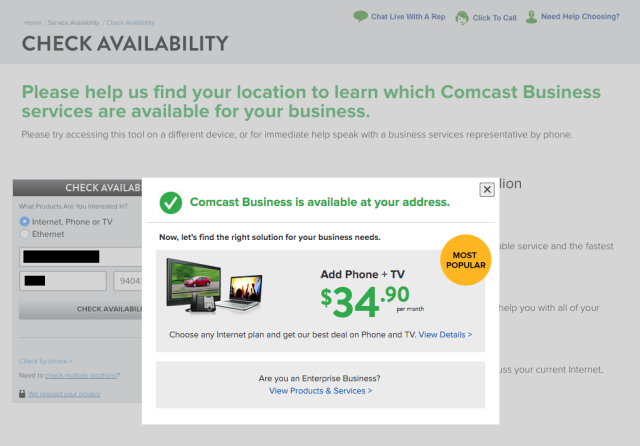
Despite all appearances, Comcast Business wasn't available at SmartCar's address. (credit: Comcast)

Nearly a year ago, a Silicon Valley startup called SmartCar signed up for Comcast Internet service. SmartCar founder and CEO Sahas Katta was moving the company into new office space in Mountain View, California, and there was seemingly no reason to think Comcast might not be able to offer him Internet access.

But Comcast never fulfilled its promise to hook up the business, blaming the delay on construction and permitting problems. Katta discovered that neighboring businesses were making do with painfully slow and unreliable DSL Internet from AT&T, and ultimately SmartCar reluctantly signed up for AT&T as well.

After hearing Comcast excuses for months, Katta finally got fed up and decided that he would find a new office building once his 12-month lease expires on April 20 of this year. Katta told Comcast he wanted to “cancel” his nonexistent service and get a refund for a $2,100 deposit he had paid. Instead, Comcast told him he’d have to pay more than $60,000 to get out of his contract with the company.

Read 23 remaining paragraphs | Comments