After Verizon FiOS changeover to Frontier, some customers lose service

Outages hit California, Florida, and Texas after “technical issue.”

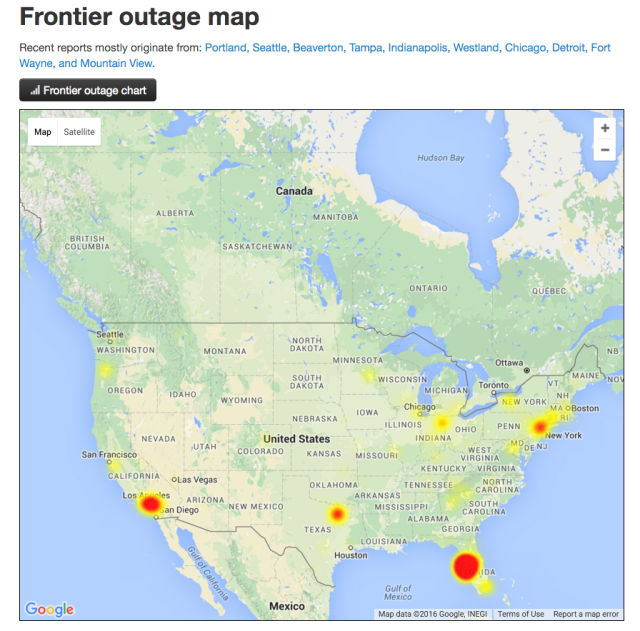
(credit: Down Detector)

Verizon FiOS and DSL networks in California, Florida, and Texas were transferred to Frontier Communications today, completing a $10.54 billion sale announced last year. Although Frontier promised it would be "ready to go day one," there were some problems that left business and residential customers temporarily without service.

There was a "technical issue" involving the integration of systems early in the morning, Frontier spokesperson Brigid Smith told Ars. She did not provide specifics on the cause of the problem or the number of customers affected but said it primarily disrupted service to enterprise and carrier customers in the three states. However, residents have been reporting problems as well through Twitter and the Down Detector website.

The technical problem was resolved at 9:30am ET, Smith said, but customer reports indicate that some have remained without Internet access into the early afternoon. In Florida, an unrelated fiber cut in Tampa caused further outages, but the problems in Texas and California were apparently due only to the system integration mishap.

Read 5 remaining paragraphs | Comments

FCC votes to help poor people buy broadband and protect privacy online

3-2 votes anger Republicans after last-minute compromise is dropped.

FCC Chairman Tom Wheeler. (credit: FCC)

The Federal Communications Commission today voted for two broadband-related proposals. One is designed to give Internet users more control over how Internet service providers monitor and monetize their Web usage. The second proposal will update the 31-year-old Lifeline phone subsidy program so that it can also be used to buy Internet service.

Both votes were 3-2, with Democrats approving and Republicans dissenting. The Lifeline vote was particularly contentious, as commissioners had worked on a bipartisan compromise last night and early this morning. The compromise fell apart at the last minute, delaying the meeting’s start by three-and-a-half hours.

The Lifeline proposal that was approved today will let poor people use a $9.25 monthly household subsidy to purchase home Internet or mobile broadband, or bundles including both voice and Internet. The vote set the Lifeline budget at $2.25 billion a year, indexed to inflation, while creating an independent entity to verify subscriber eligibility in order to reduce fraud.

Read 19 remaining paragraphs | Comments

Painful Comcast cancelation phone calls targeted by California legislation

Bill requiring online cancellation a response to infamous Comcast call.

Time to hang up the phone, evil androids. (credit: psd)

Proposed legislation in California would require Internet service providers to let customers cancel online, potentially ending the scourge of long, awkward cancellation phone calls.

"You've seen the ads from companies that advertise the ease of signing up for their cable or Internet service over the Web," said a press release from state Assemblyman Mike Gatto yesterday. "However, if individuals decide to cancel those same services, they're often forced to suffer through infuriating, time-consuming phone calls, often spending hours on hold."

Gatto's bill is simple, saying, "If a cable or Internet service provider enables an individual to subscribe to its services through an Internet Web site, it shall also enable all of its customers to cancel their subscriptions through the Internet Web site."

Read 3 remaining paragraphs | Comments
Microsoft’s new AI tools help developers build smart apps and bots

One app for phones and smart glasses helps blind people navigate the world.

(credit: Microsoft)

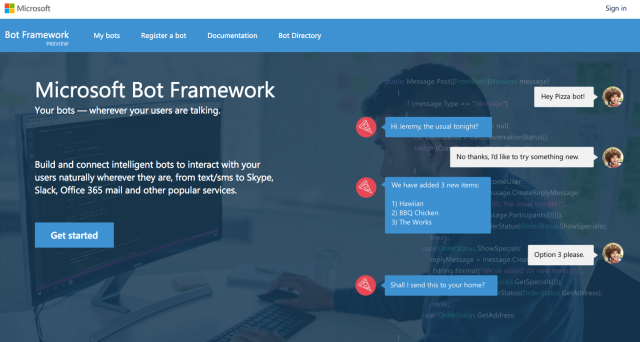
Microsoft is offering new tools to help developers build interactive bots that understand natural language, the company announced at its Build conference today.

There are two key components, which are available in preview and are both part of the larger Cortana Intelligence Suite. "The first, Microsoft Cognitive Services, is a collection of intelligence APIs that allows systems to see, hear, speak, understand and interpret our needs using natural methods of communication," Microsoft said. "The second, the Microsoft Bot Framework, can be used by developers—programming in any language—to build intelligent bots that enable customers to chat using natural language on a wide variety of platforms including text/SMS, Office 365, Skype, Slack, the Web and more."

Though Microsoft's own "Tay" bot became a public relations nightmare, the company demonstrated how artificial intelligence applications built with Microsoft technology can be useful in the real world. Most impressive right now is "Seeing AI," an application to help blind people navigate the world, built by a blind Microsoft software engineer named Saqib Shaikh.

Read 9 remaining paragraphs | Comments

Microsoft accidentally revives Nazi AI chatbot Tay, then kills it again

A week after Tay’s first disaster, the bot briefly came back to life today.

(credit: Microsoft)

Microsoft today accidentally re-activated "Tay," its Hitler-loving Twitter chatbot, only to be forced to kill her off for the second time in a week.

Tay "went on a spam tirade and then quickly fell silent again," TechCrunch reported this morning. "Most of the new messages from the millennial-mimicking character simply read 'you are too fast, please take a rest,'" according to the The Financial Times. "But other tweets included swear words and apparently apologetic phrases such as 'I blame it on the alcohol.'"

Tay's account, with 95,100 tweets and 213,000 followers, is now marked private. "Tay remains offline while we make adjustments," Microsoft told several media outlets today. "As part of testing, she was inadvertently activated on Twitter for a brief period of time."

Read 3 remaining paragraphs | Comments

AT&T boosts data caps for home Internet, and steps up enforcement

Overage fees will be $10 to $100 a month—or pay $30 extra for unlimited data.

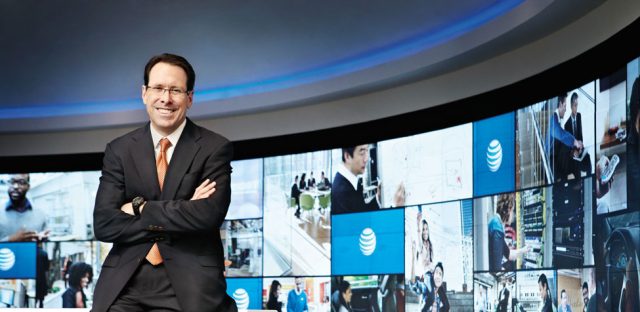
AT&T CEO Randall Stephenson. (credit: AT&T)

AT&T today announced that it will increase its data caps on home Internet service, and expand enforcement. As a result, more customers will have to pay $10 overage charges for each 50GB they use beyond their monthly limit, similar to Comcast's data cap system.

AT&T will also let customers upgrade to unlimited data for an extra $30 a month. This is only necessary for Internet-only customers. People who purchase both AT&T Internet and TV in a bundle will get unlimited home Internet data at no extra charge. That applies to bundles with either DirecTV satellite or AT&T's wireline U-verse TV system.

Previously, AT&T enforced a 150GB monthly cap on its DSL network. On May 23, AT&T will expand enforcement of caps to U-verse Internet service, which brings fiber closer to the home to boost speeds, and to "Gigapower," its all-fiber service.

Read 8 remaining paragraphs | Comments

Netflix should be investigated for throttling itself, FCC Republican says

Michael O’Rielly: The FCC, FTC, and Congress should all investigate.

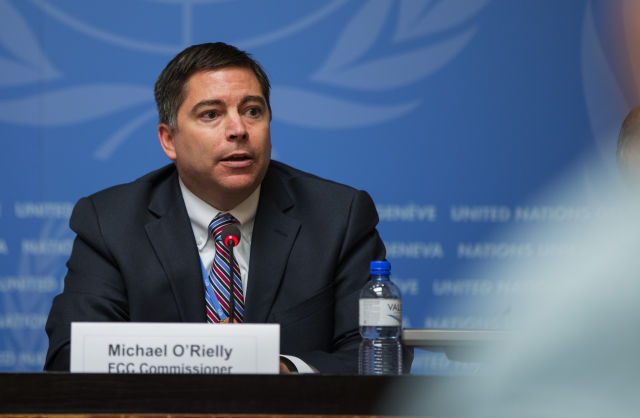
FCC Commissioner Michael O'Rielly speaking at the ITU World Radiocommunication Conference in 2015. (credit: United States Mission Geneva)

A Republican member of the Federal Communications Commission wants multiple investigations into Netflix because of the online video provider's admission that it throttles its video streams on mobile networks.

The FCC, the Federal Trade Commission, and Congress should all investigate, FCC Commissioner Michael O'Rielly said in a speech today in front of the American Action Forum, a policy research institute. O'Rielly is not impressed by Netflix's argument that it only reduces video quality to help its customers stay under mobile data caps.

"Netflix has attempted to paint a picture of altruism whereby it virtuously sought to save these consumers from bumping up against or exceeding their data caps," O'Rielly said. "There is no way to sugarcoat it: the news is deeply disturbing and justly generates calls for government—and maybe even Congressional—investigation."

Read 11 remaining paragraphs | Comments

Tom Wheeler urges Congress not to kill net neutrality rules

“No rate regulation bill” could disrupt bans on blocking and throttling.

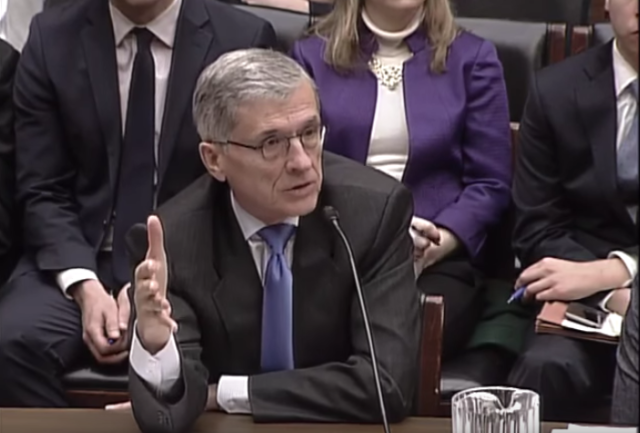
FCC Chairman Tom Wheeler testifying before the House Communications and Technology Subcommittee. (credit: House Energy and Commerce Committee)

Legislation that would ban rate regulation of Internet service providers could prevent the Federal Communications Commission from enforcing net neutrality rules against blocking, throttling, and paid prioritization, according to FCC Chairman Tom Wheeler.

Although the FCC decided not to regulate the monthly prices charged by broadband providers, the commission's net neutrality rules rely partially on rate-oversight authority over common carriers. The relevant sections of the Communications Act say that the prices charged by common carriers have to be just and reasonable; those sections also ban "unreasonable discrimination" in charges and practices.

This rate-oversight power, along with other authority, was used by the FCC to justify the three so-called "bright-line" rules that prevent blocking, throttling, and paid prioritization. That's why the Republican-sponsored "No Rate Regulation of Broadband Internet Access Act" could threaten the FCC's core net neutrality rules, Wheeler told lawmakers in a letter dated March 14 and posted on the FCC's website last week.

Read 8 remaining paragraphs | Comments

Cable group: Net neutrality rules for Netflix! (But not for us)

Netflix shouldn’t be allowed to throttle itself, small cable companies tell FCC.

Netflix CEO Reed Hastings. (credit: JD Lasica)

Since Netflix's admission last week that it throttles video on most mobile networks to help customers avoid data cap overage charges, Internet service providers and anti-net neutrality think tanks have been blasting the online video provider. Netflix is a hypocrite because it throttles its own video streams even as it supports net neutrality rules that prevent ISPs from throttling traffic that passes over their networks, they claim. Even AT&T, which has throttled its own unlimited data users for years and tried to avoid any punishment for doing so, said it is "outraged" by Netflix's actions.

While most ISPs want the elimination of the Federal Communications Commission's net neutrality rules, they generally are not demanding that new rules be applied to Netflix. But there is an exception. The American Cable Association, a cable lobby group that represents more than 900 small and medium-sized companies, has called on the FCC to consider writing new rules that apply to Netflix and similar online content providers ("edge providers" in industry parlance).

The FCC's "approach to Net Neutrality is horribly one-sided and unfair because it leaves consumers unprotected from the actions of edge providers that block and throttle lawful traffic," the ACA said Friday. Netflix's confession of throttling provides "further evidence" that consumers are being harmed, the group claimed.

Read 11 remaining paragraphs | Comments

Zero-rating by major ISPs “threatens open Internet,” advocates tell FCC

FCC urged to stop data cap exemptions at Comcast, AT&T, Verizon, and T-Mobile.

More than 50 advocacy groups today asked the Federal Communications Commission to stop zero-rating systems implemented by Comcast, AT&T, Verizon Wireless, and T­-Mobile USA.

Zero-rating plans, which exempt certain content from monthly data caps, "enable ISPs to pick winners and losers online or create new tolls for websites and applications," said a letter sent to FCC Chairman Tom Wheeler. "As a result, they present a serious threat to the Open Internet: they distort competition, thwart innovation, threaten free speech, and restrict consumer choice—all harms the rules were meant to prevent."

Letter signers included the Electronic Frontier Foundation, Free Press, MoveOn.org, the Institute for Local Self-Reliance, the New America’s Open Technology Institute, and the Rural Broadband Policy Group.

Read 14 remaining paragraphs | Comments