Google Fiber planning wireless home Internet where fiber is too pricey

Wireless can boost access in low-density areas where it’s costly to build fiber.

Google Fiber's latest expansion plans. (credit: Google Fiber)

Google Fiber is testing a few wireless technologies in an effort to build a wireless home Internet service that would complement its fiber broadband, according to a company executive.

Craig Barratt, a senior vice president at Alphabet who oversees Google Fiber and other projects in the company's Access and Energy division, spoke generally about the plans in an interview with Re/code published today. Though Barratt didn't reveal a timeline or specifics on technology, he said Google Fiber wants to provide fixed wireless Internet to homes where it wouldn't make financial sense to build fiber.

"We are experimenting with a number of different wireless technologies," Barratt said. "One of the things that is intriguing about wireless is that it allows you reach houses and users that are in lower density settings—where fiber becomes too expensive. So providing fixed wireless services using some of the technologies we think are ways of accelerating our deployments."

Read 4 remaining paragraphs | Comments
Facebook plans 60GHz gigabit broadband for dense urban areas

Antennas will “route and steer” signals around buildings and other obstacles.

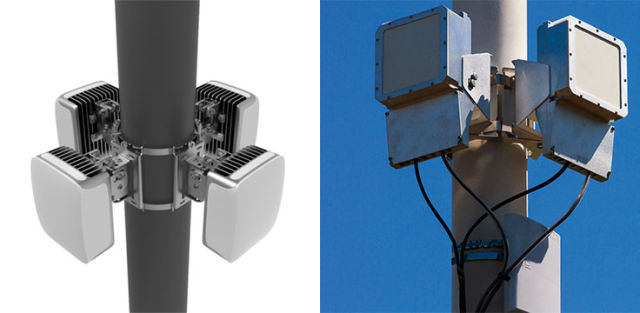
Nodes in Facebook's Terragraph wireless network. (credit: Facebook)

Facebook is building a wireless Internet service that uses 60GHz WiGig technology to deliver “ubiquitous gigabit citywide coverage” in densely populated urban areas. Facebook said it is testing the technology at its headquarters in Menlo Park, California, and preparing a larger trial for San Jose.

“So far, we have demonstrated 1.05Gbps bidirectional (2.1 Gbps total throughput per distribution node) in P2P mode, up to 250 meters away,” the company said in an announcement yesterday. “This means up to 8.4Gbps of total traffic per installation point assuming 4 sectors, and we think this number can be as high as 12.8Gbps in the future." Facebook also says it will make the technology "open and interoperable" in unlicensed spectrum, just like Wi-Fi.

The project faces technological hurdles related to the use of extremely high frequency spectrum. WiGig technology using 60GHz frequencies is generally aimed at home use, as it is great for high-speed transfers between two devices in a single room but nearly impossible to use in multiple rooms because the airwaves are easily blocked by walls.

Read 9 remaining paragraphs | Comments

White House threatens veto of GOP’s anti-net neutrality bill

“No Rate Regulation” legislation would strip FCC of consumer protection powers.

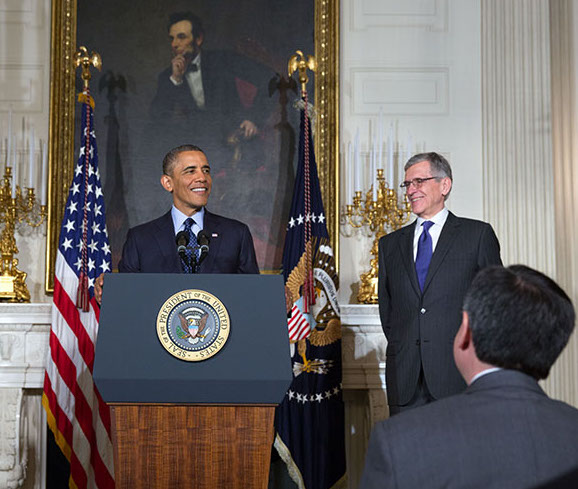
President Obama and FCC Chairman Tom Wheeler. (credit: White House)

As Republicans in Congress push legislation that would gut the Federal Communications Commission's authority to enforce net neutrality rules, the White House today issued a policy statement threatening a veto.

"If the president were presented with H.R. 2666 [the bill number] his senior advisors would recommend that he veto the bill," the statement said.

The bill is titled the No Rate Regulation of Broadband Internet Access Act and was approved by the Energy and Commerce Committee over objections from Democrats last month. The bill would strip the FCC of authority to set broadband rates or review whether a rate is reasonable, and it's controversial mainly because it defines "rate regulation" so broadly that it could prevent the FCC from enforcing net neutrality rules against blocking and throttling. It could also limit the FCC's authority to prevent ISPs from applying data caps in discriminatory ways.

Read 6 remaining paragraphs | Comments

Verizon workers strike over lost jobs and refusal to expand fiber

Non-union employees will take over customer service and network repairs.

Verizon workers rallying in July 2015, just before their contract expired. (credit: Communications Workers of America)

After 10 months of failed negotiations, 36,000 Verizon workers went on strike this morning. As a result, Verizon will use nonunion workers to perform repairs, network maintenance, and customer service on its fiber and copper wireline networks.

The strike was called by the Communications Workers of America (CWA) and the International Brotherhood of Electrical Workers (IBEW), which complain that Verizon is seeking to move jobs offshore, outsource work to low-wage contractors, close call centers, and force technicians to go on months-long assignments away from home.

“Verizon executives want wireline technicians to work away from home for as long as two months at a time, anywhere from Massachusetts to Virginia, without seeing their families,” the CWA said yesterday. “Working parents like Isaac Collazo, a cable splicer from New York, fear they will be forced to choose between caring for their kids and keeping their jobs.”

Read 8 remaining paragraphs | Comments

Verizon is actually expanding FiOS again, with new fiber in Boston

Verizon stopped expanding FiOS years ago, but that changes today.

(credit: Brad Smith)

For a few years, it seemed pretty clear that Verizon wouldn't be expanding its fiber-based FiOS network.

That changed today with an announcement from Boston, Massachusetts that Verizon will be "replacing its copper-based infrastructure with a state-of-the-art fiber-optic network platform across the city." Verizon will invest more than $300 million in the project over six years, and the city will provide expedited permitting to speed things along.

"[T]he project will begin in Dorchester, West Roxbury and the Dudley Square neighborhood of Roxbury in 2016, followed by Hyde Park, Mattapan, and other areas of Roxbury and Jamaica Plain," Mayor Martin Walsh's announcement said.

Read 7 remaining paragraphs | Comments

Verizon won’t fix copper lines when customers refuse switch to fiber

“Do not fix trouble” with copper lines, Verizon document says.

An optical fiber cable. (credit: Srleffler)

Verizon has reportedly switched 1.1 million customers from copper to fiber lines over the past few years under a program it calls "Fiber Is the Only Fix." But some phone customers have refused the switch to fiber because they prefer to keep their copper lines—even though Verizon apparently is refusing to fix problems in the copper infrastructure.

The Philadelphia Inquirer reports that it obtained internal company documents that describe the effort to switch problematic copper lines to fiber. Verizon customers with copper-based landline phones who call for repairs twice in 18 months "will be told that their 'only fix' is to replace decades-old copper line with high-speed fiber as Verizon won't fix the copper," the report said.

While Verizon still has a few million copper-line customers, the Fiber Is the Only Fix policy is responsible for 1.1 million changes to fiber in Pennsylvania and other states. The policy is also in place in New York, Massachusetts, Virginia, and Delaware, and it's expected to expand to New Jersey, the report said.

Read 12 remaining paragraphs | Comments

GOP lawmakers try to limit FCC’s ability to help consumers

Republicans in Congress push rate regulation ban and cuts to low-income program.

(credit: Aurich Lawson / Thinkstock)

Republican lawmakers are working on two proposals that would hinder Federal Communications Commission efforts to help consumers.

The House of Representatives may vote as soon as this week on a measure that could disrupt net neutrality rules by stripping the FCC of rate regulation authority, The Hill reported. Separately, the House Subcommittee on Communications and Technology on Wednesday will hold a hearing on a bill that would limit the amount of money the FCC's Lifeline program could spend helping poor people purchase Internet service.

The rate regulation bill, approved by the Energy and Commerce Committee over objections from Democrats last month, would strip the FCC of authority to set broadband rates or review whether a rate is reasonable. Although the FCC has no plans to tell broadband providers exactly what they can charge, FCC Chairman Tom Wheeler argued last month that the bill's broad language could prevent the FCC from enforcing net neutrality rules against blocking, throttling, and paid prioritization. The bill could also prevent the FCC from taking action against zero-rating schemes in which ISPs favor content by exempting it from data caps, and it would "cast doubt on the ability of the Commission to ensure that broadband providers receiving universal service subsidies do not overcharge their consumers," he argued.

Read 12 remaining paragraphs | Comments

Car makers ask US to slow down on allowing self-driving cars

Government shouldn’t rush out ill-conceived guidance, industry group says.

A Google self-driving car. (credit: Google)

As US regulators consider issuing guidance allowing the sale of self-driving cars, an industry group representing automakers has urged the government to take things slow.

The National Highway Traffic Safety Administration (NHTSA) said in January that within six months it intended to "develop guidance on the safe deployment and operation of autonomous vehicles." The agency is working with officials in states and the American Association of Motor Vehicle Administrators to develop a "model state policy" that would eventually lead to a consistent policy for the whole country.

With that effort in progress, the NHTSA held a public hearing Friday to get different viewpoints. Paul Scullion, safety manager at the Association of Global Automakers, warned that issuing guidance instead of writing regulations could allow dangerous cars on the road. "While this process is often time-consuming, these procedural safeguards are in place for valid reasons," Scullion said, according to the Associated Press.

Read 5 remaining paragraphs | Comments

Google Fiber ends free 5Mbps Internet offer in Kansas City

Entry-level now $50 for 100Mbps, but free Internet available in public housing.

This offer from Google is being phased out in Kansas City. (credit: Google)

Google Fiber is no longer offering free Internet service to any customer who wants it in Kansas City.

While Google Fiber is most famous for its $70-per-month gigabit plan, customers could also get slow Internet—5Mbps downloads and 1Mbps uploads—without paying a monthly service fee. The plan required only a $300 construction fee that could be paid up-front or in 12 monthly installments of $25 each.

But that plan is now gone in Kansas City, Re/code reported yesterday. The free offer was still online as recently as Wednesday, but the current offers now begin at $50 a month for symmetrical 100Mbps service.

Read 5 remaining paragraphs | Comments

FCC: Carrier pocketed $10M in bogus cell phone subsidies

Record $51M fine proposed for carrier accused of enrolling ineligible customers.

The website of Total Call Mobile, which is accused of defrauding the Lifeline program. (credit: Total Call Mobile)

The Federal Communications Commission is planning to collect a $51.1 million fine from a phone company accused of using “widespread enrollment fraud” to collect improper payments from a program designed to help poor people.

Since 2014, Total Call Mobile (TCM) has requested and received $9.7 million in payments by signing up tens of thousands of duplicate or ineligible consumers “despite repeated and explicit warnings from its own employees, in some cases compliance specialists, that company sales agents were engaged in widespread enrollment fraud,” the FCC said in an announcement yesterday.

The alleged fraud targeted the Lifeline program, which provides discounted phone service to people with low incomes. Lifeline, part of the Universal Service Fund, is paid for by US residents through surcharges on phone bills.

Read 15 remaining paragraphs | Comments