Solar Impulse leaves New York, heads for Spain

Two-thirds of the way around the planet, and still going.

Moving the plane was a manual affair, and it was rolled sideways rather than forward. (credit: John Timmer)

Early Monday morning, Solar Impulse 2 left John F. Kennedy Airport in New York on its attempt to cross the Atlantic as part of its 'round-the-world flight. The solar-powered craft is expected to take four days to make its way to Seville, Spain. This leg features Bertrand Piccard at the controls after fellow pilot André Borschberg brought the craft into New York.

As of noon Eastern Standard Time, the craft was eight percent of the way through its journey, which will take it northeast along the US and Canadian coasts to Newfoundland, after which it will turn southeast to head more directly to Spain. After starting the flight on battery power, the craft has largely recharged its batteries as it continues to climb above a kilometer in altitude.

Progress of the flight can be monitored at the Solar Impulse website.

Read on Ars Technica | Comments

Bird brains are dense—with neurons

A possible indication of why our feathered friends are so damn smart.

What do you think they're using all those neurons for? (credit: Flickr user Teddy Llovet)

Birds are smart. They use tools, engage in social learning, plan for the future, and do a variety of other things that were once thought to be exclusively the stuff of primates. But hundreds of millions of years of evolution separate mammals and birds, and structurally, their brains look very distinct. Plus there's the whole size thing. If you look at a bird's head, it's clear that there's not a whole lot of space for mental hardware in it. So how do the birds manage with smaller brains?

While other studies have tackled a lot of the structural differences, a new one released this week in PNAS shows that, to some extent, size doesn't matter. Its authors show that birds pack neurons into their brains at densities well above densities in mammals' brains, putting some relatively compact bird brains into the same realm as those of primates when it comes to total cell counts.

And the funny thing is, we probably should have known this was the case.

Read 12 remaining paragraphs | Comments

Calculating the costs of adding storage to renewables

For tech other than batteries, the economics look good right now.

A dam with a pumped hydro storage reservoir in Pennsylvania. (credit: Army Corps of Engineers)

The two fastest growing sources of renewable energy, wind and solar, are intermittent—they don't always generate power when you need them to. The obvious solution is to add storage, like batteries, to shift some of the electricity to when demand is highest. Elon Musk is betting a Gigafactory that consumers are going to be interested in doing this, while California has mandated that 1.3 gigawatts of storage be added to the power grid before the decade is out.

But there are a number of different types of storage, each of which has distinctive properties: how fast electrons can be shuffled in and out, how easy it is to expand the storage capacity, and so on. All of these have different costs, and figuring out what storage is most economically viable is a serious challenge.

Three academics from MIT have decided to take up that challenge. They've tried to calculate when it makes economic sense to add storage to renewable projects in three different locations in the US. Their analysis indicates the finances among options are similar right now, but only for options other than batteries.

Read 10 remaining paragraphs | Comments

LIGO data includes at least one more black hole merger

Gravitational waves capture a full second of the holes’ death spiral.

(credit: NASA)

When the LIGO collaboration announced the first, unambiguous detection of the gravitational waves produced by a black hole merger, several of the researchers hinted that there would be further news emerging from the mass of data obtained during the first run of Advanced LIGO. That news has now arrived in the form of GW151226, a merger of two black holes roughly seven and 14 times the mass of our Sun.

Because of their small size, the black holes spent more time producing gravitational waves prior to their collision. In some ways, this gives us more information, but the lower intensity of the waves mean that there are much larger errors attached to most of its properties.

For physicists, GW151226 was a slightly delayed Christmas gift: it arrived at 3:40 in the morning UTC on December 26, 2015. LIGO has automated software systems that scan the data to look for events quickly enough to notify astronomers, who can turn conventional instruments in the direction of the detection. These systems realized there was something interesting going on 70 seconds after the gravitational waves hit Earth. The preliminary estimate was that random noise should produce an event like this only once every 1,000 years, so the astronomers (or, as the paper puts it, "electromagnetic partners") got sent an alert.

Read 12 remaining paragraphs | Comments

Solar-powered aircraft makes NY its last stop before crossing the Atlantic

Ars talks with its pilots as they get ready to cross the Atlantic.

Piccard and Borschberg talk with Ars. Video shot and edited by Jennifer Hahn. (video link)

NEW YORK—Early Saturday morning, in the midst of a round-the-world flight, Solar Impulse 2 made the short hop from Pennsylvania to New York City. After gliding past the Statue of Liberty, it made its way to John F. Kennedy Airport, where it will remain until the weather permits it to start the next leg of its journey. After spending the morning soaking up the sunlight to charge its batteries, the plane was wheeled into one of Kennedy's massive hangers to give the press a chance to meet both it and the pilots who are taking it around the world.

This is the second of the team's solar-powered craft we've been able to see up close, and it's not a radical departure from the earlier one, which had completed a flight across the US by landing at JFK. Solar Impulse 2 is slightly larger and a bit more robust looking than its sister, but the general outlines are quite similar: a four-engined, glider-shaped craft, with most of its upward-facing surfaces covered in solar panels.

Read 12 remaining paragraphs | Comments

How did all this science get here?

A deep history argues that the scientific revolution was real and important.

For untold centuries, humans tracked the regularities of the natural world and developed systems that let us make predictions about the future. But, with a few rare exceptions, we did little more than that. The few stabs made at understanding things were anything but systematic, and they didn't produce unified theories about the underlying properties of the physical world. But then, roughly 500 years ago, everything changed.

To hear David Wootton tell it in his new book The Invention of Science, 16th-century Europe was the last place you'd expect an intellectual revolution. It was a region where witchcraft and unicorns were accepted as real, even by the intellectual classes. They also felt that the Greeks and Romans had already discovered everything worth knowing. An extended hangover from a night out with Aristotle and Christian theology stifled anything that looked like a sense of inquiry. Knowledge, if anything, was on the decline.

Yet, as Wootton explains, the intellectual ferment started by Copernicus and Galileo brought about a change that led to the breakthroughs of Boyle, Pascal, and Newton. Some of their findings are still in use today, and the scientific approaches they pioneered have expanded in scope to revolutionize the modern world.

Read 19 remaining paragraphs | Comments

US coal production drops to levels not seen since a 1980s miners’ strike

A 17 percent drop in just a single quarter.

(credit: US EIA)

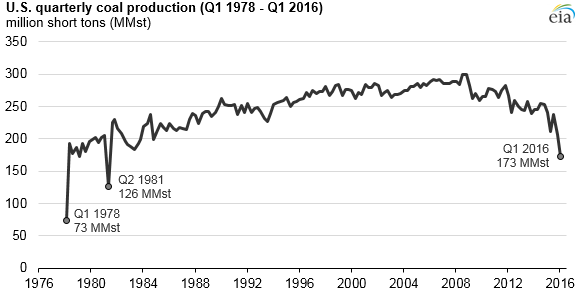
The first three months of 2016 saw a plunge in the US' coal production that may be without precedent. The US Energy Information Administration, which has figures going back to the 1970s, shows only a single quarterly drop of similar magnitude—and that one came during a workers' strike back in the early 1980s. Excepting periods of labor problems, US coal production has not been this low since the EIA started tracking it.

Part of the problem is temporary. The winter was unusually mild, which lowers energy use in general. As a result, many of the coal-burning electrical plants had large stockpiles of coal on hand; they burned through these reserves rather than ordering new coal.

But most of the issues are systemic. Coal is now being undercut by renewables and natural gas, which are displacing some of the demand. Utilities are responding to those low prices by adding new renewable and gas capacity. That additional capacity comes at a time when the US' electricity demand has been growing at an unexpectedly slow pace. Combined, these factors have resulted in less use of existing coal plants. New environmental regulations are also forcing the oldest and least efficient plants to shut down early. Most of these are also coal.

Read 1 remaining paragraphs | Comments

Four new elements get their final names

Good luck pronouncing the proposed names for elements 113, 115, 117, and 118.

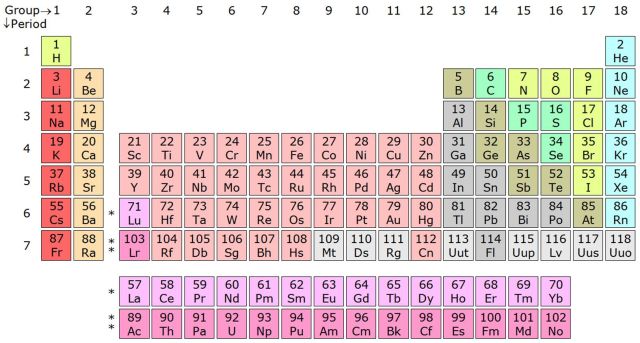
Wikipedia is behind the times. All those elements that start with "Uu" in the lower right? They've got real symbols now. (credit: Wikimedia Commons)

Earlier this year, the International Union of Pure and Applied Chemistry (IUPAC) accepted the evidence that indicated we had produced four new elements, filling out the bottom row of the periodic table. At the time, they were given temporary names—and catchy ones, too. We'll all be sad to see ununseptium (element 117) go, but you'll be glad to know that the formal names are probably just as difficult to pronounce properly.

Three of the new names honor the places where the elements were produced; the fourth recognizes a key person who helped organize the work involved.

For element 113, Japan is recognized by one of its alternate names, Nihon. The element will be called nihonium, and bear the symbol Nh. The remaining elements were produced by collaboration between the Joint Institute for Nuclear Research in Russia and two of the US' national labs: Oak Ridge and Lawrence Livermore. Element 115 honors the Russian part of that collaboration with the name moscovium (symbol Mc). 117 handles Oak Ridge by getting the name tennessine, or Ts. Lawrence Livermore has the misfortune of being in California, which already has an element named after it, so it gets left out.

Read 2 remaining paragraphs | Comments

Researchers testing a glaucoma therapy based on engineered stem cells

The stem cells appear to activate the eye’s own repair system.

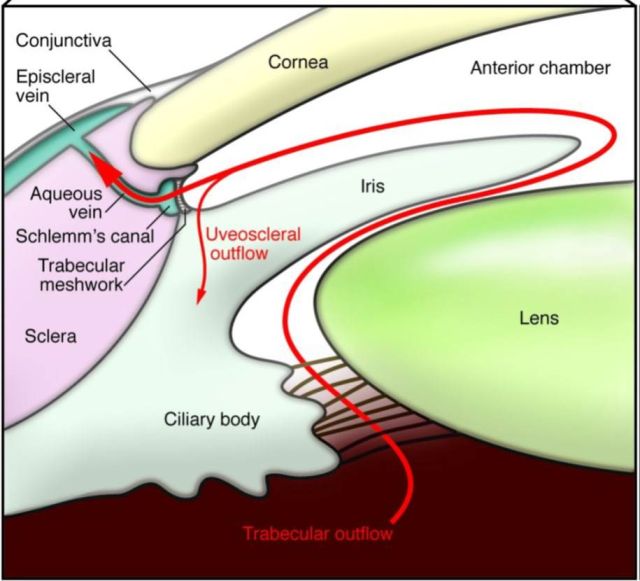
The trabecular meshwork (between the cornea and iris) helps fluid move from the eye into a drainage system, as shown by the red arrows. (credit: U of Miami Atomic Force Microscopy Lab)

Your eye may seem like a fairly static object, but it actually has an elaborate plumbing system. Tissues inside it constantly produce fluid (termed "aqueous humor") that then has to be drained to keep things in balance.

Like our man-made plumbing systems, the ones in our eyes can get backed up. When more fluid is produced than can be drained, pressure can build up in the eye, producing a condition called glaucoma. Over time, this can cause damage to sensitive eye tissue. Of the 60 million people around the globe thought to suffer from glaucoma, 7 million are blind as a result.

There are drugs and surgical means of reducing the pressure within the eye, but none is consistently effective. Now, some researchers in Iowa have found what might be an alternative approach: get the eye to repair the drainage system. They key to doing this? Stem cells.

Read 9 remaining paragraphs | Comments

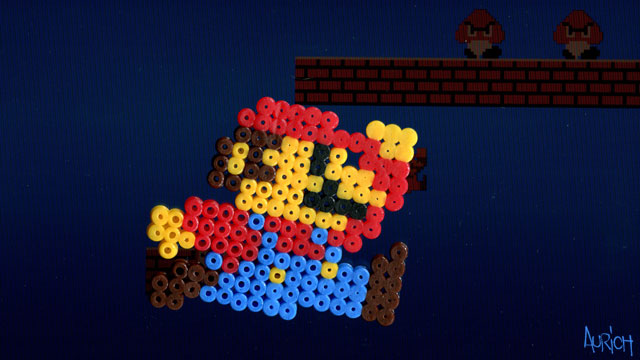
Computer scientists quantify just how hard Super Mario Bros. is

Solving an arbitrary level belongs to a class of problems called PSPACE.

(credit: Aurich Lawson)

Calling a game "hard" would seem to be a matter of personal judgement. Not so, according to an international team of computer scientists. For the past several years, the scientists have been analyzing Super Mario Bros. as if it were a math problem and beating a particular level is the solution. Now, they've extended their analysis to cover any possible arbitrary level, and they've shown that Super Mario Bros. belongs to a class of problems called PSPACE-complete.

The team's work benefits from how much we already know about how Super Mario Bros. operates. For example, every time the game needs a random number, its number generator isn't actually random. Mario's number generator starts with a fixed seed that's updated deterministically each time a scene is calculated. It's only when a player helps create a particular scene that the scene becomes effectively random—something that's not at issue when a computer is solving a level.

There are also well-described cases in which, as the authors put it, "the implementation
of Super Mario Bros. is counter to the intuitive Mario physics with which most players are familiar." These include the ability to pop Mario through a wall or to jump through a brick ceiling, provided there's a monster on top. And, while the game tracks objects that move slightly offscreen, the game forgets about bad guys who wander too far off the edges.

Read 5 remaining paragraphs | Comments